Oil And Gas Automation Market Size, Share, Growth Report By Component (Distributed Control Systems, SCADA Systems, PLCs, HMI, Industrial Sensors, Industrial Software Solutions), By Process (Upstream, Midstream, Downstream, Pipeline Monitoring), By End Use (Oil Refineries, Petrochemical Facilities, LNG Terminals, Pipeline Operators, Drilling & Exploration Companies), By Deployment (Onshore, Offshore) By Region & Segment Forecasts, 2026–2034
USD 3950
Market Overview
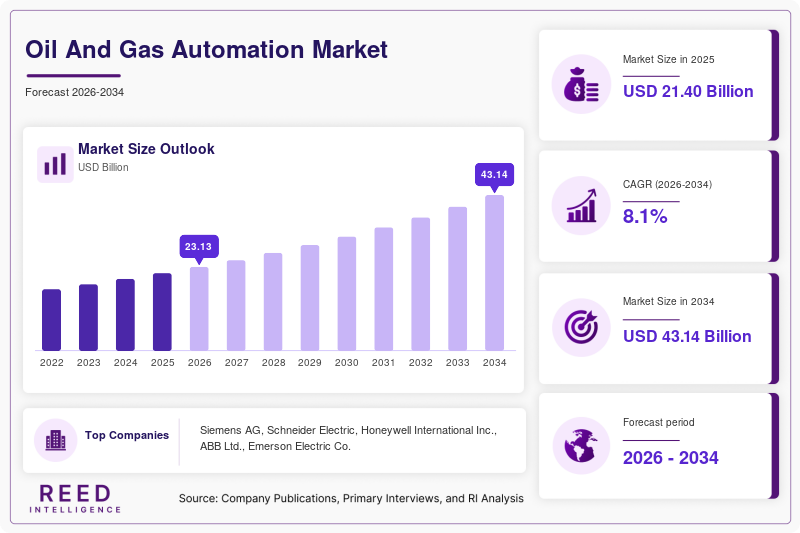
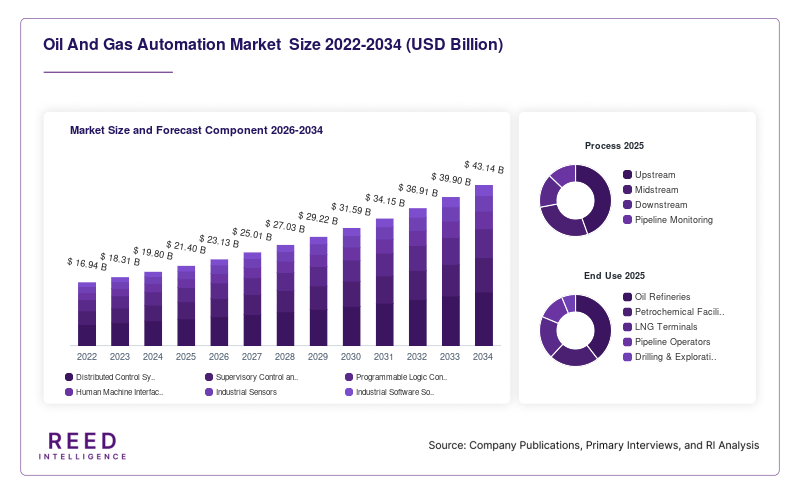
The global Oil And Gas Automation Market size was valued at USD 21.4 billion in 2026 and is projected to reach USD 39.8 billion by 2034, expanding at a CAGR of 8.1% during the forecast period from 2026 to 2034. The market is experiencing stable growth due to rising investments in digital oilfield infrastructure, process optimization technologies, and industrial control systems across upstream, midstream, and downstream operations. Automation solutions are increasingly used to improve operational efficiency, reduce downtime, and support predictive maintenance strategies in oil refineries, pipelines, offshore drilling facilities, and liquefied natural gas terminals.
The growing integration of industrial internet of things platforms, cloud-based analytics, and advanced supervisory control systems has significantly transformed the oil and gas industry. Companies are adopting automation technologies to manage remote assets, enhance worker safety, and minimize operational risks in hazardous environments. In addition, increasing pressure to reduce carbon emissions and improve energy efficiency has accelerated the deployment of smart monitoring systems and automated control equipment. Automation also enables real-time data visibility, which helps operators optimize production rates and reduce maintenance costs across large-scale facilities.
Key Highlights
- North America dominated the market with a 34.2% share in 2025.
- Asia Pacific is expected to grow at the fastest CAGR of 10.9% during 2026–2034.
- By component, distributed control systems accounted for the largest share of 36.8%, while industrial software solutions are projected to grow at a CAGR of 11.7%.
- By process, upstream operations led with a 43.5% share, whereas pipeline monitoring is expected to expand at a CAGR of 11.3%.
- The United States remained the dominant country, with market values of USD 5.2 billion in 2024 and USD 5.7 billion in 2025.
Market Trends
Expansion of Digital Oilfield Technologies
Oil and gas companies are increasingly deploying digital oilfield technologies to improve operational transparency and optimize production efficiency. Automation platforms integrated with artificial intelligence, machine learning, and cloud analytics are helping operators monitor equipment conditions in real time and identify maintenance requirements before failures occur. These systems reduce unplanned downtime and improve production consistency across upstream and downstream facilities. The growing use of connected sensors, remote monitoring platforms, and automated drilling systems is also supporting safer operations in complex environments such as offshore rigs and deepwater projects.
The transition toward digital infrastructure is particularly visible in large oil-producing economies where companies are modernizing aging production facilities. Automation solutions are enabling better decision-making through centralized data management and predictive analytics. Many operators are also investing in integrated control rooms that provide unified visibility across multiple production sites. This trend is expected to continue as companies prioritize efficiency improvements and cost optimization strategies.
Growing Adoption of Cybersecurity-Focused Automation Systems
The increasing digitalization of oil and gas operations has intensified the need for cybersecurity-focused automation systems. Industrial control systems, programmable automation controllers, and cloud-connected monitoring solutions are vulnerable to cyber threats that can disrupt production and compromise operational safety. As a result, companies are integrating advanced cybersecurity features into automation platforms to protect critical infrastructure and ensure uninterrupted operations.
Automation vendors are developing secure communication protocols, encrypted data transmission systems, and threat detection software tailored for oil and gas environments. The growing use of remote operations and centralized asset management has further increased demand for secure industrial networks. Regulatory agencies and energy operators are also strengthening cybersecurity standards for pipeline infrastructure and offshore production facilities. This trend is encouraging continuous investments in advanced automation architectures capable of balancing operational efficiency with data security requirements.
Market Drivers
Increasing Demand for Operational Efficiency and Cost Reduction
Oil and gas operators are under continuous pressure to improve productivity while reducing operational expenses. Automation technologies help companies achieve these goals by streamlining industrial processes, minimizing manual intervention, and improving asset utilization. Advanced automation systems can monitor production equipment continuously, allowing operators to optimize output and detect performance issues at an early stage. This reduces maintenance costs and lowers the probability of unexpected shutdowns.
The adoption of automated drilling systems, intelligent valves, and distributed control systems is increasing across exploration and refining activities. Companies are also using predictive maintenance tools powered by industrial analytics to improve equipment lifespan and reduce replacement expenses. In large-scale oilfields and refinery operations, automation enables faster process adjustments and improves energy consumption efficiency. These advantages are encouraging oil and gas companies to invest in integrated automation platforms across production and transportation infrastructure.
Rising Investments in Pipeline and Refinery Modernization
Aging pipeline networks and refinery infrastructure in several economies are driving the need for modernization programs supported by automation technologies. Many pipeline operators are deploying automated leak detection systems, remote terminal units, and intelligent flow monitoring solutions to improve transportation safety and operational reliability. Automation systems help companies identify pipeline anomalies quickly and reduce environmental risks associated with oil spills and gas leaks.
Refinery operators are also implementing automated process control technologies to enhance refining accuracy and improve fuel quality standards. Automated systems provide real-time visibility into temperature, pressure, and flow conditions, allowing operators to optimize production cycles and minimize waste generation. Governments and private energy companies are increasing investments in smart infrastructure projects to strengthen energy security and operational efficiency. These modernization activities are expected to sustain long-term demand for automation technologies in the global oil and gas sector.
Market Restraint
High Initial Investment and Integration Complexity
The implementation of advanced automation systems in oil and gas facilities often requires significant capital investment, which remains a major challenge for small and medium-sized operators. Installing industrial control systems, advanced sensors, cybersecurity infrastructure, and centralized monitoring platforms involves high procurement and deployment costs. In addition, integrating modern automation technologies with existing legacy infrastructure can be technically complex and time consuming. Many older refineries and production facilities operate on outdated systems that require extensive upgrades before automation platforms can be deployed effectively.
The complexity of integrating different hardware and software components can also create operational disruptions during installation phases. Companies may face additional costs related to workforce training, software customization, and cybersecurity enhancements. In remote oilfields and offshore drilling environments, automation deployment becomes even more expensive due to communication infrastructure limitations and challenging environmental conditions. These factors can delay adoption decisions, particularly among operators with constrained budgets or limited digital transformation capabilities. Although long-term operational savings often offset these investments, the high initial implementation cost continues to restrain faster market expansion.
Market Opportunities
Expansion of LNG Infrastructure and Smart Terminal Operations
The growing global demand for liquefied natural gas is creating substantial opportunities for automation providers. LNG terminals require advanced monitoring systems, automated safety controls, and real-time operational management platforms to maintain efficient processing and transportation activities. Automation technologies help operators monitor storage conditions, regulate temperature variations, and improve cargo handling accuracy across export and import terminals.
Many countries are increasing investments in LNG infrastructure to diversify energy supply sources and support cleaner fuel adoption. This is encouraging the deployment of automated process control systems and digital monitoring platforms across newly developed facilities. Smart terminal operations supported by artificial intelligence and predictive analytics are also gaining traction as operators seek to improve operational efficiency and reduce energy losses. These developments are expected to create strong long-term opportunities for automation vendors serving the LNG segment.
Increasing Adoption of Remote Operations and Autonomous Facilities
Remote operations and autonomous production facilities are becoming increasingly important in the oil and gas industry, particularly in offshore and geographically isolated regions. Automation technologies enable operators to control drilling activities, monitor production equipment, and manage pipelines from centralized locations without requiring large on-site workforces. This reduces operational risks, improves workforce safety, and lowers transportation and accommodation expenses for remote projects.
Autonomous facilities supported by robotics, artificial intelligence, and advanced industrial software are gaining attention among large energy companies seeking higher efficiency levels. Automated inspection drones, robotic maintenance systems, and smart field devices are improving operational continuity in hazardous environments. The growing use of remote asset management systems is also increasing demand for reliable communication networks and cloud-integrated automation platforms. As energy companies continue to prioritize digital transformation and operational flexibility, remote automation technologies are expected to present major growth opportunities during the forecast period.
Segmental Analysis
By Component
Distributed control systems accounted for the largest share of 36.8% in 2024 due to their widespread use in refinery operations, pipeline management, and upstream production facilities. These systems enable centralized control of complex industrial processes while improving operational efficiency and safety performance. Oil and gas companies rely on distributed control systems to monitor temperature, pressure, flow rates, and equipment conditions in real time. Their ability to integrate with industrial internet of things devices and predictive analytics platforms has strengthened adoption across large-scale energy facilities. The growing need for continuous process optimization and remote operational visibility is also contributing to segment growth. Many refineries and offshore drilling operators prefer distributed control systems because they support high reliability and reduce the risk of production interruptions during critical operations.
Industrial software solutions are expected to witness the fastest CAGR of 11.7% during the forecast period due to increasing digital transformation initiatives across the energy sector. Companies are investing in cloud-based analytics software, asset performance management platforms, and predictive maintenance applications to improve operational efficiency. Industrial software enables operators to collect and analyze real-time production data, identify inefficiencies, and optimize equipment performance across geographically dispersed assets. The rising adoption of artificial intelligence and machine learning technologies is further accelerating segment expansion. Software-driven automation systems also help companies improve decision-making processes and reduce maintenance-related downtime. As oil and gas operators continue to prioritize data-driven operational strategies, demand for advanced industrial software solutions is expected to increase substantially.
By Process
Upstream operations held the dominant market share of 43.5% in 2024 due to increasing automation adoption in exploration and drilling activities. Automation technologies are extensively used in drilling rigs, production monitoring systems, and wellhead management applications to improve operational accuracy and reduce labor-intensive processes. Oil producers are implementing automated drilling systems, smart sensors, and real-time monitoring platforms to improve productivity and minimize operational risks. The growing complexity of offshore and deepwater exploration projects has also increased reliance on automated control technologies. Upstream operators benefit from automation through reduced equipment downtime, improved reservoir management, and enhanced production efficiency. In addition, predictive maintenance systems are helping companies reduce operational disruptions and optimize equipment lifespan across drilling and extraction facilities.
Pipeline monitoring is anticipated to register the fastest CAGR of 11.3% during the forecast period due to rising investments in transportation infrastructure modernization and environmental safety compliance. Pipeline operators are deploying automated leak detection systems, remote terminal units, and intelligent flow monitoring technologies to improve operational reliability and reduce spill risks. Automation platforms provide real-time visibility into pipeline conditions and enable rapid response to anomalies or pressure fluctuations. Governments and energy companies are strengthening investments in smart pipeline infrastructure to improve energy transportation security and operational efficiency. The integration of artificial intelligence-based monitoring systems is further supporting segment growth by enabling predictive analysis and preventive maintenance capabilities. These factors are expected to accelerate adoption of automated pipeline monitoring technologies globally.
By End Use
The downstream segment accounted for the largest market share of 39.4% in 2024 due to extensive automation deployment across refineries, petrochemical plants, and fuel distribution networks. Downstream facilities require highly accurate process control systems to maintain production consistency and comply with fuel quality regulations. Automation technologies help refinery operators optimize production cycles, improve energy efficiency, and reduce waste generation. Advanced control systems and industrial analytics platforms also support continuous monitoring of refining processes and equipment conditions. The increasing adoption of automated safety systems and centralized control rooms is contributing to segment growth. Refinery modernization projects in developed and emerging economies continue to create strong demand for automation technologies within downstream operations.
The midstream segment is projected to expand at the fastest CAGR of 10.6% during the forecast period due to increasing investments in pipeline networks, storage terminals, and liquefied natural gas infrastructure. Midstream operators are implementing automation solutions to improve transportation efficiency, monitor asset performance, and reduce operational risks across large distribution networks. Automated systems enable real-time monitoring of storage facilities, pumping stations, and transportation pipelines, helping companies improve reliability and minimize energy losses. The rising focus on cross-border pipeline projects and smart terminal operations is also supporting segment growth. In addition, increasing adoption of cloud-based monitoring systems and predictive analytics platforms is enabling operators to improve maintenance planning and strengthen overall operational efficiency across midstream infrastructure.
Regional Analysis
North America
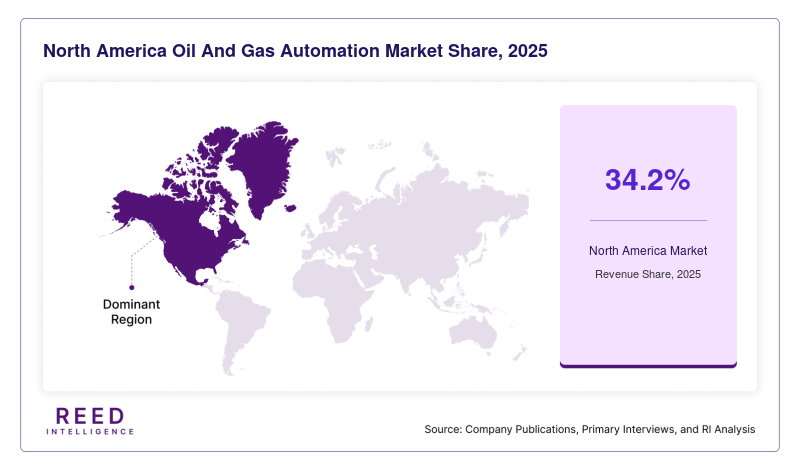
North America accounted for 34.2% of the global Oil And Gas Automation Market share in 2025 and is expected to maintain a stable growth trajectory during the forecast period. The region is projected to expand at a CAGR of 7.6% from 2026 to 2034 due to rising investments in shale exploration activities, smart pipeline systems, and refinery modernization programs. The presence of advanced industrial infrastructure and high adoption of digital oilfield technologies continues to support regional market expansion. Companies across the United States and Canada are investing heavily in predictive maintenance systems and cloud-integrated monitoring platforms to improve operational efficiency.
The United States remained the leading country in North America due to its extensive shale production activities and large refining capacity. The country recorded market values of USD 5.2 billion in 2024 and USD 5.7 billion in 2025. A major growth factor is the increasing deployment of automated drilling technologies and pipeline leak detection systems across major oil-producing states. Energy operators are also adopting cybersecurity-focused automation solutions to protect industrial control systems and improve operational resilience across upstream and downstream facilities.
Europe
Europe represented 24.1% of the global market in 2025 and is anticipated to grow at a CAGR of 7.3% during the forecast period. The region is witnessing steady demand for automation technologies due to strict environmental regulations and rising focus on energy efficiency improvements. Oil refineries and offshore operators are increasingly implementing automated monitoring systems to reduce emissions and improve process optimization. The expansion of industrial digitalization initiatives across several European economies is also accelerating the adoption of advanced automation platforms and industrial analytics solutions.
Norway emerged as the dominant country in the European market due to its strong offshore drilling infrastructure and advanced energy management capabilities. A significant growth factor in the country is the increasing use of autonomous offshore platforms equipped with real-time monitoring technologies and robotic inspection systems. Companies operating in the North Sea are adopting advanced automation systems to improve production efficiency and reduce operational risks in deepwater exploration projects. These developments continue to strengthen Europe’s position in the global market.
Asia Pacific
Asia Pacific held a market share of 21.7% in 2025 and is projected to register the fastest CAGR of 10.9% from 2026 to 2034. Rapid industrialization, increasing energy demand, and expanding refinery investments are driving regional market growth. Countries across the region are deploying automation technologies to improve energy infrastructure efficiency and strengthen pipeline monitoring capabilities. The growing adoption of industrial internet of things platforms and cloud-based operational management systems is further supporting market expansion across oil and gas facilities.
China remained the dominant country within Asia Pacific due to large-scale refinery expansion projects and increasing investments in pipeline infrastructure modernization. One major growth factor is the country’s rising focus on smart energy infrastructure and digital oilfield development. State-owned energy companies are implementing automated process control systems and intelligent monitoring technologies to optimize production efficiency and reduce operational costs. In addition, increasing investments in liquefied natural gas terminals are creating additional opportunities for automation vendors across the region.
Middle East & Africa
The Middle East & Africa region accounted for 13.5% of the global Oil And Gas Automation Market in 2025 and is expected to grow at a CAGR of 8.4% during the forecast period. The region benefits from extensive hydrocarbon reserves and ongoing investments in large-scale oil production projects. National energy companies are increasingly adopting automation technologies to improve operational safety and optimize production efficiency in desert and offshore environments. The deployment of advanced monitoring systems and automated control platforms is also increasing across refinery and pipeline infrastructure.
Saudi Arabia dominated the regional market due to significant investments in digital oilfield technologies and refinery automation programs. A key growth factor is the country’s focus on improving production efficiency through artificial intelligence-enabled automation systems and predictive analytics solutions. Energy operators are implementing smart sensors and centralized monitoring systems to enhance operational visibility across upstream and downstream activities. Large-scale investments in petrochemical expansion projects are also supporting the growing adoption of industrial automation technologies.
Latin America
Latin America captured 6.5% of the global market share in 2025 and is forecast to grow at a CAGR of 7.8% between 2026 and 2034. The region is experiencing rising demand for automation technologies due to increasing offshore drilling activities and pipeline modernization projects. Oil-producing countries are implementing digital monitoring systems and intelligent field instruments to improve operational reliability and reduce environmental risks. Automation adoption is also increasing in refining facilities as operators seek better production efficiency and reduced maintenance costs.
Brazil emerged as the leading country in the Latin American market due to its expanding offshore exploration projects and growing investments in deepwater production infrastructure. One unique growth factor is the increasing use of automated subsea monitoring systems in offshore oilfields. Energy companies are deploying real-time analytics platforms and remotely operated technologies to improve production control and minimize operational disruptions. These developments are contributing to the gradual expansion of automation solutions across the regional oil and gas industry.
Competitive Landscape
The Oil And Gas Automation Market is characterized by the presence of established industrial automation providers and specialized software companies competing through technology innovation, strategic partnerships, and infrastructure modernization projects. Major companies are focusing on expanding their digital oilfield capabilities and integrating artificial intelligence-driven analytics into automation platforms. Market participants are also investing in cybersecurity-focused industrial solutions to address growing concerns related to connected operational environments.
Schneider Electric emerged as one of the leading companies due to its strong portfolio of industrial automation software, distributed control systems, and energy management solutions. The company recently introduced an upgraded industrial analytics platform designed to improve predictive maintenance capabilities for refinery and pipeline operations. Other major companies are strengthening market positions through acquisitions, cloud integration partnerships, and development of remote asset management technologies.
Key Players
- Siemens AG
- Honeywell International Inc.
- Schneider Electric
- ABB Ltd.
- Emerson Electric Co.
- Rockwell Automation Inc.
- Yokogawa Electric Corporation
- Mitsubishi Electric Corporation
- Baker Hughes Company
- Halliburton Company
- Weatherford International plc
- National Oilwell Varco Inc.
- Cisco Systems Inc.
- General Electric Company
- Endress+Hauser Group
Recent Developments
- In February 2026, Siemens AG launched an advanced predictive maintenance platform designed for offshore drilling facilities and remote pipeline monitoring applications.
- In September 2025, Honeywell International Inc. expanded its industrial cybersecurity portfolio for oil and gas automation systems to strengthen protection against operational disruptions.
- In November 2025, ABB Ltd. announced a partnership with a Middle Eastern energy operator to deploy cloud-integrated automation systems across newly developed refinery infrastructure.
Oil And Gas Automation Market Segments
Component
- Distributed Control Systems
- Supervisory Control and Data Acquisition (SCADA) Systems
- Programmable Logic Controllers (PLC)
- Human Machine Interface (HMI)
- Industrial Sensors
- Industrial Software Solutions
Process
- Upstream
- Midstream
- Downstream
- Pipeline Monitoring
End Use
- Oil Refineries
- Petrochemical Facilities
- LNG Terminals
- Pipeline Operators
- Drilling & Exploration Companies
Deployment
- Onshore
- Offshore
By Region
- North America
- Europe
- APAC
- Middle East and Africa
- LATAM