Oil Field Bio Solvents Market Size, Share & Demand Report By Type (Ester-Based Bio Solvents, Alcohol-Based Bio Solvents, Glycol-Based Bio Solvents), By Application (Drilling Fluids, Production Chemicals, Enhanced Oil Recovery), By End-Use (Oilfield Service Companies, Exploration & Production Companies, Refineries), By Region & Segment Forecasts, 2026–2034
USD 3950
Market Overview
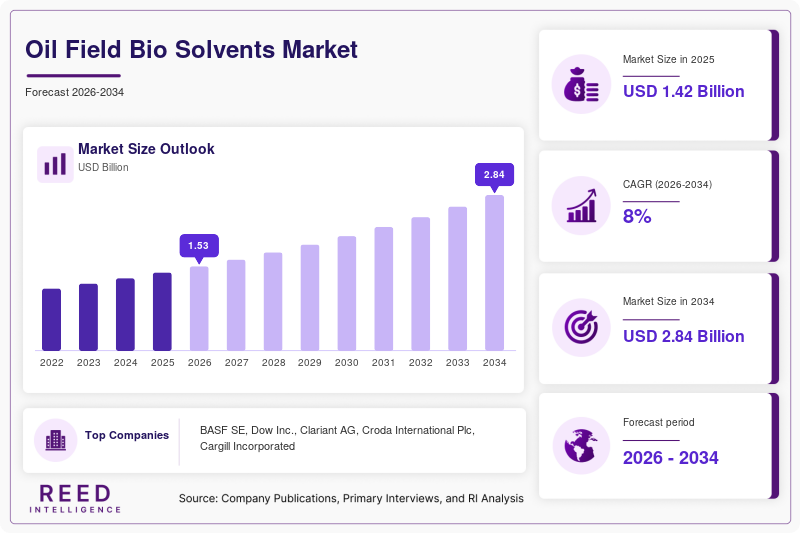
The Oil Field Bio Solvents Market size was valued at approximately USD 1.42 billion in 2026 and is projected to reach USD 2.63 billion by 2034, expanding at a CAGR of 8.0% during the forecast period from 2026 to 2034. The market has gained traction due to the increasing emphasis on environmentally sustainable oilfield operations and stricter regulations on petrochemical-based solvents. Bio-based solvents, derived from renewable feedstocks such as vegetable oils, alcohols, and esters, are increasingly being adopted as alternatives to conventional solvents in drilling, production, and well stimulation activities.
A key global factor supporting market growth is the tightening of environmental regulations across major oil-producing regions. Governments and regulatory bodies are mandating reduced emissions and lower toxicity in oilfield chemicals, prompting operators to shift toward biodegradable and low-VOC solvent solutions. Additionally, rising corporate sustainability commitments among energy companies are accelerating the adoption of green chemistry solutions, further contributing to market expansion.
Key Highlights
- North America dominated the market with a 35.1% share in 2025.
- Asia Pacific is expected to grow at the fastest CAGR of 9.4% during 2026–2034.
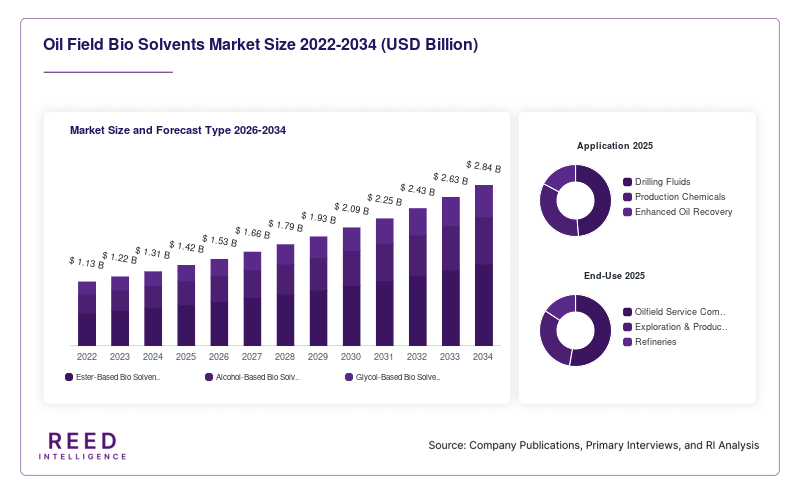
- By type, ester-based bio solvents accounted for the largest share of 39.2%.
- while alcohol-based solvents are projected to grow at a CAGR of 9.8%.
- By application, drilling fluids led with a 42.6% share, whereas enhanced oil recovery is expected to expand at a CAGR of 9.6%.
- The United States remained the dominant country, with market values of USD 480 million in 2024 and USD 525 million in 2025.
Market Trends
Rising Adoption of Green Chemistry in Oilfield Operations
The oil and gas industry is undergoing a gradual transformation toward sustainable practices, leading to increased adoption of green chemistry solutions such as bio solvents. These solvents offer reduced toxicity, lower environmental impact, and improved biodegradability compared to traditional petroleum-based solvents. Oilfield service providers are integrating these solutions into drilling fluids and cleaning applications to comply with environmental standards. Additionally, operators are investing in research and development to improve the efficiency and cost-effectiveness of bio-based alternatives. This trend is particularly visible in offshore drilling operations where environmental risks are higher, driving demand for eco-friendly chemical formulations.
Technological Advancements in Bio-Based Solvent Formulations
Technological innovation is playing a critical role in enhancing the performance characteristics of bio solvents. Manufacturers are focusing on improving solvency power, thermal stability, and compatibility with existing oilfield systems. Advanced formulations are now capable of delivering performance levels comparable to or exceeding conventional solvents. These innovations are expanding the application scope of bio solvents in complex operations such as enhanced oil recovery and well stimulation. Furthermore, partnerships between chemical companies and oilfield service providers are accelerating the commercialization of next-generation bio solvents, supporting broader market penetration and long-term growth.
Market Drivers
Increasing Environmental Regulations and Compliance Requirements
Stringent environmental regulations are a primary driver of the Oil Field Bio Solvents Market. Governments across North America and Europe have implemented policies that restrict the use of hazardous chemicals in oilfield operations. These regulations are compelling companies to transition toward safer and more sustainable alternatives. Bio solvents, being biodegradable and less toxic, align well with these regulatory requirements. In addition, regulatory pressure is not limited to developed regions; emerging economies are also adopting stricter environmental standards, further boosting demand. This shift is encouraging oilfield operators to redesign their chemical usage strategies and invest in compliant solutions.
Growing Focus on Corporate Sustainability and ESG Goals
Energy companies are increasingly prioritizing environmental, social, and governance (ESG) objectives, which is driving the adoption of bio solvents. Investors and stakeholders are demanding transparency and accountability in environmental performance, pushing companies to adopt greener technologies. Bio solvents contribute to reducing carbon footprints and improving environmental compliance, making them an attractive option for oilfield operations. Additionally, sustainability initiatives often lead to long-term cost benefits through improved efficiency and reduced environmental liabilities. As ESG considerations become integral to business strategies, the demand for bio-based oilfield chemicals is expected to rise steadily.
Market Restraint
High Cost of Bio-Based Solvents Compared to Conventional Alternatives
One of the major restraints in the Oil Field Bio Solvents Market is the relatively high cost associated with bio-based products. The production of bio solvents involves complex processes and relies on renewable feedstocks, which can be more expensive than petroleum-based raw materials. This cost disparity poses a challenge for widespread adoption, especially in price-sensitive markets. Oilfield operators often prioritize cost efficiency, and the higher upfront cost of bio solvents can limit their usage despite environmental benefits. For example, in regions with less stringent regulations, companies may continue to use conventional solvents to minimize operational expenses. This restraint highlights the need for technological advancements and economies of scale to reduce production costs and improve market competitiveness.
Market Opportunities
Expansion in Emerging Oil-Producing Regions
Emerging oil-producing regions present significant growth opportunities for the Oil Field Bio Solvents Market. Countries in Asia Pacific, Africa, and Latin America are increasing their exploration and production activities, creating demand for oilfield chemicals. As these regions develop their regulatory frameworks, there is a growing emphasis on sustainable practices. This creates an opportunity for bio solvent manufacturers to establish a strong presence in these markets. Additionally, early adoption of environmentally friendly solutions can provide a competitive advantage for operators in these regions, further driving demand for bio-based solvents.
Integration with Enhanced Oil Recovery Techniques
The integration of bio solvents with enhanced oil recovery (EOR) techniques offers promising growth potential. Bio solvents can improve oil recovery efficiency by reducing interfacial tension and enhancing fluid mobility. As conventional oil reserves decline, operators are increasingly relying on EOR methods to maximize production from existing fields. The use of bio-based solvents in these applications not only improves performance but also aligns with environmental sustainability goals. This dual benefit is encouraging oil companies to invest in research and pilot projects, paving the way for broader adoption of bio solvents in advanced oil recovery processes.
Segmental Analysis
By Type
Ester-based bio solvents dominated the market in 2024, accounting for a share of 39.2%. These solvents are widely used due to their excellent solvency properties and biodegradability. They are particularly effective in drilling and cleaning applications, where performance and environmental safety are critical. The availability of raw materials and advancements in production technologies have further strengthened their market position.
Alcohol-based solvents are expected to be the fastest-growing subsegment, with a CAGR of 9.8% during the forecast period. Their growth is driven by increasing demand for low-toxicity and high-performance solvents in oilfield operations. Additionally, alcohol-based solvents offer better compatibility with various formulations, making them suitable for diverse applications. Continuous innovation in this segment is expected to enhance their adoption.
By Application
Drilling fluids represented the largest application segment in 2024, with a share of 42.6%. Bio solvents are extensively used in drilling fluids to improve lubrication and reduce environmental impact. The increasing focus on sustainable drilling practices is driving demand in this segment. Moreover, regulatory requirements are encouraging the use of eco-friendly formulations in drilling operations.
Enhanced oil recovery is projected to be the fastest-growing application segment, with a CAGR of 9.6%. The use of bio solvents in EOR processes improves oil extraction efficiency and aligns with sustainability goals. As oil companies seek to maximize production from existing fields, the demand for advanced recovery techniques is increasing, driving growth in this segment.
By End-Use
Oilfield service companies dominated the end-use segment in 2024, accounting for a significant share. These companies play a crucial role in providing chemical solutions for oil and gas operations. Their focus on innovation and sustainability is driving the adoption of bio solvents. Additionally, partnerships with chemical manufacturers are enabling the development of customized solutions.
Exploration and production companies are expected to be the fastest-growing end-use segment, with a notable CAGR. Their growth is driven by increasing investments in sustainable technologies and the need to comply with environmental regulations. As these companies adopt greener practices, the demand for bio solvents is expected to rise significantly.
Regional Analysis
North America
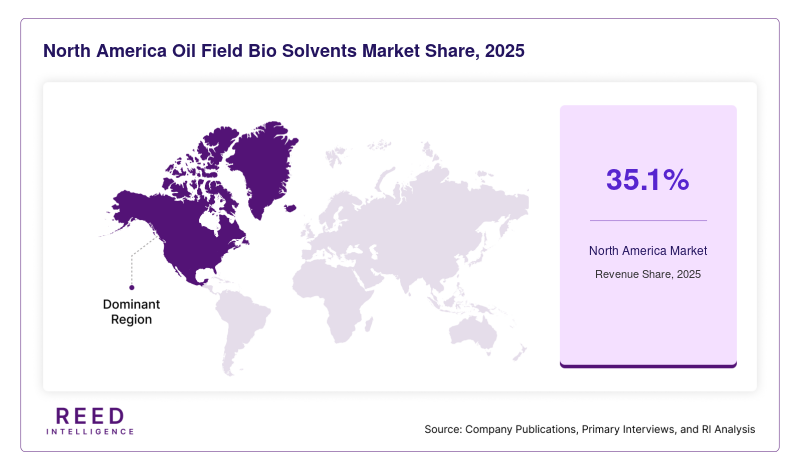
North America accounted for a 35.1% share of the Oil Field Bio Solvents Market in 2025 and is expected to maintain steady growth at a CAGR of 7.6% during the forecast period. The region’s dominance is attributed to stringent environmental regulations and a well-established oil and gas industry. The presence of advanced technologies and high awareness regarding sustainable practices further supports market growth.
The United States remains the dominant country in this region, driven by strong regulatory enforcement and significant shale oil production. A unique growth factor is the increasing adoption of green drilling technologies, which require environmentally friendly solvents. This trend is encouraging oilfield service providers to integrate bio solvents into their operations.
Europe
Europe held a 24.3% share of the market in 2025 and is projected to grow at a CAGR of 7.8% through 2034. The region’s growth is supported by strict environmental policies and a strong focus on sustainability. European countries are actively promoting the use of bio-based chemicals across industries, including oil and gas.
Germany leads the market in Europe, driven by its advanced chemical industry and commitment to environmental sustainability. A unique growth factor is the increasing investment in renewable feedstock production, which supports the development of bio solvents. This creates a favorable ecosystem for market expansion.
Asia Pacific
Asia Pacific accounted for 20.6% of the market in 2025 and is expected to grow at the fastest CAGR of 9.4% during the forecast period. Rapid industrialization and increasing energy demand are driving oil exploration activities in the region. Governments are also implementing policies to promote sustainable practices.
China is the dominant country in Asia Pacific, supported by its large-scale oil production and growing focus on environmental protection. A unique growth factor is the expansion of domestic bio-based chemical manufacturing, which enhances the availability and affordability of bio solvents in the region.
Middle East & Africa
The Middle East & Africa region held a 12.5% share in 2025 and is projected to grow at a CAGR of 7.2% through 2034. The region’s growth is driven by extensive oil reserves and ongoing exploration activities. However, adoption of bio solvents is gradually increasing due to rising environmental awareness.
Saudi Arabia dominates the market in this region, supported by its significant oil production capacity. A unique growth factor is the government’s focus on diversifying the economy and investing in sustainable technologies, which includes the adoption of eco-friendly oilfield chemicals.
Latin America
Latin America accounted for 7.5% of the market in 2025 and is expected to grow at a CAGR of 7.5% during the forecast period. The region’s growth is supported by increasing oil exploration activities and improving regulatory frameworks. Environmental concerns are also driving the adoption of bio solvents.
Brazil is the leading country in Latin America, driven by its offshore oil production activities. A unique growth factor is the increasing investment in sustainable offshore operations, which require the use of biodegradable and low-toxicity solvents, thereby boosting market demand.
Competitive Landscape
The Oil Field Bio Solvents Market is moderately fragmented, with several global and regional players competing for market share. The leading companies are focusing on product innovation, strategic partnerships, and expansion into emerging markets. Among these, BASF SE is considered a market leader due to its extensive product portfolio and strong global presence. The company has recently introduced advanced bio-based solvent formulations designed for high-performance oilfield applications, enhancing its competitive position.
Other key players are investing in research and development to improve product efficiency and reduce costs. Collaborations with oilfield service providers are also common, enabling companies to develop tailored solutions that meet specific operational requirements. The competitive landscape is expected to evolve as new entrants bring innovative technologies and established players strengthen their market presence.
Key Players List
- BASF SE
- Dow Inc.
- Clariant AG
- Croda International Plc
- Cargill Incorporated
- Archer Daniels Midland Company
- Evonik Industries AG
- Solvay SA
- Stepan Company
- Oleon NV
- Emery Oleochemicals
- Green Biologics Ltd.
- Gevo Inc.
- Vertec BioSolvents Inc.
- Elevance Renewable Sciences Inc.
Recent Developments
- BASF SE launched a new range of bio-based solvents tailored for oilfield applications, focusing on improved performance and reduced environmental impact.
- Clariant AG expanded its production capacity for bio-based chemicals to meet increasing demand from the oil and gas sector.
- Croda International Plc entered a strategic partnership with an oilfield service provider to develop customized bio solvent solutions for drilling operations.
Oil Field Bio Solvents Market Segments
Type
- Ester-Based Bio Solvents
- Alcohol-Based Bio Solvents
- Glycol-Based Bio Solvents
Application
- Drilling Fluids
- Production Chemicals
- Enhanced Oil Recovery
End-Use
- Oilfield Service Companies
- Exploration & Production Companies
- Refineries
By Region
- North America
- Europe
- APAC
- Middle East and Africa
- LATAM