Oil Gas Additive Manufacturing Market Size, Share & Demand Report By Component (Hardware, Software, Services), By Application (Upstream, Midstream, Downstream), By Material Type (Metal, Polymer, Composite) By Region & Segment Forecasts, 2026–2034
USD 3950
Market Overview
The Oil Gas Additive Manufacturing Market size is projected to reach a market size of USD 2.8 billion in 2026 and is expected to expand to USD 7.6 billion by 2034, registering a compound annual growth rate (CAGR) of 13.3% during the forecast period (2026–2034). The market growth is primarily supported by the increasing need for cost-efficient, lightweight, and complex component manufacturing across upstream, midstream, and downstream operations. Additive manufacturing (AM), commonly known as 3D printing, enables oil and gas companies to produce intricate parts on demand, reducing downtime and inventory costs while improving operational efficiency.
A key global factor driving the market is the rising focus on supply chain resilience. The oil and gas industry has experienced frequent disruptions due to geopolitical tensions and logistical bottlenecks. Additive manufacturing addresses these challenges by enabling localized production of critical components, reducing dependence on traditional supply chains. This shift toward decentralized manufacturing is expected to strengthen market penetration over the coming years.
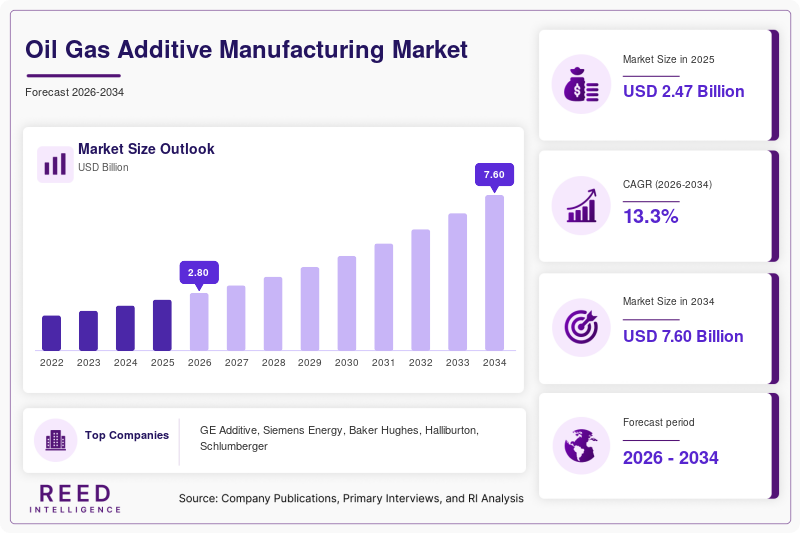
Key Highlights
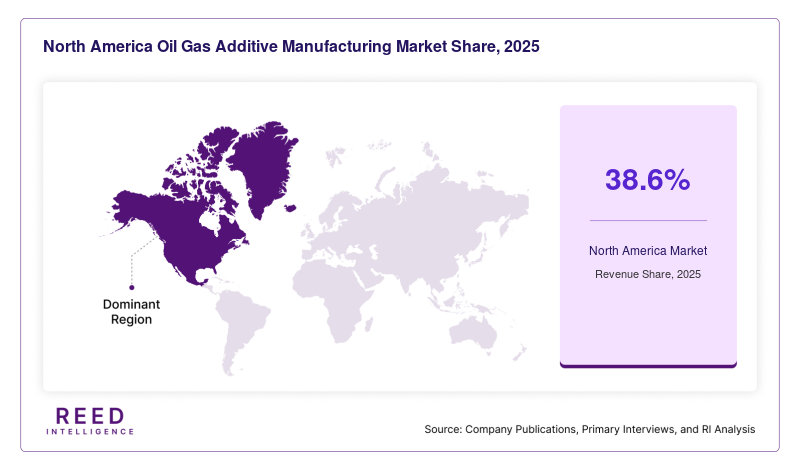
- North America dominated the market with a 38.6% share in 2025.
- Asia Pacific is projected to grow at the fastest CAGR of 15.1%.
- The hardware segment led the market in 2024, while services are expected to witness the fastest growth at a CAGR of 14.6%.
- The upstream application segment held the largest share, whereas midstream applications are projected to grow rapidly at a CAGR of 13.9%.
- The United States accounted for USD 0.82 billion in 2024 and USD 0.91 billion in 2025, maintaining its leadership position globally.
Market Trends
Integration of Digital Twin Technology with Additive Manufacturing
The integration of digital twin technology with additive manufacturing is shaping the Oil Gas Additive Manufacturing Market. Digital twins enable real-time monitoring and simulation of physical assets, allowing engineers to design, test, and optimize components before production. When combined with additive manufacturing, this technology reduces material waste and enhances precision. Companies are increasingly using digital twins to predict equipment failure and create replacement parts through 3D printing. This trend supports faster turnaround times and reduces maintenance costs. As oil and gas operations become more data-driven, the demand for integrated digital solutions is expected to grow, further strengthening the adoption of additive manufacturing technologies across various operational stages.
Increasing Use of Metal Additive Manufacturing for Critical Components
Metal additive manufacturing is gaining traction in the oil and gas industry due to its ability to produce high-strength and corrosion-resistant components. Traditional manufacturing methods often struggle with complex geometries required in harsh environments such as offshore drilling. Additive manufacturing allows for the production of customized metal parts with improved durability and reduced weight. This trend is particularly evident in the production of valves, pumps, and drilling tools. Companies are investing in advanced metal printing technologies such as selective laser melting and electron beam melting. The growing acceptance of metal AM for mission-critical applications is expected to drive innovation and increase adoption rates in the coming years.
Market Drivers
Demand for Cost Reduction and Operational Efficiency
The oil and gas industry is under continuous pressure to reduce operational costs while maintaining efficiency. Additive manufacturing offers a cost-effective solution by minimizing material waste and eliminating the need for extensive tooling. Companies can produce parts on demand, reducing inventory costs and storage requirements. This capability is particularly beneficial in remote locations where logistics can be expensive and time-consuming. By shortening production cycles and enabling rapid prototyping, additive manufacturing enhances operational efficiency. As companies seek to optimize production processes and improve profitability, the adoption of additive manufacturing technologies is expected to increase steadily.
Growing Need for Customization and Complex Design Capabilities
Oil and gas operations often require highly specialized components that are difficult to produce using traditional manufacturing methods. Additive manufacturing allows for the creation of complex geometries and customized designs without increasing production costs significantly. This capability is crucial for applications such as drilling equipment and pipeline components, where performance and reliability are critical. The ability to rapidly design and produce tailored parts reduces downtime and enhances operational flexibility. As exploration activities expand into challenging environments, the demand for customized solutions is expected to drive the growth of the Oil Gas Additive Manufacturing Market.
Market Restraint
High Initial Investment and Certification Challenges
Despite its advantages, the adoption of additive manufacturing in the oil and gas industry is hindered by high initial investment costs and stringent certification requirements. Advanced 3D printing equipment, especially for metal applications, requires significant capital expenditure. In addition, companies must invest in skilled personnel and specialized software to operate and maintain these systems. Certification of additively manufactured components is another major challenge, as the oil and gas industry follows strict safety and quality standards. Components must undergo rigorous testing and validation before deployment, which can delay implementation.
This restraint has a direct impact on small and medium-sized enterprises, limiting their ability to adopt additive manufacturing technologies. For example, a mid-sized oilfield service provider may find it difficult to justify the high upfront costs without guaranteed returns. Moreover, the lack of standardized guidelines for additive manufacturing processes creates uncertainty among industry stakeholders. These factors collectively slow down market adoption and pose challenges to widespread implementation. However, ongoing advancements in technology and increasing industry collaboration are expected to gradually address these issues over time.
Market Opportunities
Expansion of On-Site Manufacturing Capabilities
The expansion of on-site additive manufacturing capabilities presents a significant opportunity for the Oil Gas Additive Manufacturing Market. Oil and gas operations often take place in remote and offshore locations where access to spare parts is limited. Additive manufacturing enables companies to establish localized production units, reducing dependency on centralized manufacturing facilities. This capability allows for rapid production of replacement parts, minimizing downtime and improving operational efficiency. As companies continue to explore remote areas, the demand for portable and on-site additive manufacturing solutions is expected to increase. This trend is likely to create new growth opportunities for technology providers and service companies.
Adoption of Sustainable Manufacturing Practices
Sustainability is becoming a key focus area for the oil and gas industry, and additive manufacturing offers an environmentally friendly alternative to traditional manufacturing methods. By reducing material waste and energy consumption, additive manufacturing supports sustainable production practices. Companies are increasingly adopting these technologies to align with environmental regulations and corporate sustainability goals. In addition, the ability to produce lightweight components contributes to improved energy efficiency in operations. As environmental concerns continue to grow, the adoption of sustainable manufacturing solutions is expected to drive market growth and create new opportunities for innovation.
Segmental Analysis
By Component
The hardware segment dominated the Oil Gas Additive Manufacturing Market in 2024, accounting for approximately 46.2% of the total market share. This segment includes 3D printers, scanners, and related equipment used in additive manufacturing processes. The dominance of hardware is attributed to the increasing adoption of advanced printing technologies in oil and gas operations. Companies are investing heavily in high-performance printers capable of producing complex metal components. The growing demand for precision and efficiency further supports the expansion of this segment. Additionally, technological advancements in hardware design and functionality are enhancing production capabilities, contributing to market growth.
The services segment is expected to be the fastest-growing subsegment, registering a CAGR of 14.6% during the forecast period. This growth is driven by the increasing demand for consulting, maintenance, and training services related to additive manufacturing. Companies are seeking external expertise to implement and optimize additive manufacturing processes. The availability of specialized service providers enables efficient adoption of these technologies. Furthermore, the complexity of additive manufacturing systems necessitates ongoing support and maintenance, driving the demand for services. This trend is expected to continue as more companies integrate additive manufacturing into their operations.
By Application
The upstream segment held the largest share of the market in 2024, accounting for approximately 42.8%. This segment includes exploration and drilling activities where additive manufacturing is used to produce customized tools and components. The dominance of the upstream segment is attributed to the need for high-performance equipment capable of operating in harsh environments. Additive manufacturing enables the production of durable and lightweight components, improving efficiency and reducing costs. The increasing complexity of exploration activities further drives the adoption of these technologies.
The midstream segment is projected to grow at the fastest CAGR of 13.9% during the forecast period. This growth is driven by the increasing demand for pipeline components and storage solutions. Additive manufacturing enables the production of customized parts for pipeline maintenance and repair. The ability to produce components on demand reduces downtime and enhances operational efficiency. As pipeline infrastructure expands globally, the demand for additive manufacturing solutions in the midstream segment is expected to increase significantly.
By Material Type
The metal segment dominated the market in 2024, accounting for approximately 51.5% of the total share. Metal additive manufacturing is widely used for producing high-strength components required in oil and gas operations. The ability to create complex geometries and improve material properties supports the dominance of this segment. Companies are increasingly adopting advanced metal printing technologies to enhance performance and durability.
The polymer segment is expected to witness the fastest growth, with a CAGR of 13.7% during the forecast period. This growth is driven by the increasing use of lightweight materials in non-critical applications. Polymers offer cost advantages and flexibility in design, making them suitable for various applications. The growing focus on reducing weight and improving efficiency further supports the adoption of polymer-based additive manufacturing solutions.
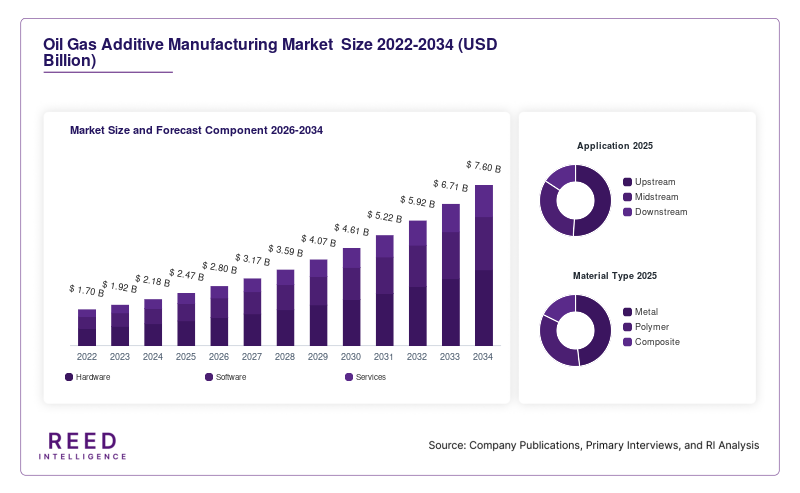
Regional Analysis
North America
North America held the largest share of the Oil Gas Additive Manufacturing Market in 2025, accounting for 38.6% of the global market. The region is expected to maintain steady growth with a CAGR of 12.8% during the forecast period. The presence of advanced manufacturing infrastructure and early adoption of innovative technologies contribute to market dominance. Oil and gas companies in the region are increasingly investing in additive manufacturing to improve operational efficiency and reduce costs.
The United States remains the dominant country in North America, driven by strong investments in research and development. A unique growth factor is the integration of additive manufacturing with shale gas operations, enabling efficient production of customized components. This trend is supported by collaborations between energy companies and technology providers, further strengthening market growth.
Europe
Europe accounted for a significant share of the market in 2025, with steady growth projected at a CAGR of 12.1%. The region’s focus on sustainability and innovation drives the adoption of additive manufacturing technologies. Governments and industry players are actively promoting advanced manufacturing practices to reduce environmental impact and improve efficiency.
Germany is the leading country in Europe, benefiting from its strong industrial base and expertise in engineering. A unique growth factor is the emphasis on circular economy principles, which encourages the use of additive manufacturing to minimize waste and optimize resource utilization. This approach supports long-term market growth in the region.
Asia Pacific
Asia Pacific is expected to witness the fastest growth in the Oil Gas Additive Manufacturing Market, with a CAGR of 15.1% during the forecast period. The region’s expanding energy demand and increasing investments in oil and gas exploration contribute to market growth. Countries are focusing on adopting advanced technologies to enhance production capabilities.
China dominates the Asia Pacific market, driven by large-scale industrialization and government support for advanced manufacturing. A unique growth factor is the rapid development of domestic additive manufacturing capabilities, enabling cost-effective production of components. This trend is expected to accelerate market expansion in the region.
Middle East & Africa
The Middle East & Africa region is experiencing steady growth, with a projected CAGR of 13.0%. The region’s strong reliance on oil and gas production drives the adoption of advanced manufacturing technologies. Companies are increasingly exploring additive manufacturing to improve efficiency and reduce operational costs.
Saudi Arabia leads the market in this region, supported by significant investments in energy infrastructure. A unique growth factor is the focus on diversifying manufacturing capabilities through national initiatives. These efforts aim to reduce dependence on imports and promote local production, boosting the adoption of additive manufacturing.
Latin America
Latin America holds a moderate share of the market, with a projected CAGR of 12.5%. The region’s oil and gas industry is gradually adopting additive manufacturing technologies to enhance operational efficiency. Economic reforms and investments in energy projects support market growth.
Brazil is the dominant country in Latin America, driven by offshore exploration activities. A unique growth factor is the increasing use of additive manufacturing in deepwater operations, where traditional supply chains are challenging. This capability enables efficient production of critical components, supporting market expansion.
Competitive Landscape
The Oil Gas Additive Manufacturing Market is characterized by the presence of several established players and emerging companies focusing on innovation and technological advancements. Leading companies are investing in research and development to enhance their product offerings and expand their market presence. Strategic collaborations and partnerships are common in this market, enabling companies to leverage complementary capabilities.
A leading player in the market is GE Additive, known for its advanced metal additive manufacturing solutions. The company has recently expanded its portfolio by introducing new high-performance printers designed for industrial applications. Other key players are also focusing on developing cost-effective solutions and improving process efficiency. The competitive landscape is expected to remain dynamic, with continuous advancements in technology and increasing adoption of additive manufacturing across the oil and gas industry.
Key Players
- GE Additive
- Siemens Energy
- Baker Hughes
- Halliburton
- Schlumberger
- EOS GmbH
- Stratasys Ltd.
- 3D Systems Corporation
- Renishaw plc
- Sandvik AB
- Carpenter Technology Corporation
- Desktop Metal
- Velo3D
- SLM Solutions
- ExOne Company
Recent Developments
- In 2025, GE Additive introduced a new industrial-grade metal 3D printer designed specifically for oil and gas applications.
- In 2024, Baker Hughes partnered with an additive manufacturing firm to enhance on-site production capabilities.
- In 2025, Siemens Energy expanded its additive manufacturing facility to support increased demand from the energy sector.
Oil Gas Additive Manufacturing Market Segments
Component
- Hardware
- Software
- Services
Application
- Upstream
- Midstream
- Downstream
Material Type
- Metal
- Polymer
- Composite
By Region
- North America
- Europe
- APAC
- Middle East and Africa
- LATAM