Oil Gas Digital Rock Analysis Market Size, Share Demand Report By Component (Software Solutions, Services), By Application (Reservoir Characterization, Enhanced Oil Recovery Analysis, Petrophysical Analysis), By End Use (Oilfield Service Companies, Exploration & Production Companies, Research Institutions) By Region & Segment Forecasts, 2026–2034
USD 3950
Market Overview
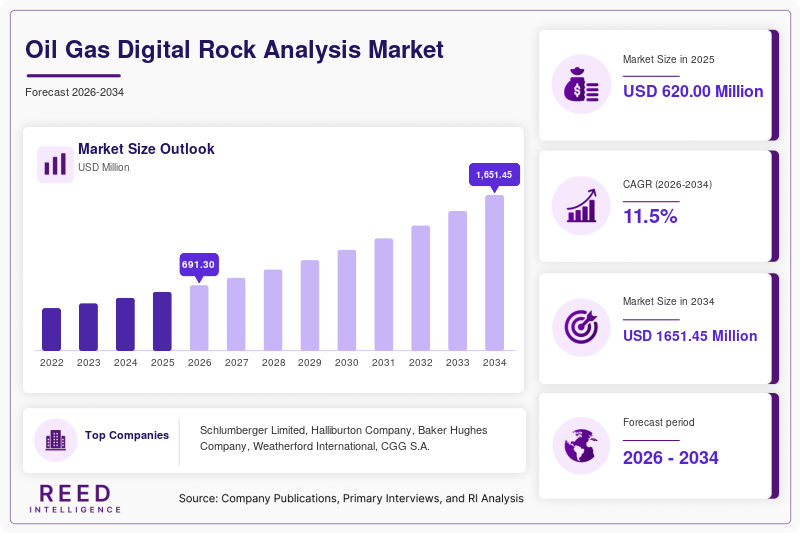
The Oil Gas Digital Rock Analysis Market size was valued at approximately USD 620 million in 2026 and is projected to reach USD 1480 million by 2034, expanding at a CAGR of 11.5% during the forecast period (2026–2034). The market is gaining traction as oil and gas operators increasingly adopt advanced reservoir characterization techniques to improve recovery efficiency and reduce operational uncertainties. Digital rock analysis enables the simulation of rock properties and fluid behavior at the pore scale, offering faster and more cost-effective alternatives to traditional core analysis methods.
A major global factor supporting market growth is the increasing complexity of hydrocarbon reservoirs. As conventional reserves decline, operators are focusing on unconventional resources such as shale gas, tight oil, and deepwater fields. These reservoirs require precise petrophysical insights, which digital rock technologies provide through high-resolution imaging and computational modeling. The integration of artificial intelligence and high-performance computing has further accelerated adoption by improving simulation accuracy and reducing analysis time.
Key Highlights
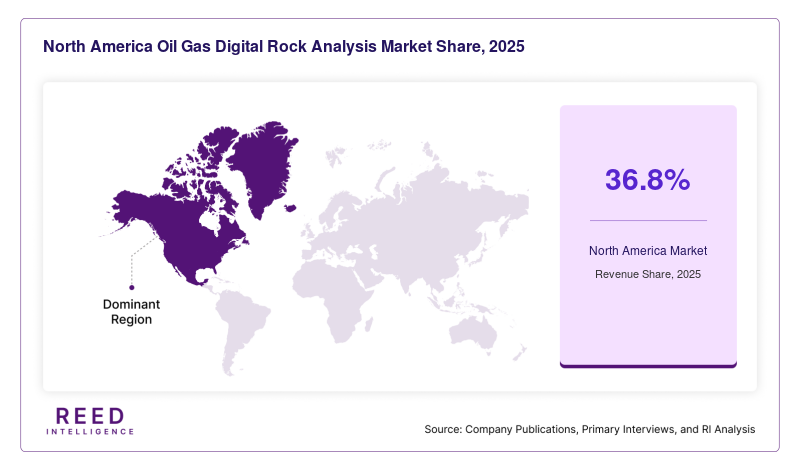
- North America dominated the market with a 36.8% share in 2025.
- Asia Pacific is expected to grow at the fastest CAGR of 12.3% during 2026–2034.
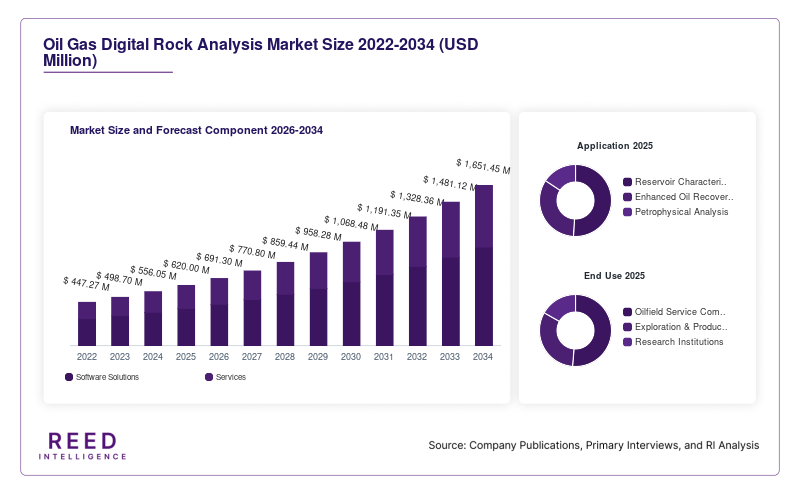
- By component, software solutions accounted for the largest share of 42.1%, while services are projected to grow at a CAGR of 12.9%.
- By application, reservoir characterization led with a 44.6% share, whereas enhanced oil recovery analysis is expected to expand at a CAGR of 12.1%.
- The United States remained the dominant country, with market values of USD 210 million in 2024 and USD 235 million in 2025.
Market Trends
Integration of artificial intelligence and machine learning in reservoir modeling
The increasing integration of artificial intelligence and machine learning into digital rock analysis workflows is shaping the evolution of the market. AI-driven algorithms are being used to automate pore structure identification, fluid flow simulations, and rock property predictions, significantly reducing the time required for analysis. These tools enable operators to process large datasets generated from micro-CT scans and imaging technologies, delivering more accurate and scalable insights. Additionally, machine learning models are improving predictive capabilities by identifying patterns that may not be evident through traditional analysis methods. This trend is particularly relevant for unconventional reservoirs where heterogeneity is high. As companies invest in digital transformation, the demand for intelligent digital rock platforms is expected to rise steadily.
Growing adoption of cloud-based simulation platforms
Cloud-based digital rock analysis platforms are gaining popularity due to their scalability and cost efficiency. Traditional on-premise solutions require substantial capital investment in computing infrastructure, which limits adoption among smaller operators. Cloud deployment allows companies to access high-performance computing resources on demand, enabling faster simulations and collaborative workflows. This trend also supports remote operations, which have become increasingly important in global oil and gas projects. Furthermore, cloud platforms facilitate integration with other digital oilfield technologies, enhancing overall operational efficiency. As cybersecurity measures improve and data management becomes more robust, cloud-based solutions are expected to become a standard approach in digital rock analysis.
Market Drivers
Increasing demand for enhanced oil recovery techniques
The growing need to maximize extraction from existing oil fields is driving the adoption of digital rock analysis. Enhanced oil recovery techniques rely heavily on accurate reservoir characterization to optimize fluid injection strategies and improve recovery rates. Digital rock analysis provides detailed insights into pore structures, permeability, and fluid behavior, enabling operators to design more effective recovery methods. This is particularly important in mature fields where traditional extraction methods are no longer sufficient. By reducing uncertainty and improving efficiency, digital rock technologies help operators achieve higher output with lower operational costs, making them an essential tool in modern oil and gas production.
Rising investments in unconventional resource exploration
The exploration of unconventional resources such as shale gas and tight oil is significantly contributing to market growth. These resources present complex geological challenges that require advanced analytical techniques for accurate evaluation. Digital rock analysis allows operators to simulate reservoir conditions and predict performance under various scenarios, reducing the risk associated with exploration activities. Governments and private companies are increasing investments in unconventional resource development to ensure energy security, further boosting demand for digital rock solutions. The ability to perform non-destructive analysis and generate high-resolution data is making digital rock technologies indispensable in this segment.
Market Restraint
High implementation costs and technical complexity
Despite its advantages, the adoption of digital rock analysis is hindered by high implementation costs and technical complexity. The technology requires advanced imaging equipment, specialized software, and skilled personnel to interpret data accurately. Small and medium-sized operators often face challenges in allocating resources for such investments, limiting market penetration. Additionally, integrating digital rock analysis into existing workflows can be complex, requiring significant changes in operational processes. The lack of standardized protocols further complicates adoption, as companies may face difficulties in comparing results across different platforms. These factors can slow down market growth, particularly in regions with limited technological infrastructure.
Market Opportunities
Expansion of digital oilfield initiatives
The increasing adoption of digital oilfield initiatives presents significant opportunities for the digital rock analysis market. Oil and gas companies are investing in integrated digital solutions to enhance operational efficiency and reduce costs. Digital rock analysis plays a crucial role in these initiatives by providing detailed reservoir insights that support decision-making. The integration of digital rock data with other technologies such as real-time monitoring and predictive analytics creates a comprehensive ecosystem for optimized production. As companies continue to embrace digital transformation, the demand for advanced analytical tools is expected to grow, creating new opportunities for market expansion.
Emerging applications in carbon capture and storage
The growing focus on sustainability and carbon management is opening new avenues for digital rock analysis. Carbon capture and storage projects require precise understanding of subsurface formations to ensure safe and efficient CO₂ storage. Digital rock analysis enables detailed characterization of reservoir properties, helping identify suitable storage sites and assess long-term stability. This application is gaining importance as governments and organizations implement stricter environmental regulations. The ability to simulate fluid interactions and predict reservoir behavior makes digital rock technologies valuable in supporting carbon management initiatives. As the energy sector transitions toward lower emissions, this opportunity is expected to drive significant market growth.
Segmental Analysis
By Component
Software solutions dominated the Oil Gas Digital Rock Analysis Market in 2024, accounting for a share of approximately 42.1%. These solutions are essential for processing and interpreting data obtained from imaging technologies such as micro-CT scanning. Advanced software platforms enable detailed simulation of rock properties and fluid dynamics, providing valuable insights for reservoir characterization. The growing integration of artificial intelligence and machine learning into these platforms further enhances their capabilities, allowing for faster and more accurate analysis. As oil and gas companies increasingly focus on digital transformation, the demand for sophisticated software solutions continues to rise.
Services are emerging as the fastest-growing subsegment, with a projected CAGR of 12.9% during the forecast period. The increasing complexity of digital rock analysis requires specialized expertise, driving demand for consulting, training, and support services. Service providers offer customized solutions to help companies integrate digital rock technologies into their operations effectively. Additionally, outsourcing analysis tasks allows operators to reduce costs and focus on core activities. The growing adoption of cloud-based platforms also supports the expansion of service offerings, enabling remote analysis and collaboration.
By Application
Reservoir characterization was the leading application segment in 2024, capturing a market share of 44.6%. This segment benefits from the critical role of digital rock analysis in understanding reservoir properties such as porosity, permeability, and fluid distribution. Accurate reservoir characterization is essential for optimizing drilling and production strategies, making it a key focus area for oil and gas companies. The ability to simulate reservoir behavior under different conditions enhances decision-making and reduces operational risks, contributing to the segment’s dominance.
Enhanced oil recovery analysis is expected to grow at the fastest CAGR of 12.1% during the forecast period. The increasing need to maximize extraction from mature fields is driving demand for advanced analytical techniques. Digital rock analysis provides detailed insights into fluid interactions and rock properties, enabling more effective design of recovery methods. This is particularly important for improving efficiency and reducing costs in challenging reservoir conditions. The adoption of enhanced oil recovery techniques is expected to increase as companies seek to extend the lifespan of existing fields.
By End Use
Oilfield service companies dominated the end-use segment in 2024, accounting for a significant share of the market. These companies play a crucial role in providing advanced technologies and analytical services to oil and gas operators. Their expertise in digital rock analysis enables them to offer comprehensive solutions for reservoir characterization and production optimization. The increasing demand for integrated services and digital solutions is driving growth in this segment.
Exploration and production companies are expected to be the fastest-growing subsegment, with a CAGR of 11.8%. These companies are increasingly adopting digital rock analysis to improve exploration success rates and optimize production strategies. The ability to generate high-resolution data and simulate reservoir conditions provides a competitive advantage in the industry. As exploration activities expand and reservoirs become more complex, the demand for advanced analytical tools is expected to rise significantly.
Regional Analysis
North America
North America accounted for a dominant share of 36.8% in 2025 and is expected to maintain steady growth with a CAGR of 10.9% during the forecast period. The region’s leadership is attributed to advanced technological infrastructure and strong investments in digital oilfield solutions. The presence of major oilfield service providers and technology companies further supports market expansion. Additionally, the widespread adoption of unconventional resource exploration in the region drives demand for digital rock analysis technologies.
The United States remains the dominant country in North America, supported by extensive shale gas and tight oil developments. A key growth factor is the increasing use of high-performance computing in reservoir simulation, enabling more accurate and faster analysis. This technological advancement allows operators to optimize production strategies and reduce operational risks, contributing to sustained market growth in the region.
Europe
Europe held a significant market share of 24.5% in 2025 and is projected to grow at a CAGR of 10.7% through 2034. The region’s growth is driven by increasing investments in offshore exploration and production activities, particularly in the North Sea. European companies are focusing on improving recovery rates from mature fields, which boosts the adoption of advanced analytical technologies. Regulatory support for technological innovation also plays a role in market development.
The United Kingdom stands out as a leading country in the region, driven by its strong offshore oil and gas sector. A unique growth factor is the emphasis on sustainability and efficient resource utilization. Companies are adopting digital rock analysis to optimize production while minimizing environmental impact, aligning with regional energy transition goals.
Asia Pacific
Asia Pacific is expected to witness the fastest growth, with a CAGR of 12.3% during the forecast period. The region accounted for a market share of 18.9% in 2025, driven by increasing energy demand and exploration activities. Rapid industrialization and urbanization are fueling the need for efficient hydrocarbon production, encouraging the adoption of advanced technologies. Governments in the region are also supporting investments in oil and gas infrastructure.
China emerges as the dominant country in Asia Pacific, supported by extensive exploration of unconventional resources. A key growth factor is the increasing adoption of digital technologies in state-owned oil companies. These organizations are investing in advanced analytics to improve reservoir understanding and enhance production efficiency, driving market growth.
Middle East & Africa
The Middle East & Africa region accounted for 12.6% of the market share in 2025 and is projected to grow at a CAGR of 11.2%. The region’s growth is supported by its vast hydrocarbon reserves and ongoing investments in oilfield modernization. Countries in the Middle East are focusing on improving recovery rates from existing fields, creating demand for advanced analytical solutions.
Saudi Arabia leads the region, driven by its large-scale oil production activities. A unique growth factor is the increasing focus on maximizing output from mature reservoirs. Digital rock analysis helps operators achieve this by providing detailed insights into reservoir properties, enabling more effective extraction strategies and supporting long-term production goals.
Latin America
Latin America held a market share of 7.2% in 2025 and is expected to grow at a CAGR of 10.5% during the forecast period. The region’s growth is driven by increasing offshore exploration activities and investments in oil and gas infrastructure. Countries are focusing on improving production efficiency to meet growing energy demands, which supports the adoption of digital technologies.
Brazil is the dominant country in Latin America, supported by its extensive offshore reserves. A key growth factor is the development of deepwater and pre-salt fields, which require advanced reservoir characterization techniques. Digital rock analysis enables operators to better understand complex geological formations, improving exploration success rates and production efficiency.
Competitive Landscape
The Oil Gas Digital Rock Analysis Market is moderately consolidated, with key players focusing on technological innovation and strategic collaborations to strengthen their market position. Leading companies are investing in research and development to enhance their digital rock platforms and integrate advanced analytics capabilities. Partnerships with oil and gas operators are also common, enabling companies to expand their customer base and improve service offerings.
Schlumberger is considered a leading player in the market, driven by its extensive portfolio of digital solutions and strong global presence. The company has recently introduced enhanced digital rock workflows that integrate artificial intelligence to improve simulation accuracy and reduce analysis time. Other major players are also focusing on expanding their capabilities through acquisitions and collaborations, contributing to increased competition and innovation in the market.
Key Players
- Schlumberger Limited
- Halliburton Company
- Baker Hughes Company
- Weatherford International
- CGG S.A.
- Core Laboratories N.V.
- Rock Flow Dynamics
- Thermo Fisher Scientific Inc.
- ZEISS Group
- FEI Company
- ExxonMobil Corporation
- Chevron Corporation
- Shell Global
- Equinor ASA
- Emerson Electric Co.
Recent Developments
- Schlumberger launched an advanced AI-enabled digital rock analysis platform in 2025 to improve reservoir simulation efficiency.
- Halliburton expanded its cloud-based digital rock services to support remote analysis and collaboration across global projects in 2024.
- Baker Hughes partnered with a technology firm in 2025 to develop high-resolution imaging solutions for unconventional reservoir analysis.
Oil Gas Digital Rock Analysis Market Segments
Component
- Software Solutions
- Services
Application
- Reservoir Characterization
- Enhanced Oil Recovery Analysis
- Petrophysical Analysis
End Use
- Oilfield Service Companies
- Exploration & Production Companies
- Research Institutions
By Region
- North America
- Europe
- APAC
- Middle East and Africa
- LATAM