Oil Gas Hose Assemblies Market Size, Share & Demand Report By Product Type (Hydraulic Hose Assemblies, Industrial Hose Assemblies, Composite Hose Assemblies), By Material (Synthetic Rubber, Thermoplastic, Stainless Steel), By Application (Upstream Exploration & Production, Midstream Transportation), By End User (Oil & Gas Operators, EPC Contractors, Oilfield Service Providers), By Region & Segment Forecasts, 2026–2034
USD 3950
Market Overview
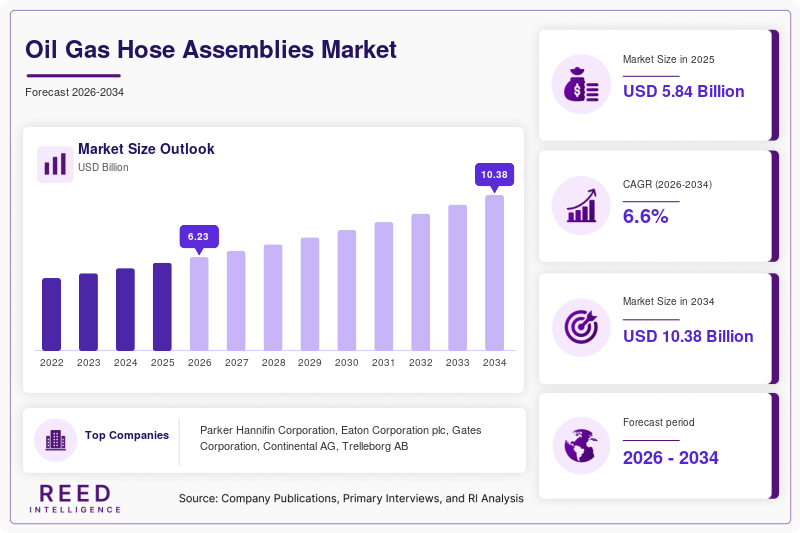
The Oil Gas Hose Assemblies Market size was valued at USD 5.84 billion in 2026 and is projected to reach USD 9.72 billion by 2034, expanding at a CAGR of 6.6% during the forecast period (2026–2034). The global Oil Gas Hose Assemblies Market continues to gain momentum as oil and gas operators invest in reliable fluid transfer systems capable of handling high-pressure, abrasive, and corrosive operating conditions across upstream, midstream, and downstream facilities.
A major global factor supporting market growth is the continued expansion of energy infrastructure projects, including offshore drilling platforms, LNG terminals, refineries, petrochemical complexes, and pipeline transportation networks. Hose assemblies remain critical components for fluid conveyance, loading and unloading operations, hydraulic systems, drilling activities, and fuel transfer applications. Rising investments in operational safety, equipment reliability, and maintenance efficiency have encouraged operators to replace aging hose systems with advanced reinforced assemblies that offer longer service life and enhanced performance.
Key Highlights
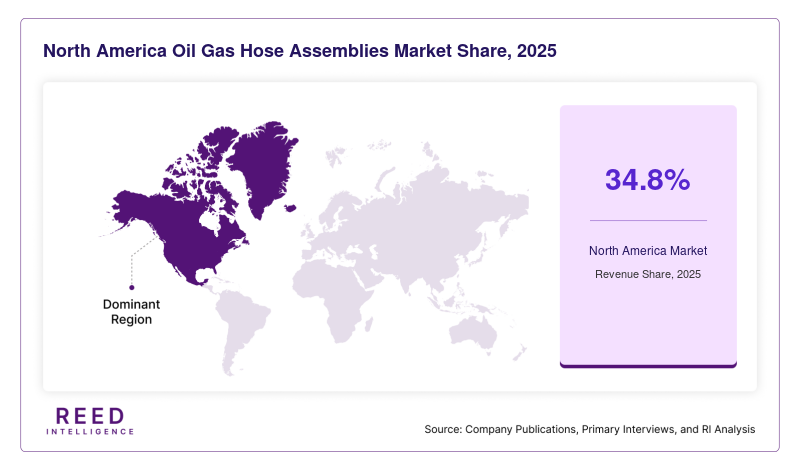
- North America dominated the Oil Gas Hose Assemblies Market with 34.8% share in 2025, while Asia Pacific is expected to register the fastest CAGR of 7.8% during 2026–2034.
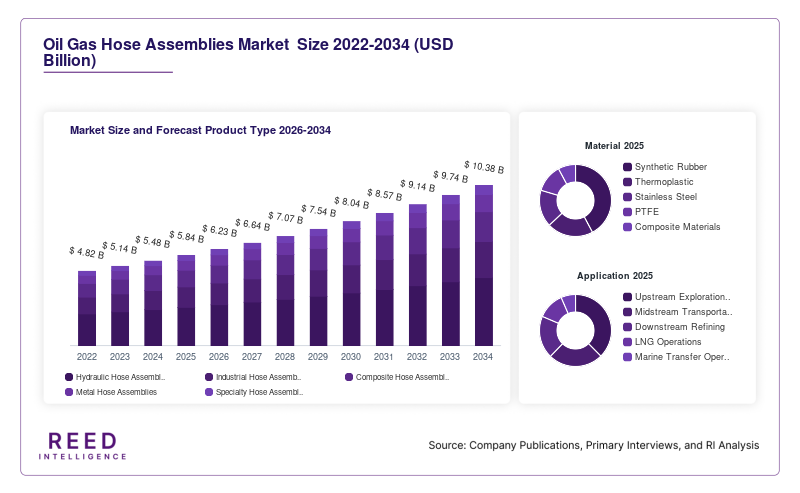
- By Product Type, Hydraulic Hose Assemblies accounted for the largest market share of 38.6% in 2025, whereas Composite Hose Assemblies are projected to grow at a CAGR of 8.2%.
- By Material, Synthetic Rubber Hose Assemblies held 46.3% market share in 2025, while Thermoplastic Hose Assemblies are anticipated to expand at 8.5% CAGR.
- By Application, Upstream Exploration & Production represented 41.5% share in 2025, while LNG Transfer Operations will witness a CAGR of 8.1%.
- By End User, Oil & Gas Operators generated 52.4% share in 2025, while Integrated Energy Infrastructure Developers are expected to grow at 7.9% CAGR.
- The United States remained the dominant country, with market values reaching USD 1.28 billion in 2024 and USD 1.35 billion in 2025.
Market Trends
Integration of Smart Monitoring Technologies
A significant trend shaping the Oil Gas Hose Assemblies Market is the incorporation of intelligent monitoring systems within hose assemblies. Manufacturers are increasingly introducing sensors capable of monitoring pressure fluctuations, temperature changes, vibration levels, and wear conditions in real time. These technologies improve predictive maintenance strategies and reduce unexpected downtime. Energy companies are prioritizing asset reliability and operational continuity, driving adoption of digitally enabled hose systems across offshore platforms and refinery environments.
Growing Demand for Lightweight High-Performance Assemblies
Another notable trend is the transition toward lightweight yet highly durable hose assemblies. Advanced composite structures, reinforced thermoplastics, and engineered elastomers provide enhanced flexibility while maintaining high-pressure performance. These solutions improve handling efficiency, reduce installation complexity, and lower maintenance costs. Offshore operators and drilling contractors increasingly favor lighter assemblies that simplify deployment without compromising operational safety.
Market Drivers
Expansion of Offshore Exploration Activities
Growing offshore oil and gas exploration projects continue to create substantial demand for specialized hose assemblies. Deepwater and ultra-deepwater operations require robust fluid transfer solutions capable of operating under harsh environmental conditions. Hose assemblies play a crucial role in drilling fluids transfer, hydraulic systems, fuel movement, and marine loading applications. As offshore investments increase across multiple producing regions, equipment procurement activities continue to support market expansion.
Rising Focus on Operational Safety and Asset Reliability
Oil and gas companies are strengthening safety protocols to minimize environmental incidents and operational disruptions. Modern hose assemblies provide enhanced resistance against pressure surges, chemical exposure, abrasion, and extreme temperatures. Operators increasingly replace conventional hoses with advanced assemblies that comply with stringent safety standards. This shift toward preventive maintenance and reliability-focused asset management continues to support market growth.
Market Restraint
Volatility in Raw Material Prices
Fluctuating prices of synthetic rubber, steel reinforcement materials, thermoplastics, and specialty polymers represent a key challenge for manufacturers. Variations in raw material costs can affect production expenses and profit margins, creating pricing pressures across the supply chain. Long-term procurement planning remains difficult when commodity prices experience significant volatility.
Market Opportunities
Growth of LNG Infrastructure Projects
The expansion of LNG terminals, storage facilities, and transportation networks presents attractive opportunities for hose assembly manufacturers. LNG transfer operations require highly specialized cryogenic hose systems capable of handling extremely low temperatures. Increasing global investments in LNG infrastructure will generate new demand for technologically advanced hose assemblies.
Development of Renewable Fuel and Hydrogen Facilities
The emergence of renewable diesel, biofuel, and hydrogen production facilities creates additional opportunities for market participants. These facilities require specialized fluid handling systems with enhanced chemical compatibility and safety performance. Manufacturers capable of developing next-generation hose solutions for alternative energy infrastructure are expected to benefit from expanding application areas.
Segmental Analysis
By Product Type
The market is segmented into Hydraulic Hose Assemblies, Industrial Hose Assemblies, Composite Hose Assemblies, Metal Hose Assemblies, and Specialty Hose Assemblies.
Hydraulic Hose Assemblies dominated the market with 38.6% share in 2025. Their widespread deployment in drilling rigs, hydraulic equipment, offshore platforms, and production facilities contributed to strong market penetration. These assemblies offer excellent pressure handling capability and operational reliability.
Composite Hose Assemblies are projected to register the fastest CAGR of 8.2% through 2034. Their lightweight structure, chemical resistance, and operational flexibility will make them increasingly attractive for fuel transfer and marine loading applications. Growing demand for efficient fluid handling solutions will support segment expansion.
By Material
The market is categorized into Synthetic Rubber, Thermoplastic, Stainless Steel, PTFE, and Composite Materials.
Synthetic Rubber Hose Assemblies accounted for 46.3% share in 2025 due to their versatility, durability, and compatibility with diverse operating environments. These assemblies remain widely used across upstream and downstream applications.
Thermoplastic Hose Assemblies are expected to grow at 8.5% CAGR during the forecast period. Their lightweight construction, abrasion resistance, and extended service life will drive adoption across advanced energy infrastructure projects. Enhanced flexibility and reduced maintenance requirements further support demand growth.
By Application
The market includes Upstream Exploration & Production, Midstream Transportation, Downstream Refining, LNG Operations, and Marine Transfer Operations.
Upstream Exploration & Production represented 41.5% of market revenue in 2025. Extensive deployment of hose assemblies within drilling systems, production facilities, and hydraulic equipment sustained segment leadership.
LNG Operations are anticipated to expand at a CAGR of 8.1% through 2034. Increasing investments in LNG terminals and cryogenic transportation infrastructure will require specialized hose assemblies capable of maintaining performance under extreme temperature conditions.
By End User
The market is segmented into Oil & Gas Operators, EPC Contractors, Service Providers, Industrial Processing Facilities, and Energy Infrastructure Developers.
Oil & Gas Operators held the largest share of 52.4% in 2025. Their extensive asset portfolios and continuous maintenance requirements generated substantial demand for replacement and upgraded hose assemblies.
Energy Infrastructure Developers are forecast to achieve a 7.9% CAGR during the forecast period. Growing investments in LNG terminals, storage facilities, petrochemical complexes, and integrated energy projects will accelerate demand for advanced hose solutions.
Regional Analysis
North America
North America accounted for 34.8% of the Oil Gas Hose Assemblies Market share in 2025. The region benefited from extensive shale production activities, refinery upgrades, pipeline infrastructure expansion, and offshore development projects. Demand remained strong across drilling operations, hydraulic fracturing applications, and petrochemical facilities.
The United States dominated the regional market due to continuous investment in unconventional hydrocarbon production. Advanced drilling technologies and extensive midstream infrastructure development supported stable demand for high-performance hose assemblies. The regional market is expected to expand at a CAGR of 6.2% through 2034.
Europe
Europe represented 24.1% market share in 2025. Ongoing modernization of refinery facilities, offshore energy infrastructure maintenance, and industrial automation initiatives contributed to market growth. Companies increasingly adopted advanced hose assemblies designed for operational efficiency and environmental compliance.
Norway emerged as the leading country within Europe due to sustained offshore oil and gas activity in the North Sea. Investments in subsea infrastructure and offshore platform maintenance supported consistent equipment replacement demand. The regional market is forecast to grow at a CAGR of 5.9% during 2026–2034.
Asia Pacific
Asia Pacific captured 22.6% market share in 2025 and is expected to record the fastest growth rate of 7.8% CAGR over the forecast period. Expanding refining capacity, industrialization, and increasing energy consumption continue to support infrastructure development throughout the region.
China led the regional market owing to large-scale investments in petrochemical manufacturing and LNG infrastructure development. The expansion of industrial processing facilities and energy transportation networks generated substantial demand for hose assembly solutions. Continued capital expenditure is expected to strengthen regional growth prospects.
Middle East & Africa
The Middle East & Africa accounted for 12.5% market share in 2025. Large hydrocarbon reserves and ongoing energy sector investments sustained demand for fluid transfer equipment across production and processing facilities. Maintenance activities within mature oilfields also contributed to replacement demand.
Saudi Arabia remained the dominant country due to extensive refinery modernization initiatives and petrochemical expansion projects. Large-scale industrial investments created consistent opportunities for hose assembly suppliers. The regional market is projected to grow at a CAGR of 6.8% through 2034.
Latin America
Latin America held 6.0% market share in 2025. Growth was supported by offshore development programs, energy sector investments, and refinery improvement projects. Infrastructure modernization efforts continued to enhance market potential.
Brazil led the regional market due to expanding offshore production activities and investments in deepwater exploration projects. Continued development of offshore resources is expected to generate steady demand for specialized hose assemblies. The regional market will likely expand at a CAGR of 6.4% during the forecast period.
Competitive Landscape
The Oil Gas Hose Assemblies Market remains moderately consolidated, with global manufacturers focusing on product innovation, material advancements, strategic partnerships, and geographic expansion. Companies continue investing in engineered solutions designed for demanding oil and gas operating environments.
Parker Hannifin Corporation maintained a leading position in the market through its broad industrial fluid handling portfolio and extensive global distribution network. The company recently expanded its high-pressure hose assembly product offerings designed for energy infrastructure applications.
Eaton Corporation plc strengthened its market presence through investments in advanced hydraulic technologies and customized fluid conveyance solutions.
Gates Corporation continued to focus on high-performance hose systems featuring enhanced durability and operational efficiency.
Continental AG expanded its industrial hose portfolio with solutions designed for demanding chemical and petroleum transfer applications.
Trelleborg AB emphasized advanced polymer engineering capabilities to improve performance across offshore and marine fluid transfer systems.
Key Players List
- Parker Hannifin Corporation
- Eaton Corporation plc
- Gates Corporation
- Continental AG
- Trelleborg AB
- Bridgestone Corporation
- Manuli Hydraulics Group
- Alfagomma S.p.A.
- Yokohama Rubber Co., Ltd.
- PIRTEK Group
- Semperit AG Holding
- Kurt Manufacturing Company
- Transfer Oil S.p.A.
- Polyhose India Pvt. Ltd.
- RYCO Hydraulics
Recent Developments
- Parker Hannifin introduced advanced high-pressure hose solutions designed for demanding energy sector environments.
- Eaton Corporation expanded its fluid conveyance product portfolio to support evolving industrial infrastructure requirements.
- Continental AG launched upgraded industrial hose technologies featuring enhanced chemical resistance and durability.
- Trelleborg developed next-generation polymer-based hose solutions optimized for offshore transfer applications.
- Alfagomma increased manufacturing capacity to address growing demand from oil, gas, and industrial processing sectors.
- Gates Corporation enhanced predictive maintenance capabilities through digital monitoring integration for selected hose assembly systems.
- Polyhose expanded its international distribution network to strengthen presence across emerging energy markets.
Oil Gas Hose Assemblies Market Segments
Product Type
- Hydraulic Hose Assemblies
- Industrial Hose Assemblies
- Composite Hose Assemblies
- Metal Hose Assemblies
- Specialty Hose Assemblies
Material
- Synthetic Rubber
- Thermoplastic
- Stainless Steel
- PTFE
- Composite Materials
Application
- Upstream Exploration & Production
- Midstream Transportation
- Downstream Refining
- LNG Operations
- Marine Transfer Operations
End User
- Oil & Gas Operators
- EPC Contractors
- Oilfield Service Providers
- Industrial Processing Facilities
- Energy Infrastructure Developers
By Region
- North America
- Europe
- APAC
- Middle East and Africa
- LATAM