Oil Gas Nuclear Magnetic Resonance Market Size, Share & Demand Report By Component (Hardware Systems, Software and Analytics Solutions, Services), By Application (Reservoir Characterization, Formation Evaluation, Unconventional Resource Exploration), By End Use (Oilfield Service Companies, National Oil Companies, Independent Exploration Companies), By Region & Segment Forecasts, 2026–2034
USD 3950
Market Overview
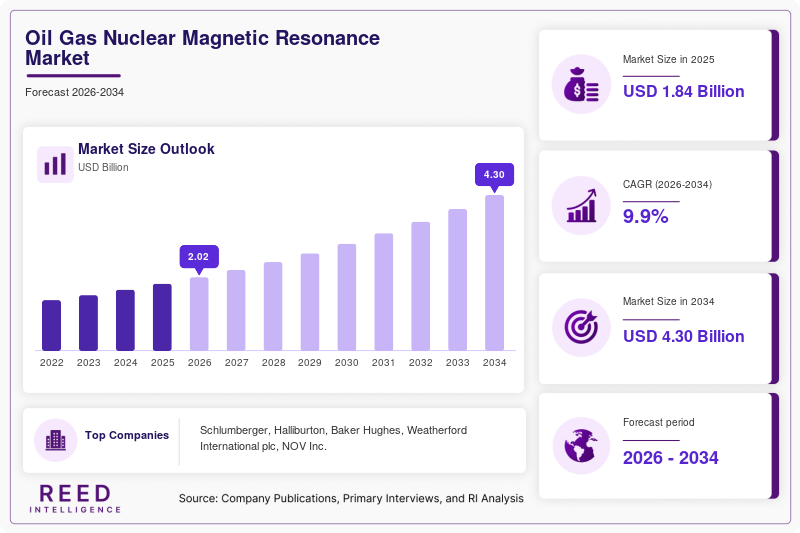
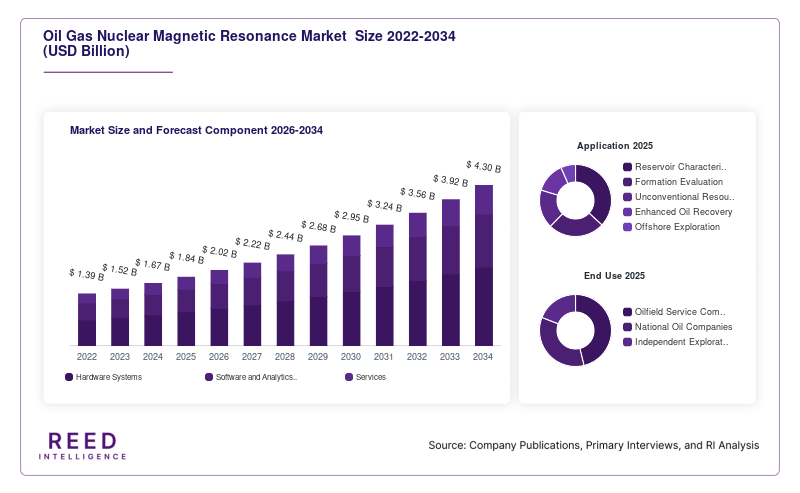
The global Oil Gas Nuclear Magnetic Resonance Market size was valued at USD 1.84 billion in 2026 and is projected to reach USD 3.92 billion by 2034, expanding at a CAGR of 9.9% during the forecast period from 2026 to 2034. The market is witnessing consistent growth due to the rising demand for advanced reservoir characterization technologies across upstream oil and gas exploration activities. Nuclear magnetic resonance (NMR) tools are increasingly used for evaluating porosity, permeability, fluid saturation, and rock properties in unconventional reservoirs, enabling operators to improve drilling efficiency and production outcomes.
Growing investments in shale gas exploration, offshore drilling projects, and enhanced oil recovery programs are supporting industry expansion. Oil and gas operators are focusing on improving hydrocarbon recovery rates while reducing operational risks and exploration costs. As a result, demand for real-time subsurface analysis solutions has increased significantly. In addition, digital oilfield transformation and integration of artificial intelligence with logging tools are improving the performance of NMR-based systems in complex geological formations.
Key Highlights
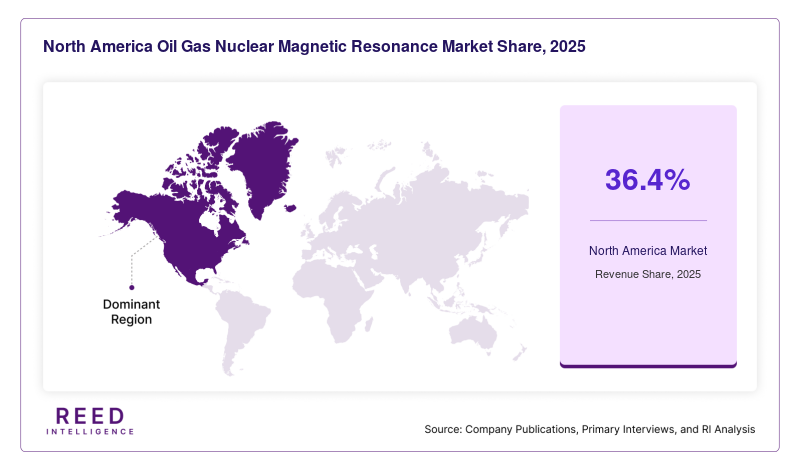
- North America dominated the market with a 36.4% share in 2025.
- Asia Pacific is expected to grow at the fastest CAGR of 11.6% during 2026–2034.
- By component, hardware systems accounted for the largest share of 42.8%.
- while software and analytics solutions are projected to grow at a CAGR of 12.9%.
- By application, reservoir characterization led with a 44.6% share.
- whereas unconventional resource exploration is expected to expand at a CAGR of 12.1%.
- The United States remained the dominant country, with market values of USD 620 million in 2024 and USD 690 million in 2025.
Market Trends
Integration of Artificial Intelligence and Digital Reservoir Analytics
The Oil Gas Nuclear Magnetic Resonance Market is experiencing increasing adoption of artificial intelligence-driven interpretation platforms integrated with NMR logging systems. Oilfield operators are focusing on improving the accuracy of reservoir evaluation by combining NMR datasets with machine learning algorithms and cloud-based analytics. These technologies enable faster identification of hydrocarbon zones, better fluid typing, and improved permeability prediction across complex formations. Companies are using AI-enabled interpretation tools to reduce uncertainty during drilling and completion operations, particularly in unconventional shale reservoirs and offshore assets where geological conditions are more challenging.
Digital transformation across the oil and gas industry is also encouraging remote monitoring and real-time interpretation capabilities. Advanced NMR tools now provide continuous data transmission from drilling sites to centralized operational centers, allowing experts to make quicker exploration decisions. Integration with digital twin technologies and predictive analytics platforms is further supporting market growth. As operators continue to prioritize operational efficiency and lower exploration risk, demand for intelligent NMR systems with automated interpretation capabilities is expected to increase steadily during the forecast period.
Rising Adoption of Advanced Logging Technologies in Offshore Exploration
The expansion of offshore oil and gas projects is creating strong demand for advanced nuclear magnetic resonance logging technologies. Offshore reservoirs often involve complex geological structures that require accurate petrophysical analysis to improve drilling productivity and reduce dry well risks. NMR logging tools are gaining popularity because they provide direct measurements of fluid properties, pore size distribution, and reservoir permeability without relying solely on traditional core analysis methods. This capability is particularly important for deepwater and ultra-deepwater exploration activities where operational costs are significantly higher.
Energy companies are increasing investments in offshore projects across the Gulf of Mexico, Brazil, West Africa, and Southeast Asia. In these regions, NMR-based wireline and logging-while-drilling systems are being deployed to optimize reservoir mapping and improve hydrocarbon recovery rates. Technological advancements such as high-temperature resistant sensors and compact downhole instruments are also enhancing tool performance under harsh offshore conditions. These developments are supporting broader acceptance of NMR technologies in offshore exploration and production operations globally.
Market Drivers
Increasing Exploration Activities in Unconventional Hydrocarbon Resources
The growth of unconventional oil and gas exploration is one of the primary drivers supporting the Oil Gas Nuclear Magnetic Resonance Market. Operators are investing heavily in shale gas, tight oil, coalbed methane, and heavy oil reservoirs to meet rising global energy demand. These unconventional formations often contain complex rock structures that require advanced reservoir characterization methods for accurate evaluation. NMR technologies help identify movable hydrocarbons, determine fluid distribution, and estimate permeability with higher precision than traditional logging techniques, making them essential for unconventional drilling operations.
North America continues to lead unconventional resource development, while countries in Asia Pacific and the Middle East are expanding shale exploration activities. Government support for domestic energy production and increasing energy security initiatives are encouraging new exploration projects. As drilling campaigns become more data-intensive, oilfield service companies are integrating advanced NMR tools into both wireline and logging-while-drilling operations. This trend is expected to strengthen market demand throughout the forecast period.
Growing Focus on Maximizing Reservoir Recovery Efficiency
Oil and gas producers are increasingly focusing on maximizing recovery rates from mature and newly discovered reservoirs. Nuclear magnetic resonance technologies provide detailed insights into reservoir fluid behavior and rock properties, helping operators optimize production strategies and improve well placement decisions. Enhanced oil recovery programs are particularly benefiting from NMR measurements because they allow engineers to identify remaining hydrocarbon saturation and monitor fluid movement more effectively during production stages.
The industry is also under pressure to improve operational efficiency and reduce exploration costs amid fluctuating crude oil prices. NMR-based reservoir characterization enables better decision-making during drilling, minimizing the risk of non-productive wells and reducing unnecessary operational expenses. Integration of high-resolution imaging and real-time formation evaluation capabilities further enhances drilling accuracy. As operators prioritize long-term production optimization and cost-effective resource management, the adoption of NMR technologies across upstream activities is expected to increase steadily.
Market Restraint
High Equipment Costs and Technical Complexity Limiting Adoption
The high cost associated with nuclear magnetic resonance equipment and data interpretation remains a major restraint for the Oil Gas Nuclear Magnetic Resonance Market. Advanced NMR logging systems involve sophisticated sensors, magnets, downhole electronics, and specialized software platforms, resulting in significant capital investment requirements. Smaller exploration companies and independent operators often face budget limitations that restrict the adoption of premium reservoir evaluation technologies. In addition, maintaining and calibrating NMR equipment requires highly skilled professionals and continuous technical support, increasing operational expenditure for service providers and oil companies.
The complexity of interpreting NMR data also creates challenges for broader market penetration. Reservoir conditions vary significantly across formations, requiring experienced geophysicists and petrophysicists to analyze results accurately. In regions with limited technical expertise, companies may continue relying on conventional logging methods instead of adopting advanced NMR solutions. Harsh drilling environments, including high-pressure and high-temperature offshore reservoirs, can further complicate tool performance and maintenance requirements. These factors may slow adoption rates in cost-sensitive markets despite the long-term operational benefits offered by NMR technologies.
Market Opportunities
Expansion of Deepwater and Ultra-Deepwater Exploration Projects
The increasing number of deepwater and ultra-deepwater exploration projects presents strong growth opportunities for the Oil Gas Nuclear Magnetic Resonance Market. Offshore energy companies are investing in advanced reservoir characterization technologies to improve exploration accuracy in challenging geological environments. Deepwater projects involve high operational costs and elevated drilling risks, making reliable formation evaluation tools essential for project success. NMR systems provide detailed information about fluid properties, porosity, and reservoir quality, helping operators optimize drilling strategies and reduce exploration uncertainty.
Countries such as Brazil, Guyana, Norway, and Angola are expanding offshore production activities, creating favorable conditions for NMR technology adoption. The growing discovery of offshore hydrocarbon reserves is also encouraging service providers to develop more durable and temperature-resistant logging systems suitable for extreme operating environments. As offshore investments continue to increase globally, demand for advanced nuclear magnetic resonance solutions is expected to rise considerably over the next decade.
Increasing Demand for Real-Time Formation Evaluation Solutions
The transition toward real-time drilling analytics is creating substantial opportunities for market participants. Oil and gas companies are seeking technologies capable of delivering instant reservoir insights during drilling operations to improve productivity and reduce operational delays. NMR-based logging-while-drilling systems are becoming increasingly important because they allow operators to assess formation properties immediately without waiting for post-drilling analysis. This capability supports faster decision-making and enhances well placement efficiency in both conventional and unconventional reservoirs.
Real-time formation evaluation is particularly valuable in complex drilling environments where rapid operational adjustments are necessary. Integration of wireless data transmission, cloud computing, and advanced software analytics is improving the speed and accuracy of NMR interpretation systems. Service providers are also introducing portable and automated solutions designed to simplify field operations and reduce downtime. As digital oilfield adoption expands worldwide, the demand for intelligent real-time NMR technologies is expected to create new revenue opportunities for equipment manufacturers and oilfield service companies.
Segmental Analysis
By Component
Hardware systems accounted for the largest share of the Oil Gas Nuclear Magnetic Resonance Market in 2024, representing approximately 42.8% of total revenue. This segment includes downhole sensors, magnets, probes, transmitters, and wireline logging tools used for reservoir characterization and formation analysis. The dominance of hardware systems is linked to the growing deployment of advanced logging-while-drilling and wireline technologies across offshore and unconventional exploration projects. Oilfield operators continue investing in high-performance NMR equipment capable of operating in harsh drilling environments characterized by extreme temperatures and pressure conditions. Increasing demand for accurate petrophysical measurements and real-time reservoir data further supports hardware adoption across upstream operations globally.
Software and analytics solutions are expected to witness the fastest growth during the forecast period, expanding at a CAGR of 12.9%. The segment is benefiting from the integration of artificial intelligence, cloud computing, and predictive analytics into reservoir interpretation workflows. Oil companies are increasingly adopting digital platforms that can process large volumes of NMR data quickly and deliver actionable insights for drilling optimization. Automated interpretation systems reduce analysis time and improve decision-making accuracy during exploration activities. Rising investments in digital oilfield transformation and remote monitoring solutions are also contributing to strong demand for advanced NMR software platforms across global oil and gas operations.
By Application
Reservoir characterization held the dominant market share in 2024, accounting for 44.6% of the overall Oil Gas Nuclear Magnetic Resonance Market revenue. NMR technologies are extensively used in reservoir characterization because they provide direct measurements of porosity, permeability, and fluid saturation. These capabilities help operators identify productive hydrocarbon zones and optimize well placement strategies. The growing complexity of unconventional reservoirs and offshore formations has increased the need for high-resolution formation evaluation tools capable of improving exploration accuracy. Oilfield service providers are also integrating advanced NMR logging solutions into drilling operations to support efficient reservoir mapping and reduce non-productive drilling activities.
Unconventional resource exploration is projected to register the fastest CAGR of 12.1% between 2026 and 2034. The increasing development of shale gas, tight oil, and coalbed methane resources is driving strong demand for advanced formation evaluation technologies. NMR systems are particularly valuable in unconventional reservoirs because they provide accurate measurements of pore structure and fluid mobility, helping operators optimize hydraulic fracturing and production strategies. North America remains a major contributor to segment growth, while China and Argentina are expanding unconventional drilling activities significantly. Rising global energy demand and government support for domestic hydrocarbon production are expected to sustain long-term segment expansion.
By End Use
Oilfield service companies accounted for the largest share of the Oil Gas Nuclear Magnetic Resonance Market in 2024 due to their extensive deployment of advanced reservoir characterization technologies across exploration and production projects. These companies provide specialized logging, interpretation, and drilling support services for upstream operators worldwide. Increasing outsourcing of technical exploration activities by oil producers has strengthened demand for service-based NMR solutions. Major service providers continue investing in advanced logging systems capable of delivering real-time reservoir insights and improved operational efficiency. The growing number of offshore and unconventional drilling projects is also supporting segment dominance globally.
National and independent oil companies are expected to emerge as the fastest-growing end-use segment during the forecast period, expanding at a CAGR of 11.4%. Energy producers are increasingly investing directly in advanced formation evaluation technologies to improve drilling accuracy and maximize hydrocarbon recovery. National oil companies in the Middle East and Asia Pacific are modernizing upstream infrastructure and integrating digital reservoir management systems into exploration workflows. Independent producers are also adopting compact and cost-efficient NMR technologies to enhance operational efficiency in mature and unconventional reservoirs. Increasing focus on energy security and domestic production capacity is expected to accelerate adoption across this segment.
Regional Analysis
North America
North America accounted for 36.4% of the global Oil Gas Nuclear Magnetic Resonance Market share in 2025 and is expected to maintain a stable growth trajectory during the forecast period. The regional market is projected to expand at a CAGR of 9.4% between 2026 and 2034 due to extensive unconventional oil and gas exploration activities. The presence of advanced drilling infrastructure, strong adoption of digital oilfield technologies, and rising shale gas production continue to support market growth across the region. Oilfield service providers are increasingly deploying advanced NMR logging systems to improve reservoir characterization efficiency.
The United States remains the dominant country in North America due to large-scale shale production activities in the Permian Basin, Eagle Ford, and Bakken formations. One unique growth factor driving the market is the increasing integration of artificial intelligence with reservoir analysis platforms. Energy companies in the country are investing in AI-enabled interpretation software to improve hydrocarbon recovery rates and optimize drilling operations. Canada is also contributing to regional demand through expanding oil sands and offshore exploration projects.
Europe
Europe represented a significant share of the Oil Gas Nuclear Magnetic Resonance Market in 2025 and is expected to grow at a CAGR of 8.7% during the forecast period. The region is witnessing increasing adoption of advanced reservoir evaluation technologies across mature oilfields in the North Sea. Operators are focusing on maximizing production from aging reservoirs through enhanced oil recovery programs and improved formation analysis methods. Growing investments in offshore drilling projects and increasing demand for efficient hydrocarbon extraction technologies are supporting regional market expansion.
Norway emerged as the leading country within the European market due to its advanced offshore exploration infrastructure and strong focus on digital oilfield innovation. One distinct growth factor is the country’s investment in sustainable offshore production technologies aimed at improving operational efficiency while reducing environmental impact. The United Kingdom is also contributing to regional growth through redevelopment of mature offshore assets and increased demand for high-precision logging systems in complex geological formations.
Asia Pacific
Asia Pacific is projected to register the fastest CAGR of 11.6% during the forecast period due to rising energy consumption and expanding oil and gas exploration activities. Countries across the region are increasing investments in domestic hydrocarbon production to improve energy security and reduce dependence on imports. The adoption of advanced nuclear magnetic resonance technologies is growing rapidly as operators seek better reservoir characterization methods for unconventional and offshore resources. Increasing industrialization and infrastructure development are also contributing to higher regional energy demand.
China dominates the Asia Pacific market because of its expanding shale gas exploration activities and growing investments in advanced drilling technologies. One important growth factor is the government’s support for domestic energy production and technological modernization across the upstream oil and gas sector. India and Australia are also witnessing increasing demand for NMR-based formation evaluation tools due to rising offshore exploration projects and efforts to improve reservoir productivity in challenging geological environments.
Middle East & Africa
The Middle East & Africa region is expected to witness steady growth in the Oil Gas Nuclear Magnetic Resonance Market during the forecast period. The market is supported by large hydrocarbon reserves, increasing offshore exploration activities, and rising investments in enhanced oil recovery technologies. National oil companies across the Gulf region are deploying advanced reservoir characterization tools to optimize production efficiency and extend the operational lifespan of mature oilfields. Growing adoption of digital drilling technologies is further supporting demand for NMR systems across upstream operations.
Saudi Arabia remains the dominant country in the regional market due to extensive oil production capacity and continuous investments in advanced exploration technologies. A unique growth factor driving the market is the country’s focus on maximizing reservoir recovery rates through integrated reservoir management strategies. The United Arab Emirates and Qatar are also expanding offshore drilling operations, creating additional demand for high-performance NMR logging solutions capable of operating under harsh reservoir conditions.
Latin America
Latin America is experiencing gradual expansion in the Oil Gas Nuclear Magnetic Resonance Market as regional governments continue encouraging offshore exploration and energy sector investments. The market is projected to grow at a notable CAGR through 2034 due to increasing deepwater drilling projects and rising production activities in offshore reserves. Oil companies operating in the region are focusing on advanced reservoir analysis solutions to improve operational efficiency and minimize exploration risks. NMR technologies are gaining traction because they provide accurate formation evaluation capabilities in complex offshore environments.
Brazil dominates the Latin American market owing to significant pre-salt offshore discoveries and growing investment in deepwater exploration technologies. One important growth factor is the rapid development of ultra-deepwater production infrastructure across the country’s offshore basins. Mexico is also contributing to market growth through energy sector reforms and increased participation of international oilfield service providers. These developments are expected to support continued adoption of nuclear magnetic resonance technologies across regional upstream operations.
Competitive Landscape
The Oil Gas Nuclear Magnetic Resonance Market is moderately consolidated, with major players focusing on technology innovation, strategic collaborations, and expansion of digital reservoir analysis capabilities. Leading companies are investing in high-performance logging systems, AI-enabled interpretation platforms, and advanced downhole measurement technologies to strengthen their market position. Competition is primarily driven by product accuracy, operational reliability, and the ability to deliver real-time reservoir insights in challenging drilling environments.
Schlumberger remains the leading company in the market due to its broad portfolio of NMR logging solutions and strong global presence across upstream oilfield services. The company recently expanded its digital reservoir characterization platform with enhanced cloud-based analytics capabilities designed to improve real-time interpretation efficiency. Halliburton, Baker Hughes, Weatherford International, and NOV Inc. are also focusing on product innovation and offshore technology development to increase market penetration. Several companies are forming partnerships with energy producers to accelerate deployment of intelligent drilling technologies and automated formation evaluation systems. Growing investment in unconventional resource exploration and offshore projects is expected to intensify competition during the forecast period.
Key Players
- Schlumberger
- Halliburton
- Baker Hughes
- Weatherford International
- NOV Inc.
- Oxford Instruments
- Magritek
- Vista Clara Inc.
- Green Imaging Technologies
- Nanalysis Scientific Corp.
- Advanced Logic Technology
- GeoSpec
- CGG
- Zhongman Petroleum and Natural Gas Group
- China Oilfield Services Limited
Recent Developments
- Schlumberger introduced an upgraded NMR logging-while-drilling platform in 2025 designed for high-temperature offshore reservoirs with improved real-time data transmission capabilities.
- Halliburton expanded its AI-enabled reservoir interpretation software suite in 2024 to enhance automated formation evaluation and permeability analysis for unconventional resources.
- Baker Hughes partnered with a Middle Eastern national oil company in 2025 to deploy advanced nuclear magnetic resonance tools across offshore enhanced oil recovery projects.
Oil Gas Nuclear Magnetic Resonance Market Segments
Component
- Hardware Systems
- Software and Analytics Solutions
- Services
Application
- Reservoir Characterization
- Formation Evaluation
- Unconventional Resource Exploration
- Enhanced Oil Recovery
- Offshore Exploration
End Use
- Oilfield Service Companies
- National Oil Companies
- Independent Exploration Companies
By Region
- North America
- Europe
- APAC
- Middle East and Africa
- LATAM