Oil Gas Risk Management Market Size, Share & Demand Report By Component (Software Solutions, Services, Cloud-Based Services, Consulting Services), By Deployment Mode (On-Premise, Cloud), By Application (Operational Risk Management, Financial Risk Management, Environmental and Safety Risk Management), By End User (Upstream, Midstream, Downstream), By Region & Segment Forecasts, 2026–2034
USD 3950
Market Overview
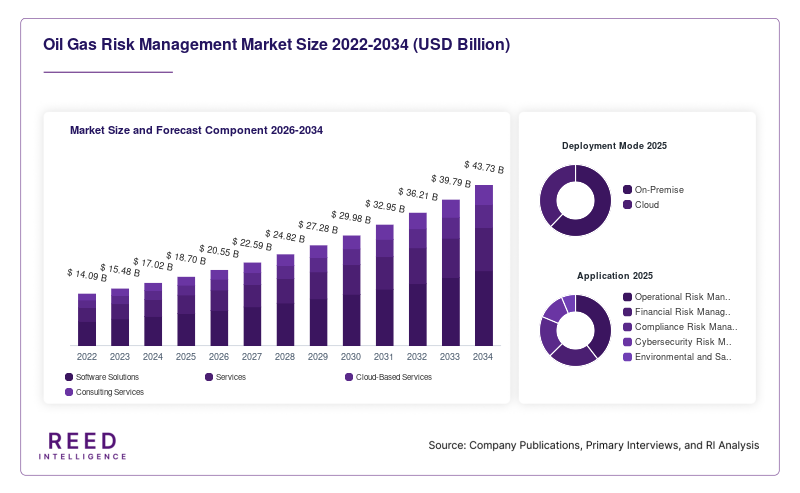
The global Oil Gas Risk Management Market size was valued at USD 18.7 billion in 2026 and is projected to reach USD 39.8 billion by 2034, expanding at a CAGR of 9.9% during the forecast period from 2026 to 2034. The market continues to gain momentum as oil and gas companies increasingly focus on operational continuity, cyber resilience, environmental compliance, and financial risk mitigation across upstream, midstream, and downstream operations. The growing complexity of global energy supply chains, volatile crude oil prices, and stricter environmental regulations are driving investment in integrated risk management platforms and predictive analytics solutions.
A major global factor supporting market expansion is the rising digital transformation across the oil and gas sector. Energy companies are deploying artificial intelligence, cloud-based monitoring systems, IoT-enabled sensors, and real-time analytics to identify operational risks before failures occur. These technologies help operators reduce unplanned downtime, improve asset utilization, and strengthen worker safety standards. In addition, geopolitical uncertainty and fluctuations in energy demand have increased the need for enterprise-wide risk visibility and advanced compliance management systems.
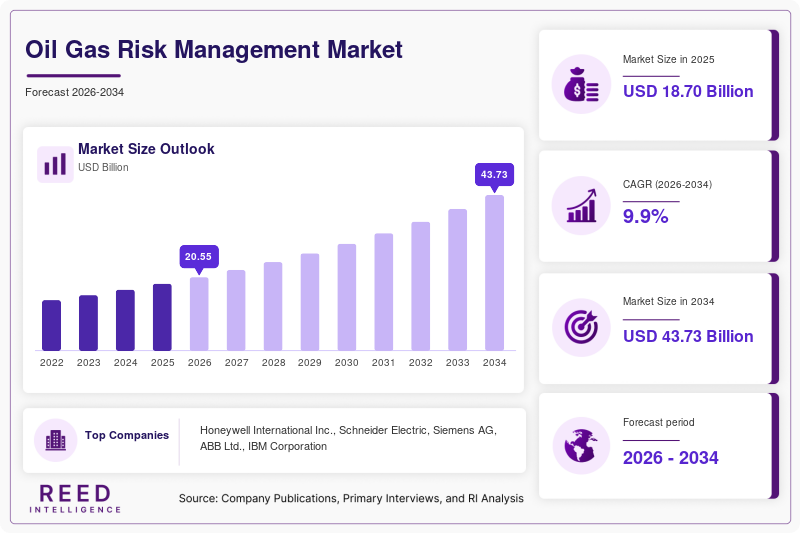
Key Highlights
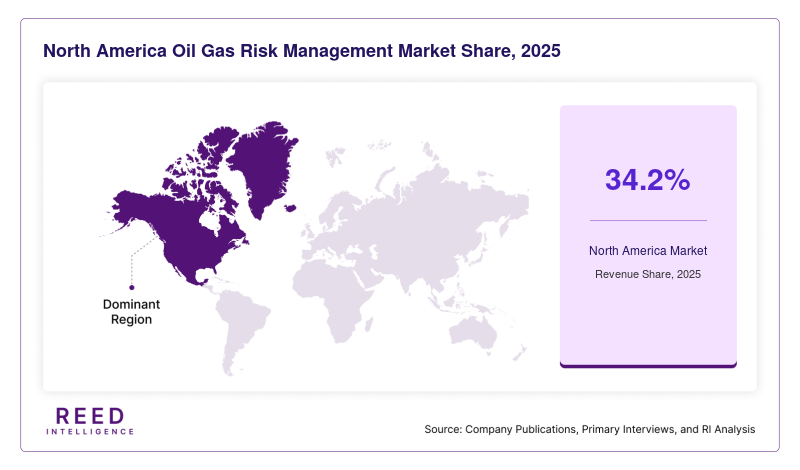
- North America dominated the market with a 34.2% share in 2025.
- Asia Pacific is expected to grow at the fastest CAGR of 11.2% during 2026–2034.
- By component, software solutions accounted for the largest share of 44.8%.
- while cloud-based services are projected to grow at a CAGR of 12.1%.
- By deployment mode, on-premise solutions led with a 58.3% share.
- whereas cloud deployment is expected to expand at a CAGR of 13.4%.
- By application, operational risk management held a 39.6% share.
- while cybersecurity risk management is expected to grow at a CAGR of 14.2%.
- The United States remained the dominant country, with market values of USD 4.8 billion in 2024 and USD 5.3 billion in 2025.
Market Trends
Integration of Artificial Intelligence and Predictive Analytics
Oil and gas operators are increasingly integrating artificial intelligence and predictive analytics into enterprise risk management systems to improve operational efficiency and reduce financial exposure. AI-enabled platforms can analyze historical asset performance, pipeline pressure fluctuations, equipment health metrics, and weather conditions to predict failures before they occur. This trend is helping companies minimize production disruptions and lower maintenance costs. Predictive models are also improving workforce safety by identifying high-risk operational zones and recommending preventive actions in real time. Large multinational operators are allocating larger technology budgets toward intelligent risk monitoring systems that provide centralized oversight across geographically distributed assets. The growing adoption of digital twins and machine learning algorithms is expected to further strengthen the role of predictive risk analytics in the oil and gas industry over the next decade.
Rising Focus on Cybersecurity Risk Monitoring
The increasing digitization of oil and gas infrastructure has elevated cybersecurity risk management as a major industry priority. Energy companies are becoming more vulnerable to ransomware attacks, data breaches, and industrial control system disruptions as operational technologies become interconnected with enterprise IT systems. This trend has encouraged operators to deploy advanced cybersecurity risk management platforms capable of continuous threat detection and incident response. Pipeline monitoring systems, refinery automation networks, and offshore drilling operations are particularly exposed to cyber threats due to their reliance on remote communication systems. Governments across North America, Europe, and the Middle East are also introducing stricter cybersecurity compliance requirements for critical energy infrastructure. As cyberattacks become more sophisticated, companies are increasing investment in cloud security, endpoint monitoring, and threat intelligence platforms to strengthen operational resilience.
Market Drivers
Expansion of Regulatory Compliance Requirements
The growing number of environmental, operational, and worker safety regulations across the energy sector is a major factor driving the Oil Gas Risk Management Market. Regulatory authorities are requiring oil and gas companies to maintain stricter monitoring standards related to emissions, pipeline integrity, hazardous waste handling, and occupational safety. Failure to comply with these standards can result in significant financial penalties, reputational damage, and operational shutdowns. As a result, energy companies are deploying integrated compliance and governance systems that automate reporting, audit tracking, and risk assessment processes. These solutions improve transparency and help operators meet evolving national and international regulatory standards. The expansion of methane emission reporting frameworks and offshore drilling safety mandates has particularly increased demand for automated compliance management software and risk analytics solutions across global energy markets.
Growing Investments in Offshore and Deepwater Projects
Increasing investments in offshore and deepwater oil exploration projects are contributing significantly to market growth. Offshore operations involve high operational complexity, expensive infrastructure, and elevated environmental risks, making advanced risk management systems essential for project success. Companies operating in offshore environments are implementing real-time monitoring technologies, predictive maintenance systems, and emergency response management platforms to reduce accident risks and equipment failures. The need to protect high-value assets such as subsea pipelines, drilling rigs, and floating production storage facilities has strengthened demand for enterprise-wide risk assessment tools. Furthermore, deepwater exploration activities in regions such as the Gulf of Mexico, Brazil, and West Africa are creating additional opportunities for software vendors and risk consulting providers specializing in operational integrity management and hazard mitigation services.
Market Restraint
High Implementation Costs and Integration Challenges
The high cost associated with implementing advanced oil and gas risk management platforms remains a key challenge for market expansion. Many integrated risk management systems require substantial upfront investment in software infrastructure, cloud migration, cybersecurity architecture, and employee training programs. Small and mid-sized energy companies often face budget limitations that restrict the adoption of enterprise-grade risk management solutions. In addition, integrating modern analytics platforms with legacy operational technology systems can create technical complications and increase deployment timelines. Older refinery facilities and aging pipeline networks frequently lack the digital infrastructure needed for seamless integration with modern monitoring systems. These integration barriers can reduce operational efficiency during implementation phases and increase maintenance expenses. Furthermore, concerns related to data privacy, interoperability, and vendor dependency continue to limit adoption among some traditional oil and gas operators, especially in developing economies with lower digital maturity levels.
Market Opportunities
Adoption of Cloud-Based Risk Management Platforms
The growing shift toward cloud-based operational management systems is creating substantial opportunities within the Oil Gas Risk Management Market. Cloud deployment allows companies to centralize operational data from multiple facilities while improving scalability and remote accessibility. Energy operators can monitor assets, safety incidents, and environmental compliance metrics in real time without relying on fragmented on-premise infrastructure. Cloud-based systems also support faster software updates and improved collaboration between geographically distributed teams. As oil and gas companies expand cross-border operations, demand for centralized cloud-enabled risk intelligence platforms is increasing steadily. The declining cost of cloud computing and rising availability of secure industrial cloud environments are expected to accelerate adoption among both large enterprises and independent operators. Vendors offering customizable cloud risk management platforms are likely to benefit from increasing digital transformation initiatives across the global energy sector.
Rising Demand for ESG and Sustainability Risk Assessment
The increasing focus on environmental, social, and governance performance presents a significant growth opportunity for market participants. Investors, regulators, and financial institutions are demanding higher transparency regarding carbon emissions, environmental impact, and workplace safety practices within the energy industry. Oil and gas companies are therefore adopting ESG-focused risk management frameworks to improve sustainability reporting and strengthen stakeholder confidence. Risk management platforms capable of tracking methane leakage, carbon intensity, water usage, and supply chain sustainability metrics are witnessing growing demand. Companies are also using advanced analytics to evaluate climate-related operational risks such as extreme weather events and resource scarcity. As sustainability reporting standards become more standardized globally, the integration of ESG risk assessment capabilities into enterprise risk management software is expected to create long-term revenue opportunities for technology providers and consulting firms.
Segmental Analysis
By Component
Software solutions accounted for the largest share of the Oil Gas Risk Management Market in 2024, representing approximately 44.8% of total revenue. The dominance of this subsegment is linked to the growing requirement for centralized operational oversight, regulatory compliance automation, and predictive analytics capabilities across energy operations. Oil and gas companies are increasingly adopting integrated software platforms that combine asset monitoring, environmental reporting, workforce safety management, and financial risk assessment into a unified system. These solutions improve operational visibility and reduce the likelihood of equipment failures and compliance violations. The ability of software platforms to generate real-time insights and support faster decision-making has made them essential for large energy operators managing geographically dispersed assets and complex supply chains.
Cloud-based services are projected to expand at the fastest CAGR of 12.1% during the forecast period. The rapid growth of this subsegment is supported by increasing demand for scalable and remotely accessible operational management solutions. Cloud-based services allow energy companies to collect and analyze data from drilling sites, refineries, and transportation networks in real time while reducing dependence on expensive on-premise infrastructure. The flexibility of cloud deployment also supports faster software updates and improved collaboration across operational teams. As cybersecurity technologies improve and industrial cloud adoption accelerates, more oil and gas operators are shifting toward subscription-based risk management services. The growing emphasis on remote operations, especially for offshore projects and cross-border energy infrastructure, is expected to further strengthen demand for cloud-enabled services.
By Deployment Mode
On-premise deployment held the dominant market share of 58.3% in 2024 due to its strong security control and reliability advantages. Many large oil and gas companies continue to prefer on-premise systems because they allow direct management of sensitive operational data and industrial control networks. This deployment model is particularly common among operators managing critical energy infrastructure such as pipelines, offshore drilling platforms, and refineries. On-premise systems also offer greater customization flexibility for integrating with legacy operational technologies and proprietary industrial processes. Companies operating in regions with strict data sovereignty regulations often rely on localized deployment models to maintain compliance and reduce cybersecurity vulnerabilities associated with external hosting environments.
Cloud deployment is expected to grow at the fastest CAGR of 13.4% between 2026 and 2034 due to increasing digital transformation across the global energy sector. Oil and gas operators are recognizing the operational benefits of cloud-based infrastructure, including lower maintenance costs, improved scalability, and enhanced remote accessibility. Cloud deployment also enables companies to centralize data from multiple facilities and improve collaboration between field operators and corporate management teams. The rise of hybrid cloud architectures and industrial cybersecurity frameworks is encouraging greater confidence in cloud adoption among energy enterprises. Furthermore, companies involved in international exploration and production projects are increasingly utilizing cloud platforms to improve real-time decision-making and strengthen enterprise-wide operational visibility.
By Application
Operational risk management emerged as the largest application subsegment in 2024, accounting for 39.6% of the global market share. The increasing complexity of oil extraction, transportation, and refining activities has elevated the need for comprehensive operational risk monitoring systems. Companies are implementing advanced analytics platforms to identify potential equipment failures, worker safety hazards, and process inefficiencies before they escalate into costly incidents. Operational risk management solutions help improve maintenance scheduling, asset utilization, and emergency response planning across both offshore and onshore facilities. The subsegment’s growth is also supported by rising investments in industrial automation and predictive maintenance technologies aimed at reducing unplanned downtime and enhancing production reliability across energy operations.
Cybersecurity risk management is expected to witness the fastest CAGR of 14.2% during the forecast period due to the increasing digitization of industrial infrastructure. Oil and gas companies are becoming more vulnerable to cyberattacks as operational technologies become interconnected with cloud systems and enterprise networks. The growing use of remote monitoring systems, IoT devices, and digital control platforms has expanded the potential attack surface for energy infrastructure. As a result, operators are investing heavily in threat detection software, network security platforms, and incident response management solutions. Governments are also introducing stricter cybersecurity regulations for critical energy infrastructure, further driving adoption of cybersecurity-focused risk management systems across the global oil and gas industry.
North America
North America accounted for 34.2% of the global Oil Gas Risk Management Market share in 2025 and is expected to maintain a strong position throughout the forecast period. The region is projected to expand at a CAGR of 8.8% between 2026 and 2034 due to the widespread adoption of digital oilfield technologies and strong investments in cybersecurity infrastructure. Energy companies in the United States and Canada are prioritizing predictive analytics, automated compliance monitoring, and operational safety management systems to improve efficiency across upstream and downstream activities. The presence of major technology providers and mature cloud infrastructure further supports market growth in the region.
The United States remains the dominant country within North America due to its large shale production industry and extensive pipeline network infrastructure. A key growth factor is the rising implementation of industrial cybersecurity solutions across refinery and transportation operations. Increasing cyber threats targeting energy infrastructure have encouraged operators to modernize their risk assessment frameworks and strengthen operational resilience. In addition, regulatory agencies continue to introduce stricter pipeline safety and environmental monitoring standards, supporting long-term demand for advanced risk management platforms.
Europe
Europe represented a significant portion of the global market in 2025 and is forecast to grow at a CAGR of 8.5% during the study period. The region is witnessing increasing adoption of integrated risk management software due to stringent environmental policies and carbon reduction targets. Oil and gas operators across Europe are investing in automated compliance management systems to meet evolving emission monitoring regulations and workplace safety requirements. The transition toward cleaner energy systems is also encouraging companies to implement sustainability-focused risk management frameworks capable of monitoring operational and environmental performance simultaneously.
Norway remains the leading country within the European market because of its advanced offshore oil and gas sector and high digitalization rate. A major growth factor is the increasing use of AI-enabled monitoring systems for offshore drilling operations in the North Sea. Norwegian operators are investing heavily in predictive maintenance and real-time operational analytics to reduce production downtime and improve worker safety. Government support for industrial innovation and digital infrastructure modernization further contributes to the expansion of the regional market.
Asia Pacific
Asia Pacific is anticipated to register the fastest CAGR of 11.2% between 2026 and 2034 due to expanding industrialization and rising energy demand. Countries across the region are increasing investments in oil refining, LNG infrastructure, and pipeline expansion projects, creating strong demand for operational risk management solutions. The growing use of cloud-based monitoring systems and industrial automation technologies is also accelerating market adoption. Energy companies are prioritizing enterprise-wide risk visibility to manage supply chain disruptions, environmental compliance, and asset reliability more effectively.
China remains the dominant country in the Asia Pacific region due to its large-scale refinery capacity and expanding energy infrastructure network. One major growth factor is the rapid deployment of smart industrial technologies across state-owned oil and gas enterprises. Chinese companies are integrating AI-driven analytics and IoT-enabled monitoring systems to improve production efficiency and reduce operational hazards. Increasing government investment in digital energy infrastructure and industrial cybersecurity frameworks is expected to strengthen regional market growth throughout the forecast period.
Middle East & Africa
The Middle East & Africa market is projected to witness stable growth at a CAGR of 9.1% during the forecast period. The region’s strong dependence on hydrocarbon exports continues to support investments in operational efficiency and infrastructure protection technologies. Oil-producing nations are deploying advanced monitoring platforms to reduce operational risks associated with offshore drilling, pipeline transportation, and refinery management. Increasing investments in digital transformation initiatives and industrial automation are also contributing to market expansion across key energy-producing economies.
Saudi Arabia dominates the regional market due to its extensive oil production capabilities and ongoing energy sector modernization programs. A unique growth factor is the country’s increasing investment in smart refinery infrastructure and integrated industrial cybersecurity systems. National energy companies are adopting predictive maintenance platforms and real-time operational analytics to improve asset performance and reduce safety incidents. Large-scale investments linked to economic diversification initiatives are further encouraging the adoption of advanced enterprise risk management solutions throughout the country.
Latin America
Latin America is expected to experience moderate market growth with a CAGR of 8.7% between 2026 and 2034. The expansion of offshore oil exploration projects and pipeline modernization initiatives is increasing demand for operational risk management technologies across the region. Energy companies are focusing on reducing environmental liabilities and improving infrastructure reliability through predictive analytics and automated compliance management systems. Rising foreign investment in oil production and refining capacity is also supporting the adoption of advanced risk monitoring platforms.
Brazil remains the leading market within Latin America because of its extensive offshore drilling activities and growing deepwater production projects. A significant growth factor is the increasing use of digital monitoring systems for offshore asset integrity management. Brazilian operators are deploying cloud-based analytics platforms to monitor subsea infrastructure, reduce maintenance costs, and improve environmental compliance. Government-backed investment programs supporting offshore exploration activities are expected to create additional opportunities for technology providers operating in the regional market.
Competitive Landscape
The Oil Gas Risk Management Market is characterized by the presence of multinational technology providers, industrial software developers, cybersecurity firms, and specialized risk consulting companies. Market participants are focusing on cloud integration, predictive analytics, AI-enabled monitoring systems, and cybersecurity enhancement to strengthen their competitive position. Strategic partnerships with oilfield service providers and energy infrastructure operators remain a common expansion strategy among leading companies.
Honeywell International Inc. remains one of the leading companies in the market due to its broad portfolio of industrial automation and operational risk management solutions. The company continues to invest in AI-enabled industrial safety platforms and cloud-connected monitoring systems for refineries and offshore operations. Recent developments across the industry include acquisitions of cybersecurity firms, expansion of industrial cloud partnerships, and increased investment in predictive maintenance technologies. Companies are also enhancing ESG reporting capabilities within enterprise risk management platforms to address rising sustainability requirements. Competition is expected to intensify as regional software providers introduce industry-specific analytics solutions tailored to operational safety, compliance monitoring, and cyber resilience needs.
Key Players
- Honeywell International Inc.
- Schneider Electric
- Siemens AG
- ABB Ltd.
- IBM Corporation
- Oracle Corporation
- SAP SE
- Emerson Electric Co.
- Halliburton
- Baker Hughes
- SLB
- KPMG International
- Deloitte
- AVEVA Group plc
- Cisco Systems Inc.
Recent Developments
- In February 2026, Schneider Electric introduced an AI-powered industrial risk monitoring platform designed for offshore oil and gas facilities to improve predictive maintenance and operational visibility.
- In September 2025, Honeywell International Inc. expanded its cloud-connected cybersecurity portfolio for refinery operations, focusing on real-time threat detection and incident response management.
- In June 2025, SLB partnered with a Middle Eastern energy operator to deploy integrated digital risk management systems across multiple upstream production facilities.
- In November 2025, AVEVA Group plc launched an ESG-focused operational analytics platform capable of tracking emissions, asset reliability, and workforce safety metrics in real time.
Oil Gas Risk Management Market Segments
Component
- Software Solutions
- Services
- Cloud-Based Services
- Consulting Services
Deployment Mode
- On-Premise
- Cloud
Application
- Operational Risk Management
- Financial Risk Management
- Compliance Risk Management
- Cybersecurity Risk Management
- Environmental and Safety Risk Management
End User
- Upstream
- Midstream
- Downstream
By Region
- North America
- Europe
- APAC
- Middle East and Africa
- LATAM