Oil Gas Swell Packer Market Size, Share, Demand & Industry Analysis Report By Type (Oil-Swell Packers, Water-Swell Packers, Hybrid Swell Packers), By Application (Unconventional Shale Wells, Offshore Deepwater Wells, Conventional Oil & Gas Wells), By End-Use (Oilfield Service Companies, Exploration & Production Companies, Drilling Contractors), By Region & Segment Forecasts, 2026–2034
USD 3950
Market Overview
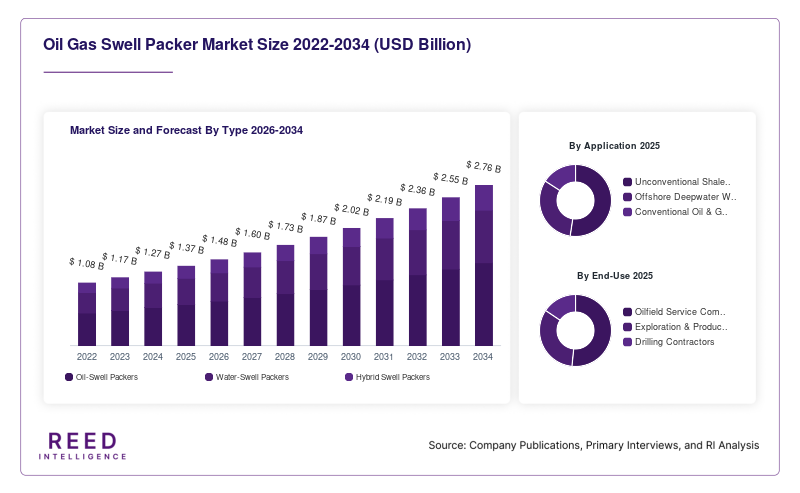
The global Oil Gas Swell Packer Market size is estimated at USD 1.48 billion, and it is projected to reach USD 2.76 billion by 2034, expanding at a CAGR of 8.1% (2026–2034). The growth is strongly influenced by the rising need for cost-effective and reliable downhole sealing solutions that improve production efficiency and reduce operational risks in high-pressure, high-temperature (HPHT) wells.
A major global factor supporting market growth is the accelerated shift toward deepwater and ultra-deepwater exploration projects, particularly in offshore basins where conventional mechanical packers face limitations. Swell packers, which expand upon contact with hydrocarbons or water, provide a simplified and durable solution for zonal isolation without requiring mechanical activation, making them highly suitable for remote offshore installations.
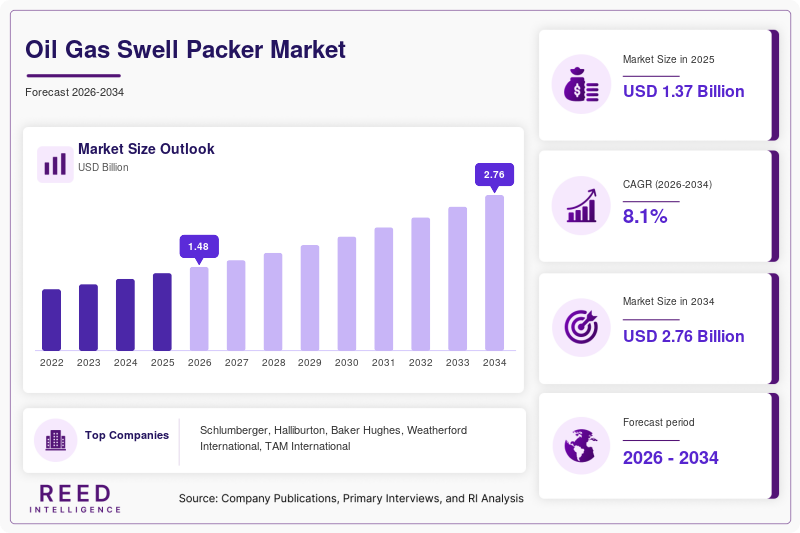
Key Highlights
- North America dominated the market with a 34.2% share in 2025.
- Asia Pacific is expected to grow at the fastest CAGR of 11.2% during 2026–2034.
- By type, oil-swell packers accounted for the largest share of 38.5%.
- while water-swell packers are projected to grow at a CAGR of 12.4%.
- By application, unconventional shale wells led with a 41.7% share, whereas offshore deepwater applications are expected to expand at a CAGR of 11.8%.
- The United States remained the dominant country, with market values of USD 510 million in 2024 and USD 560 million in 2025.
Market Trends
Increasing Adoption of Advanced Elastomeric Materials
One of the most significant trends in the Oil Gas Swell Packer Market is the rapid adoption of advanced elastomeric compounds such as thermoplastic elastomers (TPE) and hydrogenated nitrile rubber (HNBR). These materials enhance swelling efficiency, chemical resistance, and durability under extreme downhole conditions. Operators are increasingly investing in customized swell packers that can withstand corrosive fluids, high salinity, and fluctuating temperature conditions in deep reservoirs. The use of engineered elastomers also allows better control over swelling rates, ensuring optimized zonal isolation without premature expansion. Furthermore, material innovations are enabling longer service life, which reduces the need for costly workovers and improves overall well economics. As exploration moves into more complex geological formations, demand for high-performance materials is expected to intensify significantly.
Growing Integration of Digital Monitoring Systems
Another emerging trend is the integration of digital monitoring and predictive analytics systems with swell packer operations. Oilfield operators are increasingly using downhole sensors and real-time data analytics to track packer performance, swelling behavior, and pressure differentials. This digital transformation enables better decision-making and enhances operational reliability in both onshore and offshore environments. Predictive maintenance models are being deployed to anticipate packer failure or degradation, reducing non-productive time (NPT). Additionally, digital oilfield technologies are helping companies optimize well completion strategies by improving visibility into reservoir performance. This trend is particularly strong in North America and the Middle East, where operators are heavily investing in automation and smart well technologies.
Market Drivers
Rising Demand for Unconventional Oil & Gas Production
The growing exploration of unconventional resources such as shale gas, tight oil, and coalbed methane is a major driver of the Oil Gas Swell Packer Market. These reservoirs require efficient zonal isolation techniques due to their complex geological structures and horizontal drilling methods. Swell packers are widely used in multi-stage fracturing operations, where they provide reliable isolation between stages without mechanical intervention. The expansion of shale production in North America and increasing pilot projects in Asia Pacific are significantly boosting demand. Additionally, the cost-effectiveness and simplicity of swell packers compared to mechanical alternatives make them highly attractive for operators seeking to reduce completion costs while maintaining well integrity.
Expansion of Offshore and Deepwater Exploration
Another key driver is the rising investment in offshore and deepwater exploration projects across Brazil, West Africa, and the Gulf of Mexico. These environments require highly reliable downhole tools that can function without frequent intervention due to high operational complexity and costs. Swell packers offer a significant advantage because they are self-activating and do not rely on mechanical components that could fail under extreme pressure conditions. As offshore drilling projects move into deeper and more challenging reservoirs, demand for durable and long-lasting sealing technologies continues to rise. Government incentives and rising global energy demand further support offshore exploration activities, strengthening market growth.
Market Restraint
A key restraint affecting the Oil Gas Swell Packer Market is the variability in swelling performance under different reservoir conditions. Since swell packers rely on interaction with hydrocarbons or water to expand, inconsistent fluid compositions, temperature variations, and pressure differentials can significantly impact their effectiveness. In some cases, delayed swelling or incomplete expansion can lead to poor zonal isolation, increasing the risk of fluid crossflow and reducing overall well productivity. This unpredictability makes operators cautious when deploying swell packers in highly complex or unknown reservoir environments.
Additionally, limited reusability and challenges associated with retrieval present operational concerns. Once deployed and swollen, most swell packers cannot be easily retrieved or adjusted, which restricts flexibility during well interventions or re-completions. This limitation can increase long-term operational costs, especially in wells requiring frequent maintenance or stage adjustments. Furthermore, in highly deviated or extended-reach wells, ensuring uniform swelling across long intervals remains technically challenging. These constraints sometimes lead operators to prefer mechanical or inflatable packers in specific applications, thereby restraining broader market penetration.
Market Opportunities
Expansion in Emerging Oil & Gas Regions
Emerging oil and gas regions such as Southeast Asia, East Africa, and parts of Latin America present significant growth opportunities for the Oil Gas Swell Packer Market. These regions are witnessing increased exploration activity due to untapped hydrocarbon reserves and supportive government policies encouraging foreign investment. Swell packers, due to their simplicity and cost efficiency, are particularly attractive for operators entering new basins with limited infrastructure. Their ability to reduce operational complexity makes them ideal for frontier exploration projects where technical expertise and equipment availability may be limited. As exploration expands in these regions, adoption of swell packer technologies is expected to rise steadily.
Technological Advancements in Hybrid Packer Systems
The development of hybrid swell packer systems that combine mechanical and swellable technologies presents another major opportunity. These advanced systems offer improved flexibility, allowing operators to control installation while still benefiting from self-sealing capabilities. Hybrid designs also enhance reliability in variable downhole conditions, making them suitable for both conventional and unconventional reservoirs. Research into multi-stage swell materials and temperature-responsive polymers is expected to further improve performance. As oilfield service companies invest in R&D to improve durability and adaptability, hybrid systems are likely to gain traction in complex drilling environments, opening new revenue streams for manufacturers.
Segmental Analysis
By Type
Oil-swell packers held the dominant position with 39.4% market share in 2024, driven by their widespread use in hydrocarbon-rich reservoirs where interaction with oil ensures controlled expansion. These packers are extensively used in shale and conventional oil wells due to their reliability and consistent performance across varying pressure conditions.
Water-swell packers are the fastest-growing subsegment, expected to register a CAGR of 12.1%, driven by increasing application in water injection wells and offshore environments. Their ability to expand in the presence of formation water makes them suitable for long-term zonal isolation in complex reservoirs.
By Application
Unconventional shale wells accounted for 41.7% share in 2024, making them the dominant application segment. The growth is supported by high horizontal drilling activity and multi-stage fracturing operations, particularly in North America.
Offshore deepwater applications are the fastest-growing segment with a CAGR of 11.8%, driven by rising investments in ultra-deepwater exploration projects requiring reliable and maintenance-free downhole tools.
By End-Use
Oilfield service companies dominated with a 37.8% share in 2024, as they are the primary deployers of swell packer technologies in drilling and completion operations. Their strong global presence supports widespread adoption across multiple basins.
Independent exploration and production companies are the fastest-growing end-use segment, expected to grow at a CAGR of 10.9%, driven by increasing participation in frontier exploration projects and unconventional resource development initiatives.
Regional Analysis
North America
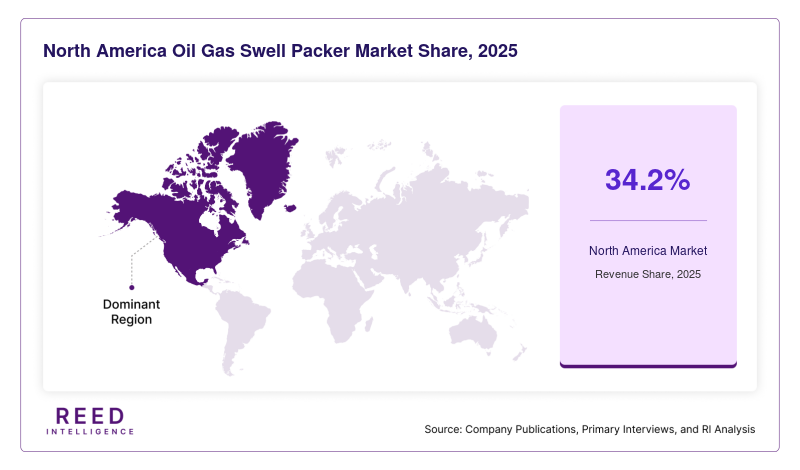
North America accounted for approximately 34.2% market share in 2025, with a projected CAGR of 7.8% from 2026 to 2034. The region remains a technological leader in oilfield services and continues to dominate demand for advanced completion tools such as swell packers. Strong shale production activity in the United States and Canada supports sustained consumption of zonal isolation technologies.
The United States is the dominant country in this region, driven by extensive shale basins such as Permian and Bakken. A key growth factor is continuous investment in hydraulic fracturing technologies, where swell packers are extensively used in multi-stage completions to enhance production efficiency and reduce operational downtime.
Europe
Europe held around 21.5% market share in 2025, and is expected to grow at a CAGR of 6.9% during the forecast period. The market is driven by offshore drilling activities in the North Sea and increasing focus on energy security. Operators in the region are prioritizing efficient well completion technologies to maximize output from mature fields.
Norway leads the European market, supported by strong offshore infrastructure and advanced drilling capabilities. A key growth factor is the modernization of aging offshore wells, where swell packers are deployed to enhance zonal isolation and extend field life in declining reservoirs.
Asia Pacific
Asia Pacific captured 24.3% market share in 2025, and is projected to expand at the fastest CAGR of 11.2% (2026–2034). Rapid industrialization, rising energy demand, and increasing exploration investments are key drivers. Countries like China, India, and Australia are expanding upstream activities significantly.
China dominates the regional market due to its large-scale shale gas development programs. A major growth factor is government-backed energy diversification initiatives, which encourage investment in unconventional resource extraction technologies, including swell packers.
Middle East & Africa
Middle East & Africa accounted for 13.8% market share in 2025, with a CAGR of 8.5% expected through 2034. The region benefits from vast hydrocarbon reserves and continuous offshore and onshore drilling projects across Saudi Arabia, UAE, and offshore West Africa.
Saudi Arabia leads the regional market, driven by large-scale upstream expansion programs. A key growth factor is the adoption of advanced completion technologies to optimize production from mature oilfields and improve reservoir efficiency under extreme desert conditions.
Latin America
Latin America held 6.2% market share in 2025, with a projected CAGR of 9.1% during 2026–2034. Brazil is the primary growth hub due to extensive deepwater pre-salt exploration activities.
Brazil dominates the regional market, supported by offshore deepwater investments in the Santos Basin. A major growth factor is the increasing use of swell packers in ultra-deepwater wells where reliability and long-term sealing performance are critical.
Competitive Landscape
The Oil Gas Swell Packer Market is moderately consolidated, with leading oilfield service companies and specialized downhole tool manufacturers competing on technology innovation, durability, and cost efficiency. Key players include Schlumberger, Halliburton, Baker Hughes, Weatherford International, and TAM International. These companies focus on expanding their product portfolios with advanced swellable elastomer technologies and hybrid packer systems.
Among these, Halliburton is a leading player due to its strong global presence and continuous investment in completion technologies. Recently, the company introduced an enhanced swell packer system designed for high-temperature shale applications, improving operational reliability and reducing installation complexity. Competitive strategies include mergers, partnerships with E&P operators, and R&D investments aimed at improving material performance and extending product lifecycle.
Key Players List
- Schlumberger
- Halliburton
- Baker Hughes
- Weatherford International
- TAM International
- NOV Inc.
- Tenaris
- TechnipFMC
- Vallourec
- Archer Limited
- Packers Plus Energy Services
- Sercel
- Aker Solutions
- Hunting PLC
- Expro Group
Recent Developments
- In 2025, Halliburton expanded its swellable packer portfolio with a high-temperature-resistant elastomer system designed for HPHT shale formations.
- Baker Hughes announced a strategic collaboration with offshore operators in Brazil to deploy advanced swell packers in deepwater pre-salt reservoirs.
- Weatherford International introduced a next-generation hybrid swell packer system integrating mechanical activation features for improved installation flexibility.
Oil Gas Swell Packer Market Segments
By Type
- Oil-Swell Packers
- Water-Swell Packers
- Hybrid Swell Packers
By Application
- Unconventional Shale Wells
- Offshore Deepwater Wells
- Conventional Oil & Gas Wells
By End-Use
- Oilfield Service Companies
- Exploration & Production Companies
- Drilling Contractors
By Region
- North America
- Europe
- APAC
- Middle East and Africa
- LATAM