One Time Password (OTP) Display Card Market Size, Share & Trends Analysis Report By OTP Type (Time-Based OTP (TOTP), Event-Based OTP (HOTP)), By Display Technology (LCD, E-Paper/E-Ink), By Form Factor (Standard Credit-Card Size, Mini Card, Biometric OTP Display Card), By End Use (BFSI, Enterprise & Corporate Security,) and By Region (North America, Europe, APAC, Middle East and Africa, LATAM) Forecasts, 2026–2034
USD 3950
One Time Password (OTP) Display Card Market Size
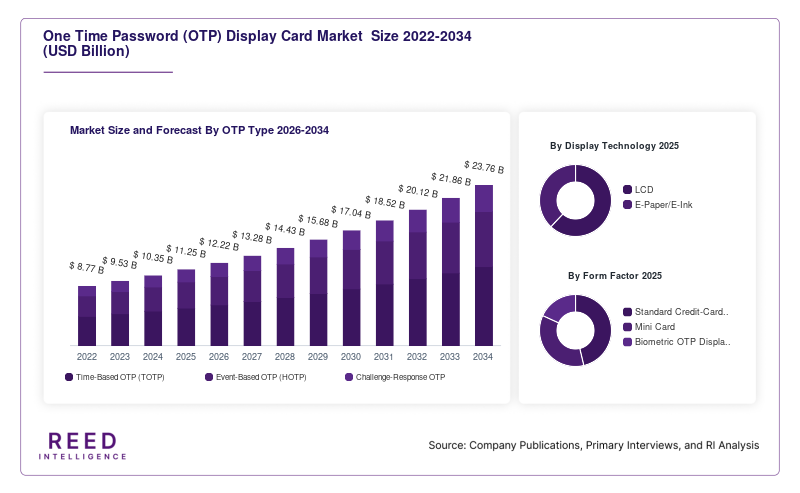
The global One Time Password (OTP) Display Card Market size was valued at USD 11.25 billion in 2025 and is projected to grow from USD 12.23 billion in 2026 to USD 21.86 billion by 2034, registering a CAGR of 8.66% during the forecast period from 2026 to 2034.
OTP display cards are physical authentication devices built in a wallet-sized card format that generate temporary authentication codes without requiring a smartphone application or network connection at the point of code generation. Current products from Thales, FEITIAN and Token2 demonstrate the category's main architecture: a thin card containing a secure secret, clock or event counter, processor and display that produces a time- or event-based OTP. Thales' SafeNet OTP Display Card uses OATH TOTP and a credit-card form factor, while FEITIAN offers both LCD and E-Ink display configurations and optional NFC.
The market is positioned between legacy hardware tokens and newer passwordless authentication. NIST's Digital Identity Guidelines recognize both hardware and software OTP authenticators, but explicitly state that manually entered OTPs are not phishing-resistant because an attacker can relay the code to the legitimate verifier.
This creates a two-sided market dynamic. Organizations that need portable, offline-capable authentication can still deploy display cards where smartphones are unavailable, restricted or undesirable. At the same time, banks and enterprises are increasingly evaluating passkeys and cryptographic authentication. FIDO reported in May 2026 that 5 billion passkeys were in active use and 68% of surveyed organizations were deploying, piloting or rolling out passkeys.
The result is a market increasingly focused on compatibility, low deployment friction, long battery life, card-based usability and migration paths toward stronger authentication.
-display-card-market-8288.png)
One Time Password (OTP) Display Card Market Drivers
Continued Requirement for Portable Hardware Authentication
Hardware authentication remains relevant where organizations require a physical possession factor that is independent of a user's smartphone. OTP display cards can be carried in a wallet, generate codes locally and authenticate users across cloud, VPN, web and enterprise applications.
Thales' SafeNet OTP Display Card generates a unique OTP when the user presses the card button and is designed for enterprise resources including cloud applications, VPNs, web portals and virtual environments. FEITIAN similarly offers ISO 7810-compliant cards with TOTP/HOTP capabilities and optional NFC.
This creates demand among organizations that need to authenticate employees, contractors or customers without distributing smartphones or installing authentication applications. Cards can also be useful in environments where corporate policies restrict personal-device authentication.
The commercial mechanism is straightforward: each authenticated user requires an issued credential, and large deployments generate recurring demand for card issuance, replacement and authentication-management services.
Strong Customer Authentication and Digital Fraud Concerns
Financial institutions remain an important demand source because authentication is directly connected to fraud prevention and regulatory requirements. The EBA and ECB reported that strong customer authentication remained effective against the fraud types it was designed to address, although fraudsters are increasingly shifting toward manipulation of payers and other social-engineering techniques. European payment fraud reached €4.2 billion in 2024.
European regulatory guidance recognizes OTP-generated or received through a hardware or software token as evidence of possession under the relevant strong-customer-authentication framework, provided the applicable requirements are met.
Display cards can therefore serve as a physical possession mechanism when combined with a PIN, password or another factor. Thales explicitly describes its display card as a "what you have" factor that can be combined with PINs, passwords and contextual attributes.
The counterbalance is that OTP itself is not phishing-resistant. NIST states that manual OTP entry does not bind the authentication output to the intended session.
Product Innovation Is Reducing the Usability Gap Between Tokens and Cards
The category is moving beyond simple LCD key fobs toward thin, wallet-compatible cards with E-Ink displays, NFC programming, longer battery life and biometric activation.
FEITIAN's current Power Card portfolio includes standard and mini cards, E-Ink displays, NFC programming, time- and event-based OTP, SHA-1/SHA-256/SM3 support and expected lifetimes exceeding five years for some configurations.
CardLab's Verity Card adds an E-Ink display and fingerprint verification, generating the OTP only after biometric verification on the card.
This development expands the potential application range from basic login authentication toward higher-assurance access and transaction workflows. The commercial implication is greater differentiation in a category that could otherwise compete primarily on unit cost.
One Time Password (OTP) Display Card Market Restraints
Passkeys and Phishing-Resistant Authentication Are Creating Substitution Pressure
The biggest structural challenge is the transition from OTP-based authentication toward cryptographic, phishing-resistant methods. NIST explicitly states that OTP authentication is not phishing-resistant, while FIDO2 and WebAuthn can provide verifier-name binding and phishing resistance.
The transition is already visible in adoption data. FIDO's May 2026 research found that 75% of surveyed consumers had enabled passkeys on at least one account and 68% of surveyed organizations were deploying, piloting or rolling out passkeys.
Entrust announced in June 2026 that its identity-centric authentication approach was designed to replace passwords, OTPs and security questions with biometric authentication for account-takeover prevention.
OTP display cards therefore face a long-term substitution risk, particularly in digitally mature enterprises where smartphone-based or platform-native authentication is easier to administer.
Hardware Lifecycle and Provisioning Costs Increase Deployment Complexity
Unlike software authenticators, physical display cards must be manufactured, personalized, distributed, tracked and replaced. Organizations must manage seed generation, provisioning, inventory, activation, revocation and end-of-life processes.
FEITIAN's documentation highlights dedicated OTP production-management systems for centralized seed security, while Thales provides backend provisioning, updating and revocation through its authentication-management platform.
Battery life is another lifecycle consideration. FEITIAN lists approximately 3–5 years for some standard cards, while Thales specifies up to 15,000 OTP codes for its display card.
These factors can make large-scale physical-token deployments more operationally intensive than centrally managed software or passkey credentials.
One Time Password (OTP) Display Card Market Opportunities
Biometric OTP Display Cards
Combining OTP generation with biometric activation provides a route to strengthen physical-token security without abandoning the card form factor. CardLab's Verity Card requires fingerprint verification before displaying the OTP and stores the fingerprint data on the card.
This approach can serve organizations that want a physical credential but need stronger assurance than a simple button-operated token. Potential applications include privileged enterprise access, government credentials, critical infrastructure and high-value financial operations.
NFC-Enabled and Programmable Display Cards
NFC adds a second interaction method to the display card, allowing secure provisioning and configuration while retaining an offline visual OTP. FEITIAN offers NFC-enabled Power Cards, while Token2 sells programmable TOTP cards that can be configured through NFC applications.
Programmability expands the addressable market because organizations can configure seeds, algorithms and authentication policies without requiring a completely new hardware design.
Hybrid Authentication Platforms
Authentication providers are increasingly positioning OTP hardware as one component of broader identity platforms rather than as a standalone product. OneSpan's July 2026 DigipassONE platform combines OTP, FIDO2, hardware tokens, mobile authenticators, transaction signing and digital credentials within one architecture.
This creates an opportunity for OTP display-card manufacturers to remain relevant as organizations gradually migrate toward passkeys. Hardware OTP can serve legacy users and specialized environments while the same management platform introduces stronger authentication technologies.
Segmental Analysis
By OTP Type
Time-Based OTP (TOTP) represents approximately 62% of the global market in 2025, making it the dominant OTP type. TOTP generates a temporary code based on a shared secret and time value. NIST recognizes time-based OTP as a standard hardware and software authentication mechanism and specifies requirements around nonce lifetime, clock synchronization and replay resistance.
Event-Based OTP (HOTP) represents approximately 29% and generates a new code based on an event or activation count rather than a continuously changing clock.
Challenge-Response OTP accounts for approximately 9% but is the fastest-growing OTP type, with a CAGR of approximately 10.4%. It is suited to authentication environments where a transaction-specific challenge or additional authentication step is required. FEITIAN's current card portfolio supports challenge-response functionality alongside time- and event-based mechanisms.
By Display Technology
LCD accounts for approximately 57% of the market in 2025, reflecting the long-established use of low-power LCD screens in hardware OTP devices. Thales' current OTP display-card specification uses a high-contrast LCD configuration while also offering the card format and OATH TOTP architecture.
E-Paper/E-Ink represents approximately 43% and is the fastest-growing display technology, with a CAGR of approximately 11.2%. E-Ink provides strong readability at very low power consumption and supports thin card designs. FEITIAN offers EPD configurations, while Token2's current display cards use E-Ink screens in standard and mini-card form factors.
By Form Factor
Standard Credit-Card Size represents approximately 72% of the market in 2025. The standard format is compatible with wallets and provides sufficient space for a display, button, battery and secure electronics. Thales and FEITIAN both offer ISO-style card configurations, while Token2's standard card measures approximately 85.6 × 54 mm.
Mini Card represents approximately 20% and addresses users seeking smaller credentials for specialized applications.
Biometric OTP Display Cards account for approximately 8% but are the fastest-growing form factor, with a CAGR of approximately 12.6%. CardLab's Verity Card demonstrates how fingerprint verification can be integrated directly into a card-based OTP device.
By End Use
BFSI represents approximately 46% of the market in 2025. Banks, payment organizations and financial institutions have strong requirements for customer and employee authentication, while regulatory frameworks continue to emphasize secure authentication. The EBA and ECB reported that SCA was applied to approximately 77% of electronically initiated credit-transfer value in 2024 and that SCA-authenticated transactions generally showed lower fraud rates than non-SCA transactions for card payments.
Enterprise & Corporate Security accounts for approximately 29%, covering VPN, cloud, privileged-access and remote-work authentication.
Government & Defense represents approximately 13%, while Healthcare represents 7% and Transportation & Other Industries approximately 5%.
Government & Defense is the fastest-growing end-use segment, with approximately 10.8% CAGR, supported by requirements for controlled physical credentials, secure remote access and identity assurance.
Regional Analysis
North America One Time Password Otp Display Card Market
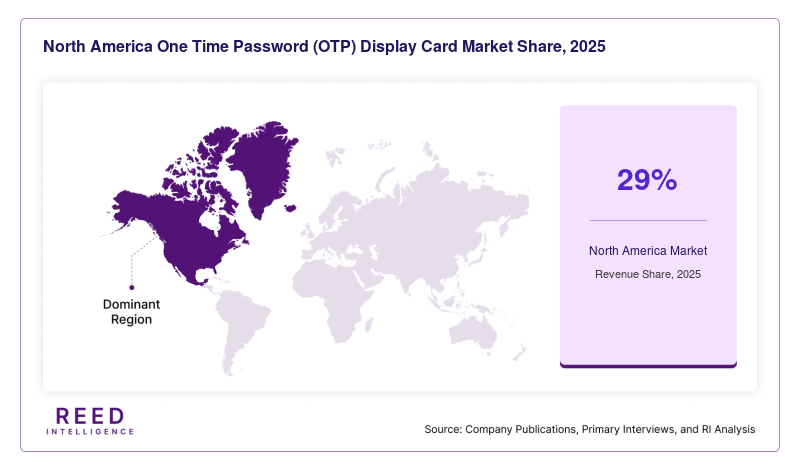
North America represents approximately 29% of the global OTP Display Card Market in 2025. The region benefits from a large enterprise cybersecurity market, extensive cloud adoption and strong demand for multi-factor authentication across government, financial services and corporate networks.
NIST's Digital Identity Guidelines provide an important technical reference for U.S. organizations deploying OTP authenticators. The current guidance recognizes hardware OTP devices as valid authenticator types while clearly distinguishing them from phishing-resistant cryptographic authentication.
The region also has a strong supplier base, including Thales, OneSpan, Entrust and other authentication providers. Thales continues to offer its SafeNet OTP Display Card for cloud, VPN and enterprise applications, while OneSpan maintains hardware authentication within its wider Digipass portfolio.
North America is projected to grow at approximately 7.6% CAGR through 2034. Growth will be supported by regulated enterprise authentication requirements, but passkey adoption will constrain new OTP-card deployments in some digitally mature organizations.
Europe One Time Password Otp Display Card Market
Europe accounts for approximately 25% of the market in 2025. Strong customer authentication requirements under the European payments framework create an important authentication ecosystem for banks and payment-service providers.
The EBA has clarified that possession can be evidenced by an OTP generated by or received on a device, including hardware or software token generators, subject to the applicable SCA requirements.
Payment-fraud data also supports continued investment in authentication. The EBA and ECB reported €4.2 billion of payment fraud in 2024, while finding that strong customer authentication remained effective against the fraud categories it was designed to mitigate.
Europe is expected to expand at approximately 7.1% CAGR. However, the region is also a major center for digital-identity modernization. OneSpan noted that EU member states must make digital identity wallets available by December 2026 and that banks and other relying parties will face further wallet-support requirements by December 2027.
APAC One Time Password Otp Display Card Market
APAC represents approximately 31% of the global market in 2025 and is the fastest-growing region, with a CAGR of approximately 10.2%.
The region combines large banking populations, rapid digital-payment adoption, enterprise digitization and diverse authentication requirements. China, India, Japan, South Korea, Singapore and Southeast Asian markets represent important demand centers.
APAC also has a strong hardware-production ecosystem. FEITIAN manufactures card-based authentication products with TOTP, HOTP, NFC, E-Ink and programmable configurations, while Token2 offers a growing range of standard and programmable OTP display cards.
At the same time, FIDO's 2026 research identified APAC-specific momentum around digital modernization and user experience as drivers for passkey adoption.
This creates a mixed market mechanism: banks and enterprises continue to require hardware credentials in some use cases, while digitally advanced organizations increasingly transition toward passkeys.
Middle East and Africa One Time Password Otp Display Card Market
Middle East and Africa represents approximately 7% of the global market in 2025 and is projected to grow at approximately 9.0% CAGR.
Demand is linked to banking modernization, government digitalization, enterprise cybersecurity and secure remote access. Financial institutions are important customers because OTP hardware can provide a physical authentication factor without requiring smartphones for every user.
The region also has a significant opportunity in organizations where connectivity, device availability or corporate smartphone policies make standalone hardware attractive.
The principal constraint is that authentication providers increasingly offer mobile, biometric and passwordless alternatives. As infrastructure improves, some new authentication deployments may bypass physical OTP cards in favor of app-based or cryptographic credentials.
LATAM One Time Password Otp Display Card Market
LATAM accounts for approximately 8% of the global market in 2025 and is expected to grow at approximately 9.3% CAGR.
Brazil and Mexico represent important markets because of their large financial sectors, growing digital-banking usage and enterprise cybersecurity requirements. Banks and regulated businesses require authentication mechanisms that can protect online accounts while remaining accessible across diverse customer device environments.
Physical OTP cards can address users who do not want to install authentication applications or who need an independent authentication device. Token2 and other specialist suppliers provide card-based TOTP products that can be integrated with existing authentication platforms.
The main constraints are hardware distribution costs, replacement logistics and competition from SMS, mobile-app and biometric authentication.
Competitive Landscape
The OTP Display Card Market is specialized and includes authentication-platform providers, hardware-token manufacturers and smart-card specialists. Competition centers on security architecture, display readability, battery life, card thickness, programmability, NFC capability, backend management, certification, customization and integration with identity platforms.
Thales maintains a broad authentication portfolio through SafeNet. Its OTP Display Card uses an OATH-compliant TOTP mechanism, credit-card form factor and high-readability display, while its management platform provides provisioning and permission-management functions.
OneSpan has a strong installed base in financial services and continues to maintain hardware OTP within a broader authentication portfolio. In July 2026, it introduced DigipassONE, bringing OTP, FIDO2, hardware tokens, mobile authentication, transaction signing and digital credentials under a unified platform. OneSpan stated that more than 60% of the world's 100 largest banks rely on its authentication technologies.
FEITIAN competes through thin card hardware, E-Ink displays, NFC and programmable configurations. Its Power Card portfolio supports both standard and mini form factors and offers multiple OTP algorithms.
Key Market Players
Recent Market Developments
- September 2026 – Thales continued its SafeNet OTP display-card offering. The current product supports OATH TOTP, credit-card form factor, LCD display, IP67 protection and up to 15,000 OTP codes, maintaining the physical-card option within its broader authentication portfolio.
- July 2026 – OneSpan launched DigipassONE. The unified authentication platform combines OTP, FIDO2, hardware tokens, mobile authenticators, transaction signing and digital credentials, providing customers with a migration path between legacy and newer authentication technologies.
One Time Password (OTP) Display Card Market Segments
By OTP Type
- Time-Based OTP (TOTP)
- Event-Based OTP (HOTP)
- Challenge-Response OTP
By Display Technology
- LCD
- E-Paper/E-Ink
By Form Factor
- Standard Credit-Card Size
- Mini Card
- Biometric OTP Display Card
By End Use
- BFSI
- Enterprise & Corporate Security
- Government & Defense
- Healthcare
- Transportation & Other Industries
By Region
- North America
- Europe
- APAC
- Middle East and Africa
- LATAM