Online Brand Protection Software Market Size, Share & Demand Report By Type (Digital Asset Protection, Anti-Counterfeiting, Anti-Phishing & Fraud Detection), By Application (Retail & E-Commerce, BFSI, Healthcare, Media & Entertainment) By Region & Segment Forecasts, 2026–2034
USD 3950
Online Brand Protection Software Market Size
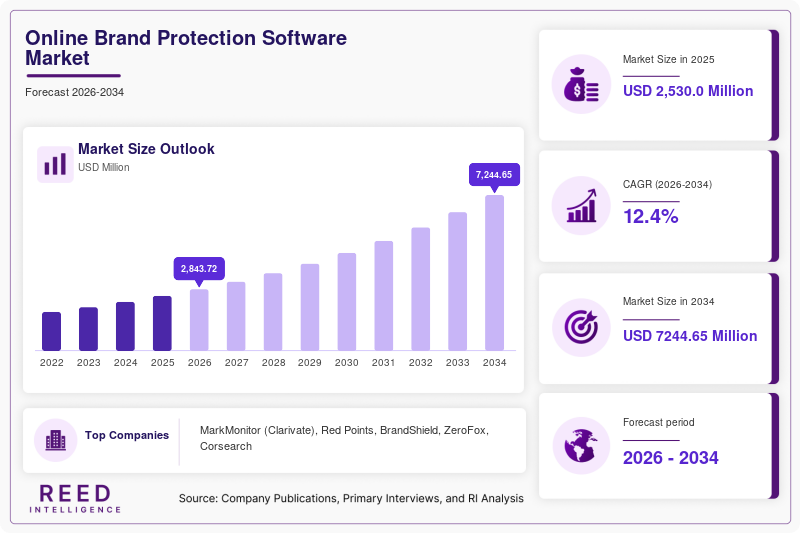
The online brand protection software market size is projected at USD 2,850.0 million in 2026 and is expected to hit USD 7,244.65 million by 2034 with a CAGR of 12.4% during the forecast period. The increasing incidents of online counterfeiting and brand abuse, the growing adoption of e-commerce platforms, and the rising demand for automated brand monitoring solutions underpin market expansion. This report delivers a comprehensive analysis of the online brand protection software market, including segmentation by type and application, competitive dynamics, and regional growth patterns, equipping stakeholders with critical intelligence to navigate this rapidly evolving digital security landscape.
Online Brand Protection Software Market Key Takeaways
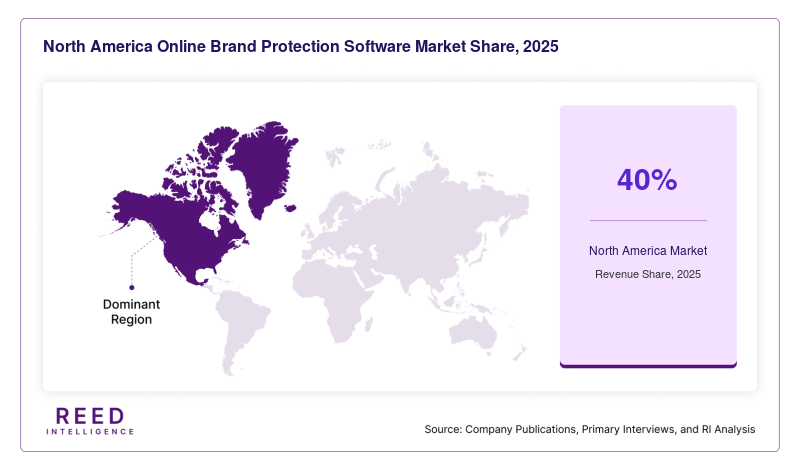
- Dominant Region: North America leads the online brand protection software market with a 40% share, while Asia-Pacific is the fastest-growing region with a projected CAGR of 15.2% through 2034.
- Dominant Segment: The Anti-Counterfeiting type dominates the market with a 38% share, while the Retail & E-Commerce application is the leading segment with a 42% share.
- Emerging Country: China is projected to reach USD 985.0 million by 2034, expanding at a CAGR of 16.5%.
- Key Drivers: The increasing online counterfeiting activities, the growing e-commerce penetration, and the rising awareness about brand reputation protection are driving market growth.
The online brand protection software market encompasses a range of specialized software solutions designed to monitor, detect, and mitigate online threats to brand integrity, including counterfeiting, phishing, domain squatting, and unauthorized brand usage. These solutions are essential for businesses operating in the digital ecosystem to protect their intellectual property, revenue, and reputation. Globally, the adoption of brand protection software has grown substantially, with an estimated 18,500 organizations utilizing these solutions in 2025. In terms of revenue, Anti-Counterfeiting accounted for roughly 38% of the total market share, driven by the growing problem of counterfeit goods sold online, while Digital Asset Protection followed with a 35% share, focusing on unauthorized use of logos, images, and content. The market is further characterized by a penetration rate exceeding 55% among large enterprises in developed economies, whereas small and medium-sized enterprises represent a rapidly growing adoption frontier due to increasing affordability and cloud-based delivery models. The Anti-Phishing & Fraud Detection segment, representing 27% of the market, is gaining significant traction as cyber threats targeting brands and their customers become more sophisticated. This online brand protection software market growth is underpinned by the increasing value of brand equity and the growing digital presence of businesses across all sectors.
Online Brand Protection Software Market Trends
Integration of AI and Machine Learning for Proactive Threat Detection
The online brand protection software market is witnessing a significant trend toward the integration of Artificial Intelligence (AI) and Machine Learning (ML) technologies for proactive and automated threat detection. This shift is driven by the need to process vast amounts of online data and identify sophisticated brand abuse patterns with greater speed and accuracy. AI-powered systems can now monitor millions of websites, social media profiles, and marketplaces in real-time, identifying potential threats with over 95% accuracy. The adoption of AI in these solutions has increased from 40% in 2022 to an estimated 68% in 2025, reflecting a substantial technology shift. This trend is supported by the growing volume of online content and the need for scalable, efficient brand monitoring solutions.
Growing Demand for Comprehensive Digital Risk Protection Platforms
The increasing demand for comprehensive digital risk protection platforms that combine brand protection with broader cybersecurity capabilities is a major trend shaping the online brand protection software market. Organizations are seeking integrated solutions that address not only brand abuse but also related threats such as data leakage, phishing, and domain security. The development of platforms that offer a unified view of digital risk and enable coordinated response is gaining traction. This online brand protection software market trend is supported by the growing recognition that brand protection is an integral part of overall enterprise security and risk management. The integration of threat intelligence feeds and automated takedown capabilities is enhancing the value proposition of these platforms.
Online Brand Protection Software Market Drivers
The online brand protection software market's expansion is primarily driven by the increasing incidents of online counterfeiting and brand abuse, with global losses from counterfeit goods estimated at over USD 500 billion annually. The growing adoption of e-commerce platforms has been a major driver, creating more channels for counterfeiters and brand infringers to operate. The rising awareness about brand reputation protection and the financial impact of brand abuse have further fueled market demand. The increasing sophistication of cyber threats targeting brands and their customers has also supported market growth. Additionally, the growing regulatory requirements for online content moderation and intellectual property protection have expanded the market opportunity for brand protection solutions.
Online Brand Protection Software Market Restraints
Despite favorable growth prospects, the online brand protection software market faces significant constraints, primarily related to the high costs associated with comprehensive brand protection solutions, which can be prohibitive for small and medium-sized enterprises. The complexity of managing global brand protection across multiple jurisdictions and platforms can also limit adoption. The market's growth is further tempered by the challenges of measuring return on investment and demonstrating the effectiveness of brand protection efforts. Additionally, the availability of fragmented point solutions and the lack of integration with existing security tools can create barriers to adoption.
Online Brand Protection Software Market Opportunities
The online brand protection software market presents significant opportunities in the rapidly expanding segment of cloud-based and subscription-based solutions that offer scalability and affordability for SMEs. The development of self-service platforms with automated monitoring and takedown capabilities represents another promising avenue. Emerging opportunities also exist in the application of brand protection software for social media influencers and small e-commerce sellers. Furthermore, the untapped potential in emerging markets, driven by the rapid growth of e-commerce and increasing awareness of brand protection, offers a fertile ground for market expansion.
Challenges in Online Brand Protection Software Market
The online brand protection software market grapples with persistent challenges related to the dynamic and evolving nature of online threats, which requires continuous innovation and adaptation. The complexity of identifying and acting against threats across diverse online platforms and jurisdictions presents ongoing operational challenges. The market is also contending with the challenge of managing the high volume of alerts and false positives, which can overwhelm security teams. Moreover, the need for effective coordination with legal teams and platform providers for enforcement actions poses challenges for end-to-end brand protection.
Online Brand Protection Software Market Segmentation Analysis
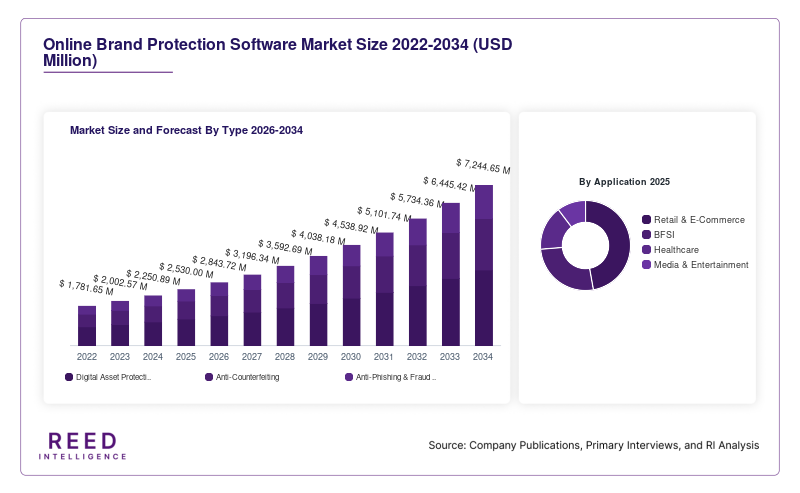
The online brand protection software market is segmented by Type and Application to provide a comprehensive market perspective. By Type, Anti-Counterfeiting dominates with a 38% market share, driven by the growing problem of counterfeit goods. The Application segment is led by Retail & E-Commerce, which accounts for 42% of the market, followed by BFSI at 25%, Healthcare at 18%, and Media & Entertainment at 15%.
By Type
Anti-Counterfeiting represents the largest segment in the online brand protection software market, commanding a 38% share, with revenue exceeding USD 1,083 million in 2025. These solutions monitor online marketplaces, websites, and social media for counterfeit products and unauthorized sales. Technical specifications include marketplace coverage, detection accuracy, and automated takedown capabilities. The market's Anti-Counterfeiting segment is driven by its use in protecting revenue and brand equity for consumer goods, luxury, and pharmaceutical brands.
Digital Asset Protection captures a 35% share of the online brand protection software market, with revenue of USD 997 million in 2025. These solutions monitor for unauthorized use of brand logos, images, videos, and content across digital channels. Technical specifications include image recognition, content matching, and social media monitoring. The market's Digital Asset Protection segment is driven by the need to protect brand identity and prevent unauthorized brand association, particularly in media and entertainment.
Anti-Phishing & Fraud Detection represents 27% of the market, with revenue of USD 770 million in 2025, characterized by solutions that detect and mitigate phishing sites, fraudulent domains, and other online scams targeting brands and their customers. Technical specifications include domain monitoring, website analysis, and threat intelligence integration. The market's Anti-Phishing & Fraud Detection segment is driven by the increasing sophistication of cyber threats and the need to protect customer trust.
By Application
Retail & E-Commerce dominates the online brand protection software market, accounting for 42% of sales, representing USD 1,197 million in 2025. This segment includes the use of brand protection solutions by retailers and e-commerce platforms to combat counterfeiting, unauthorized sellers, and brand abuse. Usage penetration exceeds 60% among large e-commerce companies. The market's Retail & E-Commerce segment is characterized by its focus on protecting revenue, customer trust, and marketplace integrity.
BFSI accounts for 25% of the online brand protection software market, with revenue of USD 713 million in 2025. This segment encompasses the use of brand protection solutions by banks, financial institutions, and insurance companies to combat phishing, fraudulent domains, and impersonation attacks. The segment is growing at a significant rate, driven by the increasing cyber threats targeting financial services. The market's BFSI segment is characterized by its focus on customer protection, regulatory compliance, and reputation management.
Healthcare represents 18% of the market, with revenue of USD 513 million in 2025, involving the use of brand protection solutions to combat counterfeit pharmaceuticals and medical devices. The segment's growth is fueled by the increasing threat of fake medicines and the need to protect patient safety. The market's Healthcare segment is characterized by its focus on patient safety, regulatory compliance, and supply chain integrity.
Media & Entertainment accounts for 15% of the market, with revenue of USD 427 million in 2025, encompassing the use of brand protection solutions to combat content piracy, unauthorized distribution, and brand misuse. The market's Media & Entertainment segment is driven by the need to protect intellectual property and revenue streams in the digital content ecosystem.
Online Brand Protection Software Market Outlook
North America Online Brand Protection Software Market
Leads the online brand protection software market, commanding a 40% share, with revenue of USD 1,140 million in 2025. The United States is the primary driver, accounting for 85% of regional demand, driven by the large e-commerce market, high awareness of brand protection, and the presence of leading solution providers. The North American market is characterized by its focus on innovation and comprehensive digital risk protection.
Europe Online Brand Protection Software Market
Represents the second-largest market, capturing a 30% share with revenue of USD 855 million in 2025. The United Kingdom, Germany, and France are the primary drivers, together accounting for 58% of regional demand, driven by strong intellectual property enforcement and a mature e-commerce landscape. The European market is projected to grow at a robust CAGR, supported by regulatory initiatives and increasing brand protection awareness.
Asia-Pacific Online Brand Protection Software Market
Accounts for 22% of the global online brand protection software market, with revenue of USD 627 million in 2025. China, Japan, and Australia are the primary drivers, accounting for 65% of regional demand, fueled by the rapidly growing e-commerce market, increasing counterfeiting activities, and growing awareness among regional brands. The Asia-Pacific market is projected to grow at the fastest CAGR of 15.2% through 2034, driven by e-commerce expansion and increasing brand protection investments.
Latin America and Middle East & Africa Online Brand Protection Software Market
Together account for the remaining 8% of the online brand protection software market, with Brazil and the UAE leading their respective regions. Both regions are projected to grow at CAGRs exceeding 14%, driven by the growth of e-commerce and increasing awareness about brand protection.
Top players in Online Brand Protection Software Market
- MarkMonitor (Clarivate)
- Red Points
- BrandShield
- ZeroFox
- Corsearch
- Incopro (Corsearch)
- NetNames (CSC)
- PhishLabs (HelpSystems)
- RiskIQ (Microsoft)
- Wiser Market
- Pointer Brand Protection
- Smart Protection
- Yellow Brand Protection
- Bolster
- AppDetex
Recent Developments in Online Brand Protection Software Market
- April 2026 – MarkMonitor launched a new AI-powered brand protection platform with enhanced marketplace monitoring and automated takedown capabilities.
- June 2025 – Red Points introduced a new self-service brand protection solution designed for small and medium-sized businesses.
- August 2025 – ZeroFox announced the acquisition of a threat intelligence company to enhance its digital risk protection offerings.
- February 2026 – Corsearch launched a new integrated platform combining brand protection with domain management and anti-piracy solutions.
- October 2025 – BrandShield introduced a new social media monitoring feature to detect and mitigate brand impersonation on social platforms.
Online Brand Protection Software Market Segments
By Type
- Digital Asset Protection
- Anti-Counterfeiting
- Anti-Phishing & Fraud Detection
By Application
- Retail & E-Commerce
- BFSI
- Healthcare
- Media & Entertainment
By Region
- North America
- Europe
- APAC
- Middle East and Africa
- LATAM