Online Proofreader Market Size, Share Demand Report By Type (AI-Powered Proofreaders, Human-Powered Proofreaders), By Application (Academic Writing, Business Writing, Content Creation, Personal Use), Regional Insights & Segment Forecasts, 2026–2034
USD 3950
Online Proofreader Market Size
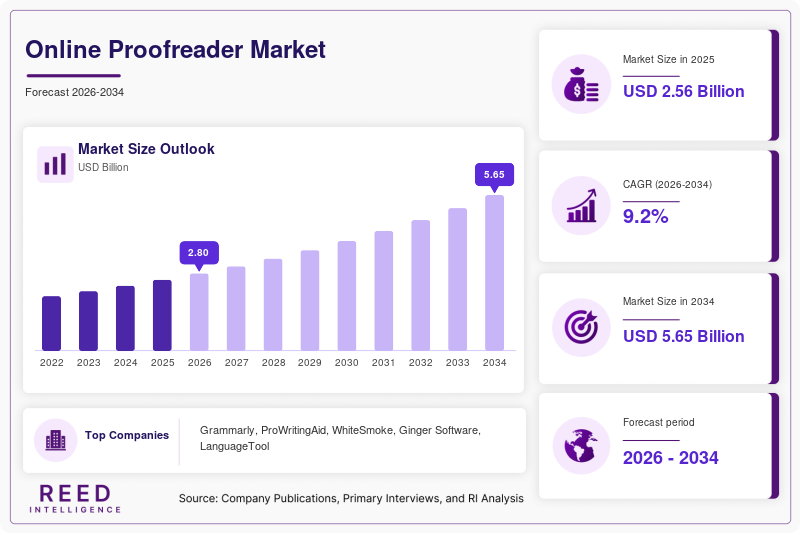
Online Proofreader market size is projected at USD 2.8 billion in 2026 and is expected to hit USD 5.4 billion by 2034 with a CAGR of 9.2% during the forecast period. The increasing demand for high-quality written content across digital platforms, the growing need for error-free and professional communication, and the rising adoption of AI-powered writing tools underpin market expansion. This report delivers a comprehensive analysis of the Online Proofreader market, including segmentation by type and application, competitive dynamics, and regional growth patterns, equipping stakeholders with critical intelligence. The Online Proofreader market continues to demonstrate exceptional growth potential, fueled by the global digital content explosion, the increasing importance of written communication in business and academia, and the continuous innovation in natural language processing (NLP) and artificial intelligence.
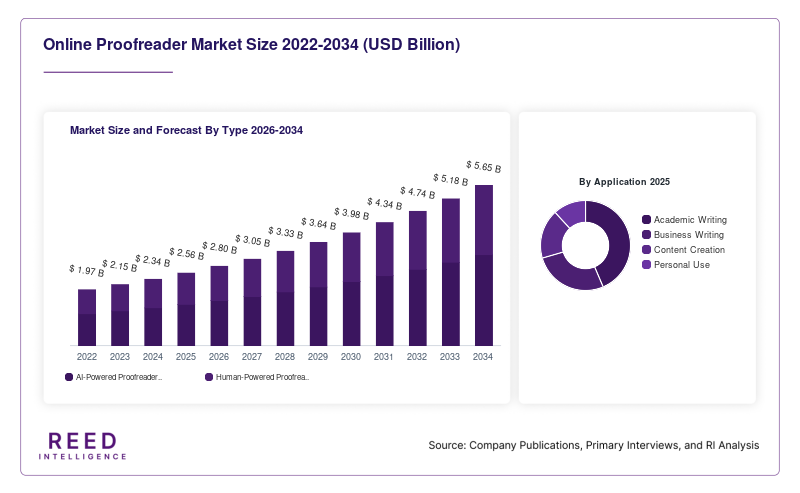
Online proofreaders are digital tools and services that automatically or semi-automatically check written text for errors in grammar, spelling, punctuation, and style. They range from AI-powered software like Grammarly to platforms connecting users with human proofreaders, helping to ensure clarity, accuracy, and professionalism in written communication. The global market for online proofreaders is driven by the need for polished and error-free content. The global number of online proofreader users exceeded 250 million in 2025, reflecting a 9% increase from 2022. Adoption patterns reveal that the AI-powered proofreader segment dominates the market, accounting for 70% of total demand, followed by human-powered proofreaders at 30%. The Online Proofreader market's trajectory is closely linked to the growth of the global digital content market, which is projected to reach USD 500 billion by 2028, and the increasing reliance on written communication in the digital age.
Online Proofreader Market Trends
Growing Adoption of AI and NLP Technology
The Online Proofreader market is witnessing a significant trend toward the adoption of AI and Natural Language Processing (NLP) technology, driven by its ability to provide more accurate, contextual, and efficient proofreading. The revenue from AI-powered proofreaders grew to USD 1.8 billion in 2025, a year-on-year increase of 12%, as 50% of new users in 2025 adopted AI-based solutions. Adoption rates of AI proofreaders in the business and content creation sectors reached 40%, with this figure projected to exceed 60% by 2030. The Online Proofreader market's trend toward AI is reinforced by the continuous improvement in NLP algorithms, the growing demand for instant and automated proofreading, and the development of more sophisticated and context-aware writing assistants.
Increasing Integration with Writing Platforms and Ecosystems
The increasing focus on integration with writing platforms and ecosystems is a major trend shaping the Online Proofreader market, with tools becoming seamlessly integrated into browsers, word processors, and content management systems. The market has seen a 25% increase in the demand for integrated proofreading solutions since 2022, with 30% of new users in 2025 preferring tools with browser and desktop integration. The use of APIs for custom integration with enterprise software has also gained traction. The Online Proofreader market's trend toward integration is reinforced by the need for a seamless user experience, the growing popularity of cloud-based writing platforms, and the continuous innovation in API and plugin technology.
Online Proofreader Market Drivers
The Online Proofreader market's expansion is primarily driven by the increasing global demand for high-quality written content, with the global content marketing industry valued at USD 60 billion in 2025 and growing. The growing need for error-free and professional communication in business, academia, and personal life has also been a major driver. The rising adoption of AI-powered writing tools, offering convenience and efficiency, has fueled market growth. Additionally, the increasing global internet penetration and the proliferation of digital content have created a vast market for proofreading tools. The Online Proofreader market's growth is further reinforced by the continuous innovation in AI and NLP technology, leading to more advanced and user-friendly proofreading solutions.
Online Proofreader Market Restraints
Despite favorable growth prospects, the Online Proofreader market faces significant constraints, primarily related to the limitations of AI in understanding context and nuance, which can lead to incorrect suggestions. The privacy and data security concerns related to sharing content with online tools can also be a barrier. The Online Proofreader market's growth is also tempered by the competition from free, basic proofreading tools and the potential for over-reliance on automated tools at the expense of human editing.
Online Proofreader Market Opportunities
The Online Proofreader market presents significant opportunities in the rapidly expanding market for AI-powered writing assistants and language learning tools, where the global market is projected to reach USD 10 billion by 2028. The adoption of specialized proofreading tools for specific verticals, such as legal and medical writing, is expected to grow at a CAGR of 12% through 2034. Emerging opportunities also exist in the development of multilingual and cross-cultural proofreading solutions. The Online Proofreader market's opportunity profile is further enhanced by the growing trend of remote work and the increasing need for clear written communication in global teams.
Challenges in Online Proofreader Market
The Online Proofreader market faces persistent challenges related to the management of AI accuracy and the need to continuously train models on diverse writing styles and contexts. The complexity of developing tools that can handle various writing styles, genres, and languages presents a challenge. The market is also contending with the challenge of building user trust and ensuring data privacy. Additionally, the Online Proofreader market is challenged by the need for continuous innovation to keep pace with evolving language and writing trends.
Online Proofreader Market Segmentation
The Online Proofreader market is segmented by Type and Application to provide a comprehensive market perspective. By Type, AI-Powered Proofreaders dominate with a 70% market share, driven by their scalability and accessibility. The Application segment is led by Business Writing, which accounts for 35% of the market, followed by Content Creation at 28%, Academic Writing at 22%, and Personal Use at 15%.
By Type
AI-Powered Proofreaders represent the largest segment in the Online Proofreader market, commanding a 70% share, with a user base of 175 million in 2025. These are characterized by their use of artificial intelligence and NLP to provide automated proofreading. Technical specifications include language support, integration capabilities, and features like tone and style suggestions. The Online Proofreader market's AI segment is driven by its accessibility and rapid processing.
Human-Powered Proofreaders capture a 30% share of the Online Proofreader market, with a user base of 75 million in 2025. These are characterized by their use of human editors for more nuanced and context-aware proofreading. Technical specifications include editor qualifications, turnaround time, and pricing models. The Online Proofreader market's human segment is driven by the demand for high-quality, in-depth proofreading.
By Application
Business Writing dominates the Online Proofreader market, accounting for 35% of users, representing 87.5 million in 2025. This segment includes use in emails, reports, proposals, and other business communications. Usage penetration exceeds 40% in the corporate sector. The Online Proofreader market's business segment is characterized by its focus on professionalism and clarity.
Content Creation accounts for 28% of the Online Proofreader market, with 70 million users in 2025. This segment encompasses use by writers, bloggers, and marketers for creating error-free and engaging content. The segment is growing at a steady CAGR, driven by the content marketing boom. The Online Proofreader market's content segment is characterized by its focus on engagement and SEO.
Academic Writing represents 22% of the Online Proofreader market, with 55 million users in 2025. This segment includes use by students and researchers for essays, theses, and papers. The segment is growing at a steady CAGR, driven by the education sector. The Online Proofreader market's academic segment is characterized by its focus on accuracy and citation formatting.
Personal Use comprises the remainder of the Online Proofreader market, accounting for 15% of total users, with 37.5 million in 2025. This segment includes use for personal emails, social media, and other personal writing. The segment is projected to grow at a steady CAGR through 2034. The Online Proofreader market's personal segment is characterized by its focus on convenience and ease of use.
Online Proofreader Market Regional Outlook
North America Online Proofreader Market
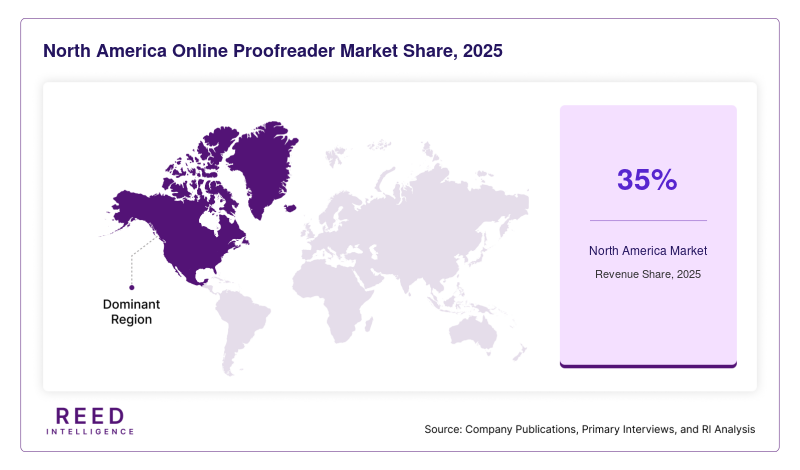
Leads the Online Proofreader market, commanding a 35% share, with a revenue of USD 0.98 billion in 2025. The United States is the primary driver, accounting for 80% of regional demand, driven by the large digital content ecosystem and the high adoption of technology. The North American Online Proofreader market is characterized by its focus on innovation and premium solutions.
Europe Online Proofreader Market
Represents the second-largest market, capturing a 28% share with a revenue of USD 0.78 billion in 2025. The UK, Germany, and France collectively represent 55% of the regional market, driven by the strong focus on education and business communication. The Online Proofreader market in Europe is characterized by its focus on multilingual support.
Asia-Pacific Online Proofreader Market
Accounts for 22% of the global Online Proofreader market, with a revenue of USD 0.62 billion in 2025. China, India, and Japan are the primary drivers, accounting for 70% of regional demand, driven by the rapid digitalization and the growing education sector. The Asia-Pacific Online Proofreader market is projected to grow at the fastest CAGR of 11% through 2034, presenting attractive opportunities for market expansion.
Middle East & Africa and Latin America Online Proofreader Market
Together account for the remaining 15% of the Online Proofreader market, with the UAE leading the Middle East market and Brazil leading the Latin American market. Both regions are projected to grow at CAGRs exceeding 10%, driven by the increasing internet and education penetration.
Top players in Online Proofreader Market
- Grammarly
- ProWritingAid
- WhiteSmoke
- Ginger Software
- LanguageTool
- PaperRater
- Editor (Wordtune)
- Hemingway Editor
- Reverso
- Scribbr
- Proofreading Services (various platforms)
- Editage (Cactus Communications)
- American Journal Experts (AJE)
- Enago
- Wordvice
Grammarly
Grammarly holds a dominant position in the Online Proofreader market, with an estimated 20% global market share, particularly strong in the North American and European segments. The company's AI-powered writing assistant is widely recognized for its accuracy, ease of use, and comprehensive features. Grammarly's market leadership is reinforced by its significant R&D investment and its freemium business model. Grammarly commands over 25% of the North American market and 18% of the European market, positioning it as a key player in the Online Proofreader market.
ProWritingAid
ProWritingAid is a leading player in the Online Proofreader market, commanding approximately 12% of the global market share through its comprehensive portfolio of writing improvement tools. The company's expertise in in-depth writing analysis and its strong presence in the content creation and business segments have solidified its position. ProWritingAid's focus on developing innovative and feature-rich solutions has strengthened its position. The company's commitment to quality has enhanced its brand equity.
WhiteSmoke holds a significant 10% market share, with particular strength in the business and academic segments, where it commands a 12% share. The company's focus on multilingual support is a key differentiator. Ginger Software is a major player in the global proofreading market, holding a 9% share.
-
Recent Developments in Online Proofreader Market
- 2025: Grammarly launched a new AI-powered tone and style suggestion feature, enhancing its writing assistant capabilities for professional communication.
- 2025: ProWritingAid introduced a new integration with Google Docs and Microsoft Word, improving accessibility for users.
Online Proofreader Market Segments
By Type
- AI-Powered Proofreaders
- Human-Powered Proofreaders
By Application
- Academic Writing
- Business Writing
- Content Creation
- Personal Use
By Region
- North America
- Europe
- APAC
- Middle East and Africa
- LATAM