Online Reputation Management Services Market Size, Share & Trends Analysis Report By Service Type (Reputation Monitoring & Review Management, Search Reputation & Content Management, Social Media & Brand Monitoring, Crisis & Issue Management, AI Reputation & Generative Search Management, Other Services), By Enterprise Size (Large Enterprises, Small & Medium Enterprises), By Application (Corporate & Enterprise Reputation, Local & Multi-location Business Reputation, Individual & Executive Reputatio
USD 3950
Online Reputation Management Services Market Size
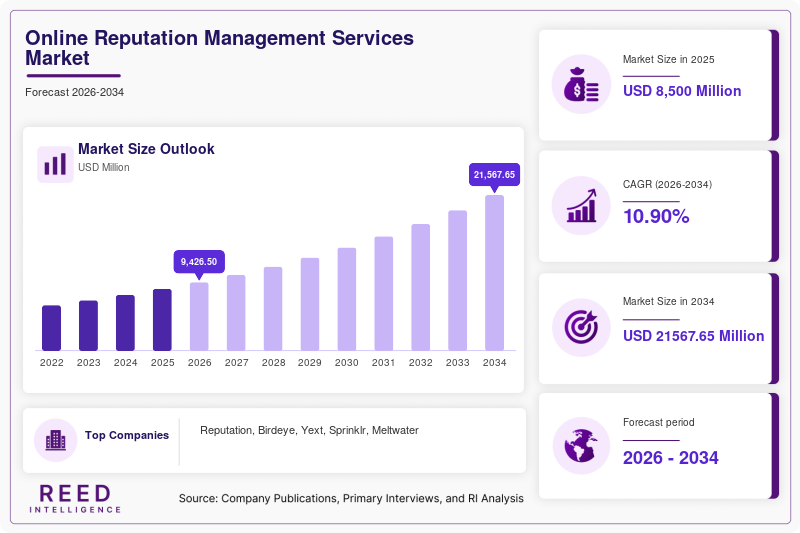
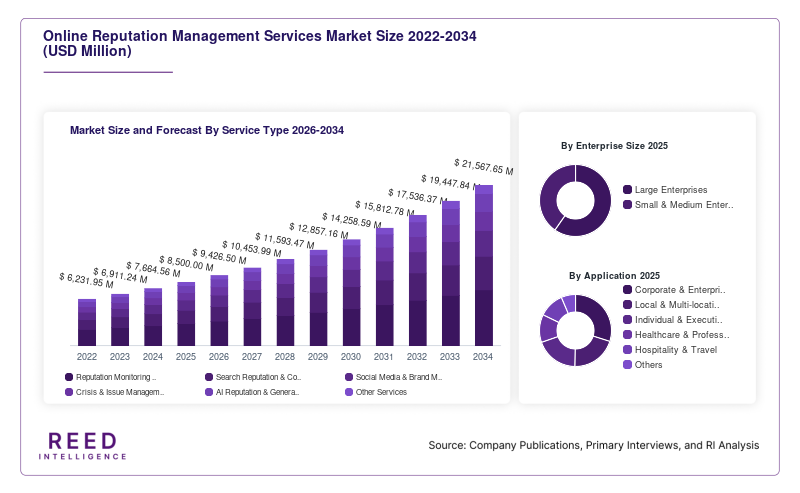
The global online reputation management services market is valued at USD 8,500 Million in 2025 and USD 9,426.50 Million in 2026. The market is projected to reach USD 21,567.65 Million by 2034, registering a 10.90% CAGR during the forecast period.
The online reputation management services market comprises services that monitor, analyze, protect and improve how organizations, brands, locations and individuals are represented across search engines, review platforms, social media, online news, forums and increasingly AI-generated search results. The service ecosystem includes review monitoring and response, social listening, reputation audits, crisis communication, search-result management, content remediation, brand monitoring, review generation, sentiment analysis and increasingly generative-engine visibility management.
The market is changing because consumers now encounter reputation signals across substantially more digital surfaces. BrightLocal's 2026 Local Consumer Review Survey found that 97% of consumers still use reviews to guide purchase decisions, 41% said they always read reviews when browsing for businesses, and consumers used an average of six review sites during the year. The survey also found that 74% of consumers consider only reviews from the previous three months relevant to their decision-making.
Online Reputation Management Services Market Drivers
Reviews have become a persistent conversion and trust signal
Online reviews are no longer an occasional marketing input. BrightLocal's 2026 survey found that 97% of consumers use reviews to guide purchase decisions, 85% are more likely to use a business after positive reviews, and 77% are deterred by negative reviews. The same survey found that 89% expect businesses to respond to reviews.
This creates a continuous operational requirement. Brands need to monitor incoming reviews, identify recurring complaints, respond consistently, collect fresh feedback and escalate critical issues.
For multi-location organizations, the workload increases rapidly because reputation can differ substantially between individual stores or facilities. Birdeye reported in January 2026 that its enterprise customer segment had grown 113% year over year and linked the expansion to adoption of its agentic platform by large multi-location brands.
The result is increasing demand for managed and technology-enabled reputation services that can convert dispersed feedback into standardized organizational action.
AI-generated search is turning reputation into a discoverability issue, not only a perception issue
Traditional reputation management focused heavily on what customers saw after finding a business. AI search adds another question: whether the business is surfaced at all.
Yext's 2026 research found that 42.7% of global respondents had used AI for local search during the previous month, while 74% of AI users rated their trust in AI recommendations at four or five out of five. However, consumers still verified AI recommendations through other sources, making the consistency of reviews, websites, social profiles and other reputation signals important after the initial AI recommendation.
Reputation, Sprinklr and Semrush are responding by adding AI visibility, AI representation, sentiment and generative-search capabilities to existing reputation, customer-experience and marketing workflows.
This is expanding the addressable service market toward Generative Engine Optimization, AI reputation monitoring, AI narrative analysis and cross-channel brand visibility management.
Reputation risk is spreading across more channels and becoming faster-moving
Reputation signals increasingly originate in short-form video, social networks, local review sites, forums, news coverage and user-generated content. Meltwater's 2026 research and summit analysis emphasized the increasing role of AI-generated misinformation, narrative attacks and deepfakes in the risk environment for communications teams.
Sprinklr's May 2026 acquisition of ViralMoment was specifically directed at understanding social-video and multimodal signals that can be missed by text-centric listening systems.
This acceleration favors continuous monitoring rather than periodic brand audits. Organizations increasingly need services capable of identifying changes in sentiment, emerging narratives and potential crises before they spread across multiple platforms.
Online Reputation Management Services Market Restraints
Authenticity requirements limit aggressive reputation-manipulation approaches
Reputation services must distinguish between legitimate reputation improvement and deceptive attempts to manipulate customer feedback.
The FTC's Consumer Review Rule prohibits certain deceptive review and testimonial practices, including undisclosed insider reviews, incentives conditioned on particular sentiments and certain forms of review suppression. In May 2026, the FTC and Illinois also pursued a case alleging fabricated local business listings and fake five-star reviews were used to artificially improve business ratings.
These requirements increase compliance, documentation and governance needs for service providers. Responsible providers must focus on authentic review generation, accurate information, transparent responses and legitimate correction or removal of content that violates platform rules or applicable law.
Fragmented digital channels increase monitoring complexity and service costs
Reputation data is dispersed across review sites, social platforms, search engines, business directories, news publications, forums and AI systems.
BrightLocal found that consumers used an average of six review sites in 2026, while Yext's research showed that consumers verify AI recommendations across search engines, websites, reviews and social media.
Service providers must therefore maintain broad source coverage while handling differences in APIs, platform policies, data access and response workflows. This increases integration requirements and can make comprehensive monitoring more expensive for smaller clients.
Online Reputation Management Services Market Opportunities
AI reputation intelligence is creating a new service layer around generative search
Generative search is creating demand for services that measure how brands are mentioned, described, cited and recommended by AI systems.
Reputation launched AI Reputation Manager and AI Location Presence Insights in May 2026 and subsequently introduced its GEO Readiness Audit in June. Sprinklr launched LLM Insights in June, while Semrush has built AI Visibility tools that measure brand mentions, citations, sentiment, competitor positioning and AI-search presence.
This creates opportunities for specialist agencies and enterprise service providers to offer AI reputation audits, generative-search monitoring, narrative optimization, source-gap analysis and ongoing AI visibility programs.
Managed reputation services can combine monitoring, response, analytics and crisis management
The growing volume of customer feedback makes fully managed programs more attractive, particularly for franchises, healthcare systems, hospitality companies, retailers and other distributed organizations.
Birdeye reported significant 2026 enterprise adoption of its agentic platform, while Yext's workflow APIs and Reputation's AI capabilities illustrate how more execution can be automated while still allowing human oversight.
Service providers can therefore combine technology platforms with human expertise in escalation, communications, crisis response, review strategy, local SEO and executive reporting. This hybrid model can serve organizations that lack dedicated reputation teams.
Service Type Analysis
Reputation Monitoring & Review Management remains the dominant service category
Reputation Monitoring & Review Management accounts for the largest share because reviews remain one of the most influential and frequently refreshed trust signals for businesses.
The Reputation Monitoring & Review Management segment accounts for 36% of the global market in 2026 and is projected to register a 10.30% CAGR.
BrightLocal's 2026 research found that 74% of consumers seek reviews from the past three months and 89% expect businesses to respond to reviews. This creates recurring requirements for monitoring, response management, review generation, sentiment analysis and reporting.
AI Reputation & Generative Search Management is the fastest-growing service category
The AI Reputation & Generative Search Management segment accounts for 11% of the global market in 2026 and is projected to register a 14.60% CAGR, making it the fastest-growing major service category.
The category is expanding as brands begin tracking not only conventional search rankings but also how AI systems describe, cite and recommend them. Reputation, Sprinklr and Semrush each introduced AI-search-oriented capabilities during 2026.
Enterprise Size Analysis
Large Enterprises remain the dominant customer group as distributed reputations require centralized governance
Large enterprises account for the greatest share because multinational brands, franchises and multi-location companies may have hundreds or thousands of locations, products and digital identities requiring consistent management.
The Large Enterprises segment accounts for 64% of the global market in 2026 and is projected to register a 10.20% CAGR.
Birdeye reported in January 2026 that its enterprise business grew 113% year over year, with adoption concentrated among large multi-location organizations seeking unified reputation, marketing and customer-experience functionality.
Large organizations also have greater exposure to regulatory, executive, crisis and brand-safety risks, increasing demand for formal reputation programs and governance.
Small & Medium Enterprises are the fastest-growing enterprise group as SaaS and AI reduce service barriers
The Small & Medium Enterprises segment accounts for 36% of the global market in 2026 and is projected to register a 12.20% CAGR, making it the fastest-growing enterprise-size category.
SMEs increasingly access reputation technology through cloud platforms, ecommerce integrations, managed services and automated review workflows.
BrightLocal's findings that 47% of consumers will not use a business with fewer than 20 reviews and 31% require ratings of at least 4.5 stars illustrate why local businesses have a direct incentive to maintain review volume, recency and response quality.
Application Analysis
Corporate & Enterprise Reputation remains the dominant application
The Corporate & Enterprise Reputation segment accounts for 34% of the global market in 2026 and is projected to register a 10.40% CAGR.
Large organizations require centralized monitoring of corporate communications, customer feedback, executive issues, news coverage, social conversations and search visibility.
Meltwater's 2026 research emphasizes the growing role of reputation intelligence in corporate communications and organizational resilience, while Sprinklr is integrating customer intelligence, social listening, AI search and service workflows within its Unified-CXM platform.
Local & Multi-location Business Reputation is the fastest-growing major application
The Local & Multi-location Business Reputation segment accounts for 28% of the global market in 2026 and is projected to register a 12.40% CAGR, making it the fastest-growing major application.
Local businesses face especially strong dependence on reviews, local listings, location-level ratings and customer responses. BrightLocal's 2026 survey found that review recency, sentiment, rating and response speed all influence customer decisions.
Yext, Reputation and Birdeye are increasingly building enterprise platforms around multi-location visibility, review workflows and AI search representation.
Healthcare & Professional Services require tightly controlled reputation workflows
The segment is projected to register a 11.30% CAGR.
Healthcare organizations, law firms, financial firms and other professional-service organizations must manage reputational feedback while addressing compliance, privacy, credentialing and approval requirements.
Yext introduced healthcare-optimized review-generation workflows in June 2026 that can route feedback between healthcare-professional and facility entities. This illustrates how reputation services are becoming more specialized by industry.
Hospitality & Travel remains highly review-sensitive
The segment is projected to register a 10.80% CAGR.
Hotels, restaurants, attractions and travel businesses depend heavily on recent reviews, location information and public responses because customers can compare multiple providers immediately.
BrightLocal found that review recency and response speed are major consumer trust signals, while its 2026 survey also documented substantial use of Google, Facebook and other platforms for business reviews.
Online Reputation Management Services Market Regional Analysis
North America Online Reputation Management Services Market
North America remains the dominant regional market because of its mature digital-marketing ecosystem, high review adoption, sophisticated enterprise communications industry and concentration of reputation-technology providers.
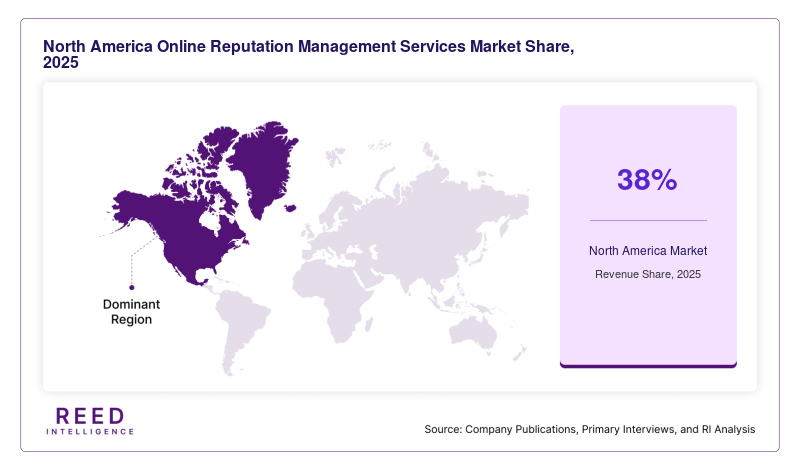
The North America region accounts for 38% of the global market in 2026 and is projected to register a 10.20% CAGR.
BrightLocal's U.S.-focused research shows the continuing importance of reviews in consumer decision-making, while major U.S.-based providers including Reputation, Birdeye, Yext and Sprinklr are rapidly expanding AI-based reputation capabilities.
The region is also seeing stronger regulatory attention to review authenticity. The FTC's May 2026 action involving alleged fake local listings and reviews illustrates the legal exposure associated with deceptive reputation practices.
APAC Online Reputation Management Services Market
APAC is the fastest-growing regional market as ecommerce, social-media usage, digital payments, local discovery and AI adoption continue expanding across China, India, Japan, South Korea, Australia and Southeast Asia.
The APAC region accounts for 24% of the global market in 2026 and is projected to register a 13.20% CAGR, making it the fastest-growing regional market.
Yext's global 2026 survey found broad AI-search adoption, while Semrush has expanded its AI-visibility database to additional international markets. Semrush's 2026 coverage includes India and numerous APAC countries, reflecting rising demand for geographically specific AI-visibility intelligence.
The region's diverse languages, marketplaces and social ecosystems create additional demand for localized reputation monitoring and response capabilities.
Europe Online Reputation Management Services Market
Europe is projected to register a 10.80% CAGR, supported by sophisticated ecommerce, established PR markets, extensive local-review usage and increasing interest in AI-search visibility.
European enterprises are also navigating data-protection and AI-governance requirements, increasing the importance of controlled workflows and documented human oversight.
Meltwater's 2026 communications research identifies AI-generated information, brand narratives and trust as central issues for European and global communications teams, while Reputation and Semrush are expanding AI-oriented visibility capabilities that apply across European markets.
Middle East and Africa Online Reputation Management Services Market
The Middle East and Africa market is projected to register a 11.70% CAGR, supported by expanding ecommerce, hospitality, tourism, healthcare and digital-service sectors.
Reputation requirements are particularly relevant for organizations competing across multiple languages and markets, where location information, customer reviews and social media can materially influence discovery.
Cloud-based reputation platforms can provide centralized monitoring while allowing localized response and reporting.
LATAM Online Reputation Management Services Market
LATAM is projected to register a 12.00% CAGR, supported by ecommerce expansion, digital payments, social-commerce activity, hospitality and growing use of local-review platforms.
SMEs and multi-location businesses represent important adoption opportunities because cloud reputation platforms can provide centralized review monitoring and response without requiring dedicated internal reputation teams.
Online Reputation Management Services Market Regional Analysis
North America Online Reputation Management Services Market
North America remains the dominant regional market because of its mature digital-marketing ecosystem, high review adoption, sophisticated enterprise communications industry and concentration of reputation-technology providers.
The North America region accounts for 38% of the global market in 2026 and is projected to register a 10.20% CAGR.
BrightLocal's U.S.-focused research shows the continuing importance of reviews in consumer decision-making, while major U.S.-based providers including Reputation, Birdeye, Yext and Sprinklr are rapidly expanding AI-based reputation capabilities.
The region is also seeing stronger regulatory attention to review authenticity. The FTC's May 2026 action involving alleged fake local listings and reviews illustrates the legal exposure associated with deceptive reputation practices.
APAC Online Reputation Management Services Market
APAC is the fastest-growing regional market as ecommerce, social-media usage, digital payments, local discovery and AI adoption continue expanding across China, India, Japan, South Korea, Australia and Southeast Asia.
The APAC region accounts for 24% of the global market in 2026 and is projected to register a 13.20% CAGR, making it the fastest-growing regional market.
Yext's global 2026 survey found broad AI-search adoption, while Semrush has expanded its AI-visibility database to additional international markets. Semrush's 2026 coverage includes India and numerous APAC countries, reflecting rising demand for geographically specific AI-visibility intelligence.
The region's diverse languages, marketplaces and social ecosystems create additional demand for localized reputation monitoring and response capabilities.
Europe Online Reputation Management Services Market
Europe is projected to register a 10.80% CAGR, supported by sophisticated ecommerce, established PR markets, extensive local-review usage and increasing interest in AI-search visibility.
European enterprises are also navigating data-protection and AI-governance requirements, increasing the importance of controlled workflows and documented human oversight.
Meltwater's 2026 communications research identifies AI-generated information, brand narratives and trust as central issues for European and global communications teams, while Reputation and Semrush are expanding AI-oriented visibility capabilities that apply across European markets.
Middle East and Africa Online Reputation Management Services Market
The Middle East and Africa market is projected to register a 11.70% CAGR, supported by expanding ecommerce, hospitality, tourism, healthcare and digital-service sectors.
Reputation requirements are particularly relevant for organizations competing across multiple languages and markets, where location information, customer reviews and social media can materially influence discovery.
Cloud-based reputation platforms can provide centralized monitoring while allowing localized response and reporting.
LATAM Online Reputation Management Services Market
LATAM is projected to register a 12.00% CAGR, supported by ecommerce expansion, digital payments, social-commerce activity, hospitality and growing use of local-review platforms.
SMEs and multi-location businesses represent important adoption opportunities because cloud reputation platforms can provide centralized review monitoring and response without requiring dedicated internal reputation teams.
Online Reputation Management Services Market Competitive Landscape
The online reputation management services market is fragmented across dedicated reputation platforms, social-listening companies, local-search providers, PR and communications firms, review-management specialists and digital-marketing agencies. G2's September 2026 category data tracks more than 440 online reputation-management software products, illustrating the breadth of the competitive ecosystem.
Reputation is expanding from conventional review and reputation management into AI-driven discovery. Its May 2026 product launch introduced Reputation IQ, AI Reputation Manager and AI Location Presence Insights, followed by its June GEO Readiness Audit.
Birdeye focuses strongly on multi-location organizations, combining reputation management, reviews, listings, messaging, social media, analytics and AI agents. The company reported particularly rapid enterprise adoption in January 2026 and continued to emphasize agentic reputation management during 2026.
Key Market Players
- Birdeye
- Yext
- Sprinklr
- Meltwater
- Semrush
- Brand24
- Brandwatch
- SOCi
- Uberall
- Synup
- Podium
- ReviewTrackers
- NiceJob
- Experience.com
- ClearlyRated
- Go Fish Digital
- Status Labs
- WebiMax
- NetReputation
Recent Developments
September 2026 – Brand24 expanded its AI-brand-mentions research and monitoring focus. The company published research on how brands are mentioned in ChatGPT, Gemini and other AI-search environments, distinguishing AI brand mentions from citations and examining how third-party sources influence AI-generated brand visibility.
August 2026 – Birdeye strengthened its positioning around AI-powered reputation and customer-experience management. Its enterprise platform combines reputation management, reviews, listings, social media, analytics and AI functionality for multi-location brands, while 2026 product communications emphasize agentic workflows.
Online Reputation Management Services Market Segments
By Service Type
- Reputation Monitoring & Review Management
- Search Reputation & Content Management
- Social Media & Brand Monitoring
- Crisis & Issue Management
- AI Reputation & Generative Search Management
- Other Services
By Enterprise Size
- Large Enterprises
- Small & Medium Enterprises
By Application
- Corporate & Enterprise Reputation
- Local & Multi-location Business Reputation
- Individual & Executive Reputation
- Healthcare & Professional Services
- Hospitality & Travel
- Others
By Region
- North America
- Europe
- APAC
- Middle East and Africa
- LATAM