Opium Tincture Market Size, Share & Demand Report By Type (Deodorized Opium Tincture, Standard Opium Tincture), By Application (Severe Diarrhea Treatment, Short Bowel Syndrome Management, Other Gastrointestinal Conditions), By Distribution Channel (Hospital Pharmacies, Retail Pharmacies, Online & Specialty Pharmacies), By End User (Hospitals, Specialty Gastroenterology Clinics, Research & Academic Institutions), By Region & Segment Forecasts, 2025–2034
USD 3950
Market Overview
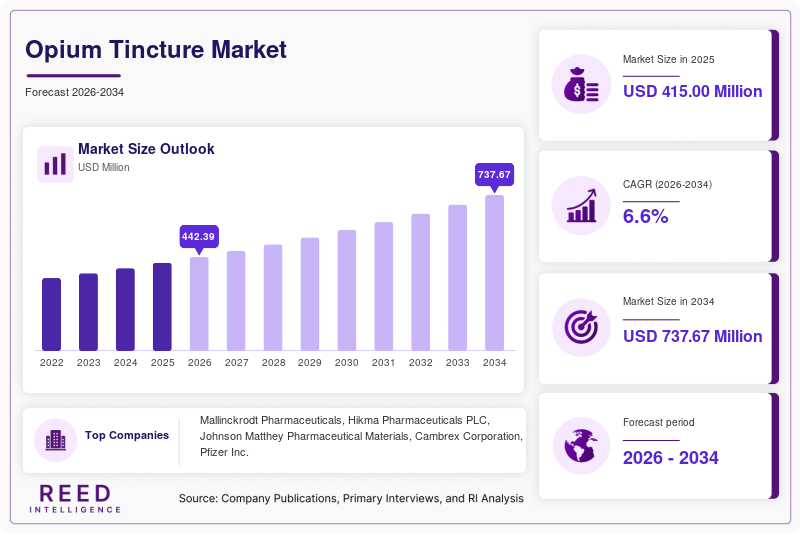
The Opium Tincture Market size was valued at approximately USD 415 million in 2025 and is projected to reach USD 735 million by 2034, registering a compound annual growth rate (CAGR) of 6.6% from 2025 to 2034. Opium tincture, a concentrated liquid preparation derived from opium alkaloids, is widely used in controlled medical settings for the treatment of severe diarrhea and specific gastrointestinal disorders. Its application in hospital pharmacies and specialized therapeutic programs has sustained steady demand across developed and emerging healthcare systems.
One global factor supporting the expansion of the Opium Tincture Market has been the increasing prevalence of gastrointestinal conditions requiring opioid-based symptomatic management. Healthcare providers continue to rely on regulated formulations such as opium tincture in cases where conventional antidiarrheal drugs show limited effectiveness. Additionally, improvements in pharmaceutical manufacturing standards and stronger regulatory monitoring frameworks have enhanced the safe distribution and medical supervision of opium-based preparations.
Key Highlights
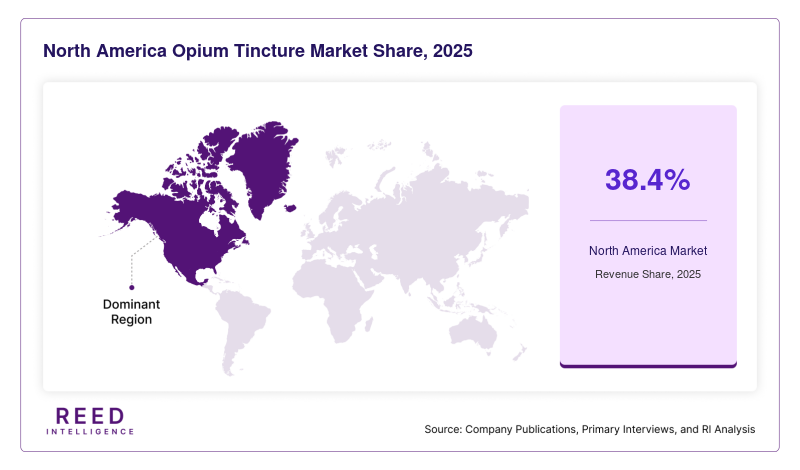
- North America accounted for the dominant regional share of 38.4% in 2025, while Asia Pacific is projected to record the fastest growth at a CAGR of 7.9% during the forecast period.
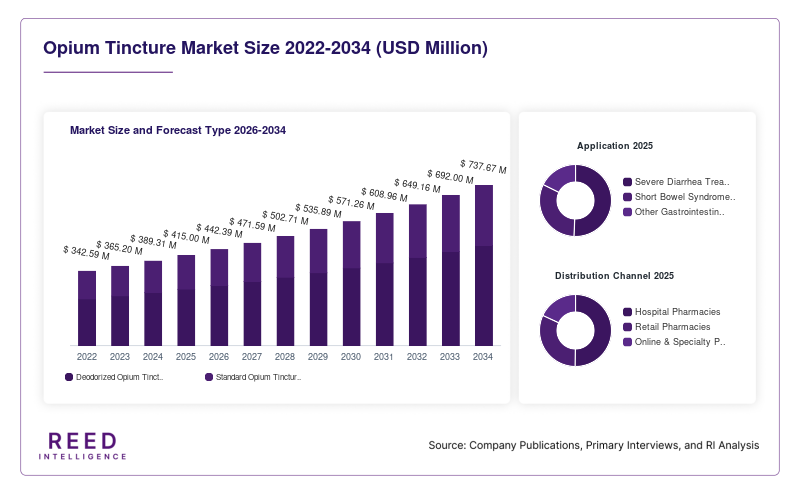
- By Type, Deodorized Opium Tincture led the market with 62% share in 2025, while Standard Opium Tincture is expected to grow fastest at 7.3% CAGR.
- By Application, Severe Diarrhea Treatment dominated with 54% market share, while Short Bowel Syndrome Management is projected to expand at 7.6% CAGR.
- The United States remained the dominant country market, valued at USD 122 million in 2025 and expected to reach USD 129 million in 2026.
Market Trends
Expansion of Controlled Pharmaceutical Manufacturing
A key trend shaping the Opium Tincture Market is the increasing investment in controlled pharmaceutical manufacturing facilities for opioid-based formulations. Pharmaceutical manufacturers are upgrading production environments to meet stricter regulatory standards governing narcotic medicines. This includes enhanced purification technologies, improved dosage accuracy, and advanced packaging solutions that support safe dispensing.
These developments have strengthened physician confidence in prescribing regulated opium tincture formulations. In addition, contract manufacturing organizations are collaborating with pharmaceutical firms to produce specialized batches for hospital pharmacies and government healthcare systems. Such partnerships are improving the global supply of compliant medical-grade tinctures.
Growing Integration in Specialized Gastrointestinal Therapies
Another notable trend in the Opium Tincture Market involves the increasing use of opioid-based antidiarrheal therapy in specialized gastrointestinal care programs. In complex cases involving chronic malabsorption, intestinal surgery recovery, or severe infections, physicians may recommend opium tincture when conventional treatments are insufficient.
Healthcare providers are increasingly incorporating these formulations into integrated treatment pathways for conditions such as short bowel syndrome and refractory diarrhea. Clinical programs focusing on patient-specific dosage adjustments and close monitoring have contributed to wider adoption within specialized medical institutions.
This trend has encouraged pharmaceutical companies to develop standardized formulations that align with hospital protocols and regulatory frameworks across multiple regions.
Market Drivers
Rising Prevalence of Chronic Gastrointestinal Disorders
The growing incidence of chronic gastrointestinal disorders has been a major driver of the Opium Tincture Market. Conditions such as inflammatory bowel disease, post-surgical digestive complications, and chronic malabsorption syndromes often lead to severe diarrhea that is difficult to manage using standard therapies.
Medical professionals sometimes rely on opium tincture due to its effectiveness in reducing intestinal motility and controlling fluid loss. As healthcare systems improve diagnosis and management of complex digestive disorders, the need for specialized pharmacological options has expanded.
In addition, aging populations in several countries have contributed to higher rates of digestive complications that require advanced symptomatic treatment. These factors collectively support sustained demand for regulated opium tincture formulations.
Increasing Hospital Pharmacy Distribution
Another important driver influencing the Opium Tincture Market is the growing role of hospital pharmacies in controlled medication distribution. Hospitals often manage severe gastrointestinal cases that require opioid-based medications under strict supervision.
Centralized dispensing systems ensure accurate dosage, prevent misuse, and maintain regulatory compliance. Many healthcare institutions have implemented electronic prescription tracking and controlled storage systems for narcotic medicines, making it easier to integrate opium tincture into clinical treatment protocols.
This structured distribution framework has improved accessibility for legitimate medical use while maintaining regulatory safeguards.
Market Restraints
Stringent Regulatory Controls on Opioid-Based Medicines
A significant restraint affecting the Opium Tincture Market is the stringent regulatory oversight governing opioid-based medications. Many countries enforce strict narcotics control laws that regulate manufacturing, storage, distribution, and prescription practices.
While these regulations are essential for preventing misuse, they also increase compliance costs for pharmaceutical manufacturers and healthcare providers. Companies must maintain specialized facilities, secure logistics systems, and comprehensive documentation to meet regulatory requirements.
In addition, the approval process for opioid-based medicines can be lengthy due to the need for extensive safety monitoring and risk management programs. Healthcare institutions may also face limitations in procurement volumes and prescription authority.
Public concerns regarding opioid misuse have further intensified regulatory scrutiny. As a result, some healthcare providers prefer alternative therapies where available, which may limit broader adoption of opium tincture in certain regions.
These factors collectively create operational challenges for companies operating in the global Opium Tincture Market, particularly when expanding into new markets with complex regulatory frameworks.
Market Opportunities
Development of Standardized Pharmaceutical Formulations
An emerging opportunity in the Opium Tincture Market lies in the development of standardized pharmaceutical-grade formulations. Advances in pharmaceutical chemistry are enabling manufacturers to refine opium tincture compositions with improved purity and controlled alkaloid concentrations.
Such improvements enhance dosage consistency and simplify regulatory approval in many healthcare systems. Pharmaceutical firms that focus on standardized formulations may gain advantages in hospital procurement programs and international distribution channels.
Furthermore, standardized production processes allow manufacturers to scale operations while maintaining compliance with strict narcotic control guidelines.
Expansion of Healthcare Infrastructure in Emerging Markets
Another opportunity for the Opium Tincture Market involves the expansion of healthcare infrastructure in emerging economies. Governments in Asia, Latin America, and parts of the Middle East are investing in hospital capacity and specialized treatment centers for gastrointestinal disorders.
As healthcare systems strengthen, demand for advanced pharmacological treatments—including controlled opioid formulations—may increase in regulated clinical environments. Improved physician training and updated treatment guidelines could further support responsible medical use.
Pharmaceutical companies entering these markets with compliant distribution frameworks may benefit from growing clinical demand.
Segmental Analysis
By Type
The Deodorized Opium Tincture segment held the dominant share of the Opium Tincture Market, accounting for 62% of total revenue in 2025. This formulation has been widely preferred in pharmaceutical manufacturing due to its refined composition and reduced odor profile. Healthcare providers often favor deodorized formulations because they improve patient acceptance while maintaining therapeutic effectiveness. Pharmaceutical companies have also focused on producing standardized deodorized tinctures to align with regulatory requirements and hospital procurement specifications.
The Standard Opium Tincture segment is expected to register the fastest CAGR of 7.3% from 2025 to 2034. Growth will be supported by increasing demand in pharmaceutical compounding applications where traditional formulations are required for specific therapeutic protocols. Compounding pharmacies may utilize standard tincture forms for customized dosage preparation. This flexibility is expected to drive steady growth of the segment over the forecast period.
By Application
The Severe Diarrhea Treatment segment dominated the Opium Tincture Market, representing 54% of global revenue in 2025. Physicians often prescribe opium tincture in cases where conventional antidiarrheal medications do not provide adequate relief. Its pharmacological ability to reduce intestinal motility and fluid secretion makes it useful in managing persistent gastrointestinal symptoms. Hospital-based treatment programs frequently rely on such medications for short-term symptom control in complex cases.
The Short Bowel Syndrome Management segment will grow at the highest CAGR of 7.6% during the forecast period. Patients with short bowel syndrome often experience chronic malabsorption and severe diarrhea due to reduced intestinal length. Medical specialists are expected to incorporate controlled opioid-based therapies as part of integrated treatment strategies to improve fluid balance and nutritional absorption. Increasing clinical awareness of this condition will support future demand.
By Distribution Channel
The Hospital Pharmacies segment accounted for the largest share of the Opium Tincture Market, capturing 48% of revenue in 2025. Hospital pharmacies operate under strict medication management systems that ensure controlled storage and accurate dispensing of opioid-based medicines. Many hospitals maintain specialized pharmaceutical departments that handle narcotic medications used in complex gastrointestinal treatment programs. This controlled environment has supported the dominance of hospital pharmacy distribution.
The Online Pharmacy and Licensed Specialty Pharmacy segment will record the fastest CAGR of 7.4% through 2034. Digital healthcare platforms are expanding their role in prescription management and pharmaceutical logistics. Licensed specialty pharmacies operating under regulatory supervision may facilitate distribution to approved healthcare providers and patients. Advancements in digital prescription verification systems will contribute to the growth of this channel.
By End User
The Hospitals segment dominated the Opium Tincture Market with a 58% share in 2025. Hospitals frequently treat patients with complex gastrointestinal conditions that require specialized pharmacological therapies. Clinical supervision, patient monitoring, and multidisciplinary treatment programs available in hospital settings make them the primary end users of controlled opioid-based medications.
The Specialty Gastroenterology Clinics segment is expected to grow at a CAGR of 7.1% between 2025 and 2034. Increasing specialization in digestive disease treatment is leading to the establishment of dedicated clinics focused on advanced gastrointestinal care. These clinics often manage chronic digestive disorders and post-surgical recovery cases, creating opportunities for the adoption of regulated opium tincture formulations within targeted treatment protocols.
Regional Analysis
North America
North America accounted for 38.4% of the global Opium Tincture Market in 2025. The region’s market expansion will progress at a projected CAGR of 6.1% between 2025 and 2034. Established healthcare infrastructure, advanced pharmaceutical manufacturing capabilities, and well-regulated opioid prescription systems have supported the region’s market presence.
The United States remained the dominant country market due to the widespread presence of hospital-based gastrointestinal treatment programs. Specialized medical centers frequently manage complex digestive disorders where opioid-based antidiarrheal therapy may be required. In addition, the presence of regulated pharmaceutical supply chains and advanced monitoring systems has supported safe dispensing practices. Continuous development of hospital pharmacy infrastructure has strengthened the country’s position in the regional market.
Europe
Europe represented 27.6% of the global Opium Tincture Market in 2025, and the region will grow at a CAGR of 5.8% during the forecast period. Several European countries maintain well-defined narcotics control policies that allow controlled medical use of opium-based medicines.
Germany dominated the regional market due to its strong pharmaceutical manufacturing ecosystem and advanced hospital care networks. German healthcare institutions maintain rigorous medication management protocols for controlled substances. In addition, the country’s pharmaceutical research environment supports the development of refined opioid formulations used in specialized gastrointestinal therapies.
Asia Pacific
Asia Pacific held 21.9% of the Opium Tincture Market in 2025 and will expand at the fastest CAGR of 7.9% through 2034. Rapid healthcare modernization, increasing hospital capacity, and rising awareness of specialized gastrointestinal treatments are contributing to regional growth.
China emerged as the dominant country in the region. Expansion of tertiary hospitals and improved pharmaceutical manufacturing capabilities have strengthened domestic production of regulated medicines. Government initiatives to improve treatment for digestive diseases and increase access to hospital care have also supported demand for specialized therapeutic formulations.
Middle East & Africa
The Middle East & Africa accounted for 6.8% of the global Opium Tincture Market in 2025 and will grow at a CAGR of 5.2% during the forecast period. Growth in this region is influenced by the gradual development of healthcare infrastructure and the introduction of specialized treatment programs in urban medical centers.
The United Arab Emirates represented the leading country market due to its expanding network of advanced hospitals and medical research facilities. Healthcare authorities have implemented strict pharmaceutical import regulations and controlled medication management systems. These policies ensure that regulated opioid medicines are available in hospital environments under appropriate clinical supervision.
Latin America
Latin America captured 5.3% of the Opium Tincture Market in 2025, and the region will expand at a CAGR of 5.6% through 2034. The regional market has been influenced by the gradual strengthening of pharmaceutical distribution networks and the modernization of healthcare institutions.
Brazil dominated the regional market due to its large healthcare system and expanding hospital infrastructure. The country has invested in improving access to specialized treatment centers for digestive disorders. Pharmaceutical regulatory agencies also maintain controlled approval pathways for opioid-based medicines used in hospital settings, supporting legitimate medical applications.
Competitive Landscape
The global Opium Tincture Market is moderately consolidated, with several pharmaceutical companies focusing on controlled substance manufacturing and regulated distribution. Leading firms operate specialized facilities designed to comply with strict narcotics regulations and pharmaceutical quality standards.
Mallinckrodt Pharmaceuticals has remained a prominent market participant due to its extensive portfolio of opioid-based pharmaceutical products and established distribution networks for controlled medicines. The company has strengthened its manufacturing processes to maintain compliance with evolving regulatory frameworks.
Other key participants include pharmaceutical manufacturers and compounding medicine providers that supply regulated tincture formulations to hospitals and specialty pharmacies. Market competition is primarily based on manufacturing quality, regulatory compliance, distribution efficiency, and pharmaceutical formulation expertise.
Strategic partnerships with hospital systems and healthcare distributors continue to influence the competitive dynamics of the Opium Tincture Market.
Key Players
- Mallinckrodt Pharmaceuticals
- Hikma Pharmaceuticals
- Johnson Matthey Pharmaceutical Materials
- Cambrex Corporation
- Pfizer Inc.
- Sanofi
- Novartis AG
- Sun Pharmaceutical Industries Ltd.
- Teva Pharmaceutical Industries Ltd.
- Perrigo Company plc
- Viatris Inc.
- Akorn Pharmaceuticals
- Wockhardt Ltd.
- Lupin Limited
- Zydus Lifesciences Ltd.
- Cipla Limited
Recent Developments
- 2024: A pharmaceutical manufacturer expanded controlled substance manufacturing capacity to improve supply of opioid-based gastrointestinal medicines.
- 2023: Several hospital networks implemented enhanced digital tracking systems for narcotic medication management, supporting regulated distribution.
- 2023: A specialty pharmaceutical company introduced an improved pharmaceutical-grade deodorized opium tincture formulation for hospital use.
- 2022: Regulatory authorities in multiple countries updated guidelines for controlled opioid medicines to improve patient safety and monitoring protocols.
Opium Tincture Market Segments
Type
- Deodorized Opium Tincture
- Standard Opium Tincture
Application
- Severe Diarrhea Treatment
- Short Bowel Syndrome Management
- Other Gastrointestinal Conditions
Distribution Channel
- Hospital Pharmacies
- Retail Pharmacies
- Online & Specialty Pharmacies
End User
- Hospitals
- Specialty Gastroenterology Clinics
- Research & Academic Institutions
By Region
- North America
- Europe
- APAC
- Middle East and Africa
- LATAM