Optical Coordinate Measuring Machine Market Size, Share Demand Report By Product Type (Video Measuring Machines, Multisensor Optical Systems, Laser Scanning Systems, White Light Interferometers), By Application (Automotive Inspection, Aerospace Inspection, Semiconductor Inspection, Medical Device Inspection, Industrial Manufacturing), By End Use Industry (Automotive, Electronics & Semiconductor, Aerospace & Defense, Healthcare, Industrial Equipment), By Region & Segment Forecasts, 2026–2034
USD 3950
Market Overview
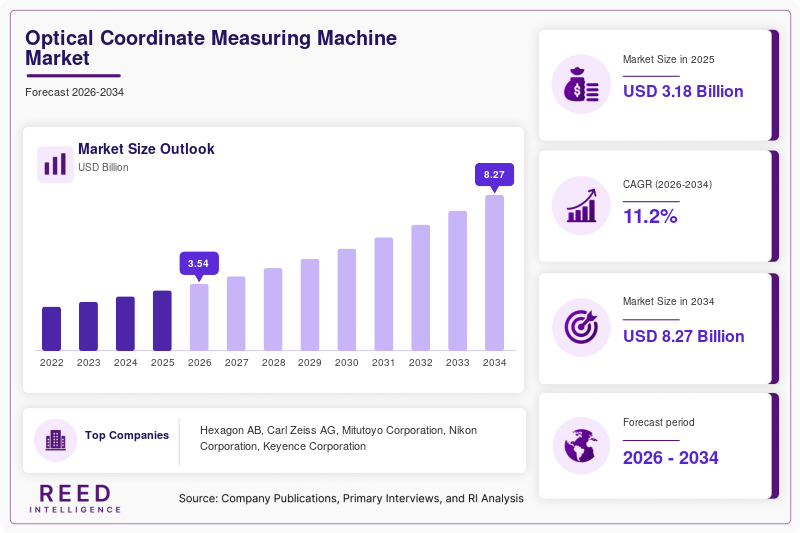
The global Optical Coordinate Measuring Machine Market size was valued at USD 3.18 billion in 2026 and is projected to reach USD 7.42 billion by 2034, expanding at a CAGR of 11.2% during the forecast period from 2026 to 2034. Optical coordinate measuring machines (OCMMs) are becoming essential precision metrology systems across automotive, aerospace, electronics, medical device manufacturing, and semiconductor sectors due to their ability to deliver non-contact, high-speed, and micron-level dimensional inspection. Growing global emphasis on precision engineering, miniaturization of components, and Industry 4.0 integration has created favorable market conditions. One major global factor supporting growth is the rapid digital transformation of manufacturing environments, where smart factories increasingly require automated quality control systems that can integrate with robotics, AI-powered inspection, and cloud analytics. OCMMs offer manufacturers enhanced productivity by reducing inspection cycle times while improving accuracy in complex geometries, making them particularly suitable for advanced manufacturing lines. Increasing investment in electric vehicles, semiconductor fabrication, and precision healthcare equipment has further accelerated adoption. As industries shift toward zero-defect production standards, demand for optical measurement systems continues to rise across both developed and emerging economies.
Key Highlights
- North America dominated the market with a 36.4% share in 2025.
- Asia Pacific is expected to grow at the fastest CAGR of 12.8% during 2026–2034.
- By product type, video measuring machines accounted for the largest share of 42.1%, while multisensor optical systems are projected to grow at a CAGR of 13.6%.
- By application, automotive dimensional inspection led with a 39.4% share, whereas semiconductor inspection is expected to expand at a CAGR of 14.1%.
- The United States remained the dominant country, with market values of USD 720 million in 2024 and USD 795 million in 2025.
Market Trends
AI-enabled metrology platforms are reshaping industrial inspection workflows
Artificial intelligence integration is emerging as a defining trend in the Optical Coordinate Measuring Machine Market. Manufacturers are increasingly deploying AI-driven software that automates defect recognition, predictive calibration, and adaptive measurement strategies. These systems can interpret large datasets generated from optical scanning and provide real-time process optimization. This trend is particularly visible in electronics and semiconductor industries where component tolerances are shrinking rapidly. AI-based OCMM platforms also reduce dependency on skilled labor by simplifying programming and improving repeatability. As smart manufacturing adoption expands globally, companies are prioritizing systems that combine optical hardware with intelligent software ecosystems to improve throughput, reduce scrap rates, and support predictive quality assurance initiatives.
Demand for multisensor and hybrid systems is expanding across precision industries
A growing market trend is the shift from standalone optical systems toward multisensor OCMMs that combine vision, laser, white light, and tactile technologies within one platform. These hybrid systems improve versatility by allowing manufacturers to inspect varied materials, reflective surfaces, and micro-components using a single machine. Automotive suppliers increasingly use multisensor systems for battery component inspection, while medical device manufacturers prefer them for complex implants and surgical tools. This trend is strengthening because manufacturers seek cost-efficient systems capable of handling diverse production requirements without multiple inspection setups. Enhanced flexibility, improved measurement speed, and broader application range are driving strong adoption across advanced industrial sectors.
Market Drivers
Expansion of electric vehicle and advanced automotive manufacturing
The global rise in electric vehicle production is a significant driver for the Optical Coordinate Measuring Machine Market. EV manufacturing requires precise inspection of battery casings, electronic connectors, lightweight materials, and drivetrain components, all of which demand non-contact high-accuracy measurement. OCMMs provide essential support for dimensional verification in automated assembly lines. Automotive OEMs are increasingly investing in optical systems to improve efficiency, reduce production errors, and meet stringent safety regulations. As EV adoption accelerates in North America, Europe, and Asia Pacific, suppliers are expanding precision metrology infrastructure. This industrial transformation is creating sustained demand for optical measurement technologies that support mass production with enhanced quality assurance.
Semiconductor miniaturization and electronics precision requirements
The semiconductor and consumer electronics industries are fueling strong growth due to increasing component miniaturization. Optical coordinate measuring machines are critical for inspecting wafers, connectors, microchips, and PCB assemblies where traditional contact systems may damage components or fail to capture tiny geometries. With global chipmakers investing in advanced fabrication nodes and packaging technologies, OCMM demand is increasing for sub-micron precision applications. Consumer electronics brands also rely on optical systems for smartphones, wearables, and compact sensors. As device complexity rises and tolerance thresholds tighten, manufacturers are prioritizing non-contact inspection systems that offer speed, repeatability, and compatibility with automated production systems.
Market Restraint
High capital investment and integration complexity limit adoption among smaller manufacturers
Despite strong growth potential, the Optical Coordinate Measuring Machine Market faces a notable restraint in the form of high upfront investment costs and implementation challenges. Advanced optical metrology systems often require substantial capital expenditure, including hardware acquisition, software licensing, calibration tools, and operator training. For small and medium-sized manufacturers, particularly in cost-sensitive developing markets, this creates a barrier to adoption. Integration with existing manufacturing execution systems and automation infrastructure can also be technically demanding. Industries with lower production volumes may struggle to justify ROI compared to traditional measurement tools. For example, smaller machine shops in emerging economies often continue using manual or tactile systems due to affordability concerns, slowing widespread penetration of advanced OCMM technologies.
Market Opportunities
Rising medical device manufacturing creates new precision inspection demand
Medical device production is presenting major growth opportunities for the Optical Coordinate Measuring Machine Market. Increasing global demand for implants, diagnostic devices, surgical instruments, and microfluidic equipment requires extremely accurate dimensional control. Optical systems are particularly suitable for inspecting delicate or sterile-sensitive components without physical contact. Regulatory requirements in healthcare manufacturing are becoming stricter, encouraging adoption of advanced metrology solutions. As aging populations and healthcare investments rise globally, OCMM suppliers can expand through specialized solutions for orthopedic implants, dental devices, and minimally invasive surgical products. This segment offers stable long-term growth due to regulatory compliance and technological innovation.
Emerging industrial automation in developing economies supports market expansion
Developing economies across Southeast Asia, Latin America, and the Middle East are rapidly modernizing industrial infrastructure, creating substantial opportunities for OCMM vendors. Governments are investing in smart manufacturing, aerospace, and electronics production to diversify industrial bases. As these regions adopt Industry 4.0 frameworks, demand for automated quality control systems is increasing. Local manufacturers are transitioning from manual inspection toward scalable optical solutions to compete globally. Vendors offering modular, cost-efficient, and cloud-integrated systems are likely to gain traction. Expansion into these underpenetrated markets could significantly increase global addressable demand while diversifying revenue beyond mature industrial economies.
Segmental Analysis
By Product Type
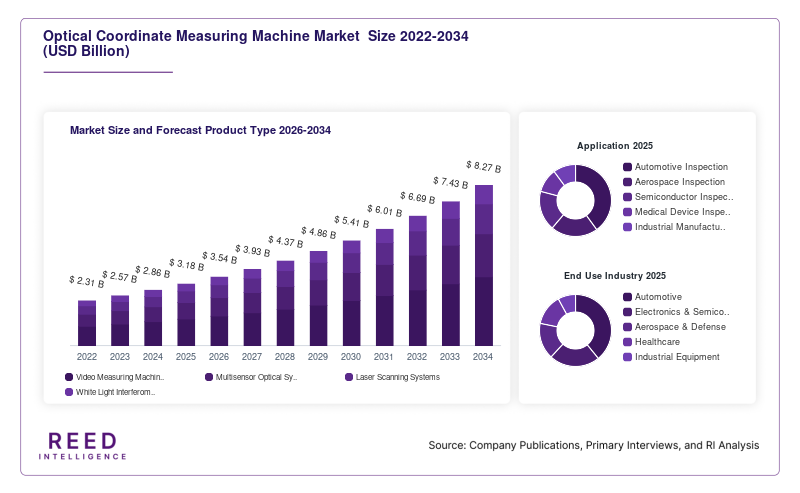
Video measuring machines dominated the Optical Coordinate Measuring Machine Market in 2024, accounting for 42.1% of total share. These systems are widely adopted because they offer fast, non-contact inspection suitable for automotive, electronics, and medical sectors. Their ability to inspect small components with high repeatability while reducing production downtime has strengthened market preference. Video measuring machines also provide cost advantages compared to more advanced multisensor systems, making them suitable for both large manufacturers and mid-sized industrial facilities.
Multisensor optical systems are projected to witness the fastest CAGR of 13.6% during the forecast period. Growth is driven by rising demand for versatile platforms capable of combining vision, laser, and tactile measurement. These systems support broader industrial applications, particularly in aerospace and semiconductors where complex geometries require multiple inspection approaches. Their flexibility is increasing enterprise-level adoption.
By Application
Automotive dimensional inspection represented the dominant application segment in 2024 with a 39.4% market share. Automotive manufacturers increasingly rely on optical systems for body panels, EV battery housings, and drivetrain components. The transition toward lightweight materials and precision battery systems has expanded demand. OCMMs reduce quality deviations and support automated assembly processes, making them critical for modern automotive manufacturing.
Semiconductor inspection is forecast to expand at the fastest CAGR of 14.1% through 2034. Growth stems from rising chip miniaturization, packaging complexity, and wafer precision requirements. Optical systems provide critical non-contact measurement for microelectronics. Increasing global semiconductor fabrication investments are expected to strengthen this segment significantly.
By End Use Industry
Automotive manufacturing remained the leading end-use industry in 2024, capturing 33.8% of market share. Demand is supported by high-volume production, strict safety regulations, and rising EV manufacturing. Optical coordinate systems improve production efficiency and dimensional consistency. OEMs are investing heavily in advanced inspection technologies to maintain competitiveness and reduce recalls.
Medical device manufacturing is anticipated to grow at the fastest CAGR of 13.2% over the forecast period. The need for precise inspection of implants, diagnostic tools, and surgical equipment is rising. Regulatory quality standards and increasing healthcare manufacturing investments are key factors supporting growth.
Regional Analysis
North America
North America accounted for 36.4% of the global Optical Coordinate Measuring Machine Market in 2025 and is projected to maintain a CAGR of 10.4% through 2034. The region benefits from strong adoption across aerospace, automotive, semiconductor, and defense industries. Advanced manufacturing ecosystems in the United States and Canada continue to drive investments in automated metrology solutions. Industry 4.0 deployment, combined with substantial R&D funding, supports sustained demand for high-precision optical systems.
The United States dominates the regional market due to its strong aerospace manufacturing base and semiconductor investment expansion. Federal support for domestic chip manufacturing and EV production has accelerated OCMM adoption. Precision compliance standards in defense and medical manufacturing also contribute to growth. The country’s emphasis on reshoring advanced manufacturing is a distinct factor strengthening long-term market demand.
Europe
Europe held 27.6% of the global market share in 2025 and is forecast to grow at a CAGR of 10.8% during the forecast period. Germany, France, Italy, and the UK are leading adopters due to robust industrial automation and automotive engineering sectors. The region’s focus on sustainable manufacturing and smart factory development is encouraging investment in optical metrology technologies.
Germany leads the European market, supported by its automotive and industrial machinery sectors. Precision manufacturing requirements in electric mobility, battery systems, and industrial robotics are major contributors. The country’s export-oriented engineering ecosystem demands consistent dimensional quality, creating sustained demand for OCMM systems integrated with digital production platforms.
Asia Pacific
Asia Pacific captured 24.8% of global market share in 2025 and is expected to register the fastest CAGR of 12.8% through 2034. Rapid industrialization, electronics manufacturing growth, and expanding semiconductor investments in China, Japan, South Korea, and India are key growth factors. The region is increasingly becoming a global production hub for precision components.
China remains the dominant country in Asia Pacific due to its large-scale electronics, EV, and semiconductor industries. Government support for advanced manufacturing and domestic technology upgrades is accelerating optical metrology deployment. Massive factory automation initiatives and competitive export manufacturing are unique factors fueling strong market expansion.
Middle East & Africa
The Middle East & Africa region represented 5.8% of the global market in 2025 and is projected to grow at a CAGR of 9.6% through 2034. Growth is supported by increasing aerospace investments, industrial diversification, and infrastructure modernization. Gulf economies are investing in manufacturing ecosystems that require advanced quality control technologies.
Saudi Arabia dominates the regional market due to industrial diversification under national economic transformation strategies. Investments in aerospace, defense, and industrial automation are increasing demand for advanced metrology systems. Strategic development of local manufacturing capabilities is a unique factor driving OCMM market growth.
Latin America
Latin America held 5.4% market share in 2025 and is anticipated to grow at a CAGR of 9.9% through 2034. Automotive manufacturing, industrial modernization, and medical equipment production are supporting regional demand. Brazil and Mexico are primary contributors due to industrial supply chain expansion.
Brazil leads the regional market because of its automotive and industrial equipment sectors. Increased investment in precision manufacturing and export competitiveness is supporting OCMM adoption. Local modernization of production facilities serves as a unique regional growth factor.

Competitive Landscape
The Optical Coordinate Measuring Machine Market is moderately consolidated, with major players competing through innovation, software integration, and geographic expansion. Hexagon AB remains a leading company due to its broad metrology portfolio, advanced automation capabilities, and global industrial presence. Recent developments include expanded AI-powered quality control platforms. Carl Zeiss AG maintains strong market positioning through high-precision optical systems for semiconductor and healthcare industries. Nikon Corporation continues expanding through advanced imaging metrology. Mitutoyo Corporation emphasizes cost-efficient industrial solutions, while Keyence Corporation focuses on automation-friendly inspection platforms. Competitive dynamics increasingly revolve around software ecosystems, cloud integration, and multisensor technology advancement.
Key Players
- Hexagon AB
- Carl Zeiss AG
- Mitutoyo Corporation
- Nikon Corporation
- Keyence Corporation
- OGP Measurement Systems
- FARO Technologies
- Creaform Inc.
- Jenoptik AG
- Perceptron Inc.
- Vision Engineering Ltd.
- Micro-Vu Corporation
- Werth Messtechnik
- Renishaw plc
- GOM GmbH
Recent Developments
- Hexagon AB expanded its AI-powered optical metrology software portfolio in 2025 to improve automated dimensional inspection accuracy across automotive, aerospace, and semiconductor manufacturing environments.
- Carl Zeiss AG increased production capacity for advanced optical coordinate measuring systems in Germany in 2025 to support rising demand from EV battery inspection and semiconductor precision measurement sectors.
- Mitutoyo Corporation launched next-generation high-accuracy optical coordinate measuring machines in 2025 to strengthen precision inspection capabilities for aerospace, medical device, and industrial automation applications.
Optical Coordinate Measuring Machine Market Segments
Product Type
- Video Measuring Machines
- Multisensor Optical Systems
- Laser Scanning Systems
- White Light Interferometers
Application
- Automotive Inspection
- Aerospace Inspection
- Semiconductor Inspection
- Medical Device Inspection
- Industrial Manufacturing
End Use Industry
- Automotive
- Electronics & Semiconductor
- Aerospace & Defense
- Healthcare
- Industrial Equipment
By Region
- North America
- Europe
- APAC
- Middle East and Africa
- LATAM