Optical Encryption Market Size, Share & Demand Report By Component (Optical Transponders, Encryption Software, Key Management Systems), By Application (Data Center Interconnect, Telecom Backbone Security, Government & Defense Networks, Cloud & Enterprise Networking), By End-Use Industry (Telecommunications, BFSI, IT & Cloud Service Providers, Government & Defense), By Region & Segment Forecasts, 2026–2034
USD 3950
Market Overview
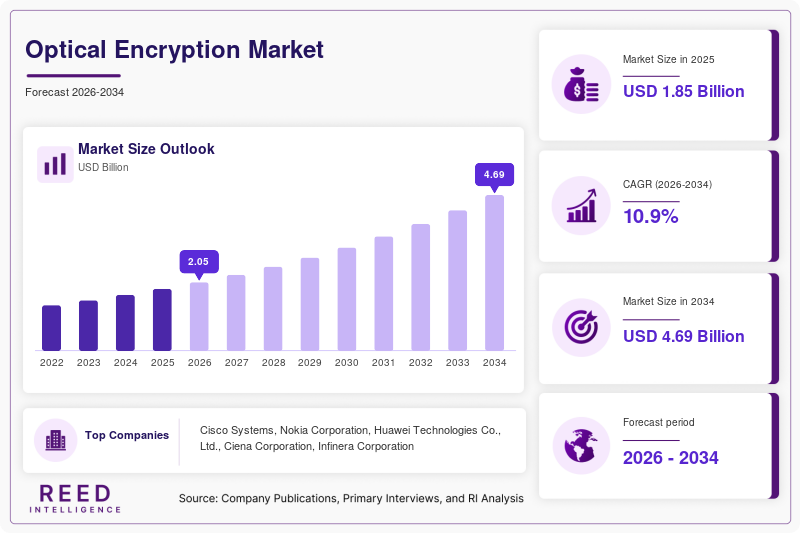
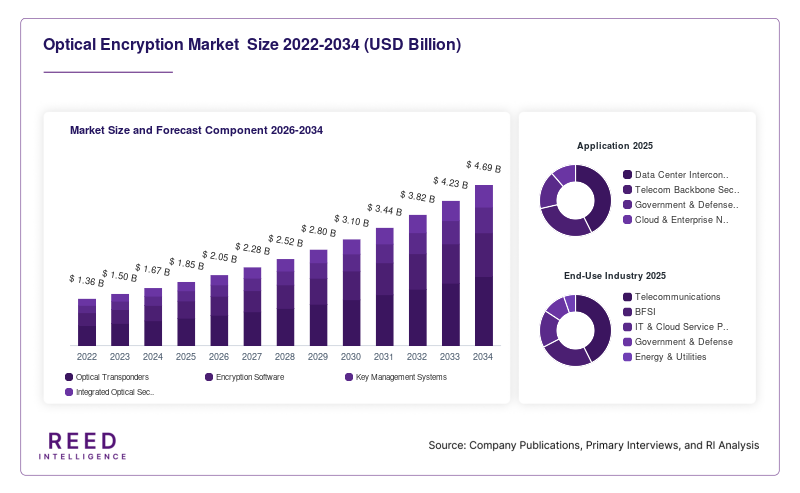
The global Optical Encryption Market size is witnessing steady expansion, with the market valued at USD 1.85 billion in 2026 and projected to reach USD 4.28 billion by 2034, growing at a CAGR of 10.9% during 2026–2034. This growth is primarily driven by the increasing need for ultra-secure data transmission across fiber-optic communication networks, particularly in sectors such as defense, banking, telecommunications, and cloud infrastructure. The rise in cyberattacks targeting high-speed data networks has pushed enterprises to adopt optical-layer encryption solutions that ensure security without compromising bandwidth efficiency or latency performance. Additionally, global expansion of 5G infrastructure and hyperscale data centers has significantly contributed to market adoption.
A key global factor supporting market growth is the rapid digital transformation across enterprises, which has increased dependency on high-capacity optical fiber networks for secure communication and real-time data exchange. Governments and private organizations are investing heavily in quantum-safe encryption technologies, further strengthening the demand for optical encryption systems.
Key Highlights
- North America dominated the market with a 34.2% share in 2025.
- Asia Pacific is expected to grow at the fastest CAGR of 11.2% during 2026–2034.
- By equipment type, optical transponders accounted for the largest share of 38.5%.
- while encryption software solutions are projected to grow at a CAGR of 12.4%.
- By application, data center interconnect led with a 41.7% share, whereas telecom backbone security is expected to expand at a CAGR of 11.8%.
- The United States remained the dominant country, with market values of USD 510 million in 2024 and USD 560 million in 2025.
Market Trends
Integration of Quantum-Safe Encryption in Optical Networks
One of the most significant trends shaping the Optical Encryption Market is the integration of quantum-safe encryption technologies into optical communication systems. With the rapid advancement of quantum computing, traditional encryption methods face increasing vulnerability. As a result, enterprises and governments are actively investing in post-quantum cryptography and quantum-resistant algorithms embedded directly into optical transport layers. This integration ensures that high-speed fiber networks remain secure even against future computational threats. Telecom operators and defense organizations are leading adopters, deploying hybrid encryption systems that combine classical and quantum-safe protocols. Additionally, research institutions are collaborating with technology vendors to develop standardized quantum-secure optical frameworks. This trend is expected to redefine long-term security architecture in global communication networks.
Expansion of Software-Defined Optical Encryption Solutions
Another emerging trend is the shift toward software-defined optical encryption platforms that offer centralized control, automation, and scalability. Unlike traditional hardware-based encryption systems, software-defined solutions enable dynamic key management and real-time encryption policy updates across distributed optical networks. This flexibility is particularly valuable for cloud service providers and large enterprises managing multi-region data centers. Vendors are increasingly integrating AI-driven monitoring tools that detect anomalies in encrypted optical traffic and automatically adjust security parameters. The adoption of SDN (Software Defined Networking) and NFV (Network Function Virtualization) is further accelerating this transition. As organizations prioritize operational efficiency and cost reduction, software-defined optical encryption is expected to become a standard architecture in next-generation network security frameworks.
Market Drivers
Rising Demand for High-Speed Secure Data Transmission
The increasing demand for high-speed data transmission combined with stringent security requirements is a major driver of the Optical Encryption Market. Industries such as banking, healthcare, and cloud computing rely heavily on fiber-optic networks to transfer sensitive and large-scale datasets in real time. As data breaches become more sophisticated, organizations are adopting optical-layer encryption to secure data without introducing latency or reducing network performance. Unlike traditional encryption methods that operate at higher network layers, optical encryption provides line-rate security, making it ideal for ultra-low-latency applications. The expansion of 5G networks, IoT ecosystems, and edge computing infrastructure is further intensifying the need for secure optical communication channels across global networks.
Growing Deployment of Data Centers and Cloud Infrastructure
Another key driver is the rapid expansion of hyperscale data centers and cloud infrastructure globally. Leading cloud service providers are increasingly deploying optical encryption technologies to secure inter-data center communication and protect sensitive workloads. As enterprises migrate to hybrid and multi-cloud environments, ensuring secure optical connectivity between distributed infrastructure has become critical. Optical encryption systems enable seamless protection of data in transit across high-capacity fiber links without compromising throughput. Furthermore, increasing regulatory compliance requirements related to data privacy and cross-border data transfers are encouraging enterprises to invest in advanced optical security solutions. This trend is particularly strong among financial institutions and global IT service providers.
Market Restraint
High Deployment Cost and Complex Integration Challenges
A significant restraint affecting the Optical Encryption Market is the high initial cost associated with deployment and integration of optical encryption systems. These solutions require specialized hardware such as encryption-enabled optical transponders, advanced key management systems, and compatible network infrastructure. For small and medium-sized enterprises, the capital expenditure can be prohibitive. Additionally, integrating optical encryption into existing legacy network architectures often involves complex upgrades and compatibility challenges. Network downtime during implementation further adds to operational costs, discouraging rapid adoption. In developing regions, limited technical expertise and infrastructure constraints also slow down deployment. As a result, despite strong demand for secure communication systems, cost and integration complexity remain key barriers to widespread market penetration.
Market Opportunities
Expansion in 5G and Next-Generation Telecom Networks
The global rollout of 5G networks presents a substantial opportunity for the Optical Encryption Market. 5G infrastructure relies heavily on high-capacity optical fiber backhaul networks that require robust security mechanisms to protect massive volumes of real-time data. Optical encryption enables telecom operators to secure these high-speed links without affecting performance, making it highly suitable for 5G use cases. As countries continue to expand 5G coverage and prepare for 6G research initiatives, demand for advanced optical security solutions is expected to grow significantly. Network slicing, edge computing, and IoT-driven applications further increase the complexity of telecom networks, creating additional opportunities for optical encryption deployment across distributed architectures.
Rising Adoption in Defense and Critical Infrastructure Security
Another major opportunity lies in the growing adoption of optical encryption technologies in defense communication systems and critical infrastructure protection. Governments are increasingly focusing on securing military communication networks, satellite data links, and intelligence systems from cyber threats. Optical encryption provides a highly secure and low-latency solution suitable for mission-critical operations. Additionally, industries such as energy, transportation, and utilities are adopting fiber-based secure communication systems to protect operational data and control systems. Increasing geopolitical tensions and cybersecurity threats are accelerating investments in secure optical communication technologies, creating long-term growth opportunities for market players.
Segmental Analysis
By Component
Optical transponders dominated the market with a 42.3% share in 2024, as they form the core hardware enabling encryption at the optical layer. Their ability to support high-speed secure data transmission across long distances makes them essential in telecom and data center applications.
Encryption software is the fastest-growing subsegment, projected at a CAGR of 12.4%, driven by increasing demand for flexible and scalable security solutions. Software-based encryption enables centralized management and integration with SDN architectures, making it highly attractive for cloud environments.
By Application
Data center interconnect held the largest share at 41.7% in 2024, driven by exponential growth in cloud computing and hyperscale data centers. Secure optical links between distributed facilities are critical for data integrity and operational continuity.
Telecom backbone security is the fastest-growing application, expected to expand at a CAGR of 11.8%, due to rising 5G deployments and increasing cybersecurity threats targeting telecom infrastructure.
By End-Use Industry
Telecommunications dominated with a 39.5% share in 2024, as operators increasingly deploy encrypted optical networks to support high-speed data transmission. The need for secure and reliable communication infrastructure continues to drive adoption.
The BFSI sector is the fastest-growing end-use industry, with a projected CAGR of 11.5%, driven by increasing digital banking transactions and stringent data protection regulations requiring secure optical communication systems.
Regional Analysis
North America
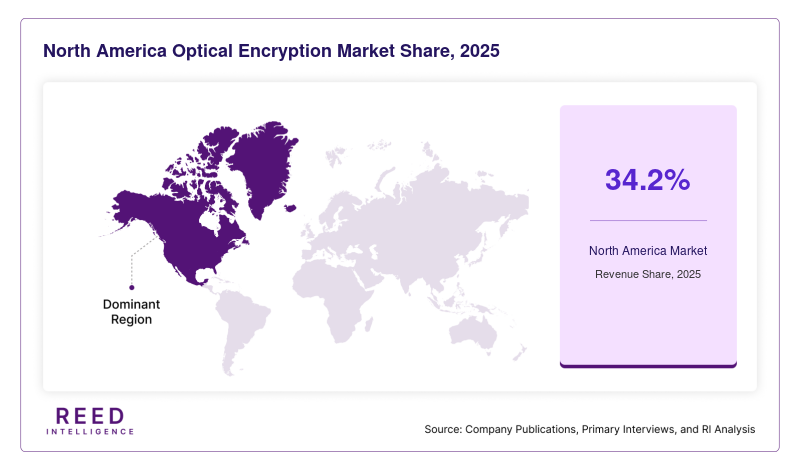
North America held approximately 34.2% market share in 2025, with a projected CAGR of 10.3% during 2026–2034. The region remains a dominant hub due to advanced telecommunications infrastructure and early adoption of optical security technologies. Strong presence of hyperscale data centers and leading cloud providers further strengthens market demand.
The United States leads the regional market, driven by extensive investment in defense communication systems and next-generation fiber networks. Increasing cybersecurity threats and government-backed digital infrastructure modernization programs are key growth contributors.
Europe
Europe accounted for nearly 27.6% share in 2025, with a forecast CAGR of 9.8% during 2026–2034. The region benefits from strong regulatory frameworks emphasizing data protection and privacy.
Germany leads the European market, supported by industrial automation and secure enterprise networking initiatives. Expansion of cross-border data infrastructure within the EU is further accelerating optical encryption adoption.
Asia Pacific
Asia Pacific accounted for approximately 23.9% market share in 2025 and is projected to grow at the fastest CAGR of 11.2% (2026–2034), making it the most dynamic regional market.
China dominates the region with more than 40% share of Asia Pacific revenue, driven by large-scale 5G deployment, AI infrastructure expansion, and government-led cybersecurity initiatives. The country is also investing heavily in next-generation optical transport networks (OTN) and secure data center interconnectivity.
Middle East & Africa
The MEA region held approximately 7.1% market share in 2025, with a projected CAGR of 10.1% (2026–2034). Growth is primarily driven by smart city initiatives, telecom modernization, and increasing cybersecurity investments in government sectors.
The United Arab Emirates leads the region, accounting for nearly 30–35% of MEA market revenue, supported by large-scale projects such as smart governance platforms, digital banking infrastructure, and secure national communication networks.
Latin America
Latin America accounted for around 7.2% market share in 2025, with a steady CAGR of 9.6% (2026–2034). Growth is primarily driven by broadband expansion, increasing cloud adoption, and rising demand for secure enterprise connectivity.
Brazil dominates the region with nearly 45% of total Latin American revenue, supported by large-scale telecom infrastructure investments and rapid digital banking expansion. Mexico follows, driven by manufacturing digitization and nearshoring-related IT infrastructure upgrades.
Competitive Landscape
The Optical Encryption Market is moderately consolidated, with key players focusing on product innovation, partnerships, and network security advancements. Major companies include Cisco Systems, Nokia Corporation, Huawei Technologies, Ciena Corporation, and Infinera Corporation. These players are actively investing in next-generation optical encryption platforms integrated with AI-driven network management tools.
Cisco Systems is recognized as a leading player, driven by its strong portfolio of secure networking solutions and continuous innovation in optical transport security. Recently, the company expanded its encrypted optical backbone solutions for hyperscale data centers, enhancing scalability and performance.
Competition is intensifying as companies focus on developing quantum-safe encryption capabilities and software-defined optical security platforms to address evolving cybersecurity threats.
Key Players List
- Cisco Systems
- Nokia Corporation
- Huawei Technologies Co., Ltd.
- Ciena Corporation
- Infinera Corporation
- ADVA Optical Networking SE
- Juniper Networks, Inc.
- Fujitsu Limited
- NEC Corporation
- Ericsson AB
- IBM Corporation
- Thales Group
- Keysight Technologies
- Arista Networks, Inc.
- Broadcom Inc.
- Intel Corporation
- ZTE Corporation
- F5, Inc.
- Marvell Technology, Inc.
- Lumentum Holdings Inc.
Recent Developments
- In 2025, Cisco Systems expanded its optical encryption portfolio with AI-enabled secure transport solutions for hyperscale data centers.
- In 2024, Nokia introduced quantum-safe encryption integration within its optical networking systems to enhance long-term cybersecurity resilience.
- In 2025, Ciena Corporation partnered with cloud providers to deploy software-defined encrypted optical networks across multi-region data centers.
Optical Encryption Market Segments
Component
- Optical Transponders
- Encryption Software
- Key Management Systems
- Integrated Optical Security Modules
Application
- Data Center Interconnect
- Telecom Backbone Security
- Government & Defense Networks
- Cloud & Enterprise Networking
End-Use Industry
- Telecommunications
- BFSI
- IT & Cloud Service Providers
- Government & Defense
- Energy & Utilities
By Region
- North America
- Europe
- APAC
- Middle East and Africa
- LATAM