Oral Rehydration Salts (ORS) Market Size, Share Demand Report By Product Type (Standard ORS, Rice-Based ORS, Reduced Osmolarity ORS), By Application (Diarrhea Treatment, Dehydration Management, Sports and Fitness) By Region & Segment Forecasts, 2026–2034
USD 3950
Oral Rehydration Salts (ORS) Market Size
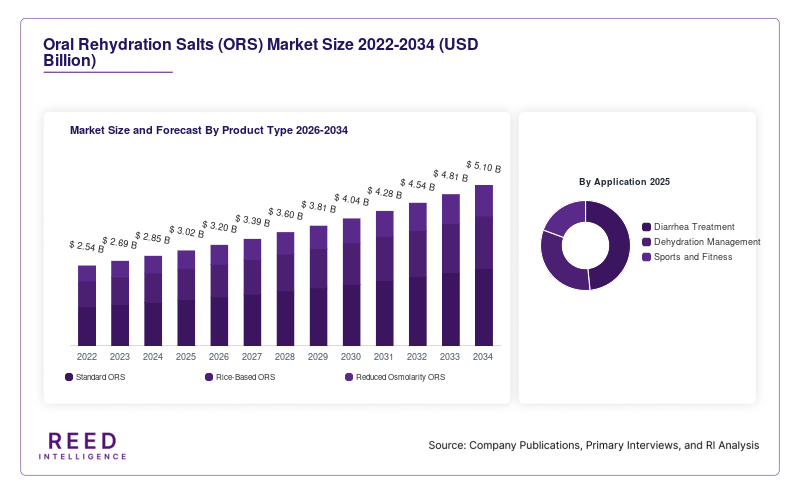
Global oral rehydration salts (ORS) market size is projected at USD 3.2 billion in 2026 and is expected to hit USD 5.1 billion by 2034 with a CAGR of 6.0%. Growing awareness of dehydration management, increasing diarrheal disease burden, pediatric healthcare requirements, and wider availability through pharmacies and community health programs are supporting demand. Detailed market data by product formulation, application, distribution channel, geography, and competitive positioning is important for assessing consumption patterns and identifying changes in healthcare access and consumer adoption.
Key takeaways
- Asia Pacific dominated the global ORS market with approximately 42.6% share in 2026, while Latin America is among the fastest-growing regions, expanding at approximately 6.8% CAGR through 2034.
- Standard ORS accounted for approximately 47.8% of global revenue in 2026, while reduced osmolarity ORS is expanding at about 6.7% CAGR as healthcare systems favor optimized electrolyte formulations.
- Diarrhea treatment represented approximately 58.4% of global revenue in 2026, maintaining its leading position due to widespread use in pediatric and adult rehydration protocols.
- Dehydration management contributed approximately 30.2% share, supported by increased use across outpatient care, travel medicine, and community health programs.
- India is an emerging country market, projected to reach approximately USD 420 million by 2034, expanding at a CAGR of 7.4% during 2026–2034.
The global oral rehydration salts (ORS) market covers powdered, tablet, liquid, and ready-to-use electrolyte formulations designed to replace fluids and essential salts lost through dehydration. Global production is estimated at more than 2.6 billion equivalent ORS sachets annually, with standard formulations accounting for approximately 47.8%, reduced osmolarity products 38.6%, and rice-based formulations 13.6% of revenue. Adoption is particularly high in regions with significant diarrheal disease prevalence and strong public-health distribution programs. Pediatric use represents a substantial proportion of consumption, while adult applications are expanding through pharmacies, clinics, sports nutrition channels, and home healthcare. Typical formulations contain sodium, chloride, potassium, and glucose in carefully controlled concentrations to facilitate intestinal fluid absorption.
-market-8040.png)
Oral Rehydration Salts (ORS) Market Trends
Formulation Innovation and Convenient Rehydration Formats
ORS manufacturers are increasingly focusing on optimized electrolyte compositions, improved dissolution, palatability, and convenient dosage formats. Reduced-osmolarity formulations are gaining adoption because their electrolyte and glucose concentrations are designed to improve fluid absorption while reducing stool volume in appropriate clinical settings. Manufacturers are also developing single-dose sachets, effervescent tablets, ready-to-drink solutions, and flavored formulations that simplify administration for children and adults.
Sector-specific demand is broadening beyond traditional diarrhea management. Hospitals, pediatric clinics, pharmacies, humanitarian organizations, sports facilities, travel-health providers, and household consumers increasingly use oral rehydration products for fluid-loss management. Digital health education and pharmacy-led awareness programs are also increasing consumer recognition of ORS as a targeted rehydration product rather than an ordinary beverage. Premium formulations increasingly emphasize low-sugar profiles, standardized electrolyte concentrations, and improved taste.
Oral Rehydration Salts (ORS) Market Drivers
Rising Need for Effective Dehydration Management
Dehydration associated with diarrhea, vomiting, fever, heat exposure, and other fluid-loss conditions remains a major demand driver for ORS products. Public-health programs and healthcare professionals continue to emphasize timely oral rehydration, particularly for children and vulnerable populations. More than 2.6 billion equivalent sachets of ORS are estimated to be produced globally each year, supported by pharmacy distribution, institutional procurement, and household preparedness.
Oral Rehydration Salts (ORS) Market Restraints
Product Misuse and Formulation Standardization Constraints
Improper preparation, incorrect dilution, inappropriate storage, and substitution with unsuitable beverages can reduce the effectiveness of ORS therapy. Product quality also depends on accurate concentrations of sodium, glucose, potassium, and other electrolytes. Manufacturers must maintain tight formulation tolerances and packaging integrity, particularly in hot and humid distribution environments. Limited healthcare awareness in some low-income areas can further restrict correct product utilization despite underlying dehydration-management needs.
Oral Rehydration Salts (ORS) Market Opportunities
Expansion of Pediatric, Community and Ready-to-Use Rehydration Products
Significant opportunities exist in pediatric-friendly formulations, ready-to-drink ORS, effervescent tablets, low-sugar products, and single-dose packaging. Community healthcare initiatives can increase access in rural and underserved populations through pharmacies, clinics, schools, and humanitarian supply networks. Manufacturers can also expand into sports and fitness applications with products formulated specifically for prolonged fluid loss, provided their positioning remains differentiated from conventional clinical ORS therapy.
Challenges in Oral Rehydration Salts (ORS) Market
Maintaining Quality Across Diverse Distribution Environments
ORS manufacturers face challenges in maintaining product stability, regulatory compliance, and consistent quality across international supply chains. Temperature, humidity, transportation conditions, and packaging quality can affect shelf life and usability. Public-health procurement may also involve competitive pricing and large-volume tenders, creating pressure on manufacturers to balance affordability with pharmaceutical-grade manufacturing, quality control, packaging, and distribution requirements.
Oral Rehydration Salts (ORS) Market Segmentation Analysis
Standard ORS represented approximately 47.8% of global revenue in 2026, followed by reduced osmolarity ORS at 38.6% and rice-based ORS at 13.6%. By application, diarrhea treatment dominated with 58.4%, followed by dehydration management at 30.2% and sports and fitness at 11.4%. Product adoption is strongly influenced by formulation composition, clinical suitability, packaging convenience, consumer awareness, and availability through healthcare distribution networks.
By Type
Standard ORS accounted for approximately 47.8% of 2026 revenue and represents an estimated 1.25 billion equivalent sachets of annual production. These formulations generally contain glucose and essential electrolytes including sodium, potassium, chloride, and citrate or bicarbonate-related components. Sachets commonly provide a single treatment dose that is dissolved in a specified volume of clean water. Standard formulations remain widely distributed through pharmacies, hospitals, humanitarian programs, and community health facilities.
Rice-based ORS represented approximately 13.6% share and corresponds to about 350 million equivalent sachets or treatment units annually. Instead of relying exclusively on glucose, these formulations use rice-derived carbohydrates as the energy substrate. Typical products are formulated as water-soluble powders with controlled electrolyte concentrations and carbohydrate content. Their adoption is strongest in selected Asian and emerging markets where rice-based nutritional formulations have established consumer familiarity and local production capabilities.
Reduced osmolarity ORS generated approximately 38.6% of global revenue, with annual production estimated at more than 1.0 billion equivalent treatment units. Modern reduced-osmolarity formulations typically use lower sodium and glucose concentrations than older standard formulations while maintaining the electrolyte balance required for effective oral rehydration. Powdered sachets remain the dominant format, although ready-to-use liquids and tablets are increasing. Hospitals, pediatric centers, pharmacies, and public-health programs represent major demand channels.
By Application
Diarrhea treatment represented approximately 58.4% of global ORS revenue in 2026 and accounts for more than 1.5 billion equivalent treatment units annually. Pediatric patients form a major consumption group, alongside adults experiencing acute gastrointestinal fluid loss. Hospitals, clinics, pharmacies, community health centers, and humanitarian organizations are major users. Product specifications emphasize standardized sodium and glucose concentrations, rapid dissolution, shelf stability, and packaging suitable for household and institutional use.
Dehydration management generated approximately 30.2% share, equivalent to nearly 790 million annual treatment units. Applications include fluid loss associated with vomiting, fever, heat exposure, travel-related illness, and other non-diarrheal conditions. Pharmacies and outpatient healthcare facilities represent major distribution points, while household adoption is supported by increased awareness of dehydration symptoms. Single-dose sachets, effervescent tablets, and ready-to-drink products are particularly relevant where rapid preparation and portability are important.
Sports and fitness accounted for approximately 11.4% of revenue, representing nearly 300 million equivalent units annually. Demand comes from endurance athletes, recreational fitness participants, outdoor workers, and consumers exposed to prolonged heat or physical activity. Products typically emphasize electrolyte replenishment and convenient packaging, including tablets, powders, and ready-to-drink formats. This segment remains smaller than clinical applications but is expanding as consumers become more aware of electrolyte replacement and hydration management.
Oral Rehydration Salts (ORS) Market Regional Analysis
North America Oral Rehydration Salts (ORS) Market
North America accounted for approximately 19.8% of global revenue in 2026, led by the United States and Canada. The United States contributes more than 80% of regional revenue. Dehydration management represents approximately 42% of regional demand, while diarrhea treatment contributes 38% and sports and fitness approximately 20%. Retail pharmacies, hospitals, pediatric practices, travel-health channels, and sports nutrition outlets form the principal distribution network.
Europe Oral Rehydration Salts (ORS) Market
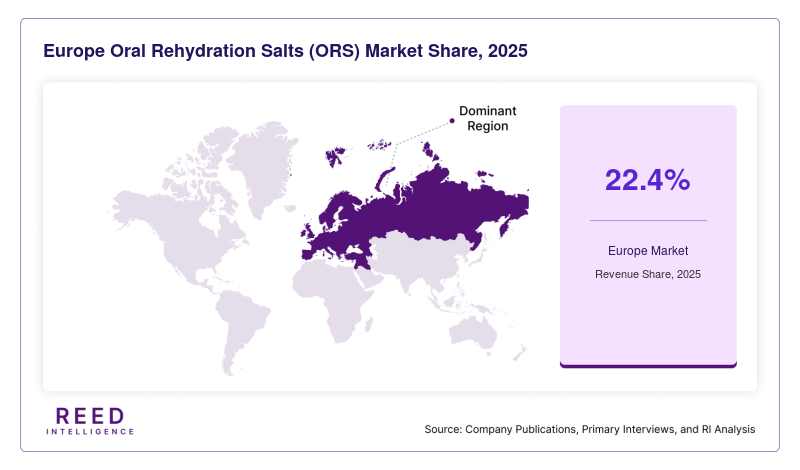
Europe represented approximately 22.4% share in 2026, with Germany, the United Kingdom, France, Italy, and Spain serving as key contributors. Diarrhea treatment contributes around 49% of regional revenue, dehydration management 36%, and sports and fitness 15%. Demand is supported by established pharmacy networks, clinical awareness, pediatric healthcare, travel medicine, and increasing consumer interest in convenient electrolyte products.
Asia Pacific Oral Rehydration Salts (ORS) Market
Asia Pacific dominated the global market with approximately 42.6% share in 2026. China, India, Japan, South Korea, Indonesia, and Australia are major contributors, with China and India together accounting for a substantial portion of regional consumption. Diarrhea treatment contributes nearly 63% of regional demand, followed by dehydration management at 28% and sports and fitness at 9%. Public-health initiatives, large populations, pediatric demand, and pharmacy accessibility support continued expansion.
Latin America Oral Rehydration Salts (ORS) Market
Latin America held approximately 9.1% of global revenue in 2026, with Brazil, Mexico, Argentina, Colombia, and Chile representing important contributors. Diarrhea treatment accounts for nearly 57% of regional revenue, dehydration management 31%, and sports and fitness 12%. Pharmacy-based distribution, pediatric healthcare, tropical climate conditions, and increasing awareness of oral rehydration contribute to regional demand.
Middle East & Africa Oral Rehydration Salts (ORS) Market
Middle East & Africa represented approximately 6.1% share in 2026. Saudi Arabia, the United Arab Emirates, South Africa, Egypt, and Nigeria are among the leading contributors. Diarrhea treatment accounts for approximately 61% of demand, while dehydration management contributes 30% and sports and fitness 9%. Humanitarian healthcare programs, pediatric care, pharmacy expansion, and initiatives addressing water- and sanitation-related illnesses support long-term adoption.
Top players in Oral Rehydration Salts (ORS) Market
- Reckitt Benckiser Group PLC
- Abbott Laboratories
- Fresenius Kabi AG
- FDC Limited
- Dr. Reddy's Laboratories Ltd.
- Cipla Limited
- Novartis AG
- Sanofi
- Himalaya Wellness Company
- Unilever PLC
- Jana Care
- Electral
Recent Developments in Oral Rehydration Salts (ORS) Market
- 2026, January: ORS manufacturers continued expanding single-dose and convenient electrolyte formats designed for household, pharmacy, pediatric, and travel-health use.
- 2025, November: Healthcare suppliers increased attention to reduced-osmolarity formulations and standardized electrolyte compositions across pediatric and adult rehydration portfolios.
- 2025, August: Manufacturers expanded flavored and easier-to-dissolve ORS products to improve consumer acceptance and simplify administration, particularly among pediatric users.
- 2025, May: Public-health and humanitarian procurement programs increased distribution of oral rehydration products in communities affected by diarrheal disease and limited healthcare access.
- 2024, October: ORS companies broadened pharmacy and digital-health education initiatives focused on correct preparation, dosage, hydration awareness, and appropriate use of oral rehydration products.
Oral Rehydration Salts (ORS) Market Segments
By Product Type
- Standard ORS
- Rice-Based ORS
- Reduced Osmolarity ORS
By Application
- Diarrhea Treatment
- Dehydration Management
- Sports and Fitness
By Region
- North America
- Europe
- APAC
- Middle East and Africa
- LATAM