Orbital Atherectomy Market Size, Share & Demand Report By Application (Coronary Artery Disease, Peripheral Artery Disease), By Product Type (Orbital Atherectomy Systems, Accessories & Consumables), By End-Use (Hospitals, Ambulatory Surgical Centers, Specialty Clinics), By End-User Specialty (Interventional Cardiology, Vascular Surgery), By Region & Segment Forecasts, 2025–2034
USD 3950
Market Overview
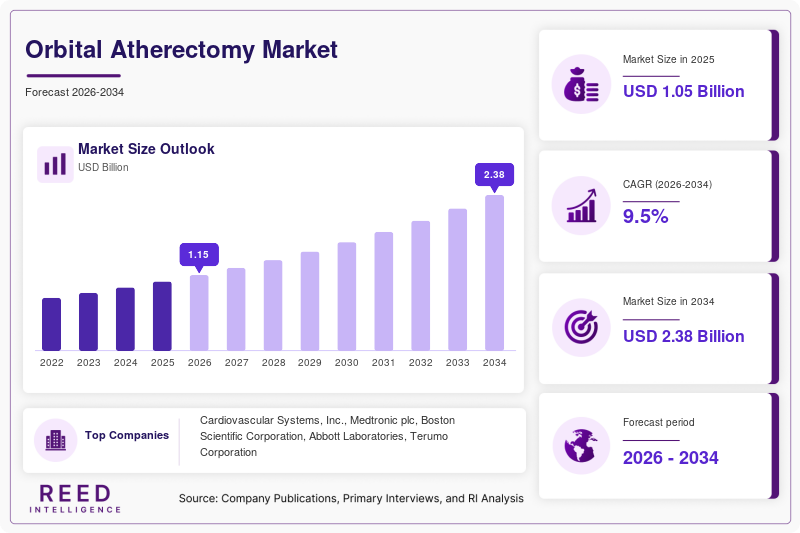
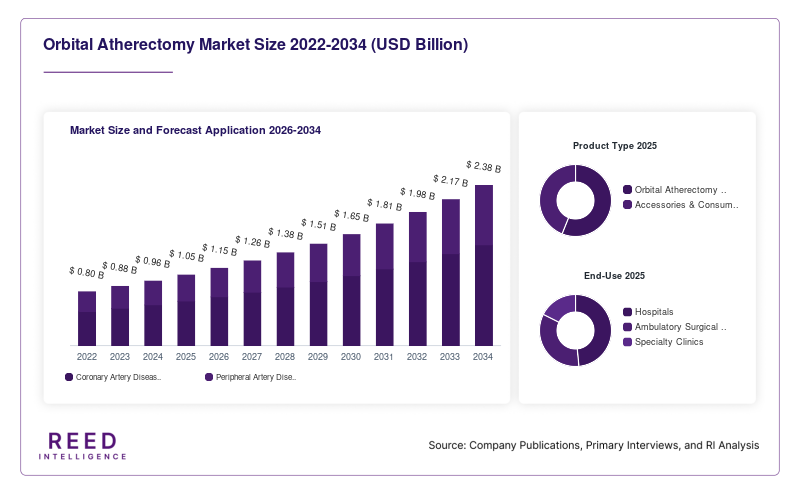
The global Orbital Atherectomy Market size was valued at USD 1.05 billion in 2026 and is projected to reach USD 2.38 billion by 2034, expanding at a CAGR of 9.5% during the forecast period (2026–2034). The market growth is primarily supported by the rising burden of cardiovascular diseases and increasing adoption of minimally invasive procedures worldwide. Orbital atherectomy systems are gaining traction for their effectiveness in treating calcified coronary and peripheral artery lesions, offering improved procedural outcomes and reduced recovery time.
A key global factor driving the Orbital Atherectomy Market is the growing preference for advanced interventional cardiology procedures that enhance precision and safety. Technological advancements in device design, such as improved crown coatings and enhanced orbital mechanisms, have significantly improved treatment efficacy. Additionally, the expansion of healthcare infrastructure in emerging economies has enabled wider adoption of these systems.
Key Highlights:
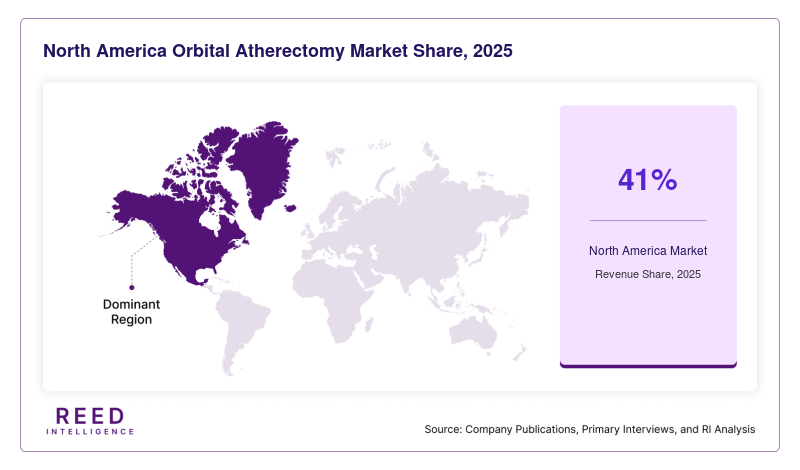
- North America dominated the market with a 41% share in 2025, while Asia Pacific is expected to register the fastest CAGR of 11.2% during the forecast period.
- By application, coronary artery disease was the leading segment, accounting for 58% share in 2024, whereas peripheral artery disease is projected to grow at a CAGR of 10.4%.
- By end-use, hospitals held the dominant share of 62% in 2024, while ambulatory surgical centers are expected to grow at a CAGR of 10.8%.
- The U.S. remained the dominant country, with market values of USD 420 million in 2024 and USD 455 million in 2025.
Market Trends
Integration of Imaging Technologies with Atherectomy Systems
The integration of intravascular imaging technologies such as optical coherence tomography (OCT) and intravascular ultrasound (IVUS) with orbital atherectomy systems is shaping the Orbital Atherectomy Market. These technologies allow clinicians to visualize arterial plaque characteristics in real time, enabling more precise lesion modification. This integration enhances procedural safety and supports better clinical decision-making, which is contributing to increased adoption among interventional cardiologists.
Expansion of Outpatient Cardiovascular Procedures
The shift toward outpatient care settings is influencing market dynamics. Ambulatory surgical centers are increasingly performing atherectomy procedures due to cost efficiency and shorter patient stays. This trend is supported by advancements in device portability and procedural simplicity. As healthcare systems aim to reduce hospital burden and costs, the adoption of orbital atherectomy in outpatient settings is expected to rise, driving overall market growth.
Market Drivers
Rising Prevalence of Calcified Arterial Lesions
The increasing incidence of heavily calcified coronary and peripheral artery diseases is a major driver of the Orbital Atherectomy Market. Traditional angioplasty techniques often struggle with such lesions, leading to suboptimal outcomes. Orbital atherectomy devices are specifically designed to treat calcified plaques effectively, improving vessel compliance and facilitating stent placement. This clinical advantage has led to higher adoption rates among healthcare providers.
Technological Advancements in Atherectomy Devices
Continuous innovation in device design and functionality is accelerating market growth. Modern orbital atherectomy systems offer improved control, reduced complication rates, and enhanced procedural efficiency. Features such as diamond-coated crowns and adjustable rotational speeds have increased treatment precision. These advancements are encouraging healthcare facilities to upgrade their equipment, thereby boosting market expansion.
Market Restraint
High Cost of Procedures and Devices
The high cost associated with orbital atherectomy procedures remains a significant restraint for the market. The devices themselves are expensive, and the procedures require specialized training and infrastructure. This limits adoption, particularly in low- and middle-income countries where healthcare budgets are constrained. Additionally, reimbursement challenges in certain regions further hinder widespread utilization. Hospitals and clinics may opt for alternative treatment methods that are more cost-effective, even if they offer comparatively lower efficacy. Addressing cost-related challenges through pricing strategies and reimbursement support will be crucial for market penetration in emerging economies.
Market Opportunities
Growth in Emerging Healthcare Markets
Emerging economies present significant opportunities for the Orbital Atherectomy Market. Rapid urbanization, increasing healthcare expenditure, and improving access to advanced medical technologies are driving demand in regions such as Asia Pacific and Latin America. Governments are investing in healthcare infrastructure, which is expected to facilitate the adoption of advanced interventional procedures, including orbital atherectomy.
Development of Next-Generation Devices
The development of next-generation orbital atherectomy systems offers strong growth potential. Innovations focusing on enhanced safety, reduced procedure time, and improved patient outcomes are expected to attract healthcare providers. Integration with digital health platforms and robotic-assisted procedures could further expand the application scope of these devices, creating new revenue streams for manufacturers.
Segmental Analysis
By Application
Coronary artery disease was the dominant subsegment, accounting for 58% of the Orbital Atherectomy Market share in 2024. The high prevalence of coronary conditions and the effectiveness of orbital atherectomy in treating calcified coronary lesions contributed to its dominance. Healthcare providers preferred this approach due to improved procedural outcomes and reduced complications.
Peripheral artery disease is expected to be the fastest-growing subsegment, with a projected CAGR of 10.4%. The increasing incidence of peripheral vascular conditions and growing awareness of advanced treatment options will drive this segment. Technological improvements enabling better treatment of peripheral lesions will further support growth.
By End-Use
Hospitals dominated the market with a 62% share in 2024. The availability of advanced infrastructure and skilled professionals enabled hospitals to perform complex procedures efficiently. The presence of specialized cardiology departments further supported this segment’s dominance.
Ambulatory surgical centers are anticipated to grow at a CAGR of 10.8%. The shift toward cost-effective outpatient procedures and shorter recovery times will drive this segment. Increasing patient preference for minimally invasive treatments in convenient settings will contribute to its growth.
By Product Type
Orbital atherectomy systems held the dominant share of 68% in 2024. These systems are widely used due to their ability to effectively treat calcified lesions and improve vessel compliance. Continuous advancements in system design have enhanced their performance and reliability.
Accessories and consumables are expected to grow at a CAGR of 10.1%. The recurring demand for consumables and the increasing number of procedures will drive this segment. Hospitals and clinics require a consistent supply of accessories, contributing to steady growth.
By End-User Specialty
Interventional cardiology accounted for the largest share of 55% in 2024. The widespread use of orbital atherectomy in coronary procedures supported this segment’s dominance. Cardiologists prefer these devices for their precision and effectiveness.
Vascular surgery is projected to grow at a CAGR of 10.2%. The increasing focus on treating peripheral artery diseases and expanding applications of orbital atherectomy in vascular procedures will drive this segment.
Regional Analysis
North America
North America accounted for 41% of the Orbital Atherectomy Market share in 2025 and is expected to grow at a CAGR of 8.7% during the forecast period. The region benefited from a well-established healthcare system and high adoption of advanced medical technologies. Favorable reimbursement policies and the presence of leading market players supported market expansion.
The United States dominated the regional market due to its advanced interventional cardiology landscape. A key growth factor was the high volume of cardiovascular procedures performed annually, supported by strong clinical expertise and access to cutting-edge devices.
Europe
Europe held a 27% market share in 2025 and is projected to grow at a CAGR of 8.9%. The region experienced steady adoption of orbital atherectomy systems due to increasing awareness and improved healthcare infrastructure. Regulatory support for innovative medical devices also contributed to market development.
Germany emerged as the leading country, driven by its strong medical device industry and emphasis on early diagnosis and treatment of cardiovascular conditions. The country’s focus on healthcare innovation supported the adoption of advanced treatment modalities.
Asia Pacific
Asia Pacific captured 19% of the market share in 2025 and is expected to grow at the fastest CAGR of 11.2%. The region’s growth was supported by expanding healthcare infrastructure and rising prevalence of cardiovascular diseases. Increasing investments in healthcare and growing medical tourism further boosted market expansion.
China dominated the region due to its large patient population and rapid healthcare modernization. Government initiatives aimed at improving access to advanced treatments played a key role in market growth.
Middle East & Africa
The Middle East & Africa accounted for 7% of the market share in 2025 and is anticipated to grow at a CAGR of 9.1%. The region showed gradual adoption of advanced medical technologies, supported by improving healthcare systems and increasing investments.
Saudi Arabia led the market due to its focus on healthcare modernization and increasing adoption of minimally invasive procedures. Government initiatives aimed at enhancing healthcare quality supported market growth.
Latin America
Latin America held a 6% share of the Orbital Atherectomy Market in 2025 and is projected to grow at a CAGR of 9.4%. The region experienced moderate growth due to improving healthcare infrastructure and increasing awareness of advanced treatment options.
Brazil dominated the regional market, driven by a growing healthcare sector and rising demand for advanced cardiovascular treatments. Expansion of private healthcare facilities contributed to increased adoption of orbital atherectomy systems.
Competitive Landscape
The Orbital Atherectomy Market is characterized by the presence of established medical device manufacturers focusing on innovation and strategic expansion. The market leader, Cardiovascular Systems, Inc., has maintained a strong position through continuous product development and clinical research. The company recently introduced an upgraded orbital atherectomy system with enhanced safety features, strengthening its market presence.
Other key players are investing in research and development to improve device performance and expand their product portfolios. Strategic collaborations, mergers, and acquisitions are common as companies aim to enhance their global footprint. The competitive environment is driven by technological advancements and the need to address evolving clinical requirements.
Key Players List
- Cardiovascular Systems, Inc.
- Medtronic plc
- Boston Scientific Corporation
- Abbott Laboratories
- Terumo Corporation
- Philips Healthcare
- B. Braun Melsungen AG
- Cook Medical
- MicroPort Scientific Corporation
- Biotronik SE & Co. KG
- Cardinal Health, Inc.
- Johnson & Johnson MedTech
- Teleflex Incorporated
- AngioDynamics, Inc.
- Asahi Intecc Co., Ltd.
Recent Developments
- Cardiovascular Systems, Inc. launched an advanced orbital atherectomy platform with improved crown durability.
- Medtronic expanded its vascular portfolio through strategic acquisitions.
- Boston Scientific introduced new imaging-integrated solutions for enhanced procedural accuracy.
- Abbott strengthened its cardiovascular device segment with new product approvals.
- Terumo focused on expanding its presence in emerging markets through distribution partnerships.
Orbital Atherectomy Market Segments
Application
- Coronary Artery Disease
- Peripheral Artery Disease
Product Type
- Orbital Atherectomy Systems
- Accessories & Consumables
End-Use
- Hospitals
- Ambulatory Surgical Centers
- Specialty Clinics
End-User Specialty
- Interventional Cardiology
- Vascular Surgery
By Region
- North America
- Europe
- APAC
- Middle East and Africa
- LATAM