Order Picker Machines Market Size, Share & Demand Report By Equipment Type (Low-Level Order Pickers, Mid-Level Order Pickers, High-Level Order Pickers, Autonomous Order Pickers), By Application (E-Commerce Fulfillment Centers, Retail Warehouses, Cold Storage Warehouses, Manufacturing Facilities, Distribution Centers), By End-Use Industry (Retail & E-Commerce, Third-Party Logistics, Manufacturing, Food & Beverage, Pharmaceuticals, Automotive), By Region & Segment Forecasts, 2026–2034
USD 3950
Market Overview
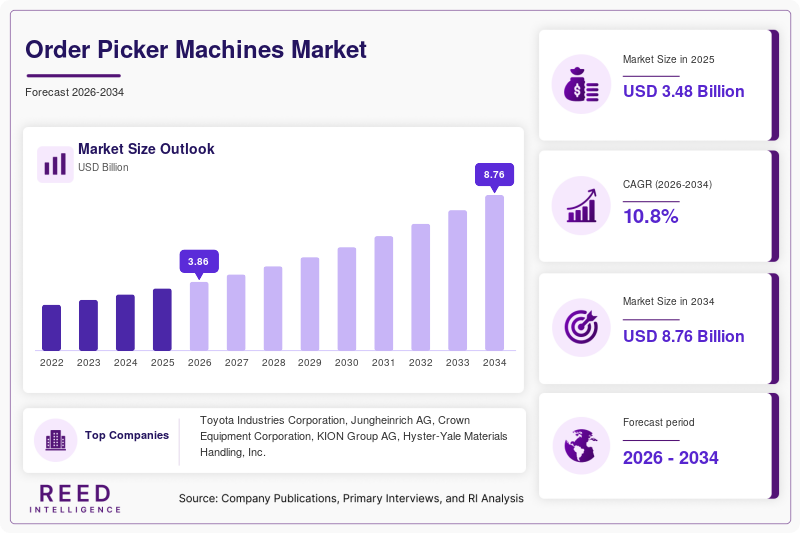
The global Order Picker Machines Market size was valued at USD 3.48 billion in 2026 and is projected to reach USD 7.91 billion by 2034, expanding at a CAGR of 10.8% during 2026–2034. The market continues to gain momentum as warehouse operators, distribution centers, and e-commerce companies increase investments in material handling automation to improve productivity and reduce order fulfillment times. Order picker machines have become an essential component of modern warehousing infrastructure, enabling operators to access inventory stored at varying heights while improving safety and operational efficiency.
The rapid expansion of e-commerce and omnichannel retailing has significantly contributed to market growth. Rising consumer expectations for same-day and next-day deliveries have encouraged logistics providers to modernize warehouse operations and adopt advanced order-picking equipment. These machines support faster inventory retrieval, lower labor requirements, and enhanced space utilization. Furthermore, growing warehouse construction activities across developing economies have created favorable conditions for equipment deployment.
Key Highlights
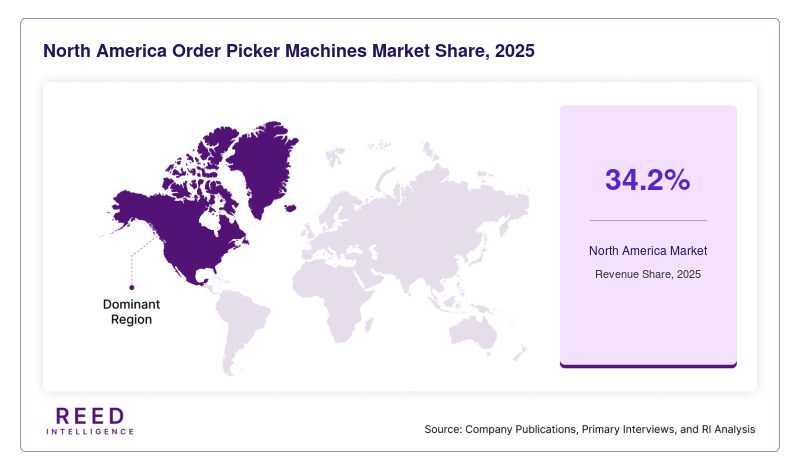
- North America dominated the market with a 34.2% share in 2025, while Asia Pacific is expected to grow at the fastest CAGR of 12.1% during 2026–2034.
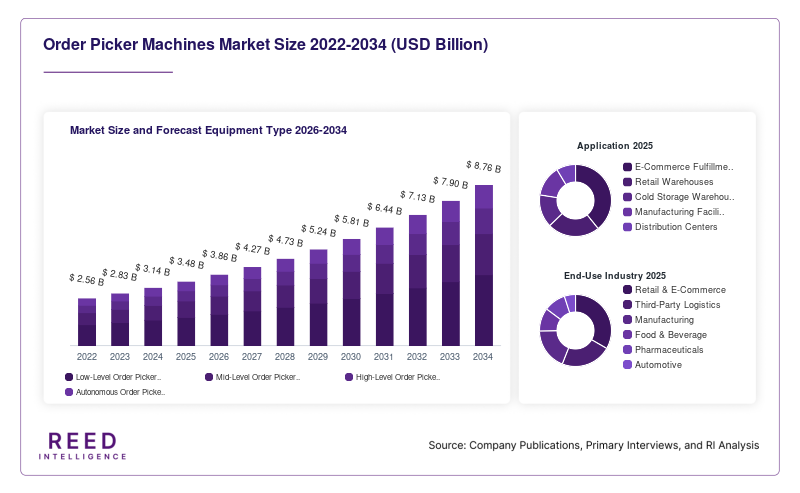
- By equipment type, low-level order pickers accounted for the largest share of 43.6%, while autonomous order pickers are projected to grow at a CAGR of 13.8%.
- By application, e-commerce fulfillment centers led with a 39.4% share, whereas cold storage warehouses are expected to expand at a CAGR of 12.9%.
- By end-use industry, retail and e-commerce accounted for the largest share of 37.8%, while third-party logistics providers are projected to grow at a CAGR of 13.2%.
- The United States remained the dominant country, with market values of USD 790 million in 2024 and USD 865 million in 2025.
Market Trends
Expansion of Smart Warehouse Integration
One of the most significant trends shaping the Order Picker Machines Market is the integration of smart warehouse technologies. Warehouse operators increasingly deploy connected equipment capable of exchanging real-time operational data with warehouse management systems and enterprise resource planning platforms. Modern order picker machines are being equipped with telematics, predictive maintenance capabilities, and performance monitoring solutions that improve fleet visibility and utilization rates. These technologies help warehouse managers optimize workflows, reduce downtime, and enhance labor productivity. The trend is particularly evident among large distribution centers seeking data-driven decision-making capabilities. As digital transformation accelerates across logistics operations, demand for intelligent order picker machines capable of supporting connected warehouse ecosystems is expected to rise steadily throughout the forecast period.
Growing Adoption of Lithium-Ion Powered Equipment
The transition from traditional lead-acid batteries to lithium-ion technology is becoming increasingly prominent across warehouse equipment fleets. Lithium-ion-powered order picker machines offer faster charging cycles, longer operational life, reduced maintenance requirements, and improved energy efficiency. Warehouse operators benefit from reduced downtime because batteries can be opportunity-charged during operational breaks. In addition, sustainability objectives adopted by major logistics and retail companies are encouraging the use of energy-efficient equipment. Manufacturers are responding by expanding lithium-ion-compatible product portfolios and incorporating advanced battery management systems. As energy costs rise and warehouse operators seek greater operational efficiency, lithium-ion adoption is expected to become a major competitive differentiator across the order picker machines industry.
Market Drivers
Rapid Growth of E-Commerce Fulfillment Operations
The continuous growth of e-commerce remains a primary factor driving demand for order picker machines worldwide. Online retail platforms process large volumes of individual orders that require accurate and efficient picking operations. Traditional manual picking methods often struggle to meet the speed requirements of modern fulfillment networks. Order picker machines enable workers to access products quickly, improve picking accuracy, and increase throughput across distribution centers. As online retailers expand warehouse footprints and establish regional fulfillment centers, demand for advanced material handling equipment continues to increase. The proliferation of direct-to-consumer delivery models and expanding product assortments further reinforce the need for efficient warehouse solutions, creating favorable market conditions for order picker machine manufacturers.
Rising Investment in Warehouse Automation Infrastructure
Warehouse automation investments are accelerating across industries seeking greater operational efficiency and labor optimization. Businesses increasingly deploy automated and semi-automated systems to address labor shortages, rising wages, and growing order complexity. Order picker machines play a vital role within these automation strategies by enabling faster inventory retrieval and supporting high-density storage environments. Companies operating large-scale logistics facilities recognize that efficient picking processes directly influence customer satisfaction and profitability. Consequently, investments in technologically advanced order picker equipment continue to rise. Government support for industrial modernization initiatives and private-sector investments in logistics infrastructure further contribute to market expansion, particularly in emerging economies experiencing rapid industrial growth.
Market Restraint
High Initial Acquisition and Maintenance Costs
The relatively high capital expenditure associated with advanced order picker machines remains a notable challenge for market growth. Modern equipment incorporating lithium-ion batteries, telematics systems, automation technologies, and enhanced safety features often requires substantial upfront investment. Small and medium-sized warehouse operators may face financial constraints when upgrading existing fleets or adopting new equipment. Beyond acquisition costs, ongoing maintenance, software updates, operator training, and battery replacement expenses can increase total ownership costs over time. These factors may delay purchasing decisions, particularly in cost-sensitive markets. For example, regional logistics providers operating smaller facilities often prioritize extending the lifespan of existing equipment rather than investing in new technology. While long-term productivity gains can offset initial expenditures, cost concerns continue to influence procurement strategies and limit adoption rates among certain end-user segments.
Market Opportunities
Emergence of Autonomous Order Picking Solutions
The increasing development of autonomous warehouse technologies presents significant opportunities for market participants. Autonomous order picker machines equipped with sensors, artificial intelligence, and navigation systems can operate with limited human intervention, reducing labor dependency and improving operational consistency. Large fulfillment centers are actively exploring autonomous solutions to address workforce shortages and enhance productivity. As technological maturity improves and implementation costs decline, adoption rates are expected to increase. Manufacturers that invest in autonomous capabilities, software integration, and fleet management platforms are likely to strengthen their market position. The growing acceptance of robotics within warehouse environments creates favorable conditions for innovation and new product development across the order picker machines sector.
Expansion of Cold Chain Logistics Networks
The rapid growth of cold chain logistics infrastructure provides another attractive opportunity for market expansion. Demand for temperature-controlled storage and transportation has increased due to rising consumption of pharmaceuticals, frozen foods, and healthcare products. Cold storage facilities require specialized material handling equipment capable of operating efficiently in low-temperature environments. Order picker machine manufacturers are developing equipment with enhanced battery performance, durable components, and operator-friendly designs tailored to cold storage applications. As governments and private organizations continue investing in food security and pharmaceutical supply chains, cold chain warehousing capacity is expected to expand substantially. This development is likely to generate significant demand for specialized order picker solutions throughout the forecast period.
Segmental Analysis
Equipment Type
Low-level order pickers represented the dominant equipment type segment and accounted for approximately 43.6% of global revenue in 2024. Their widespread adoption is attributed to extensive utilization in retail distribution centers, e-commerce warehouses, and general merchandise storage facilities. These machines are particularly effective for high-volume picking operations involving fast-moving inventory. Warehouse operators favor low-level equipment because it offers improved maneuverability, efficient picking performance, and lower acquisition costs compared to specialized alternatives. Additionally, the increasing number of fulfillment centers handling consumer goods has contributed significantly to segment leadership. The ability of low-level order pickers to support rapid order processing while maintaining operator productivity continues to reinforce their strong market position across developed and emerging regions.
Autonomous order pickers represent the fastest-growing equipment type segment and are projected to expand at a CAGR of 13.8% through 2034. Growth is driven by increasing investments in warehouse automation and artificial intelligence technologies. Companies seeking greater operational efficiency and reduced labor dependency are exploring autonomous solutions capable of navigating warehouse environments independently. These machines improve consistency, reduce human error, and support continuous operation. Technological advancements in sensors, machine vision systems, and navigation software continue to enhance performance capabilities. Furthermore, rising labor shortages in logistics-intensive regions are accelerating adoption. As implementation costs gradually decline and return-on-investment metrics improve, autonomous order pickers are expected to gain significant traction across global warehouse operations.
Application
E-commerce fulfillment centers emerged as the dominant application segment and accounted for approximately 39.4% of market revenue in 2024. The rapid growth of online shopping has increased demand for efficient order processing systems capable of handling large volumes of individual orders. Order picker machines enable warehouse operators to retrieve products quickly and accurately, supporting customer expectations for rapid delivery. Major online retailers continue expanding fulfillment infrastructure to accommodate rising order volumes and diverse product assortments. These facilities require scalable equipment solutions that enhance throughput and reduce picking times. As e-commerce penetration continues to increase globally, fulfillment centers remain the largest application area for order picker machine deployment.
Cold storage warehouses are anticipated to be the fastest-growing application segment, registering a CAGR of 12.9% during the forecast period. Increasing demand for temperature-sensitive products, including pharmaceuticals, vaccines, frozen foods, and specialty chemicals, is driving investments in cold chain infrastructure. Operators require specialized order picker equipment capable of performing efficiently under extreme environmental conditions. Manufacturers are introducing machines designed specifically for cold storage environments, featuring durable components and enhanced battery performance. The expansion of global food distribution networks and healthcare supply chains further supports demand. As cold storage capacity continues to grow worldwide, this application segment is expected to create substantial opportunities for equipment manufacturers.
End-Use Industry
Retail and e-commerce constituted the largest end-use industry segment, accounting for approximately 37.8% of global market revenue in 2024. The segment's dominance reflects the increasing complexity of inventory management and order fulfillment operations within modern retail supply chains. Retailers require efficient picking solutions to support omnichannel distribution models and maintain competitive delivery timelines. Order picker machines help improve warehouse productivity while reducing labor-intensive processes. Continuous expansion of online shopping platforms and increasing consumer demand for faster deliveries have encouraged retailers to invest in advanced warehouse equipment. Consequently, the retail and e-commerce sector continues to represent the largest source of demand for order picker machines globally.
Third-party logistics providers are projected to record the fastest CAGR of 13.2% through 2034. Logistics outsourcing trends are encouraging businesses to rely on specialized service providers for warehousing and distribution operations. Third-party logistics companies manage diverse inventory categories and handle large order volumes on behalf of multiple clients, requiring highly efficient warehouse processes. Investments in automation, fleet modernization, and smart warehouse technologies are increasing among these operators. Order picker machines play a critical role in enhancing throughput and reducing fulfillment times. As supply chains become increasingly complex and companies seek flexible logistics solutions, third-party logistics providers are expected to generate substantial future demand for advanced order picker equipment.
Regional Analysis
North America
North America accounted for approximately 34.2% of the global Order Picker Machines Market in 2025 and is expected to maintain a strong position throughout the forecast period. The region is projected to expand at a CAGR of 9.8% from 2026 to 2034. High levels of warehouse automation adoption, advanced logistics infrastructure, and significant e-commerce activity continue to support market demand. Major retailers and logistics companies regularly invest in fleet modernization programs to improve operational efficiency and order fulfillment capabilities.
The United States remains the dominant market within North America. Strong investments in smart warehouses and fulfillment center expansion continue to drive equipment demand. A unique growth factor supporting regional development is the widespread implementation of omnichannel retail strategies. Businesses increasingly require flexible warehouse operations capable of handling both online and in-store inventory requirements, encouraging the deployment of advanced order picker machines across distribution networks.
Europe
Europe represented approximately 27.4% of the global market in 2025 and is anticipated to grow at a CAGR of 9.6% through 2034. The region benefits from a mature logistics sector, expanding automation initiatives, and increasing focus on warehouse safety standards. Many organizations are replacing aging equipment with energy-efficient alternatives to improve operational performance while meeting sustainability targets. Growth is also supported by expanding cross-border e-commerce activities within the region.
Germany dominates the European market due to its strong industrial base and advanced warehousing infrastructure. A unique growth factor is the region's emphasis on sustainability and carbon reduction initiatives. Warehouse operators increasingly adopt electric and lithium-ion-powered equipment to comply with environmental objectives and reduce operating costs. These trends continue to create opportunities for manufacturers offering efficient and technologically advanced order picker machines.
Asia Pacific
Asia Pacific captured approximately 24.1% of the global market in 2025 and is forecast to register the fastest CAGR of 12.1% between 2026 and 2034. Rapid industrialization, expanding e-commerce penetration, and large-scale warehouse construction projects contribute significantly to market growth. Countries across the region are investing heavily in logistics infrastructure to support domestic consumption and international trade activities. Rising adoption of automation technologies further strengthens market prospects.
China remains the leading country within Asia Pacific owing to its extensive manufacturing sector and growing e-commerce ecosystem. A unique growth factor is the rapid expansion of regional fulfillment networks supporting domestic and international online retail operations. Large investments in logistics parks, automated warehouses, and smart supply chain systems continue to generate substantial demand for advanced order picker equipment throughout the country.
Middle East & Africa
The Middle East & Africa region accounted for approximately 7.2% of global market revenue in 2025 and is projected to grow at a CAGR of 10.4% during the forecast period. Investments in logistics diversification, warehousing infrastructure, and industrial development programs are supporting market expansion. Governments across several countries are focusing on strengthening supply chain capabilities to support economic diversification objectives and enhance regional trade competitiveness.
Saudi Arabia leads the regional market due to extensive investments in logistics infrastructure and industrial development initiatives. A unique growth factor is the establishment of large logistics hubs designed to serve international trade routes connecting Asia, Europe, and Africa. These projects require modern warehouse equipment capable of supporting efficient inventory handling, thereby creating sustained demand for order picker machines.
Latin America
Latin America held approximately 7.1% of the global Order Picker Machines Market in 2025 and is expected to grow at a CAGR of 9.9% through 2034. Expanding retail networks, increasing warehouse modernization efforts, and growth in regional e-commerce activities continue to support demand. Businesses across the region are gradually investing in material handling equipment to improve operational efficiency and address increasing order volumes.
Brazil remains the dominant country within Latin America. A unique growth factor driving market expansion is the continued development of domestic distribution networks serving geographically dispersed consumer populations. Logistics providers increasingly require efficient warehouse operations to reduce delivery times and improve inventory management. As a result, investments in order picker machines are expected to increase steadily throughout the forecast period.
Competitive Landscape
The Order Picker Machines Market is characterized by the presence of established material handling equipment manufacturers competing through product innovation, technological integration, and geographic expansion strategies. Market participants focus on developing energy-efficient machines, autonomous capabilities, and connected fleet management solutions to strengthen competitive positioning. Partnerships with warehouse automation providers and logistics technology companies have become increasingly common as manufacturers seek to offer comprehensive warehouse solutions.
Toyota Industries Corporation remains the market leader due to its extensive product portfolio, strong global distribution network, and continuous investment in warehouse equipment innovation. The company recently expanded its smart fleet management capabilities through enhanced telematics integration designed to improve warehouse productivity and equipment utilization.
Key Players
- Toyota Industries Corporation
- Jungheinrich AG
- Crown Equipment Corporation
- KION Group AG
- Hyster-Yale Materials Handling Inc.
- Mitsubishi Logisnext Co., Ltd.
- Komatsu Ltd.
- Clark Material Handling Company
- Doosan Industrial Vehicle
- Hangcha Group Co., Ltd.
- Anhui Heli Co., Ltd.
- Raymond Corporation
- EP Equipment Co., Ltd.
- UniCarriers Corporation
- Combilift Ltd.
Recent Developments
- In 2025, Toyota Industries Corporation introduced an advanced autonomous order picker platform featuring AI-enabled navigation, real-time fleet analytics, and predictive maintenance capabilities for large-scale distribution centers.
- In 2025, Jungheinrich AG expanded its lithium-ion order picker portfolio with enhanced energy efficiency features and intelligent fleet connectivity designed for e-commerce fulfillment facilities.
- In 2024, Crown Equipment Corporation launched a new high-performance order picker series incorporating operator-assistance technologies, collision avoidance systems, and remote performance monitoring functions.
- In 2024, KION Group AG enhanced its digital warehouse ecosystem by integrating cloud-based fleet management analytics and warehouse optimization software into selected order picker machine models.
- In 2025, Hyster-Yale Materials Handling expanded production capacity for electric order picker machines to address growing demand from retail, third-party logistics, and manufacturing warehouse operations.
Order Picker Machines Market Segments
Equipment Type
- Low-Level Order Pickers
- Mid-Level Order Pickers
- High-Level Order Pickers
- Autonomous Order Pickers
Application
- E-Commerce Fulfillment Centers
- Retail Warehouses
- Cold Storage Warehouses
- Manufacturing Facilities
- Distribution Centers
End-Use Industry
- Retail & E-Commerce
- Third-Party Logistics
- Manufacturing
- Food & Beverage
- Pharmaceuticals
- Automotive
By Region
- North America
- Europe
- APAC
- Middle East and Africa
- LATAM