Organ Care System Market Size, Share & Demand Report By Product Type (Organ Perfusion Systems, Portable Organ Care Systems), By Organ Type (Heart, Lung, Liver, Kidney), By Application (Transplant Centers, Research Institutes), By End-Use (Hospitals, Specialty Clinics), By Region & Segment Forecasts, 2025–2034
USD 3950
Market Overview
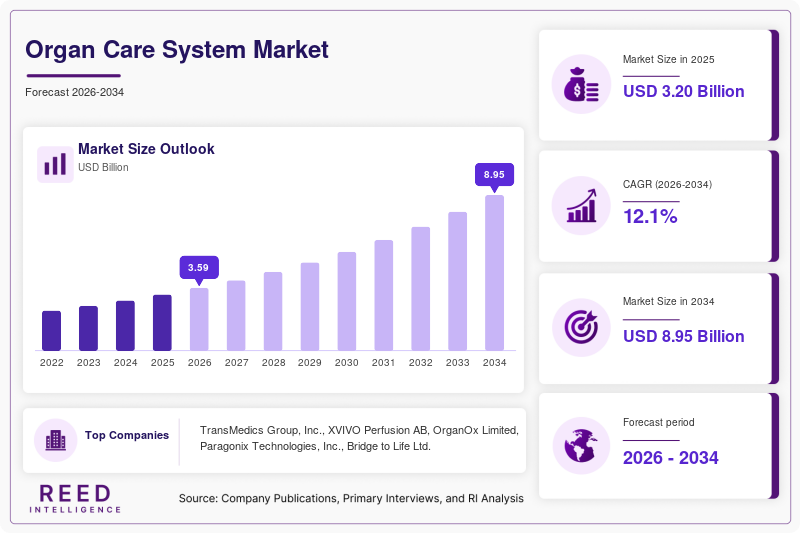
The Organ Care System Market was valued at approximately USD 3.2 billion in 2025 and is projected to reach around USD 8.9 billion by 2034, expanding at a compound annual growth rate (CAGR) of 12.1% during the forecast period (2025–2034). The market growth is being supported by the increasing global demand for organ transplantation and advancements in preservation technologies that improve transplant outcomes.
A major global factor driving the Organ Care System Market is the rising prevalence of chronic diseases such as cardiovascular disorders, kidney failure, and liver diseases, which has significantly increased the need for organ transplantation. Traditional cold storage methods are gradually being replaced by advanced organ care systems that maintain organs in near-physiological conditions, enhancing viability and reducing transplant rejection rates. These systems also enable longer preservation times and better organ utilization rates, thereby improving transplant success.
Key Highlights:
- North America dominated the market with a 41% share in 2025, while Asia Pacific is projected to register the fastest CAGR of 14.3% during the forecast period.
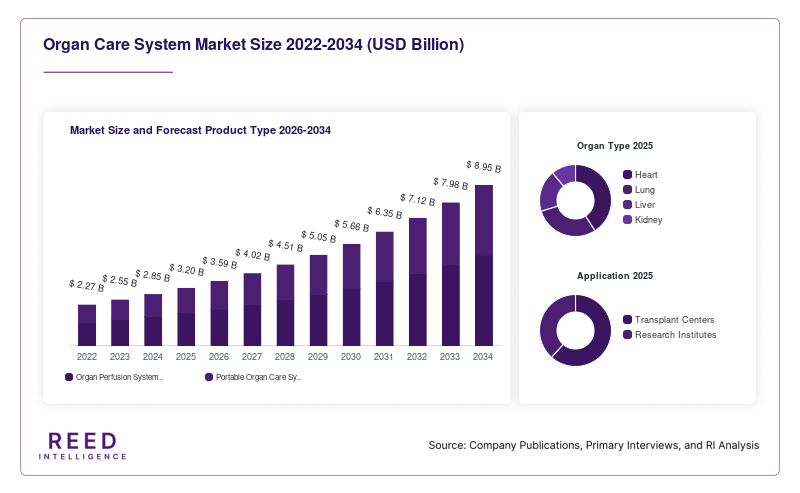
- By product type, organ perfusion systems led with a 64% share in 2024, whereas portable organ care systems are expected to grow at a CAGR of 13.5%.
- By application, heart transplantation held the largest share, while lung transplantation is anticipated to grow at the fastest rate with a CAGR of 14.1%.
- The U.S. remained the dominant country with a market size of USD 1.1 billion in 2024, increasing to USD 1.25 billion in 2025.
Market Trends
Integration of Normothermic Machine Perfusion Technologies
One of the prominent trends in the Organ Care System Market is the increasing adoption of normothermic machine perfusion (NMP) systems. These technologies preserve organs at body-like temperatures, allowing continuous monitoring and functional assessment prior to transplantation. This approach improves organ quality and enables the use of marginal or previously discarded organs. As transplant centers aim to enhance outcomes and expand donor pools, NMP systems are gaining significant traction across developed healthcare markets.
Expansion of Portable and Transportable Systems
Another key trend shaping the Organ Care System Market is the development of portable organ care systems designed for long-distance transportation. These systems are compact, efficient, and capable of maintaining optimal conditions during transit. The rising number of cross-border organ donations and the need for real-time monitoring during transport have accelerated demand for such solutions. Technological innovations focusing on battery life, digital monitoring, and integration with cloud-based platforms are further driving the adoption of portable systems.
Market Drivers
Increasing Organ Transplantation Procedures
The rising number of organ transplantation procedures globally is a primary driver of the Organ Care System Market. Growing awareness about organ donation and improvements in surgical techniques have led to an increase in transplant volumes. This has created a strong demand for advanced organ preservation systems that ensure higher success rates. Organ care systems help reduce ischemic injury and improve post-transplant recovery, making them essential in modern transplant protocols.
Technological Advancements in Organ Preservation
Continuous innovation in organ preservation technologies is another significant driver. Advanced systems now incorporate features such as real-time monitoring, automated perfusion control, and data analytics. These innovations allow clinicians to assess organ viability more accurately and make informed decisions. The integration of artificial intelligence and predictive analytics is further enhancing the performance of organ care systems, supporting their widespread adoption across healthcare facilities.
Market Restraint
High Cost of Organ Care Systems and Procedures
A major restraint impacting the Organ Care System Market is the high cost associated with these systems and related procedures. Advanced organ care technologies involve significant capital investment, making them less accessible for smaller hospitals and healthcare facilities, particularly in developing regions. Additionally, the cost of maintenance, training, and operation further adds to the financial burden.
Limited reimbursement policies in certain countries also restrict the adoption of these systems. While developed regions benefit from structured reimbursement frameworks, many emerging economies lack comprehensive coverage for advanced organ preservation technologies. This disparity creates a gap in market penetration.
Moreover, the complexity of these systems requires specialized training for healthcare professionals, which can further limit their widespread adoption. The need for skilled personnel and infrastructure support adds to operational challenges, especially in resource-constrained settings.
Market Opportunities
Expansion in Emerging Markets
Emerging economies present significant growth opportunities for the Organ Care System Market. Rapid improvements in healthcare infrastructure, increasing healthcare expenditure, and growing awareness about organ donation are driving demand in these regions. Governments are also introducing initiatives to promote organ transplantation, which is expected to boost the adoption of advanced organ care systems.
Development of Multi-Organ Preservation Systems
The development of multi-organ preservation systems represents another promising opportunity. These systems are designed to preserve multiple types of organs using a single platform, enhancing efficiency and reducing costs. As healthcare providers seek integrated solutions, demand for versatile organ care systems is expected to increase. This innovation can streamline transplant logistics and improve overall system utilization, making it a key area of focus for market players.
Segmental Analysis
By Product Type
Organ perfusion systems dominated the Organ Care System Market with a share of approximately 64% in 2024. These systems were widely used due to their ability to maintain organ viability by providing continuous oxygen and nutrient supply. Their effectiveness in improving transplant outcomes made them the preferred choice among healthcare providers.
Portable organ care systems are expected to be the fastest-growing subsegment, with a projected CAGR of 13.5% during the forecast period. Their ability to facilitate long-distance transportation and real-time monitoring will drive their adoption. Increasing cross-border organ transfers will further support growth.
By Organ Type
Heart organ care systems held the largest share of the market in 2024, accounting for around 35%. The high demand for heart transplants and the critical nature of preservation requirements contributed to this dominance.
Lung organ care systems are projected to grow at the fastest CAGR of 14.1%. The increasing prevalence of respiratory diseases and advancements in lung preservation technologies will support this growth.
By Application
Transplant centers accounted for the largest share in 2024, driven by the high volume of transplant procedures conducted in these facilities. Their access to advanced technologies and skilled professionals supported their dominance.
Research institutes are expected to witness the fastest growth, with a CAGR of 13.8%. Increasing focus on organ preservation research and innovation will drive demand in this segment.
By End-Use
Hospitals dominated the Organ Care System Market in 2024 with a share exceeding 60%, owing to their role as primary centers for transplantation procedures. Availability of infrastructure and skilled personnel supported their leadership.
Specialty clinics are projected to grow at the fastest rate, driven by increasing adoption of specialized transplant services and improved patient care models.
Regional Analysis
North America
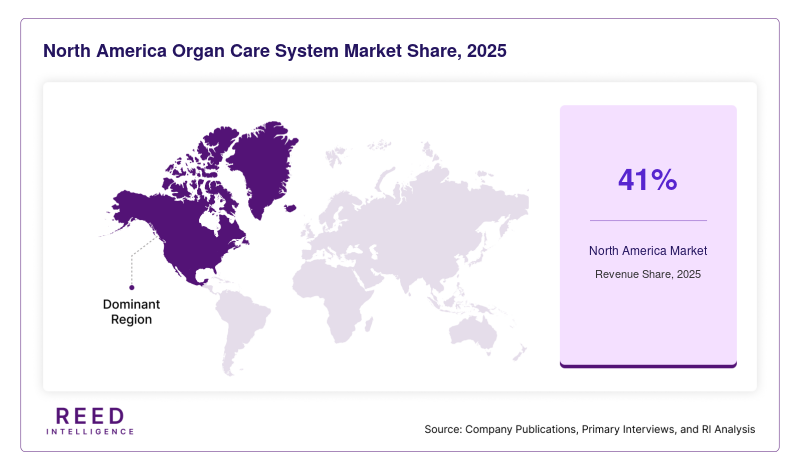
North America accounted for approximately 41% of the Organ Care System Market share in 2025 and is expected to grow at a CAGR of 11.5% during the forecast period. The region benefited from advanced healthcare infrastructure and a well-established organ transplantation network. High adoption of innovative medical technologies and strong regulatory support contributed to market dominance.
The United States led the regional market due to its high number of transplant procedures and strong presence of key market players. Increasing investments in research and development, along with favorable reimbursement policies, supported the adoption of advanced organ care systems.
Europe
Europe held around 27% of the Organ Care System Market share in 2025 and is projected to expand at a CAGR of 11.2% through 2034. The region demonstrated steady growth due to increasing organ donation rates and supportive government policies. Countries implemented structured organ allocation systems, enhancing transplant efficiency.
Germany emerged as the dominant country, driven by its robust healthcare system and emphasis on medical innovation. Strong collaboration between research institutions and healthcare providers further contributed to market expansion.
Asia Pacific
Asia Pacific represented approximately 18% of the market share in 2025 and is anticipated to grow at the fastest CAGR of 14.3% during the forecast period. The region experienced rapid growth due to expanding healthcare infrastructure and rising awareness about organ transplantation. Increasing investments in healthcare technology supported market development.
China led the region due to its large patient population and growing focus on healthcare modernization. Government initiatives to improve organ donation systems and increase transplant capacity played a significant role in market growth.
Middle East & Africa
The Middle East & Africa accounted for nearly 8% of the Organ Care System Market share in 2025 and is expected to grow at a CAGR of 10.6% over the forecast period. The region showed gradual growth due to improving healthcare infrastructure and increasing focus on specialized medical services.
Saudi Arabia dominated the regional market, supported by government investments in healthcare and the establishment of advanced medical facilities. Efforts to enhance organ donation awareness further contributed to market development.
Latin America
Latin America held approximately 6% of the market share in 2025 and is projected to grow at a CAGR of 10.9% during the forecast period. The region experienced moderate growth driven by improving access to healthcare services and increasing transplant procedures.
Brazil emerged as the leading country due to its expanding healthcare system and rising adoption of advanced medical technologies. Government initiatives to support organ donation and transplantation further strengthened market growth.
Competitive Landscape
The Organ Care System Market is moderately consolidated, with a mix of established players and emerging companies focusing on innovation and product development. Leading companies are investing in research and strategic collaborations to enhance their market presence.
TransMedics Group, Inc. is recognized as a leading player, driven by its advanced organ care technologies and continuous product innovation. The company recently expanded its product portfolio with next-generation portable systems designed to improve organ preservation and transport efficiency.
Other key players are focusing on partnerships with healthcare institutions and expanding their geographic footprint to strengthen their position in the global market. Competitive strategies include product launches, mergers, and technological advancements aimed at improving system performance and patient outcomes.
Key Players
- TransMedics Group, Inc.
- XVIVO Perfusion AB
- OrganOx Limited
- Paragonix Technologies, Inc.
- Bridge to Life Ltd.
- Organ Recovery Systems
- Waters Medical Systems LLC
- Transonic Systems Inc.
- Dr. Franz Köhler Chemie GmbH
- Cleveland Clinic Innovations
Recent Developments
- 2025: TransMedics introduced an upgraded portable organ care system with enhanced monitoring capabilities.
- 2024: XVIVO Perfusion launched a new lung preservation platform to improve transplant success rates.
- 2024: OrganOx expanded its manufacturing capacity to meet increasing global demand.
- 2025: Paragonix Technologies partnered with transplant centers to deploy advanced transport solutions.
- 2024: BioLife Solutions developed new preservation media to support extended organ viability.
Organ Care System Market Segments
Product Type
- Organ Perfusion Systems
- Portable Organ Care Systems
Organ Type
- Heart
- Lung
- Liver
- Kidney
Application
- Transplant Centers
- Research Institutes
End-Use
- Hospitals
- Specialty Clinics
By Region
- North America
- Europe
- APAC
- Middle East and Africa
- LATAM