Organic Friction Modifier Additives Market Size, Share & Demand Report By Product Type (Fatty Amide Additives, Ester-Based Additives, Glycerol Ester Additives, Fatty Acid Additives), By Application (Automotive Lubricants, Industrial Lubricants, Metalworking Fluids, Greases), By End-Use Industry (Automotive, Industrial Manufacturing, Energy & Power, Marine, Renewable Energy Equipment), By Lubricant Type (Engine Oils, Transmission Fluids, Hydraulic Fluids, Gear Oils), By Region & Segment Forecasts
USD 3950
Market Overview
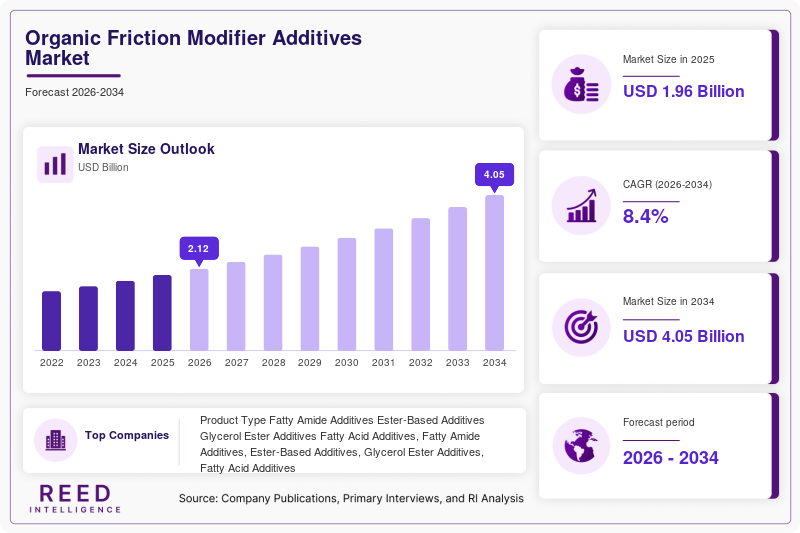
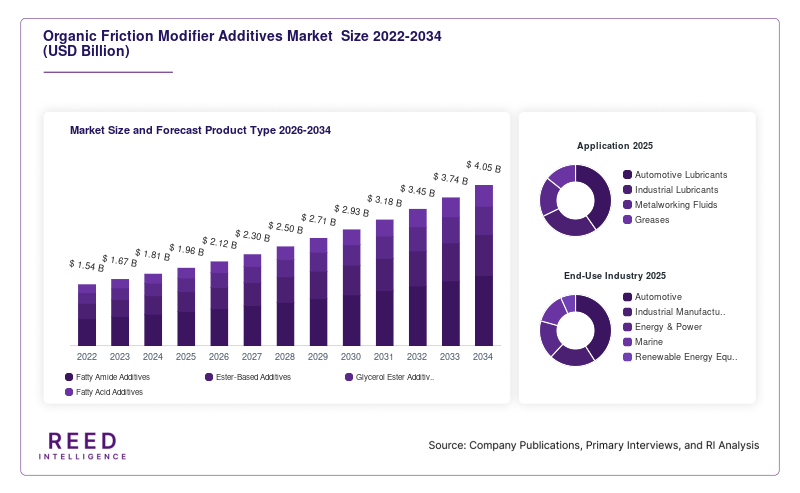
The Organic Friction Modifier Additives Market was valued at approximately USD 1.96 billion in 2026 and is projected to reach USD 3.74 billion by 2034, expanding at a CAGR of 8.4% during the forecast period from 2026 to 2034. The global Organic Friction Modifier Additives Market growth has been supported by the increasing demand for fuel-efficient lubricants and high-performance automotive fluids across global transportation and industrial sectors. Organic friction modifier additives are widely used in engine oils, transmission fluids, industrial lubricants, and greases to reduce friction, improve wear resistance, and enhance energy efficiency.
The growing emphasis on lowering carbon emissions and improving machinery performance has accelerated the adoption of advanced lubricant additive technologies worldwide. Automotive manufacturers and industrial equipment producers are increasingly focusing on lubricant formulations that enhance operational efficiency while reducing maintenance costs. In addition, advancements in synthetic lubricant technologies and stricter fuel economy regulations have strengthened the long-term outlook for the Organic Friction Modifier Additives Market.
Key Highlights
- Asia Pacific accounted for 38.9% of the global Organic Friction Modifier Additives Market share in 2025, while North America is projected to witness the fastest CAGR of 9.1% during the forecast period.
- By product type, fatty amide additives held the leading share of 35.7% in 2025, whereas ester-based additives are anticipated to expand at a CAGR of 9.8% through 2034.
- By application, automotive lubricants represented the dominant segment with 46.3% market share in 2025, while industrial lubricants are forecast to register the fastest CAGR of 9.3%.
- By end-use industry, automotive accounted for 49.6% share in 2025, whereas renewable energy equipment is projected to grow at a CAGR of 10.2%.
- China remained the dominant country with market values of USD 286 million in 2024 and USD 309 million in 2025 due to expanding automotive production and increasing lubricant consumption.
Market Trends
Increasing Adoption of Synthetic and Low-Viscosity Lubricants
One of the major trends shaping the Organic Friction Modifier Additives Market is the rising adoption of synthetic and low-viscosity lubricants. Automotive manufacturers are increasingly using advanced lubricants that improve fuel efficiency and reduce engine wear under demanding operating conditions. Organic friction modifier additives play a critical role in minimizing friction losses and enhancing lubricant stability.
The transition toward hybrid and electric mobility systems has further encouraged the development of advanced additive formulations compatible with next-generation drivetrain technologies. This trend is expected to strengthen demand for high-performance organic additives during the forecast period.
Growing Preference for Environmentally Compatible Additives
Environmental sustainability has become another important trend in the Organic Friction Modifier Additives Market. Lubricant manufacturers are increasingly focusing on biodegradable and environmentally compatible additive technologies to comply with stricter environmental standards.
Organic-based additives are gaining preference over conventional metal-containing additives due to their lower environmental impact and improved compatibility with modern lubricant formulations. The trend toward eco-friendly industrial operations is expected to support future market growth.
Market Drivers
Rising Demand for Fuel-Efficient Automotive Lubricants
The increasing global demand for fuel-efficient automotive lubricants is a key driver supporting the Organic Friction Modifier Additives Market. Governments and regulatory agencies are implementing fuel economy standards aimed at reducing greenhouse gas emissions and improving vehicle efficiency.
Organic friction modifier additives help reduce internal engine friction and improve lubricant performance, contributing to better fuel economy. Growing vehicle production and increasing demand for premium engine oils continue to support market expansion.
Expansion of Industrial Machinery and Manufacturing Activities
The rapid growth of industrial manufacturing and machinery operations is contributing significantly to market development. Industrial lubricants containing friction modifier additives are increasingly used to improve machinery efficiency, reduce wear, and minimize downtime in manufacturing facilities.
The expansion of industrial automation, metal processing, and heavy equipment manufacturing has strengthened demand for advanced lubricant additive technologies across global industrial sectors.
Market Restraint
Volatility in Raw Material Prices
One of the major restraints affecting the Organic Friction Modifier Additives Market is the volatility in raw material prices. Fluctuations in the costs of fatty acids, esters, and specialty chemicals can impact production expenses and profitability for additive manufacturers. Supply chain disruptions and changing petrochemical pricing trends may also create operational challenges.
Market Opportunities
Increasing Demand from Electric Vehicle Fluids
The growing electric vehicle industry presents a strong opportunity for the Organic Friction Modifier Additives Market. Electric drivetrains require specialized lubricants and thermal management fluids capable of delivering low friction and improved heat transfer performance.
Lubricant manufacturers are developing advanced additive formulations specifically designed for electric vehicle transmission systems and battery cooling applications. This opportunity is expected to accelerate future market growth.
Expansion of Renewable Energy Equipment Lubrication
Renewable energy systems are creating emerging opportunities for organic friction modifier additive manufacturers. Wind turbines, solar tracking systems, and hydroelectric equipment require high-performance lubricants that can operate efficiently under variable environmental conditions.
The increasing deployment of renewable energy infrastructure is likely to strengthen demand for advanced industrial lubricants containing friction modifier additives.
Segmental Analysis
By Product Type
Fatty Amide Additives
Fatty amide additives dominated the Organic Friction Modifier Additives Market with a 35.7% share in 2025. The segment growth was supported by their widespread use in automotive engine oils and industrial lubricants requiring enhanced friction reduction and wear protection.
Ester-Based Additives
Ester-based additives are anticipated to witness the fastest CAGR of 9.8% during the forecast period. The segment growth will be driven by increasing demand for biodegradable and high-temperature lubricant formulations used in advanced industrial applications.
By Application
Automotive Lubricants
Automotive lubricants accounted for the largest market share of 46.3% in 2025. The segment benefited from rising vehicle production and increasing demand for fuel-efficient engine oils and transmission fluids.
Industrial Lubricants
Industrial lubricants are projected to expand at a CAGR of 9.3% through 2034. Growing industrial automation and increasing use of heavy machinery will support segment growth. Manufacturers are increasingly adopting advanced lubricant technologies to improve operational efficiency.
By End-Use Industry
Automotive
Automotive represented the dominant end-use segment with 49.6% market share in 2025. Increasing passenger vehicle production and rising demand for high-performance lubricants contributed to segment expansion.
Renewable Energy Equipment
Renewable energy equipment is expected to register the fastest CAGR of 10.2% during the forecast period. The increasing installation of wind turbines and renewable power systems requiring advanced lubrication technologies will accelerate segment growth.
By Lubricant Type
Engine Oils
Engine oils held a significant market share in 2025 due to increasing demand for lubricants capable of reducing engine friction and improving fuel economy.
Transmission Fluids
Transmission fluids are anticipated to grow at a CAGR of 9.0% during the forecast period. Rising adoption of automatic and hybrid transmission systems will support future segment expansion.
Regional Analysis
Asia Pacific
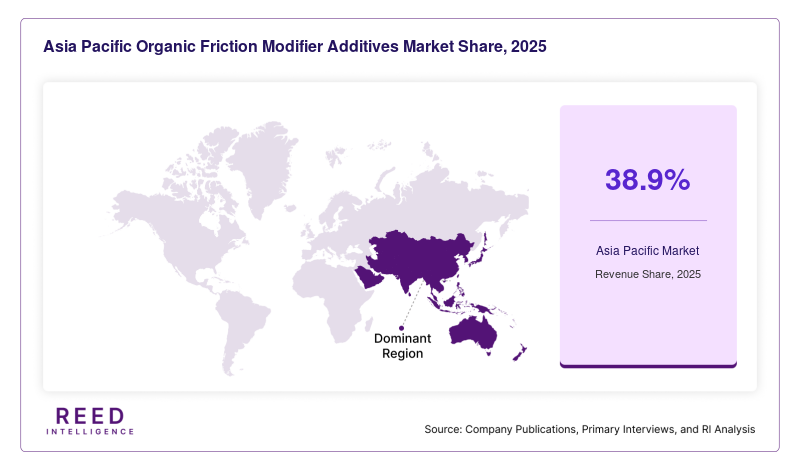
Asia Pacific held 38.9% of the global Organic Friction Modifier Additives Market share in 2025 and is projected to grow at a CAGR of 8.7% during the forecast period. The region benefited from strong automotive manufacturing output, expanding industrial activities, and increasing lubricant consumption.
China dominated the regional market due to rising vehicle production and increasing industrial machinery operations. Expanding domestic lubricant manufacturing capacity further supported regional market growth.
North America
North America accounted for 26.8% of the Organic Friction Modifier Additives Market share in 2025 and is anticipated to expand at a CAGR of 9.1% through 2034. The region experienced strong demand due to increasing adoption of synthetic lubricants and advanced automotive fluid technologies.
The United States remained the dominant country owing to growing demand for fuel-efficient vehicles and increasing industrial automation investments. Expanding electric vehicle production also contributed to regional market expansion.
Europe
Europe represented 22.6% of the global Organic Friction Modifier Additives Market share in 2025 and is expected to register a CAGR of 7.8% during the forecast period. The region benefited from strict environmental regulations and increasing demand for sustainable lubricant formulations.
Germany led the regional market due to advanced automotive engineering capabilities and strong industrial manufacturing activities. The growing focus on low-emission transportation systems further strengthened regional demand.
Middle East & Africa
The Middle East & Africa region captured 6.4% of the Organic Friction Modifier Additives Market share in 2025 and is forecast to grow at a CAGR of 6.9% from 2026 to 2034. Rising industrialization and increasing lubricant demand in energy and transportation sectors supported market growth.
Saudi Arabia dominated the regional market because of expanding petrochemical operations and growing industrial equipment usage. Increasing investments in industrial diversification also contributed to market development.
Latin America
Latin America accounted for 5.3% of the global Organic Friction Modifier Additives Market share in 2025 and is expected to expand at a CAGR of 7.1% during the forecast period. Growing automotive production and industrial manufacturing activities supported regional demand.
Brazil remained the dominant country due to increasing use of industrial lubricants and rising transportation sector activities. Expanding agricultural machinery operations further supported market growth.
Competitive Landscape
The Organic Friction Modifier Additives Market is moderately consolidated with the presence of global lubricant additive manufacturers, specialty chemical companies, and industrial lubricant solution providers. Market participants are focusing on sustainable additive technologies, synthetic lubricant compatibility, and product innovation to strengthen their competitive position.
The Lubrizol Corporation remained one of the leading companies in the market due to its broad lubricant additive portfolio and advanced research capabilities. The company recently introduced new friction modifier formulations designed for electric vehicle fluid applications.
Afton Chemical Corporation continued expanding its additive technology portfolio for automotive and industrial lubricant markets.
Infineum International Limited focused on advanced low-viscosity lubricant additive development to support fuel economy requirements.
BASF SE strengthened its sustainable lubricant additive solutions for environmentally compatible industrial applications.
Chevron Oronite Company LLC expanded production capacity for specialty friction modifier additives used in modern engine oils.
Key Players List
- The Lubrizol Corporation
- Afton Chemical Corporation
- Infineum International Limited
- BASF SE
- Chevron Oronite Company LLC
- Croda International Plc
- Evonik Industries AG
- LANXESS AG
- Clariant AG
- Vanderbilt Chemicals, LLC
- TotalEnergies SE
- Exxon Mobil Corporation
- Shell plc
- FUCHS SE
- Arkema S.A.
Recent Developments
- In 2025, multiple lubricant additive manufacturers introduced advanced organic friction modifier formulations for electric vehicle transmission fluids.
- During 2024, specialty chemical companies expanded biodegradable additive production capacity to support environmentally compatible lubricant demand.
- In 2025, industrial lubricant manufacturers increased investment in synthetic lubricant technologies with improved friction reduction performance.
- During 2024, automotive lubricant producers introduced low-viscosity engine oils designed to improve fuel economy and emission performance.
- In 2025, renewable energy equipment manufacturers adopted advanced industrial lubricants containing organic friction modifier additives for wind turbine applications.
Organic Friction Modifier Additives Market Segments
Product Type
- Fatty Amide Additives
- Ester-Based Additives
- Glycerol Ester Additives
- Fatty Acid Additives
Application
- Automotive Lubricants
- Industrial Lubricants
- Metalworking Fluids
- Greases
End-Use Industry
- Automotive
- Industrial Manufacturing
- Energy & Power
- Marine
- Renewable Energy Equipment
Lubricant Type
- Engine Oils
- Transmission Fluids
- Hydraulic Fluids
- Gear Oils
By Region
- North America
- Europe
- APAC
- Middle East and Africa
- LATAM