Organic Milk Powder Market Size, Share, Demand Report By Type (Whole Milk Powder, Skim Milk Powder, Infant Organic Milk Powder, Specialty Organic Milk Powder), By Application (Infant Nutrition, Bakery & Confectionery, Dairy Beverages, Clinical Nutrition), By Distribution Channel (B2B, Retail Stores, E-commerce Platforms), By Region & Segment Forecasts, 2026–2034
USD 3950
Market Overview
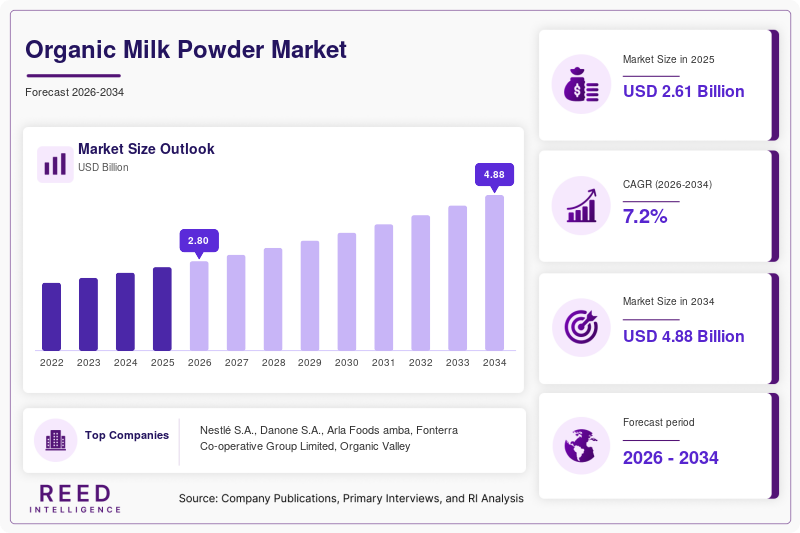
The market size is estimated at approximately USD 2.8 billion, and it is projected to reach nearly USD 5.1 billion by 2034, registering a CAGR of 7.2% during 2026–2034. This steady growth trajectory reflects rising awareness regarding food safety, nutritional purity, and environmental sustainability, all of which are becoming central decision-making factors in dairy consumption patterns across developed and emerging economies.
A significant global growth factor supporting the Organic Milk Powder Market is the increasing adoption of organic dietary lifestyles, particularly among urban populations where consumers are more informed about food sourcing and long-term health impacts. This shift is further reinforced by regulatory encouragement for organic farming practices and the expansion of certified organic dairy supply chains across key producing countries.
Key Highlights
- Dominant Region Share (2025): Europe held 28% share, driven by strong organic certification systems and established dairy industries.
- Fastest-Growing Region CAGR (2026–2034): Asia Pacific is expected to grow at 8.5% CAGR, supported by rising infant nutrition demand and organic dairy expansion.
- Dominant Segment: Infant organic milk powder accounted for 38% share in 2025, driven by strong parental preference for safe nutrition.
- Fastest-Growing Subsegment: Specialty organic milk powder is projected to grow at 9.5% CAGR, fueled by functional nutrition demand.
- Dominant Country (2024): United States recorded USD 0.75 billion market size.
- Dominant Country (2025): United States reached USD 0.82 billion, supported by retail organic penetration growth.
Market Trends
Clean Label Premiumization in Dairy Nutrition
The Organic Milk Powder Market is increasingly shaped by the global clean-label movement, where consumers actively prefer products that are transparent in sourcing, free from synthetic additives, and aligned with natural production processes. This trend is particularly strong in infant nutrition, premium dairy beverages, and functional food applications, where trust and safety perception play a critical role. Manufacturers are responding by investing in certified organic sourcing, minimal processing technologies, and clearer labeling practices that reinforce authenticity and quality assurance.
Digital Traceability and Certification Technologies
Another major trend influencing the Organic Milk Powder Market is the integration of digital traceability systems across the dairy supply chain. Technologies such as blockchain-based tracking, QR-code verification, and automated certification databases are increasingly being deployed to ensure transparency from farm to finished product. These innovations not only enhance consumer trust but also help brands comply with stringent international organic standards, thereby strengthening competitiveness in global markets.
Market Drivers
Rising Demand for Organic Infant Nutrition Products
One of the strongest drivers of the Organic Milk Powder Market is the rapid rise in demand for organic infant formula and pediatric nutrition products. Parents are increasingly prioritizing safety, purity, and high nutritional value when selecting infant food products, leading to higher adoption of organic-certified milk powders. This demand is especially prominent in urban households where disposable incomes are higher and awareness regarding chemical-free nutrition is more widespread.
Expansion of Organic Dairy Farming Infrastructure
The growth of certified organic dairy farming infrastructure is also significantly accelerating the Organic Milk Powder Market. Governments and private stakeholders are actively investing in sustainable livestock practices, organic feed systems, and improved milk yield technologies that comply with organic certification requirements. This expansion is helping stabilize raw material supply while also enabling large-scale production of organic milk powder across major dairy-producing regions.
Market Restraint
High Production Costs and Supply Limitations
A key restraint affecting the Organic Milk Powder Market is the relatively high cost structure associated with organic dairy production. Organic farming requires strict adherence to natural feeding systems, animal welfare standards, and certification protocols, all of which increase operational expenses compared to conventional dairy farming. Additionally, limited availability of organic feed and seasonal fluctuations in milk yield often create supply constraints, impacting production scalability and pricing stability in global markets.
Market Opportunities
Expansion in Emerging Asian Consumer Markets
Emerging economies in Asia present a major growth opportunity for the Organic Milk Powder Market, driven by rapid urbanization, expanding middle-class populations, and growing awareness of premium dairy nutrition. Countries such as India, China, Indonesia, and Vietnam are witnessing increasing demand for organic infant nutrition and imported dairy products, creating strong opportunities for both global and regional manufacturers to expand their footprint.
Growth in Functional Organic Dairy Ingredients
The development of functional and fortified organic milk powder products is emerging as a significant opportunity area. Manufacturers are increasingly focusing on enhancing product formulations with added probiotics, vitamins, minerals, and immunity-boosting compounds. These advanced formulations are gaining traction in clinical nutrition, sports nutrition, and dietary supplement applications, thereby expanding the scope of the Organic Milk Powder Market beyond traditional consumption categories.
Segmental Analysis
By Type
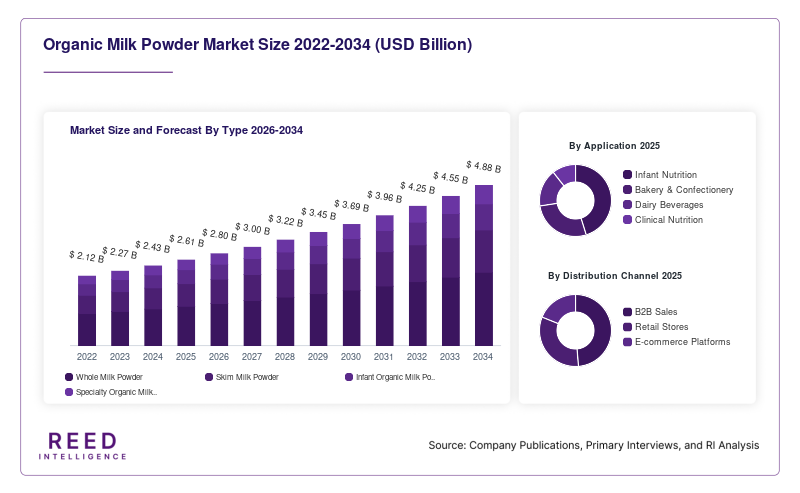
The type segment includes whole milk powder, skim milk powder, infant organic milk powder, and specialty formulations. Infant organic milk powder dominated with 38% share in 2025, largely due to strong demand from parents seeking safe and nutrient-rich infant nutrition solutions. Specialty organic milk powder is expected to expand at a CAGR of 9.5%, driven by increasing demand for functional and fortified dairy-based nutrition products.
By Application
Applications include infant nutrition, bakery & confectionery, dairy beverages, and clinical nutrition. Bakery & confectionery accounted for 34% share in 2025, supported by growing usage of organic dairy ingredients in premium baked goods and desserts. Clinical nutrition is projected to grow at a CAGR of 9%, driven by rising healthcare applications and dietary supplementation trends.
By Distribution Channel
The distribution channel segment comprises B2B, retail stores, and e-commerce platforms. B2B dominated with 62% share in 2025, as bulk procurement by food manufacturers remains the primary sales channel. Meanwhile, e-commerce is projected to grow at a CAGR of 10%, supported by increasing digital purchasing behavior and direct-to-consumer organic product availability.
Regional Analysis
North America
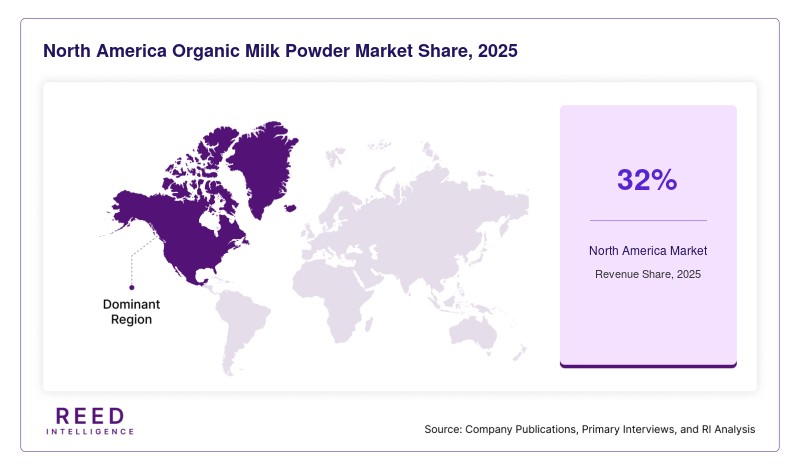
North America accounted for 32% share of the Organic Milk Powder Market in 2025 and continues to maintain strong demand driven by high consumer awareness regarding organic food consumption. The United States remains the key contributor due to its well-established organic retail ecosystem and growing demand for infant nutrition products. Increasing preference for clean-label dairy products and strong distribution networks further support regional market stability.
Europe
Europe held 28% share in 2025, supported by strict organic certification frameworks and long-established dairy cooperatives. Countries such as Germany, France, and the Netherlands are leading contributors, where consumers strongly prioritize sustainability, animal welfare, and traceability in dairy production. The region benefits from mature supply chains and high regulatory compliance standards that reinforce market credibility.
Asia Pacific
Asia Pacific accounted for 25% share in 2025 and is expected to register the fastest growth with a CAGR of 8.5% (2026–2034). The region’s growth is driven by increasing birth rates, rising disposable incomes, and expanding awareness of organic infant nutrition. China and India are emerging as key markets, supported by growing retail modernization and increasing availability of imported organic dairy products.
Middle East & Africa
The Middle East & Africa region held 8% share in 2025, with growth primarily driven by import-dependent demand for premium dairy products. Countries such as the UAE and Saudi Arabia are witnessing increasing consumption of organic nutrition products due to rising health awareness and expanding expatriate populations that prefer high-quality dairy alternatives.
Latin America
Latin America accounted for 7% share in 2025, with Brazil leading regional demand due to growing organic farming initiatives and rising consumer awareness. The region is gradually adopting organic dairy consumption patterns, supported by increasing retail penetration and government support for sustainable agricultural practices.
Competitive Landscape
The Organic Milk Powder Market features a moderately consolidated competitive structure with several global dairy giants and specialized organic producers competing across premium and mass-market segments. Leading players include Nestlé S.A., Danone S.A., Arla Foods amba, Fonterra Co-operative Group, and Organic Valley, each maintaining strong global or regional presence through diversified product portfolios and robust distribution networks.
Nestlé S.A. continues to dominate the competitive landscape through its strong infant nutrition portfolio and continuous expansion of organic-certified dairy offerings. Danone focuses on sustainability-led sourcing and innovation in functional dairy products. Arla Foods leverages its cooperative farming model to ensure stable organic milk supply across Europe, while Fonterra benefits from large-scale dairy export capabilities. Organic Valley maintains a strong position in North America through premium organic positioning. Companies are increasingly investing in traceability systems, product innovation, and sustainable packaging to strengthen long-term competitiveness in the Organic Milk Powder Market.
Key Players List
- Nestlé S.A.
- Danone S.A.
- Arla Foods amba
- Fonterra Co-operative Group Limited
- Organic Valley
- Abbott Laboratories
- Royal FrieslandCampina N.V.
- Lactalis Group
- Saputo Inc.
- Amul (GCMMF)
- SunOpta Inc.
- Hochdorf Holding AG
- Meadow Foods Ltd.
- Murray Goulburn Co-operative
- Schreiber Foods Inc.
- Devondale Dairy
Recent Developments
- In 2026, major dairy companies expanded certified organic milk sourcing networks to stabilize raw material availability.
- In 2025, several players introduced fortified organic milk powder variants targeting infant and clinical nutrition segments.
- Blockchain-based traceability systems were increasingly adopted to improve supply chain transparency.
- Strategic collaborations between dairy cooperatives and retail chains strengthened distribution in Asia Pacific markets.
- Investments in sustainable packaging solutions increased across Europe and North America.
- Organic certification upgrades were implemented to align with evolving international regulatory standards.
- E-commerce expansion strategies gained momentum, particularly in emerging markets with rising digital adoption.
Organic Milk Powder Market Segments
By Type
- Whole Milk Powder
- Skim Milk Powder
- Infant Organic Milk Powder
- Specialty Organic Milk Powder
By Application
- Infant Nutrition
- Bakery & Confectionery
- Dairy Beverages
- Clinical Nutrition
By Distribution Channel
- B2B Sales
- Retail Stores
- E-commerce Platforms
By Region
- North America
- Europe
- Asia Pacific
- Middle East & Africa
- Latin America
By Region
- North America
- Europe
- APAC
- Middle East and Africa
- LATAM