Organic Textile Market Size, Share & Demand Report By Material Type (Organic Cotton, Organic Wool, Organic Silk, Organic Hemp, Others), By Application (Apparel, Home Textiles, Industrial Textiles), By End-Use Industry (Fashion, Healthcare, Hospitality, Others), By Distribution Channel (Online Retail, Offline Retail), By Region & Segment Forecasts, 2025–2034
USD 3950
Market Overview
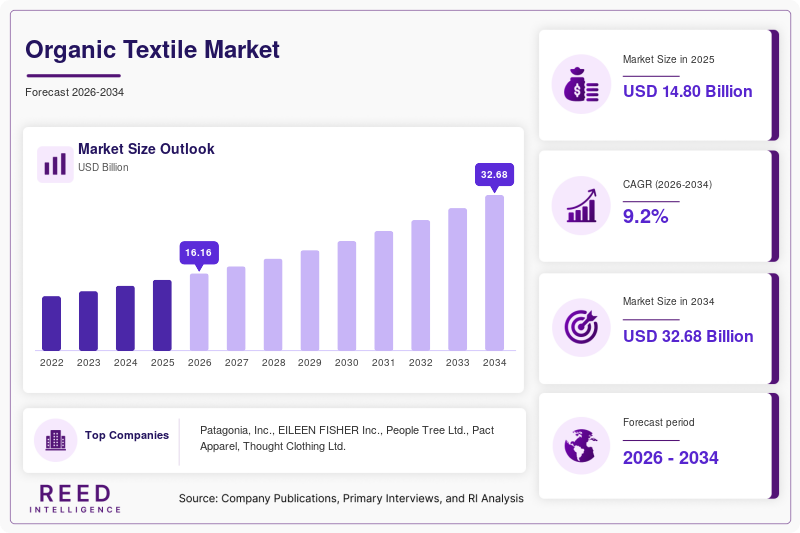
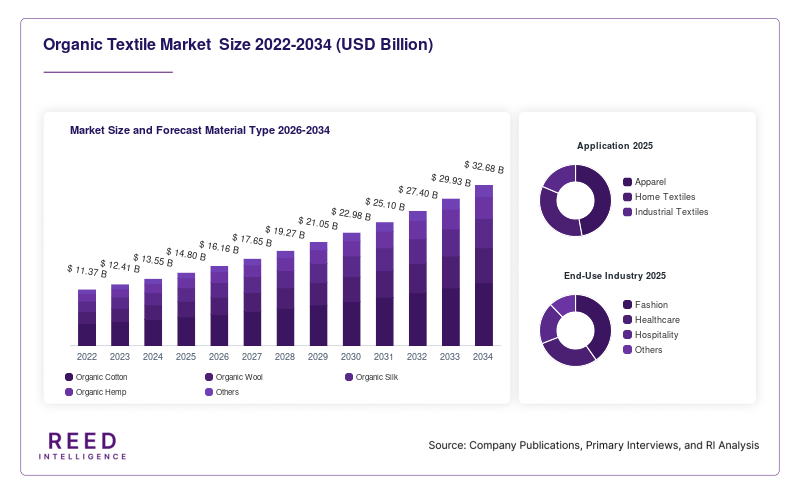
The Organic Textile Market size was valued at approximately USD 14.8 billion in 2025 and is projected to reach USD 32.6 billion by 2034, expanding at a CAGR of 9.2%during theforecast period (2025–2034). The market has witnessed consistent expansion driven by increasing environmental awareness, regulatory emphasis on sustainable manufacturing, and growing consumer preference for eco-friendly apparel and home textiles. The shift toward ethical sourcing and reduced chemical usage in textile production has played a significant role in shaping demand patterns across both developed and emerging economies.
A key global factor supporting market growth is the rising adoption of sustainable fashion practices by major apparel brands. Companies are integrating organic cotton, hemp, and bamboo-based fibers into their product portfolios to align with environmental, social, and governance (ESG) goals. This transition has enhanced supply chain transparency and encouraged investments in organic farming and certification standards.
Key Highlights:
- North America dominated the market with a 36.4% share in 2025, while Asia Pacific is projected to register the fastest CAGR of 10.6%.
- Organic cotton led the material segment with a 62.8% share, while organic hemp is expected to grow at the fastest CAGR of 11.3%.
- Apparel accounted for the largest application segment with 54.2% share, while home textiles are anticipated to grow at a CAGR of 9.8%.
- The U.S. remained the dominant country, with market values of USD 4.2 billion in 2024 and USD 4.6 billion in 2025.
Market Trends
Rise of Sustainable Fashion and Circular Economy Practices
The increasing focus on circular economy principles has significantly influenced the Organic Textile Market. Brands are adopting recyclable and biodegradable materials to reduce waste and carbon emissions. Organic textiles are gaining traction as they support closed-loop systems, where materials are reused or composted after use. This trend is also driving innovations in fiber processing and dyeing technologies that minimize environmental impact.
Expansion of Certification and Traceability Standards
The demand for transparency in textile sourcing has led to the expansion of certification systems such as GOTS (Global Organic Textile Standard) and OEKO-TEX. Consumers are increasingly seeking verified organic products, prompting manufacturers to invest in traceability technologies like blockchain and digital labeling. This trend enhances consumer trust and strengthens brand credibility, especially in premium and export-oriented markets.
Market Drivers
Increasing Consumer Awareness of Eco-Friendly Products
Growing awareness regarding the environmental impact of synthetic textiles has led consumers to prefer organic alternatives. Organic textiles are produced without harmful pesticides and chemicals, making them safer for both the environment and human health. This shift in consumer behavior has boosted demand across apparel, home furnishings, and personal care textiles.
Regulatory Support and Sustainability Mandates
Governments and international organizations are implementing stricter environmental regulations to reduce pollution from textile manufacturing. Policies promoting organic farming and sustainable production practices have encouraged manufacturers to adopt organic materials. Incentives, subsidies, and sustainability certifications are further accelerating the adoption of organic textiles across global markets.
Market Restraint
High Production Costs and Limited Supply Chain Infrastructure
One of the primary challenges in the Organic Textile Market is the high cost associated with organic farming and processing. Organic cotton and other fibers require more land, labor, and time compared to conventional alternatives. Additionally, the lack of well-established supply chain infrastructure for organic materials limits scalability and increases costs for manufacturers.
The certification process also adds to operational expenses, making organic textiles relatively expensive for end consumers. This price disparity restricts adoption in price-sensitive markets and limits penetration in developing regions. Furthermore, inconsistent availability of raw materials due to climate variability and limited organic farmland poses a constraint on market growth.
Market Opportunities
Growth in Emerging Economies
Emerging markets in Asia Pacific and Latin America present significant growth opportunities for the Organic Textile Market. Increasing disposable income, urbanization, and awareness of sustainable products are driving demand in these regions. Local manufacturers are also investing in organic production capabilities to cater to both domestic and export markets.
Technological Advancements in Organic Fiber Processing
Innovations in textile processing technologies are creating new opportunities for market expansion. Advanced dyeing techniques, water-efficient processing methods, and biodegradable finishing treatments are enhancing product quality while maintaining sustainability standards. These technological improvements are expected to reduce production costs over time and increase the accessibility of organic textiles.
Segmental Analysis
By Material Type
Organic cotton dominated the market with a 62.8% share in 2024. Its widespread availability, established supply chains, and versatility in textile applications contributed to its leading position. Organic cotton is widely used in apparel, home textiles, and personal care products, making it a preferred choice among manufacturers.
Organic hemp is expected to grow at the fastest CAGR of 11.3% during the forecast period. Its durability, low water requirements, and eco-friendly cultivation process make it an attractive alternative. Increasing adoption in sustainable fashion and industrial textiles will drive growth.
By Application
Apparel accounted for the largest share of 54.2% in 2024. The growing demand for sustainable clothing and ethical fashion has supported the dominance of this segment. Organic textiles are increasingly used in casual wear, sportswear, and luxury apparel.
Home textiles are projected to grow at a CAGR of 9.8%. Rising consumer preference for eco-friendly bedding, towels, and furnishings is driving demand. Increased awareness of indoor environmental quality is also contributing to growth.
By End-Use Industry
The fashion industry dominated the market with a 48.6% share in 2024. The integration of organic materials into clothing lines has become a key strategy for brands aiming to reduce environmental impact.
The healthcare sector is expected to grow at a CAGR of 10.1%. Organic textiles are increasingly used in medical textiles due to their hypoallergenic properties and absence of harmful chemicals.
By Distribution Channel
Offline retail held the largest share of 63.5% in 2024. Physical stores provide consumers with the ability to assess product quality and certifications, supporting segment dominance.
Online retail is anticipated to grow at a CAGR of 10.8%. The expansion of e-commerce platforms and increasing digital penetration are driving growth. Online channels also offer a wider range of organic textile products.
Regional Analysis
North America
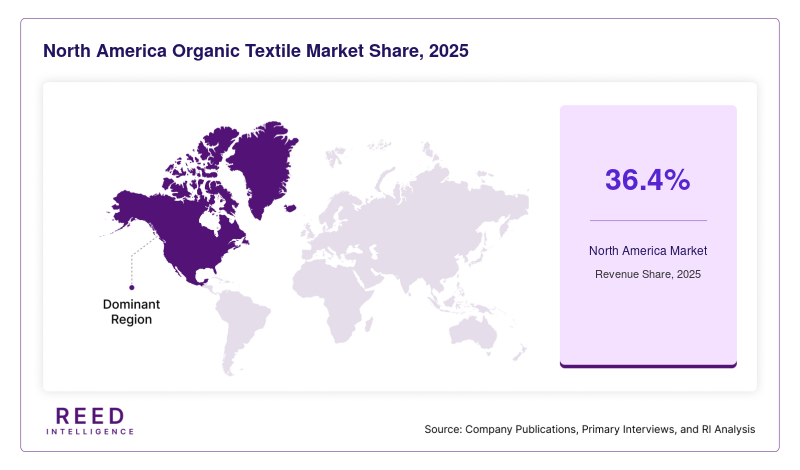
North America accounted for 36.4% of the Organic Textile Market share in 2025 and is expected to grow at a CAGR of 8.7% during the forecast period. The region’s strong presence of sustainable fashion brands and high consumer awareness supported market dominance. The demand for organic apparel and home textiles remained consistent across retail and e-commerce channels.
The United States dominated the regional market due to strong demand for certified organic products. The presence of established retailers and increasing adoption of sustainable sourcing practices contributed to growth. Additionally, consumer preference for premium and eco-friendly clothing supported steady expansion.
Europe
Europe held a significant share of 28.1% in 2025 and is projected to grow at a CAGR of 8.9%. The region’s stringent environmental regulations and commitment to sustainability have driven the adoption of organic textiles. Countries across Europe have implemented policies encouraging eco-friendly manufacturing practices.
Germany emerged as the leading country due to its strong textile industry and focus on sustainable innovation. The presence of eco-conscious consumers and established certification frameworks has strengthened market growth in the region.
Asia Pacific
Asia Pacific captured 22.7% of the market share in 2025 and is expected to grow at the fastest CAGR of 10.6%. The region benefits from a large textile manufacturing base and increasing investments in organic farming. Rising disposable income and expanding middle-class population are boosting demand for organic products.
India dominated the regional market due to its extensive organic cotton production. Government initiatives promoting organic agriculture and export-oriented textile manufacturing have supported market expansion. The availability of raw materials and cost advantages further strengthen the region’s position.
Middle East & Africa
The Middle East & Africa region held a smaller share of 6.5% in 2025 and is projected to grow at a CAGR of 7.8%. The market is gradually expanding due to increasing awareness of sustainable products and rising investments in textile manufacturing.
South Africa led the regional market, supported by growing retail infrastructure and demand for eco-friendly apparel. The region’s focus on sustainable agriculture is also contributing to the development of organic textile production.
Latin America
Latin America accounted for 6.3% of the market share in 2025 and is expected to grow at a CAGR of 8.2%. The region is witnessing increasing adoption of organic textiles due to rising environmental awareness and government support for sustainable agriculture.
Brazil dominated the market due to its strong agricultural base and growing textile industry. Investments in organic cotton farming and export opportunities are driving growth in the region.
Competitive Landscape
The Organic Textile Market is moderately fragmented, with several global and regional players competing based on product quality, certification standards, and sustainability initiatives. Leading companies are focusing on expanding their organic product portfolios and strengthening supply chain transparency.
A key market leader is Patagonia, which has consistently emphasized sustainable sourcing and organic materials. The company recently expanded its organic cotton apparel line, reinforcing its commitment to environmental responsibility.Other prominent players are investing in partnerships with organic farmers and adopting advanced processing technologies to enhance efficiency and reduce costs. Strategic collaborations and product innovations remain key competitive strategies in the market.
Key Players
- Patagonia, Inc.
- EILEEN FISHER Inc.
- People Tree Ltd.
- Pact Apparel
- Thought Clothing Ltd.
- Boll & Branch LLC
- Coyuchi Inc.
- Under the Canopy
- Textile Exchange
- H&M Group
Recent Developments
- In 2024, several apparel brands expanded their organic cotton sourcing programs to meet sustainability goals.
- In 2025, new certifications were introduced to enhance transparency in organic textile supply chains.
- Leading manufacturers invested in eco-friendly dyeing technologies to reduce water consumption.
- Partnerships between textile companies and organic farmers increased to ensure stable raw material supply.
Organic Textile Market Segments
Material Type
- Organic Cotton
- Organic Wool
- Organic Silk
- Organic Hemp
- Others
Application
- Apparel
- Home Textiles
- Industrial Textiles
End-Use Industry
- Fashion
- Healthcare
- Hospitality
- Others
Distribution Channel
- Online Retail
- Offline Retail
By Region
- North America
- Europe
- APAC
- Middle East and Africa
- LATAM