Organization Chart Software Market Size, Share & Demand Report By Deployment Type (Cloud-Based, On-Premises), By Organization Size (Large Enterprises, Medium-Sized Enterprises), By Application (Workforce Planning, Human Resource Management, Organizational Design & Restructuring), By End User (Information Technology, BFSI, Healthcare, Education), By Region & Segment Forecasts, 2026–2034
USD 3950
Market Overview
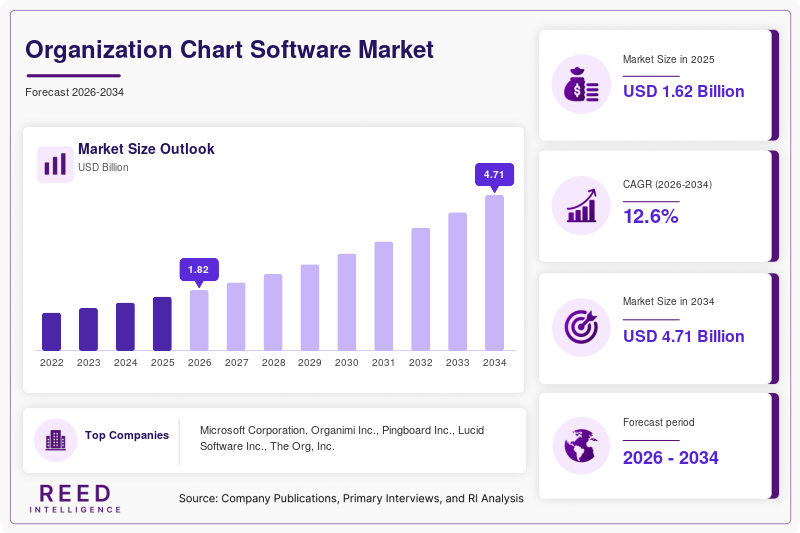
The Organization Chart Software Market was valued at USD 1.62 billion in 2026 and is projected to reach USD 4.18 billion by 2034, expanding at a CAGR of 12.6% during the forecast period (2026–2034). The market is experiencing sustained growth as organizations increasingly prioritize workforce visibility, organizational planning, talent management, and digital workplace transformation. Organization chart software solutions help businesses visualize reporting structures, employee hierarchies, departmental relationships, workforce distribution, and succession planning initiatives, making them a critical component of modern human capital management strategies.
A major global factor supporting market expansion is the accelerating adoption of cloud-based enterprise software across organizations of all sizes. As companies continue digitizing human resource operations and workforce management functions, demand for integrated organization chart platforms has increased significantly. Businesses are leveraging these solutions to improve organizational transparency, streamline workforce planning, support restructuring initiatives, and enhance decision-making through real-time employee data visualization.
Key Highlights
- North America dominated the Organization Chart Software Market with 37.8% market share in 2025, while Asia Pacific is projected to register the fastest CAGR of 14.3% during 2026–2034.
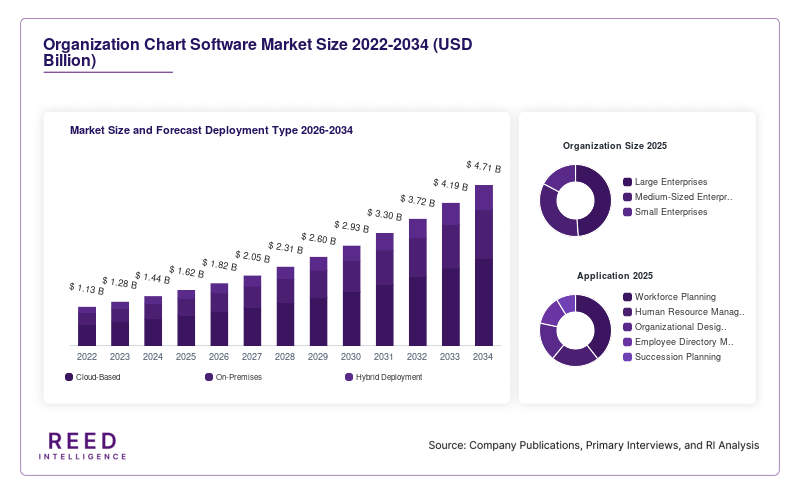
- By Deployment Mode, Cloud-Based Solutions accounted for 63.9% market share in 2025, while Hybrid Deployment Solutions are forecast to grow at a CAGR of 14.8%.
- By Organization Size, Large Enterprises held 58.4% of market revenue in 2025, while Small and Medium-Sized Enterprises (SMEs) are anticipated to expand at 13.9% CAGR.
- By Application, Workforce Management & Organizational Planning represented 34.6% market share in 2025, whereas Succession Planning & Talent Analytics will grow at 15.1% CAGR.
- By Industry Vertical, Information Technology & Telecommunications remained the leading segment with 26.2% market share, while Healthcare is projected to grow at 14.5% CAGR.
- The United States, the dominant country market, was valued at USD 418 million in 2024 and increased to USD 462 million in 2025.
Market Trends
AI-Powered Workforce Visualization and Organizational Analytics
Organizations increasingly seek software solutions capable of providing predictive workforce insights rather than static organizational diagrams. Vendors are integrating artificial intelligence and machine learning technologies to automate reporting structures, identify workforce gaps, recommend organizational adjustments, and support succession planning. These capabilities improve strategic decision-making while reducing administrative workloads for HR departments.
Growing Adoption of Employee Self-Service Organizational Directories
Modern enterprises are implementing organization chart software that functions as an interactive employee directory. These platforms allow staff members to search organizational structures, identify reporting relationships, locate subject-matter experts, and access departmental information. The trend supports improved collaboration, onboarding efficiency, and workforce transparency across geographically distributed organizations.
Market Drivers
Rising Enterprise Demand for Workforce Planning Solutions
Businesses increasingly require detailed workforce visibility to support hiring strategies, organizational restructuring, talent allocation, and operational efficiency initiatives. Organization chart software enables management teams to analyze organizational structures and identify opportunities for workforce optimization. This growing demand for workforce planning capabilities continues to drive market expansion.
Expansion of Human Capital Management Technology Investments
Organizations are increasing investments in digital human resource technologies to improve employee management processes and operational efficiency. Organization chart software has become an important component of broader human capital management ecosystems, creating substantial opportunities for software vendors and solution providers worldwide.
Market Restraint
Data Privacy and Employee Information Security Concerns
Organization chart platforms frequently store sensitive employee information, including reporting relationships, contact details, compensation classifications, and workforce records. Organizations operating under strict privacy regulations may face implementation challenges related to data governance, compliance requirements, and cybersecurity concerns.
Market Opportunities
Integration with Enterprise Collaboration Platforms
Growing adoption of workplace collaboration tools creates opportunities for software vendors to integrate organization charts directly into communication environments. Enhanced accessibility and real-time workforce visibility can increase platform utilization and strengthen user engagement across enterprises.
Demand for Advanced Succession Planning Capabilities
Organizations increasingly focus on leadership continuity and talent development strategies. Advanced organization chart solutions that provide succession planning simulations, leadership pipeline analysis, and workforce scenario modeling will create significant growth opportunities throughout the forecast period.
Segmental Analysis
By Deployment Mode
The market is segmented into Cloud-Based Solutions, On-Premises Solutions, and Hybrid Deployment Solutions.
Cloud-Based Solutions dominated the market with 63.9% share in 2025 due to scalability, remote accessibility, reduced infrastructure requirements, and lower implementation costs. Organizations increasingly prefer subscription-based deployment models that simplify software management and upgrades.
Hybrid Deployment Solutions are projected to achieve the fastest growth with a CAGR of 14.8%. Enterprises requiring flexibility between cloud environments and internal infrastructure will increasingly adopt hybrid deployment architectures to balance operational requirements and compliance objectives.
By Organization Size
The market includes Large Enterprises and Small & Medium-Sized Enterprises (SMEs).
Large Enterprises accounted for 58.4% market share in 2025 because of their complex organizational structures, extensive workforce management requirements, and greater technology budgets. Large organizations frequently require advanced visualization, analytics, and succession planning capabilities.
SMEs will expand at a projected CAGR of 13.9% through 2034. Increasing availability of affordable cloud-based solutions and simplified subscription pricing models will encourage adoption among growing businesses seeking workforce visibility tools.
By Application
The market is segmented into Workforce Management & Organizational Planning, Employee Directory Management, Succession Planning & Talent Analytics, Compliance Management, and Organizational Restructuring.
Workforce Management & Organizational Planning held the largest share of 34.6% in 2025. Organizations increasingly rely on organizational chart software to visualize reporting relationships, evaluate workforce structures, and support strategic planning initiatives.
Succession Planning & Talent Analytics will register the fastest CAGR of 15.1%. Organizations seeking leadership continuity and talent optimization strategies will increasingly invest in analytical workforce planning capabilities.
By Industry Vertical
The market comprises Information Technology & Telecommunications, BFSI, Healthcare, Government, Manufacturing, Retail & E-Commerce, Education, and Others.
Information Technology & Telecommunications accounted for 26.2% market share in 2025 owing to highly dynamic organizational structures and widespread adoption of workforce management technologies.
Healthcare is anticipated to grow at a CAGR of 14.5% during the forecast period. Increasing workforce complexity, staff coordination requirements, and administrative modernization initiatives will support segment growth.
Regional Analysis
North America
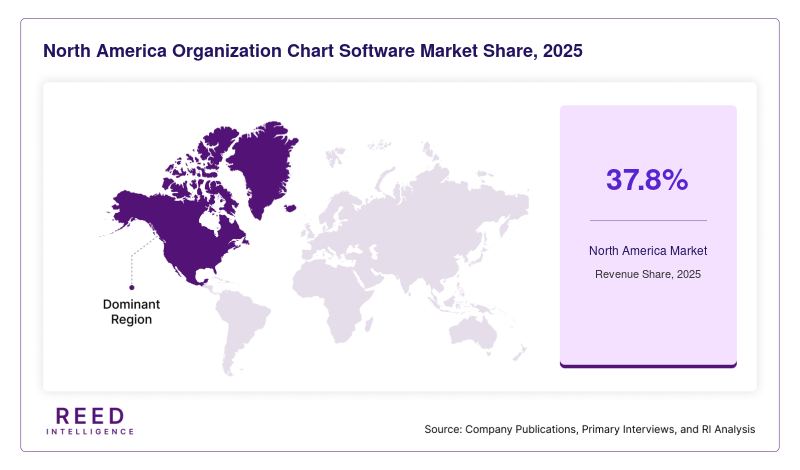
North America accounted for 37.8% of the global Organization Chart Software Market in 2025 and will expand at a projected CAGR of 11.8% through 2034. The region benefits from extensive enterprise software adoption and mature digital transformation initiatives. The United States dominated the regional market due to widespread implementation of integrated HR technology platforms across large corporations and multinational enterprises.
Europe
Europe represented 27.1% market share in 2025 and is forecast to grow at a CAGR of 11.9% during 2026–2034. Demand is supported by organizational modernization initiatives and increasing investments in workforce management technologies. Germany led the regional market owing to strong adoption of enterprise workforce planning solutions among industrial and professional service organizations.
Asia Pacific
Asia Pacific captured 23.6% market share in 2025 and will register the fastest regional CAGR of 14.3% through 2034. Rapid enterprise digitalization and growing investments in human resource technologies continue to support regional expansion. China dominated the region due to increasing adoption of cloud-based workforce management solutions among large enterprises and rapidly expanding private-sector organizations.
Middle East & Africa
The Middle East & Africa accounted for 6.1% market share in 2025 and is expected to grow at a CAGR of 12.4% during the forecast period. Organizations across government, financial services, and energy sectors increasingly seek workforce visibility solutions to support organizational modernization initiatives. United Arab Emirates emerged as the leading country due to ongoing digital transformation investments across public and private sectors.
Latin America
Latin America represented 5.4% of market revenue in 2025 and will expand at a CAGR of 12.8% through 2034. Rising enterprise software adoption and workforce digitization initiatives continue to strengthen regional demand. Brazil remained the dominant market owing to increasing implementation of cloud-based HR management platforms among large and medium-sized organizations.
Competitive Landscape
The Organization Chart Software Market remains competitive, with vendors focusing on cloud innovation, workforce analytics capabilities, integration functionality, and user experience improvements. Market participants continue investing in artificial intelligence, automation technologies, and advanced workforce planning features to strengthen competitive positioning.
Organimi Inc. maintained a leading position due to its dedicated organization chart platform, extensive integration capabilities, and strong enterprise customer base. The company recently enhanced its workforce planning suite with AI-powered reporting relationship recommendations and expanded HR system connectivity options.
The Sage Group plc continues strengthening organizational visualization capabilities within its broader human capital management ecosystem.
Lucid Software Inc. leverages collaborative diagramming capabilities and enterprise integration features to serve diverse organizational requirements.
Pingboard Inc. remains focused on employee directory management and dynamic organizational visualization solutions.
Microsoft Corporation continues expanding organizational chart functionality through integration with workplace productivity and collaboration platforms.
Key Players List
- Organimi Inc.
- Pingboard Inc.
- Lucid Software Inc.
- Microsoft Corporation
- The Sage Group plc
- SAP SE
- Oracle Corporation
- Workday, Inc.
- BambooHR LLC
- ADP, Inc.
- UKG Inc.
- Personio GmbH
- HiBob Ltd.
- Zoho Corporation
- ChartHop Inc.
Organization Chart Software Market Segments
Deployment Type
- Cloud-Based
- On-Premises
- Hybrid Deployment
Organization Size
- Large Enterprises
- Medium-Sized Enterprises
- Small Enterprises
Application
- Workforce Planning
- Human Resource Management
- Organizational Design & Restructuring
- Employee Directory Management
- Succession Planning
End User
- Information Technology
- BFSI
- Healthcare
- Education
- Retail & E-commerce
- Manufacturing
- Government & Public Sector
By Region
- North America
- Europe
- APAC
- Middle East and Africa
- LATAM