OTT TV Video Market Size, Share Demand Report By Product Type (Subscription Video on Demand, Advertising Video on Demand, Transactional Video on Demand), By Application (Media & Entertainment, Gaming, Education, Others), By Platform (Smart TVs, Mobile Devices, Desktop/Laptops, Streaming Devices) & Segment Forecasts, 2026–2034
USD 3950
OTT TV Video Market Size
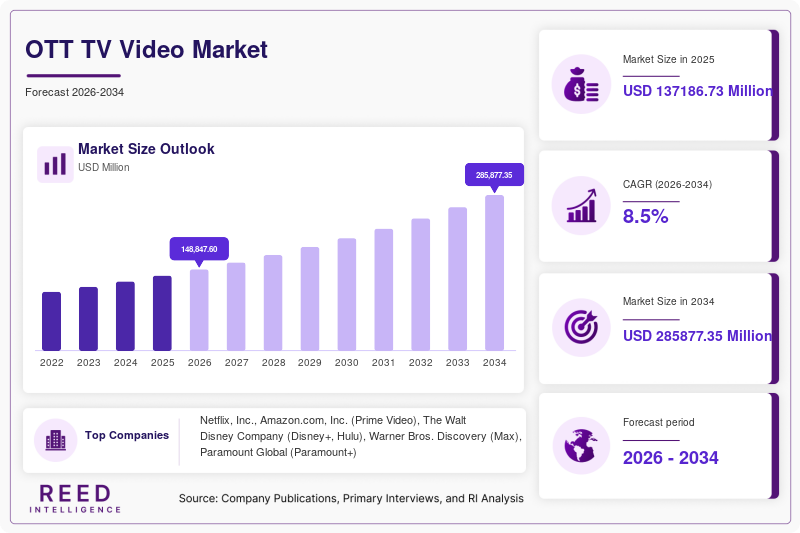
OTT TV Video market size is projected at USD 148,847.6 million in 2026 and is expected to hit USD 284,847.5 million by 2034 with a CAGR of 8.5% during the forecast period. The increasing consumer preference for on-demand, personalized, and flexible viewing experiences, coupled with the proliferation of high-speed internet and connected devices, underpins market expansion. This report delivers a comprehensive analysis of the OTT TV Video market, including segmentation by type and application, competitive dynamics, and regional growth patterns, equipping stakeholders with critical intelligence. The OTT TV Video market continues to demonstrate robust growth potential, fueled by the global shift from traditional linear TV to digital streaming, the growing investment in original content, and continuous innovation in streaming technology and user interfaces.
OTT (Over-The-Top) TV video refers to the delivery of video content over the internet directly to viewers, bypassing traditional cable, satellite, and broadcast television platforms. This includes streaming services like Netflix, Amazon Prime Video, Disney+, and a wide range of niche platforms. The global OTT TV video market is experiencing explosive growth, with global SVOD (Subscription Video on Demand) subscriptions exceeding 1.8 billion in 2025, reflecting a 10% increase from 2023, driven by the increasing penetration of broadband and mobile internet. Adoption patterns reveal that the Subscription Video on Demand (SVOD) type dominates the market, accounting for 55% of total revenue, followed by Advertising Video on Demand (AVOD) at 30%, and Transactional Video on Demand (TVOD) at 15%. The OTT TV Video market's trajectory is closely linked to the growth of the global digital media market, which is projected to reach USD 1 trillion by 2028, and the increasing demand for on-demand and ad-free viewing experiences.
OTT TV Video Market Trends
Rise of Hybrid and Ad-Supported Models
The OTT TV Video market is witnessing a significant trend toward the rise of hybrid and ad-supported models (AVOD), driven by consumer pushback against rising subscription costs and the need for wider audience reach. The revenue from AVOD services grew to USD 45 billion in 2025, a year-on-year increase of 18%, as 50% of new platform launches in 2025 specified ad-supported or hybrid tiers. Adoption rates of ad-supported viewing in the US reached 40%, with this figure projected to exceed 60% by 2030. The OTT TV Video market's trend toward AVOD is reinforced by the need for affordable options, the increasing effectiveness of targeted advertising, and the continuous innovation in ad-tech and measurement.
Growing Focus on Live Sports and Interactive Content
The increasing focus on live sports and interactive content is a major trend shaping the OTT TV Video market, with platforms investing heavily in sports rights and interactive features to engage audiences. The market has seen a 25% increase in the demand for live sports streaming since 2022, with 30% of new content investments in 2025 being directed towards sports and interactive formats. The use of OTT for niche sports and event streaming has also gained significant traction. The OTT TV Video market's trend toward live and interactive content is reinforced by the need for differentiation, the high value of sports audiences, and the continuous innovation in low-latency streaming and interactive technologies.
OTT TV Video Market Drivers
The OTT TV Video market's expansion is primarily driven by the increasing consumer demand for on-demand and personalized viewing experiences, with the global average screen time exceeding 6 hours per day in 2025. The need for flexibility, convenience, and a wide content library has been a major driver, with OTT offering unmatched choice. The proliferation of high-speed internet and affordable smart devices has also fueled market growth. Additionally, the increasing investment in original and exclusive content by streaming giants has spurred demand. The OTT TV Video market's growth is further reinforced by the continuous improvement in streaming technology, leading to better quality and user experience.
OTT TV Video Market Restraints
Despite favorable growth prospects, the OTT TV Video market faces significant constraints, primarily related to the high cost of content production and licensing, which can be a barrier for new entrants. The fragmentation of content across multiple platforms and the resulting subscription fatigue can also be a limitation. The OTT TV Video market's growth is also tempered by the challenge of retaining subscribers in a competitive market, and the issue of password sharing and piracy.
OTT TV Video Market Opportunities
The OTT TV Video market presents significant opportunities in the rapidly expanding market for live sports and events, which can attract large and engaged audiences. The development of interactive and shoppable video experiences is expected to grow at a CAGR of 12% through 2034. Emerging opportunities also exist in the use of AI and machine learning for hyper-personalization and content discovery. The OTT TV Video market's opportunity profile is further enhanced by the growing trend of FAST (Free Ad-Supported Streaming TV) channels and the expansion into international markets.
Challenges in OTT TV Video Market
The OTT TV Video market faces persistent challenges related to the need for continuous content investment to retain and attract subscribers. The complexity of managing global rights and distribution can also be a challenge. The market is also contending with the challenge of reducing churn and increasing customer lifetime value. Additionally, the OTT TV Video market is challenged by the need to balance monetization with user experience, particularly with ad-supported models.
OTT TV Video Market Segmentation
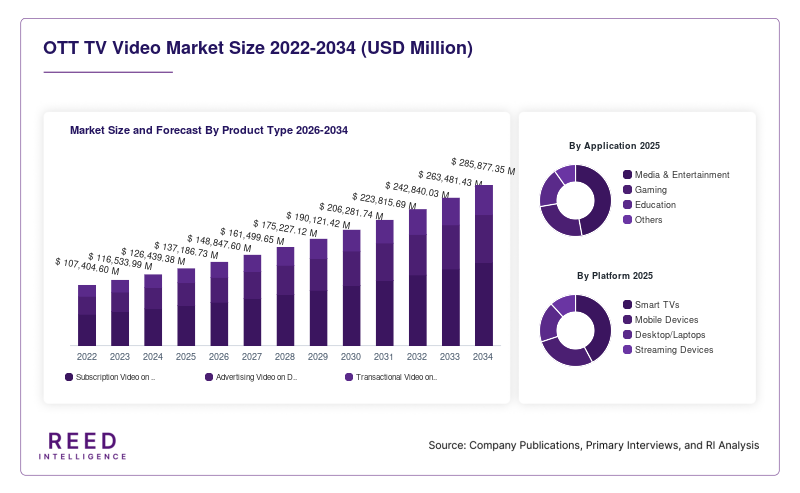
The OTT TV Video market is segmented by Type and Application to provide a comprehensive market perspective. By Type, Subscription Video on Demand (SVOD) dominates with a 55% revenue share, driven by the popularity of major streaming platforms. The Application segment is led by Media & Entertainment, which accounts for 75% of the market, followed by Gaming at 12%, Education at 8%, and Others at 5%.
By Type
Subscription Video on Demand (SVOD) represent the largest segment in the OTT TV Video market, commanding a 55% share, with revenue exceeding USD 81.8 billion in 2025. These are characterized by their monthly subscription model offering unlimited access to a content library. Technical specifications include content catalog size, streaming quality, and user interface. The OTT TV Video market's SVOD segment is driven by its use in premium content consumption.
Advertising Video on Demand (AVOD) capture a 30% share of the OTT TV Video market, with revenue of USD 44.6 billion in 2025. These are characterized by their free or lower-cost access supported by advertisements. Technical specifications include ad load, targeting capabilities, and content variety. The OTT TV Video market's AVOD segment is driven by its use in broad, cost-conscious audiences.
Transactional Video on Demand (TVOD) represent the remaining 15% of the OTT TV Video market, with revenue of USD 22.3 billion in 2025. These are characterized by their pay-per-view or rental model. Technical specifications include pricing, availability windows, and content type. The OTT TV Video market's TVOD segment is driven by its use in new releases and premium events.
By Application
Media & Entertainment dominates the OTT TV Video market, accounting for 75% of revenue, representing USD 111.6 billion in 2025. This segment includes use in movies, series, documentaries, and live events. Usage penetration exceeds 80% in the sector. The OTT TV Video market's Media & Entertainment segment is characterized by its focus on content, user engagement, and retention.
Gaming accounts for 12% of the OTT TV Video market, with revenue of USD 17.8 billion in 2025. This segment encompasses use in game streaming, e-sports, and gaming content. The segment is growing at a robust CAGR, driven by the popularity of gaming. The OTT TV Video market's Gaming segment is characterized by its focus on low latency and interactive features.
Education represents 8% of the OTT TV Video market, with revenue of USD 11.9 billion in 2025. This segment includes use in e-learning, tutorials, and educational content. The segment is growing at a steady pace, driven by the digitalization of education. The OTT TV Video market's Education segment is characterized by its focus on informational content and accessibility.
Others comprises the remainder of the OTT TV Video market, accounting for 5% of total revenue, with USD 7.4 billion in 2025. This includes use in fitness, corporate training, and other niche applications. The segment is projected to grow at a moderate CAGR through 2034. The OTT TV Video market's Others segment is characterized by its diverse and evolving applications.
OTT TV Video Market Regional Outlook
North America OTT TV Video Market
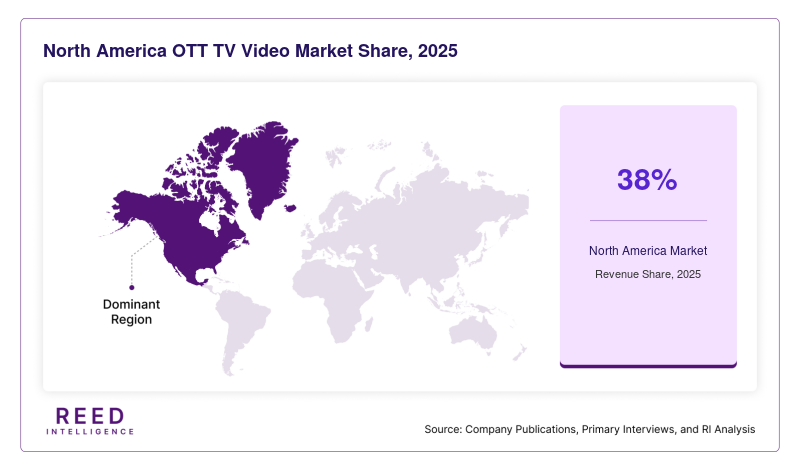
Leads the OTT TV Video market, commanding a 38% share, with a revenue of USD 56.5 billion in 2025. The United States is the primary driver, accounting for 85% of regional demand, driven by the mature streaming market, high disposable income, and strong content production. The North American OTT TV Video market is characterized by its focus on innovation and premium content.
Europe OTT TV Video Market
Represents the second-largest market, capturing a 28% share with a revenue of USD 41.6 billion in 2025. The UK, Germany, and France are the primary drivers, collectively accounting for 60% of regional demand, driven by high internet penetration, diverse content preferences, and a strong media sector. The OTT TV Video market in Europe is characterized by its focus on local content and privacy regulations.
Asia-Pacific OTT TV Video Market
Accounts for 25% of the global OTT TV Video market, with a revenue of USD 37.2 billion in 2025. China, India, and Japan are the primary drivers, together accounting for 70% of regional demand, driven by a large population, rapid digitalization, and growing middle class. The Asia-Pacific OTT TV Video market is projected to grow at the fastest CAGR of 12% through 2034.
Middle East & Africa and Latin America OTT TV Video Market
Together account for the remaining 9% of the OTT TV Video market, with the UAE leading the Middle East market and Brazil leading the Latin American market. Both regions are projected to grow at CAGRs exceeding 10%, driven by increasing internet penetration and content demand.
Top players in OTT TV Video Market
- Netflix, Inc.
- Amazon.com, Inc. (Prime Video)
- The Walt Disney Company (Disney+, Hulu)
- Warner Bros. Discovery (Max)
- Paramount Global (Paramount+)
- NBCUniversal (Peacock)
- Apple Inc. (Apple TV+)
- Sony Corporation (Crunchyroll)
- YouTube (Google)
- Tubi (Fox Corporation)
- Roku Inc. (Roku Channel)
- Pluto TV (ViacomCBS)
- Rakuten Group (Rakuten TV)
- BBC iPlayer (BBC)
- Tencent Video
Netflix, Inc.
Netflix, Inc. holds a dominant position in the OTT TV Video market, with an estimated 15% global market share, particularly strong in the SVOD segment. The company's portfolio of original content is widely recognized for its quality, diversity, and global appeal. Netflix's market leadership is reinforced by its significant investment in content, its strong brand reputation, and its global subscriber base of over 250 million. Netflix commands over 18% of the North American market and 14% of the European market, positioning it as a key player in the OTT TV Video market.
Amazon.com, Inc. (Prime Video)
Amazon.com, Inc. is a leading player in the OTT TV Video market, commanding approximately 12% of the global market share through its Prime Video service, which is bundled with its Prime membership ecosystem. The company's expertise in e-commerce, cloud infrastructure, and content production have solidified its position. Prime Video is known for its diverse content, original series, and integration with the Amazon ecosystem. The company's commitment to innovation and its strong presence in the North American and European markets have enhanced its competitive advantage.
The Walt Disney Company holds a significant 10% market share, with particular strength in its Disney+, Hulu, and ESPN+ bundle. Warner Bros. Discovery is a major player, holding an 8% share with its Max (formerly HBO Max) service.
Recent Developments in OTT TV Video Market
- 2025: Netflix announced a major expansion of its live sports offerings, including a new deal for NFL games, marking its entry into premium sports streaming.
- 2025: Amazon Prime Video introduced a new AI-powered content discovery tool to enhance user experience and engagement.
OTT TV Video Market Segments
By Product Type
- Subscription Video on Demand (SVOD)
- Advertising Video on Demand (AVOD)
- Transactional Video on Demand (TVOD)
By Application
- Media & Entertainment
- Gaming
- Education
- Others
By Platform
- Smart TVs
- Mobile Devices
- Desktop/Laptops
- Streaming Devices
By Region
- North America
- Europe
- APAC
- Middle East and Africa
- LATAM