Out Of Home (OOH) Advertising Market Size, Share & Trends Analysis Report By Format (Billboards, Street Furniture, Transit Advertising, Place-Based Advertising), By Type (Traditional OOH, Digital Out Of Home (DOOH)), By Application (Brand Advertising, Retail & Consumer Advertising, Government & Public Information), By End User (Retail & Consumer Goods, Automotive, Financial Services, Telecommunications & Technology) and By Region (North America, Europe, APAC, Middle East and Africa, LATAM) Forec
USD 3950
Out Of Home (OOH) Advertising Market Size
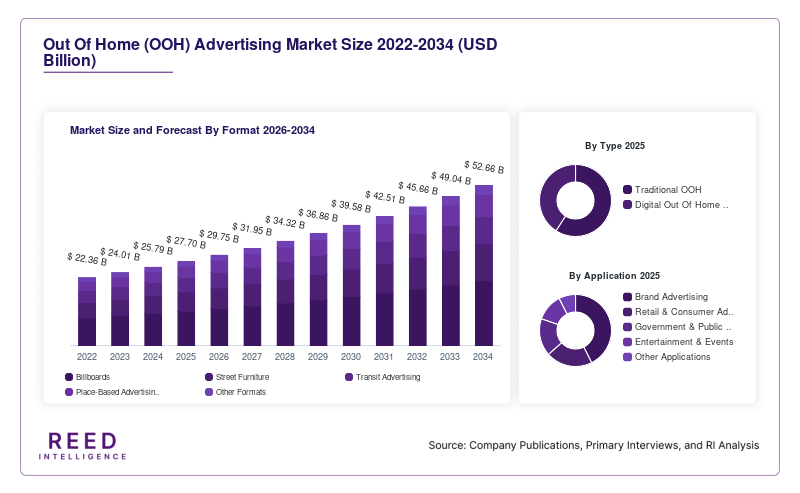
The global Out of Home (OOH) Advertising Market size was valued at USD 27.70 billion in 2025 and is projected to grow from USD 29.75 billion in 2026 to USD 52.66 billion by 2034, registering a CAGR of 7.40% during the forecast period from 2026 to 2034.
Out-of-Home advertising is shifting from a predominantly static medium into a measurable, digitally connected advertising channel that combines physical reach with data, dynamic creative and automated buying. The World Out of Home Organization (WOO) reported that global OOH expenditure reached USD 54.2 billion in 2025, up 15% from 2024, while Digital Out of Home (DOOH) accounted for USD 25.5 billion, or 47% of global OOH expenditure. WOO forecasts DOOH's share to reach 49% in 2026.
The market supplied in this report uses the specified USD 27.70 billion 2025 base, which reflects the defined market scope and methodology rather than WOO's broader expenditure measurement.
Digitalization is the central structural change. JCDecaux reported 10% organic DOOH growth in 2025, with digital representing 41.7% of group revenue. In H1 2026, its DOOH revenue grew 14.5% organically, while programmatic revenue increased 30.9%.
Programmatic buying is also becoming measurable at global scale. A September 2026 WOO study, independently aggregated by PwC across 12 supply-side platforms and more than 40 markets, measured global programmatic DOOH expenditure at USD 1.339 billion in 2025, equivalent to 7% of global DOOH spending.
This changes the commercial proposition: advertisers can increasingly purchase OOH using audience, location, time, context and campaign-performance signals rather than relying only on fixed-location media plans.
-advertising-market-8290.png)
Out Of Home (OOH) Advertising Market Drivers
Digital Conversion Is Increasing the Commercial Value of OOH Inventory
The transition from static billboards and posters to digital screens is changing how advertisers use physical media. DOOH allows multiple advertisers to share one screen, campaigns to change according to time or context, and creative to be updated without physically replacing advertising material.
WOO reported that global DOOH expenditure reached USD 25.5 billion in 2025, representing 47% of OOH expenditure, and expects the share to approach half of total OOH expenditure in 2026.
JCDecaux provides a company-level signal of the economics behind this transition. Its digital revenue grew 10% organically in 2025, while programmatic revenue increased 19.2%. In H1 2026, digital growth accelerated to 14.5% and programmatic revenue grew 30.9%.
For media owners, digital screens increase inventory flexibility and utilization. For advertisers, they allow multiple creative executions and closer integration with mobile, social, search and retail campaigns. The counterbalance is higher capital expenditure for screens, connectivity, maintenance and energy, meaning digital conversion does not automatically improve economics at every location.
Programmatic Buying Is Making OOH More Measurable
Programmatic DOOH is changing the purchasing mechanism from primarily location-based media buying toward automated, audience-oriented transactions. WOO's first independently aggregated global pDOOH study measured USD 1.339 billion in 2025 and found that private marketplace transactions accounted for roughly three-quarters of global pDOOH spend.
The significance is that OOH can increasingly participate in the same campaign-planning environment as digital media. Advertisers can select inventory according to location, audience, time of day, venue characteristics and campaign objectives.
Broadsign's 2026 transaction analysis, based on activity across Broadsign and Place Exchange, covers more than 1.7 million programmatically enabled screens and more than 1.5 trillion available impressions each month. Food and drink represented 18.5% of programmatic OOH spending in its 2025 dataset, while shopping/retail-related categories were also prominent.
This creates demand from advertisers that previously allocated more heavily toward online channels because of measurement requirements. The limitation is that programmatic penetration remains uneven, particularly in markets with lower digital-screen density or fragmented media-owner infrastructure.
High-Mobility Environments and Retail Locations Expand Audience Reach
OOH benefits from physical movement through airports, rail stations, roads, shopping districts, retail locations, entertainment venues and other high-traffic environments. These locations provide repeated exposure that cannot be replicated by a single digital impression.
JCDecaux reported a daily audience of approximately 850 million people across 79 countries and more than 1.1 million advertising panels in 2026. Its transport business covers airports, metros, buses, trains and trams, while street furniture remains a major component of its global footprint.
Retail media is adding another layer. Kroger's 2026 filing describes its retail-media business as combining first-party shopping data with digital and in-store placements and connecting advertising impressions with household transactions.
The commercial mechanism is therefore moving closer to the point of purchase. Brands can use OOH near stores, transit locations and shopping environments to influence consumers shortly before a transaction. This is particularly relevant for consumer packaged goods, retail, restaurants and entertainment.
Out Of Home (OOH) Advertising Market Restraints
Digital Infrastructure Requires Significant Capital Investment
The migration to DOOH requires screens, media players, connectivity, electricity, software, monitoring systems and maintenance. Media owners must invest before additional digital inventory can generate advertising revenue.
Lamar's 2025 results illustrate the capital requirements: the company reported USD 90.9 million of capital expenditure on digital billboards in 2025, compared with USD 60.7 million in 2024. Total 2025 capital expenditure reached USD 180.8 million.
Digital assets also require ongoing maintenance and replacement cycles. Energy consumption can become an additional operating consideration, particularly for large-format screens operating continuously.
Consequently, the economic benefit of digitization depends on location quality, utilization rates, advertising demand and the ability to sell inventory at sufficient yields.
Macroeconomic and Advertising-Budget Volatility Can Affect Campaign Spending
OOH competes for advertiser budgets with search, social, video, retail media, connected TV and other channels. WARC's 2026 global advertising analysis identifies economic and geopolitical volatility as important variables affecting advertising investment. Its baseline scenario projected global advertising growth of 11.5% in 2026, while more severe conditions could reduce spending substantially.
OOH can be particularly exposed to changes in local advertising demand because retail, entertainment, automotive, travel and other sectors frequently adjust campaign spending according to consumer conditions.
Nevertheless, the medium's physical reach and increasingly measurable digital formats give media owners tools to defend budgets. In the U.S., OAAA reported that OOH revenue reached a record USD 9.46 billion in 2025, growing 3.6% year over year and extending the industry's growth streak to 19 consecutive quarters.
Out Of Home (OOH) Advertising Market Opportunities
Programmatic DOOH and Data-Driven Creative
Programmatic DOOH creates an opportunity to connect physical advertising with automated campaign planning and digital measurement. WOO's 2026 global study establishes a new independently aggregated baseline for pDOOH, while JCDecaux reported 30.9% organic pDOOH growth in H1 2026.
Dynamic creative can also respond to weather, traffic, sporting events, store proximity, time of day or audience conditions. This makes OOH more suitable for campaigns requiring frequent creative changes and can increase the value of premium digital inventory.
Retail Media and In-Store Digital Screens
Retail environments are becoming a major extension of OOH because advertisers can connect physical exposure with purchase data. Kroger's retail-media model links advertising activity with first-party shopping behavior and uses both digital and in-store placements.
This creates an opportunity for OOH operators to participate in commerce-oriented advertising rather than competing only for brand-awareness budgets. Digital screens near stores, in shopping centers and inside retail environments can provide brands with additional inventory that sits close to the purchase decision.
Transit, Airport and Major-Event Advertising
Transit advertising remains a strong premium OOH category because airports, rail systems and urban transit networks provide high-frequency exposure. JCDecaux reported that it operates across 154 airports and 257 metro, bus, train and tram contracts globally.
Large sporting and cultural events can also temporarily increase advertising demand. JCDecaux identified the 2026 FIFA World Cup as a positive contributor to its H1 2026 performance.
The opportunity extends beyond the event itself because host cities can upgrade digital infrastructure, transportation displays and public-space media assets.
Segmental Analysis
By Format
Billboards represent approximately 38% of the global market in 2025, making them the largest format segment. Their scale, visibility and roadside reach continue to support demand from national brands, automotive companies, retail businesses and local advertisers.
Street Furniture accounts for approximately 22%, supported by bus shelters, kiosks, urban panels and pedestrian-focused advertising. JCDecaux reported more than 636,000 street-furniture advertising panels globally in 2026.
Transit Advertising represents approximately 20% and is the fastest-growing format, with a CAGR of approximately 8.6%. OAAA reported transit as the fastest-growing U.S. OOH segment for the second consecutive year in 2025, with revenue increasing 9.2%.
Place-Based Advertising accounts for approximately 13%, while other formats contribute approximately 7%.
By Type
Traditional OOH represents approximately 53% of the global market in 2025. Static billboards, posters and conventional street furniture remain important because they require less technology investment and can provide long-duration exposure.
Digital Out Of Home (DOOH) represents approximately 47% and is the fastest-growing type, with a CAGR of approximately 11.0%. WOO reported that DOOH represented 47% of global OOH expenditure in 2025 and is forecast to reach 49% in 2026.
The shift is supported by higher creative flexibility, dynamic campaigns, automated transactions and the ability to integrate OOH with data-driven media planning.
By Application
Brand Advertising accounts for approximately 39% of market demand in 2025. Large consumer brands continue to use OOH to build broad awareness through high-frequency physical exposure.
Retail & Consumer Advertising represents approximately 27% and is the fastest-growing application, with a CAGR of approximately 9.2%. The growth mechanism is proximity to purchase: advertisers can combine OOH exposure with retail-media data and store-level targeting. Kroger's retail-media model illustrates the industry's movement toward linking advertising impressions with actual transactions.
Entertainment & Events represents approximately 12%, Telecommunications & Technology and government/public information together account for approximately 14%, while other applications contribute approximately 8%.
By End User
Retail & Consumer Goods represents approximately 28% of OOH advertising demand in 2025, reflecting the medium's suitability for broad consumer reach and proximity to stores.
Telecommunications & Technology accounts for approximately 16%, while Automotive represents approximately 15%.
Entertainment accounts for approximately 12%, Financial Services 10%, and Travel & Hospitality 9%.
Retail & Consumer Goods remains the largest end-user category, while Travel & Hospitality is the fastest-growing segment at approximately 9.0% CAGR, supported by airport, transit, destination and tourism advertising.
Regional Analysis
North America Out Of Home (OOH) Advertising Market
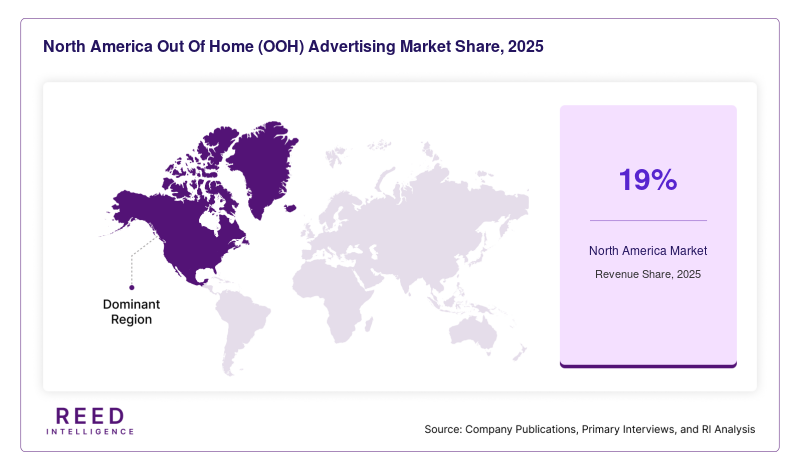
North America represents approximately 19% of the global OOH Advertising Market in 2025. The U.S. is the region's dominant market, supported by extensive billboard infrastructure, transit systems, retail environments and sophisticated digital advertising technology.
OAAA reported U.S. OOH advertising revenue of USD 9.46 billion in 2025, up 3.6% year over year, with DOOH representing 36.3% of total revenue and growing 10.5%.
The market is also developing around programmatic buying. WOO's 2026 pDOOH study measured the U.S. at USD 545.5 million of programmatic OOH spend in 2025, making it the largest national pDOOH market by volume.
Lamar generated USD 2.27 billion in revenue in 2025, up 2.7%, while investing USD 90.9 million in digital-billboard capital expenditure.
North America is projected to grow at approximately 6.5% CAGR through 2034. The main commercial mechanisms are digital conversion, programmatic purchasing, retail-media integration and transit expansion.
Europe Out Of Home (OOH) Advertising Market
Europe accounts for approximately 19% of the global market in 2025. The region has a mature OOH ecosystem supported by dense urban populations, public transportation, airports and established street-furniture networks.
JCDecaux reported that it was the largest outdoor advertising operator in Europe, with 740,067 advertising panels across the region as of 2026. Its European business is increasingly digitized, with DOOH becoming a major contributor to revenue.
Programmatic adoption is also comparatively advanced in selected markets. WOO's 2026 pDOOH study found Germany had the highest programmatic penetration globally at 31.8%, while France reached 16.7%.
The UK provides another strong signal: WARC and the Advertising Association reported OOH advertising investment increased 15.0% in Q1 2026, one of the strongest performances among established media channels.
Europe is projected to grow at approximately 7.0% CAGR. Digital conversion, programmatic buying and transport advertising are the principal growth mechanisms.
APAC Out Of Home (OOH) Advertising Market
APAC represents approximately 55% of global OOH expenditure in 2025 and is the largest regional market. WOO reported APAC OOH expenditure of approximately USD 29.7 billion, substantially ahead of North America and Europe.
China alone accounted for approximately USD 18.2 billion, while Japan generated USD 3.2 billion and South Korea USD 1.04 billion. China, Brazil and South Korea recorded some of the strongest OOH shares of total media among the leading markets identified by WOO.
APAC also has the highest DOOH penetration among major regions. WOO reported that digital represented 55.7% of APAC OOH revenue in 2025, compared with 41.3% in Europe and 36.9% in North America.
The region is projected to grow at approximately 8.0% CAGR through 2034. China, Japan, South Korea, Australia, India and Southeast Asia provide diverse growth pools, while urbanization and expanding retail environments create additional screen inventory.
The main constraint is the uneven maturity of OOH infrastructure between highly digitized markets such as Japan, China and South Korea and developing markets where static inventory remains more prevalent.
Middle East and Africa Out Of Home (OOH) Advertising Market
Middle East and Africa represents approximately 4% of the global market in 2025. The region is undergoing rapid development in premium urban, airport, retail and destination advertising infrastructure.
WOO reported Africa's 2025 OOH expenditure at approximately USD 1.2 billion and found that DOOH accounted for 18% of African OOH revenues. Saudi Arabia stood out in WOO's digital data, with an exceptionally high DOOH share.
Large-scale urban development and tourism investment across Gulf markets are increasing the availability of premium digital advertising locations. Airports, shopping centers, hospitality districts and major events create concentrated audiences that are attractive to luxury, automotive, travel, financial and consumer brands.
The region is projected to grow at approximately 8.2% CAGR, supported by urban development, tourism, premium retail and digital-screen deployment.
Infrastructure costs, regulatory differences and uneven measurement standards remain constraints, particularly outside the major Gulf advertising markets.
LATAM Out Of Home (OOH) Advertising Market
LATAM represents approximately 8% of the global market in 2025 and is projected to grow at approximately 8.7% CAGR, making it the fastest-growing regional market in this analysis.
WOO reported approximately USD 2.9 billion in OOH expenditure across Latin America in 2025. Brazil was the region's largest market at approximately USD 1.33 billion and recorded 12% growth in OOH's share of total media.
JCDecaux reported particularly high digital penetration in Brazil, where 79% of its revenue was digital in 2025.
This creates a strong mechanism for future growth: traditional roadside inventory is progressively being converted to digital, while urbanization and retail development create additional locations. Mexico, Brazil, Colombia, Argentina and Chile provide important advertising markets.
The main constraints are currency volatility, uneven digital infrastructure and differences in measurement standards. However, the combination of digital conversion and rising advertiser demand supports continued regional expansion.
Competitive Landscape
The OOH advertising market includes global media owners, regional billboard operators, transit-media companies, digital-screen networks, retail-media operators, programmatic platforms and specialized technology providers.
JCDecaux maintains one of the industry's broadest geographic footprints, with more than 1.1 million advertising panels and operations across 79 countries. Digital revenue represented 42.8% of group revenue in H1 2026, while programmatic revenue grew 30.9%.
Lamar Advertising has a particularly strong U.S. billboard position. It generated USD 2.27 billion in 2025 revenue and continued converting inventory toward digital billboards, with USD 90.9 million invested in digital-billboard capital expenditure during the year.
Ströer reported EUR 2.08 billion of 2025 revenue and EUR 1.04 billion in revenue during the first six months of 2026, providing a major European OOH and media-platform presence.
Key Market Players
- JCDecaux
- Lamar Advertising Company
- Clear Channel Outdoor
- OUTFRONT Media
- Ströer
- Global
- Intersection
- OUTFRONT Media Canada
- Ocean Outdoor
- APG|SGA
- Broadsign
- VIOOH
- Place Exchange
- Daktronics
- Adams Outdoor Advertising
Recent Market Developments
- September 2026 – WOO published its inaugural Global pDOOH Expenditure Study. The PwC-aggregated study measured global programmatic DOOH expenditure at USD 1.339 billion in 2025 across more than 40 markets and 12 SSPs, establishing a new independently aggregated benchmark for programmatic OOH.
- August 2026 – Broadsign published its 2026 Programmatic DOOH Trends analysis. The study used transaction data from Broadsign and Place Exchange covering more than 1.7 million programmatically enabled screens and more than 1.5 trillion available impressions monthly, highlighting the increasing maturity of automated OOH buying.
Out Of Home (OOH) Advertising Market Segments
By Format
- Billboards
- Street Furniture
- Transit Advertising
- Place-Based Advertising
- Other Formats
By Type
- Traditional OOH
- Digital Out Of Home (DOOH)
By Application
- Brand Advertising
- Retail & Consumer Advertising
- Government & Public Information
- Entertainment & Events
- Other Applications
By End User
- Retail & Consumer Goods
- Automotive
- Financial Services
- Telecommunications & Technology
- Travel & Hospitality
- Entertainment
- Other Industries
By Region
- North America
- Europe
- APAC
- Middle East and Africa
- LATAM