Outbound Call Tracking Software Market Size, Share & Demand Report By Deployment Mode (Cloud-Based, On-Premise, Hybrid), By Enterprise Size (Large Enterprises, Small and Medium-Sized Enterprises), By End-Use Industry (Retail and E-commerce, Banking Financial Services and Insurance, Healthcare, Telecommunications, IT and SaaS, Travel and Hospitality, Education, Others), By Region & Segment Forecasts, 2026–2034
USD 3950
Market Overview
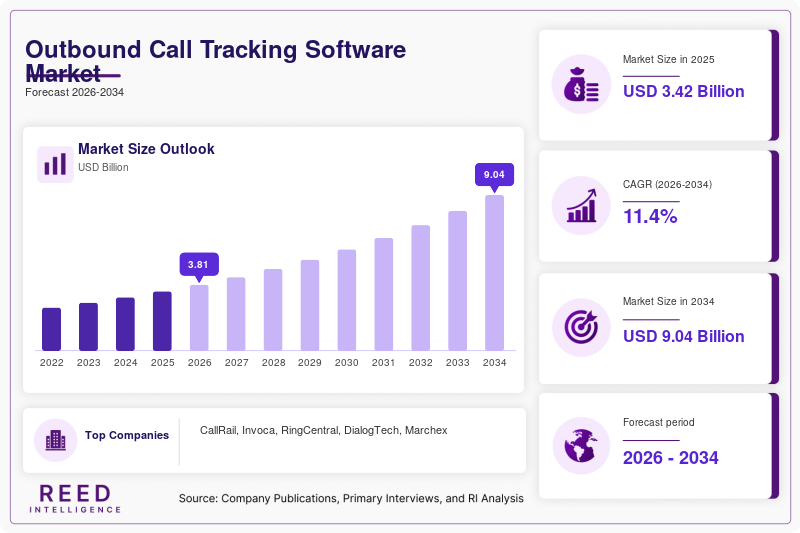
The global Outbound Call Tracking Software Market size was valued at approximately USD 3.42 billion in 2026 and is projected to reach nearly USD 8.11 billion by 2034, expanding at a CAGR of 11.4% during the forecast period from 2026 to 2034. The market is gaining momentum as enterprises continue to prioritize measurable customer engagement, sales productivity, and marketing attribution across digital and voice-based communication channels. Outbound call tracking software enables organizations to monitor call campaigns, evaluate customer interactions, optimize lead conversion rates, and improve return on advertising investments. Increasing integration of artificial intelligence, cloud communication systems, and customer relationship management platforms has further strengthened the adoption of advanced outbound call analytics solutions.
A major global factor supporting market expansion is the rapid digitization of customer engagement operations across industries such as retail, banking, healthcare, telecommunications, and e-commerce. Businesses are investing in omnichannel marketing ecosystems that combine voice calls, SMS campaigns, email automation, and conversational analytics. Outbound call tracking software has become an essential component of this ecosystem because it helps organizations identify campaign effectiveness, analyze customer behavior, and automate sales workflows. Small and medium-sized enterprises are also adopting subscription-based cloud solutions due to lower implementation costs and easier scalability.
Key Highlights
- North America dominated the market with a 34.2% share in 2025, while Asia Pacific is expected to grow at the fastest CAGR of 13.1% during 2026–2034.
- By deployment mode, cloud-based solutions accounted for the largest share of 62.8%, while hybrid deployment platforms are projected to grow at a CAGR of 14.2%.
- By enterprise size, large enterprises led with a 58.4% share, whereas small and medium-sized enterprises are expected to expand at a CAGR of 13.8%.
- By end-use industry, retail and e-commerce dominated with a 29.7% share, while healthcare is projected to grow at a CAGR of 14.6% during the forecast period.
- The United States remained the dominant country, with market values of USD 780 million in 2024 and USD 865 million in 2025.
Market Trends
AI-Powered Conversational Analytics Transforming Call Intelligence
The integration of artificial intelligence and machine learning technologies into outbound call tracking platforms has become one of the most influential trends shaping the market. Businesses are increasingly using AI-powered conversational analytics to gain deeper visibility into customer interactions, sales outcomes, and agent performance. Modern outbound call tracking software platforms now include sentiment analysis, keyword tracking, predictive lead scoring, and automated call summarization features. These capabilities help organizations reduce manual monitoring efforts while improving campaign efficiency and customer engagement quality. Enterprises are also leveraging speech analytics to identify purchasing intent, customer dissatisfaction patterns, and conversion opportunities in real time.
The growing use of AI-driven dashboards is enabling sales managers to monitor outbound campaigns more effectively and make data-based decisions faster. Companies in sectors such as insurance, banking, and telecommunications are integrating AI call analytics with CRM systems to create unified customer profiles and automate follow-up actions. As organizations seek better operational efficiency and measurable sales outcomes, vendors are introducing more advanced natural language processing and intelligent automation features. This trend is expected to continue influencing software purchasing decisions throughout the forecast period.
Rising Adoption of Cloud-Based Communication Infrastructure
Cloud deployment models are rapidly becoming the preferred choice among enterprises implementing outbound call tracking software solutions. Organizations are transitioning from legacy on-premise communication systems to cloud-native platforms because of scalability, lower infrastructure costs, and easier integration with remote workforce operations. The increasing popularity of software-as-a-service business models has accelerated demand for subscription-based outbound call tracking solutions among small and medium-sized enterprises. Cloud platforms provide businesses with flexible deployment, remote accessibility, and centralized reporting capabilities across multiple locations.
Another factor supporting this trend is the expansion of remote and hybrid work environments. Sales teams operating across distributed regions require secure and accessible communication tools that can be monitored and optimized from a centralized interface. Cloud-based outbound call tracking software also supports rapid software updates, AI integration, and omnichannel communication features without major hardware investments. Vendors are increasingly introducing customizable cloud dashboards and API-based integrations with marketing automation systems, enabling organizations to build connected customer engagement ecosystems. This ongoing transition toward cloud infrastructure is expected to significantly shape future market growth.
Market Drivers
Increasing Demand for Marketing Attribution and Campaign Optimization
Organizations across industries are focusing heavily on measurable marketing performance and customer acquisition efficiency, which is driving the adoption of outbound call tracking software. Businesses spend substantial budgets on digital advertising campaigns, search engine marketing, social media promotions, and lead generation activities. Outbound call tracking solutions help companies determine which campaigns generate the highest quality leads and strongest conversion rates. By assigning unique phone numbers to specific marketing channels, businesses can evaluate return on investment more accurately and optimize future spending decisions.
The growing importance of data-driven decision-making has increased demand for advanced reporting and analytics capabilities. Sales and marketing teams use outbound call tracking software to monitor campaign performance in real time, evaluate customer interactions, and improve sales scripts. Industries such as automotive, healthcare, real estate, and financial services rely on these tools to improve lead management and customer engagement. As competition intensifies across digital markets, organizations are expected to continue investing in software platforms that enhance visibility into outbound sales activities and campaign effectiveness.
Expansion of Remote Sales Operations and Virtual Contact Centers
The rapid expansion of remote sales teams and virtual contact centers has become a major factor supporting the growth of the outbound call tracking software market. Enterprises are increasingly adopting distributed workforce models to improve operational flexibility, reduce infrastructure costs, and access wider talent pools. Managing outbound communication activities across remote environments requires centralized monitoring systems capable of tracking agent productivity, customer engagement, and campaign performance.
Outbound call tracking software provides organizations with real-time call monitoring, automated reporting, and performance analytics that help maintain consistent service quality across geographically dispersed teams. Companies are also integrating cloud telephony and collaboration platforms with outbound call tracking tools to create unified communication ecosystems. The demand for remote workforce management solutions has increased significantly among customer support providers, telemarketing agencies, and business process outsourcing firms. In addition, enterprises are prioritizing compliance monitoring and call recording capabilities to ensure secure communication practices. These operational requirements are expected to sustain long-term demand for outbound call tracking technologies.
Market Restraint
Data Privacy Regulations and Integration Complexity Limiting Adoption
Stringent data privacy regulations and integration challenges continue to restrain the expansion of the outbound call tracking software market, particularly among highly regulated industries. Governments and regulatory authorities across North America, Europe, and Asia Pacific are implementing stricter rules regarding customer data collection, call recording, consent management, and cross-border information transfer. Businesses operating outbound calling campaigns must comply with regulations related to telemarketing permissions, consumer privacy, and data retention standards. Failure to comply can result in financial penalties, operational disruptions, and reputational risks.
Many organizations also face difficulties integrating outbound call tracking software with existing legacy communication infrastructure, CRM systems, and enterprise resource planning platforms. Large enterprises often operate complex technology ecosystems that require customized integrations and extended deployment timelines. Small businesses may struggle with technical expertise limitations and additional implementation expenses associated with system configuration and employee training. For example, financial institutions handling sensitive customer information must ensure secure encryption, storage compliance, and audit-ready reporting before deploying advanced call tracking platforms. These factors can delay purchasing decisions and limit adoption among organizations with strict compliance requirements or outdated communication systems.
Market Opportunities
Growing Adoption Among Healthcare and Telemedicine Providers
The healthcare industry is creating substantial opportunities for outbound call tracking software vendors as hospitals, clinics, insurance providers, and telemedicine companies increase investments in patient communication technologies. Healthcare organizations rely on outbound communication for appointment scheduling, prescription reminders, follow-up consultations, insurance verification, and patient engagement campaigns. Outbound call tracking platforms help healthcare providers monitor communication quality, reduce missed appointments, and improve patient satisfaction metrics.
The expansion of telemedicine services and digital healthcare platforms has further accelerated demand for advanced communication analytics solutions. Healthcare providers require systems capable of tracking patient interactions across multiple communication channels while maintaining compliance with data privacy regulations. AI-powered call analysis features are also being used to identify patient concerns, improve support efficiency, and optimize resource allocation. As healthcare organizations continue to modernize customer engagement operations and improve patient experience strategies, software providers are expected to benefit from increasing long-term demand across both public and private healthcare sectors.
Rising Penetration of Outbound Analytics in Emerging Economies
Emerging economies across Asia Pacific, Latin America, and the Middle East are presenting significant growth opportunities for outbound call tracking software providers. Businesses in these regions are rapidly digitizing customer engagement operations to support expanding e-commerce, banking, retail, and telecommunications sectors. Small and medium-sized enterprises are increasingly adopting cloud-based communication tools to improve lead generation and customer retention strategies while minimizing operational costs.
The availability of affordable internet infrastructure, expanding smartphone penetration, and growing use of digital payment ecosystems are accelerating enterprise technology adoption across developing markets. Governments are also supporting digital transformation initiatives that encourage businesses to modernize communication systems and customer service operations. Outbound call tracking software vendors are introducing multilingual dashboards, regional cloud hosting options, and localized analytics tools to strengthen market penetration in emerging economies. As awareness regarding marketing attribution and customer analytics continues to increase, these regions are expected to generate substantial revenue opportunities during the forecast period.
Segmental Analysis
By Deployment Mode
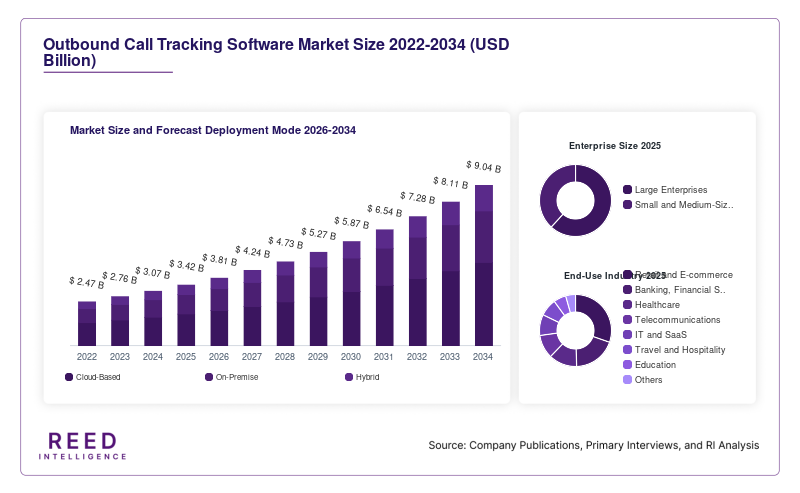
Cloud-based deployment emerged as the dominant subsegment within the Outbound Call Tracking Software Market, accounting for approximately 62.8% of the market share in 2024. The strong performance of cloud platforms is primarily linked to their scalability, lower infrastructure costs, and ease of remote accessibility. Enterprises are increasingly replacing legacy on-premise communication systems with subscription-based cloud solutions that offer centralized management and automated updates. Cloud deployment also enables businesses to integrate outbound call tracking capabilities with CRM platforms, marketing automation systems, and AI-powered analytics tools. Industries such as retail, healthcare, and telecommunications are rapidly adopting cloud-based outbound communication systems to improve operational flexibility and customer engagement performance.
Hybrid deployment solutions are expected to register the fastest CAGR of 14.2% during the forecast period due to rising demand for customizable and secure communication environments. Large enterprises operating in highly regulated sectors often require a balance between cloud scalability and on-premise security infrastructure. Hybrid models allow organizations to maintain sensitive customer data within private systems while leveraging cloud-based analytics and automation capabilities. Financial institutions, healthcare providers, and government agencies are increasingly implementing hybrid deployment frameworks to ensure compliance with internal security policies and data privacy regulations. Vendors are also introducing modular deployment architectures that support seamless integration between private servers and public cloud platforms, further accelerating adoption.
By Enterprise Size
Large enterprises accounted for the highest market share of approximately 58.4% in 2024 due to extensive outbound communication requirements and significant technology investment capacity. These organizations manage high volumes of customer interactions across sales, customer support, and marketing departments, making outbound call tracking software an essential operational tool. Large enterprises often require advanced analytics, AI-powered monitoring, multilingual support, and integration with existing enterprise software systems. Sectors such as banking, telecommunications, insurance, and retail are major contributors to demand because they rely heavily on outbound campaigns for lead generation and customer relationship management.
Small and medium-sized enterprises are projected to witness the fastest CAGR of 13.8% during 2026–2034 as affordable cloud-based subscription models continue to reduce implementation barriers. SMEs are increasingly recognizing the importance of measurable marketing performance and customer engagement analytics for business growth. Outbound call tracking software enables smaller businesses to optimize advertising campaigns, improve lead conversion rates, and automate communication workflows without major infrastructure investments. Vendors are developing simplified dashboards, low-cost licensing structures, and mobile-friendly interfaces specifically designed for smaller organizations. Growing digitalization among regional businesses and increasing use of online marketing channels are expected to accelerate adoption within this segment.
By End-Use Industry
Retail and e-commerce emerged as the dominant end-use industry segment, accounting for nearly 29.7% of the market share in 2024. Retailers and online commerce companies rely heavily on outbound communication strategies for customer engagement, order confirmation, promotional campaigns, and loyalty program management. Outbound call tracking software helps these businesses monitor campaign effectiveness, evaluate customer preferences, and improve conversion performance across digital sales channels. The rapid growth of omnichannel retailing and personalized marketing strategies has increased the need for advanced call analytics and campaign attribution tools. Integration with customer relationship management platforms and AI-powered recommendation systems further supports adoption across the retail sector.
Healthcare is expected to record the fastest CAGR of 14.6% during the forecast period due to rising investments in patient communication and telemedicine services. Hospitals, clinics, and healthcare service providers are increasingly adopting outbound call tracking platforms to manage appointment scheduling, follow-up consultations, insurance verification, and patient engagement programs. AI-driven communication analytics are helping healthcare organizations improve service quality, reduce missed appointments, and optimize operational efficiency. The growing use of digital healthcare applications and remote consultation services is also creating demand for secure and compliant communication tracking systems. Vendors are introducing healthcare-focused solutions with advanced encryption, compliance monitoring, and multilingual support capabilities to strengthen market penetration.
Regional Analysis
North America
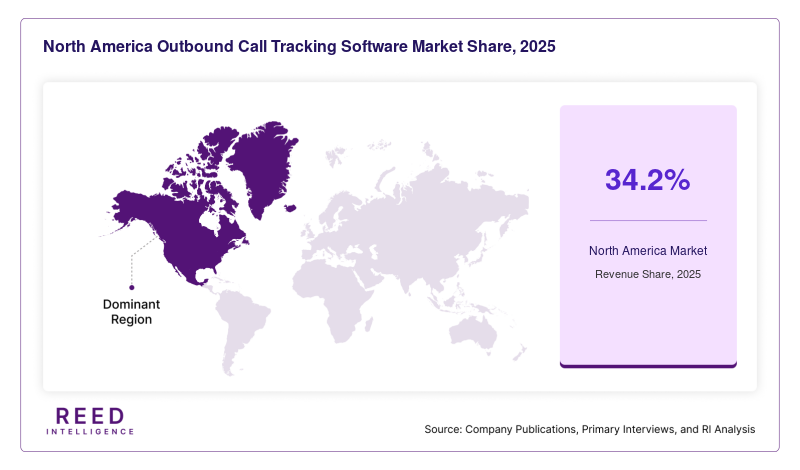
North America accounted for approximately 34.2% of the global Outbound Call Tracking Software Market share in 2025 and is expected to maintain its dominant position throughout the forecast period. The region is projected to expand at a CAGR of 10.7% from 2026 to 2034 due to widespread adoption of advanced customer engagement technologies and strong presence of cloud communication providers. Enterprises across the United States and Canada are heavily investing in AI-powered sales analytics, omnichannel marketing platforms, and remote contact center management systems. The growing focus on customer retention and marketing performance measurement continues to support market expansion.
The United States remains the leading country in the region because of its mature digital advertising industry and high enterprise technology spending. A unique growth factor supporting the national market is the rapid integration of outbound call tracking software with AI-driven customer relationship management platforms. Businesses in industries such as banking, retail, and healthcare are increasingly deploying predictive call analytics and automated lead scoring tools to improve customer acquisition efficiency. Rising investments in cloud-based sales infrastructure are expected to sustain market demand across the country.
Europe
Europe represented nearly 25.1% of the global market share in 2025 and is anticipated to witness steady expansion at a CAGR of 9.8% during the forecast period. Demand for outbound call tracking software in the region is being supported by increasing digital transformation initiatives among enterprises and growing investments in customer experience management solutions. Organizations across sectors such as telecommunications, automotive, and financial services are prioritizing advanced analytics platforms to improve outbound communication performance and campaign optimization. Cloud adoption and AI integration are also contributing to market growth across European economies.
Germany remains the dominant country within the European market due to its advanced industrial infrastructure and high enterprise software adoption rates. A distinctive growth factor in Germany is the strong emphasis on operational efficiency and data-driven sales management across manufacturing and automotive industries. Enterprises are deploying outbound call tracking platforms to improve customer engagement, optimize dealer communication networks, and monitor service quality. The expansion of digital commerce and rising demand for CRM integration solutions are expected to create additional growth opportunities throughout the region.
Asia Pacific
Asia Pacific held approximately 22.8% of the global Outbound Call Tracking Software Market share in 2025 and is projected to register the fastest CAGR of 13.1% during 2026–2034. The region is benefiting from rapid digitalization, expanding e-commerce activities, and increasing cloud infrastructure investments. Businesses across countries such as China, India, Japan, and Australia are modernizing customer engagement strategies to improve lead generation and customer retention outcomes. Small and medium-sized enterprises are particularly contributing to market growth due to increasing adoption of affordable cloud-based communication solutions.
China dominates the regional market because of its large telecommunications industry and rapidly expanding digital economy. One unique growth factor driving the Chinese market is the widespread adoption of AI-enabled customer engagement platforms among e-commerce and online retail companies. Businesses are using outbound call tracking tools to manage promotional campaigns, improve customer service efficiency, and analyze consumer purchasing behavior. Government support for digital transformation initiatives and increasing investments in cloud data centers are expected to further strengthen market development across Asia Pacific.
Middle East & Africa
The Middle East & Africa region accounted for nearly 8.4% of the global market share in 2025 and is expected to expand at a CAGR of 10.3% over the forecast period. Increasing digital transformation projects, rising investments in smart communication infrastructure, and expansion of customer service operations are contributing to market growth. Enterprises in sectors such as banking, retail, and telecommunications are adopting outbound call tracking software to enhance customer engagement and improve sales management capabilities. Growing interest in cloud-based communication platforms is also supporting technology adoption among regional businesses.
The United Arab Emirates remains the leading market within the region due to its advanced digital infrastructure and strong enterprise technology investments. A unique factor driving growth in the country is the rapid expansion of customer engagement technologies within the tourism and hospitality sectors. Businesses are implementing outbound communication analytics platforms to improve reservation management, customer follow-up services, and multilingual customer support operations. Government-led smart city initiatives and rising investments in digital business ecosystems are expected to create additional market opportunities.
Latin America
Latin America captured approximately 9.5% of the global market share in 2025 and is forecast to grow at a CAGR of 10.9% during the forecast period. Increasing internet penetration, growing adoption of digital marketing technologies, and expansion of regional contact center industries are supporting market growth. Enterprises are recognizing the importance of outbound analytics for campaign optimization and customer acquisition management. Cloud-based deployment models are particularly popular among small businesses seeking affordable and scalable communication management solutions.
Brazil continues to dominate the Latin American market due to its large consumer base and expanding digital commerce ecosystem. A major growth factor supporting the Brazilian market is the rapid development of outsourced customer support and telemarketing services. Companies are increasingly investing in outbound call tracking software to improve campaign monitoring, agent productivity, and customer conversion performance. The growth of fintech platforms, online retail businesses, and mobile-based customer engagement channels is expected to further accelerate market expansion across the region.
Competitive Landscape
The Outbound Call Tracking Software Market is moderately fragmented, with global technology providers and regional software vendors competing through innovation, cloud integration, and AI-driven analytics capabilities. Leading companies are focusing on strategic partnerships, product customization, and subscription-based pricing models to strengthen their competitive positions. Vendors are increasingly investing in artificial intelligence, speech analytics, and predictive reporting technologies to improve customer engagement and sales optimization capabilities.
CallRail remains one of the leading players in the market due to its strong presence in marketing analytics and cloud communication solutions. The company recently expanded its AI-powered conversational intelligence features to improve lead qualification and campaign performance tracking for enterprise clients. Other major participants are emphasizing API integration, multilingual support, and advanced compliance management tools to address the growing requirements of global businesses.
Key Players
Recent Developments
- In February 2026, CallRail introduced an upgraded AI-based call summarization engine designed to automate customer interaction reporting and improve sales conversion analysis.
- In September 2025, RingCentral announced expanded integration capabilities between its cloud communication platform and multiple CRM systems to strengthen outbound sales tracking functionalities.
- In June 2025, Invoca launched advanced conversational analytics tools with predictive customer intent detection features aimed at retail and financial service organizations.
- In November 2025, Five9 partnered with a major cloud infrastructure provider to enhance real-time outbound campaign monitoring and distributed workforce management capabilities.
- In March 2026, Genesys expanded its AI-driven customer engagement portfolio with enhanced multilingual outbound call tracking features for international contact centers.
Outbound Call Tracking Software Market Segments
Deployment Mode
- Cloud-Based
- On-Premise
- Hybrid
Enterprise Size
- Large Enterprises
- Small and Medium-Sized Enterprises
End-Use Industry
- Retail and E-commerce
- Banking, Financial Services, and Insurance
- Healthcare
- Telecommunications
- IT and SaaS
- Travel and Hospitality
- Education
- Others
By Region
- North America
- Europe
- APAC
- Middle East and Africa
- LATAM