Outbound Tourism Market Size, Share & Demand Report By Travel Purpose (Leisure Tourism, Business Tourism, Medical Tourism, Educational Tourism, Religious Tourism), By Traveler Type (Independent Travelers, Group Travelers, Family Travelers, Corporate Travelers), By Booking Channel (Online Travel Agencies, Direct Mobile Booking Platforms, Offline Travel Agencies, Corporate Booking Services), By Region & Segment Forecasts, 2026–2034
USD 3950
Market Overview
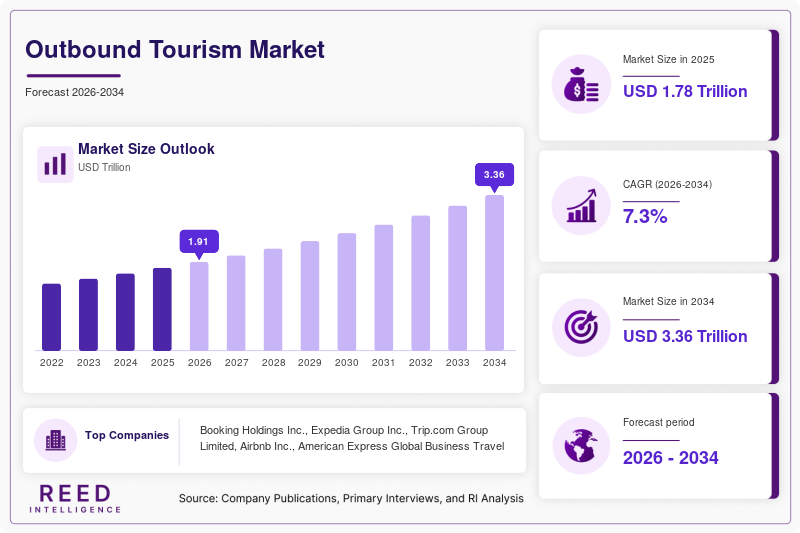
The global Outbound Tourism Market size was valued at USD 1.78 trillion in 2026 and is projected to reach USD 3.12 trillion by 2034, expanding at a CAGR of 7.3% during the forecast period from 2026 to 2034. The market continues to gain momentum as rising disposable income, improved international air connectivity, and digital travel booking platforms encourage consumers to travel abroad more frequently for leisure, business, education, and medical purposes. Increased access to visa-on-arrival programs and simplified online travel documentation systems have also supported international travel demand across developed and emerging economies.
One of the primary global factors supporting market expansion is the recovery and modernization of international aviation infrastructure. Airlines are expanding long-haul routes, low-cost carriers are entering international corridors, and governments are investing in tourism-friendly border management systems. This combination has reduced travel costs and improved accessibility for middle-income travelers. In addition, mobile-based travel planning applications, AI-powered itinerary platforms, and multilingual digital payment systems are making cross-border tourism more convenient. Growing interest in experiential travel, cultural immersion programs, wellness tourism, and international sporting events is further contributing to sustained market growth.
Key Highlights
- North America dominated the market with a 33.8% share in 2025.
- Asia Pacific is expected to grow at the fastest CAGR of 9.8% during 2026–2034. By travel purpose, leisure tourism accounted for the largest share of 46.1%, while medical tourism is projected to grow at a CAGR of 10.7%.
- By traveler type, independent travelers led with a 57.4% share, whereas group travelers are expected to expand at a CAGR of 8.9%.
- By booking channel, online travel agencies accounted for the highest share of 52.3%, while direct mobile booking platforms are projected to grow at a CAGR of 11.1%.
- The United States remained the dominant country, with market values of USD 286 billion in 2024 and USD 309 billion in 2025.
Market Trends
Growth of Digital and Mobile-Based Travel Ecosystems
The Outbound Tourism Market is witnessing rapid adoption of digital booking ecosystems supported by mobile applications, AI-driven travel planning tools, and integrated payment solutions. Consumers increasingly prefer mobile-first travel experiences that allow them to compare flight prices, reserve accommodations, purchase insurance, and access destination guidance through a single platform. Travel operators are investing in predictive analytics and customer personalization technologies to improve traveler engagement and retention. Real-time language translation features and virtual customer support are further improving international travel convenience.
Digital transformation is also supporting travel demand among younger consumers who prioritize flexibility and self-guided travel experiences. Social media platforms continue to influence destination selection, while influencer marketing campaigns encourage travelers to explore emerging international destinations. Subscription-based travel memberships and app-based reward systems are increasing customer loyalty. As internet penetration expands across developing countries, digital tourism services are expected to remain a major growth trend across the global outbound tourism industry.
Rising Demand for Experiential and Sustainable International Travel
Travelers are increasingly shifting away from traditional sightseeing packages toward experience-focused tourism activities that include cultural immersion, culinary exploration, eco-tourism, adventure tourism, and wellness retreats. Consumers are showing stronger interest in personalized itineraries that offer authentic local engagement instead of standardized group tours. This trend is encouraging travel companies to develop specialized international travel packages focused on sustainability and unique destination experiences.
Sustainable tourism practices are also gaining importance as governments and travelers prioritize environmental responsibility. Airlines are investing in fuel-efficient aircraft, hotels are implementing energy-saving programs, and travel agencies are promoting low-impact tourism destinations. Younger travelers in particular are selecting tourism operators that demonstrate sustainability commitments. The growing popularity of volunteer tourism, nature-based travel, and carbon-offset programs is expected to reshape service offerings across the Outbound Tourism Market during the forecast period.
Market Drivers
Expansion of Middle-Class Population and Disposable Income
The growing middle-class population across Asia Pacific, Latin America, and parts of the Middle East is significantly supporting the expansion of the Outbound Tourism Market. Rising household income levels are enabling consumers to allocate larger budgets toward international leisure and business travel. Improved employment opportunities, urbanization, and access to consumer financing have increased spending on overseas vacations, educational tours, and international shopping travel.
Many travelers from emerging economies are now taking multiple international trips annually due to affordable travel packages and easier access to global destinations. Financial institutions are also offering travel-focused credit cards, installment-based vacation financing, and loyalty reward programs that encourage outbound tourism spending. Younger professionals and dual-income households are increasingly prioritizing travel experiences as part of their lifestyle choices. This shift in consumer behavior is creating sustained demand for international tourism services across both developed and developing regions.
Expansion of International Connectivity and Tourism Infrastructure
Global improvements in aviation networks, airport modernization projects, and transportation infrastructure are accelerating outbound travel activity. Airlines are increasing direct international routes between secondary cities, reducing travel time and improving convenience for passengers. Governments are also introducing digital visa systems, automated immigration checkpoints, and tourism partnerships to strengthen international mobility.
The emergence of low-cost international airlines has reduced airfare expenses for budget-conscious travelers, particularly in Asia Pacific and Europe. Travel operators are collaborating with hospitality companies and transport providers to create bundled tourism packages that improve affordability. Smart airport technologies, multilingual navigation systems, and integrated transportation networks are improving the overall international travel experience. As global tourism infrastructure continues to modernize, outbound travel volumes are expected to increase steadily during the forecast period.
Market Restraint
Economic Uncertainty and Geopolitical Disruptions Affecting International Travel
Economic instability, currency fluctuations, and geopolitical tensions continue to create challenges for the Outbound Tourism Market. International travel demand is highly sensitive to inflation, rising transportation costs, and reduced consumer confidence. During periods of economic slowdown, consumers often postpone discretionary spending on overseas travel and prioritize domestic alternatives. Exchange rate volatility also affects travel affordability, particularly for tourists from emerging economies where currency depreciation increases international travel expenses.
Geopolitical conflicts, travel restrictions, and diplomatic disputes can disrupt airline operations and reduce tourism activity across specific regions. Political instability may also lead to increased visa limitations and higher travel insurance costs. For example, periods of regional unrest in parts of Eastern Europe and the Middle East have temporarily impacted international booking patterns and airline capacity allocation. Health-related travel concerns and sudden border policy changes can additionally affect traveler confidence. These uncertainties create operational challenges for airlines, hospitality providers, and tourism agencies that rely on stable international travel demand.
Market Opportunities
Expansion of Medical and Wellness Tourism Across Emerging Economies
Medical and wellness tourism is creating significant opportunities for the Outbound Tourism Market as consumers increasingly travel abroad for specialized healthcare services, cosmetic procedures, rehabilitation therapies, and preventive wellness treatments. Countries offering cost-effective healthcare infrastructure and internationally accredited hospitals are attracting patients from both developed and developing economies. This trend is encouraging travel agencies and healthcare providers to collaborate on integrated tourism and medical service packages.
Wellness tourism is also expanding due to rising interest in mental health retreats, spa tourism, yoga destinations, and holistic treatment programs. Travelers are seeking international destinations that combine healthcare access with leisure experiences and cultural activities. Governments in Asia Pacific and the Middle East are investing in medical tourism infrastructure and promotional campaigns to attract international visitors. The growing acceptance of teleconsultation and digital medical coordination is expected to further support cross-border healthcare travel during the forecast period.
Growth Potential in Remote Work and Long-Stay International Travel
The rise of remote and hybrid work models is generating new opportunities for international tourism providers. Many professionals are combining work responsibilities with long-term international travel, creating demand for flexible accommodation, coworking spaces, and extended-stay tourism services. Countries are increasingly introducing digital nomad visa programs to attract skilled remote workers who contribute to local tourism spending.
Travel operators are developing specialized packages that include high-speed internet access, work-friendly accommodation, local transportation, and cultural activities. Long-stay travelers often spend more on local experiences, dining, and wellness services compared to short-term tourists. Coastal destinations, cultural cities, and affordable urban centers are benefiting from this trend. As companies continue to support flexible work arrangements, the demand for international work-and-travel experiences is expected to contribute significantly to the long-term growth of the Outbound Tourism Market.
Segmental Analysis
By Travel Purpose
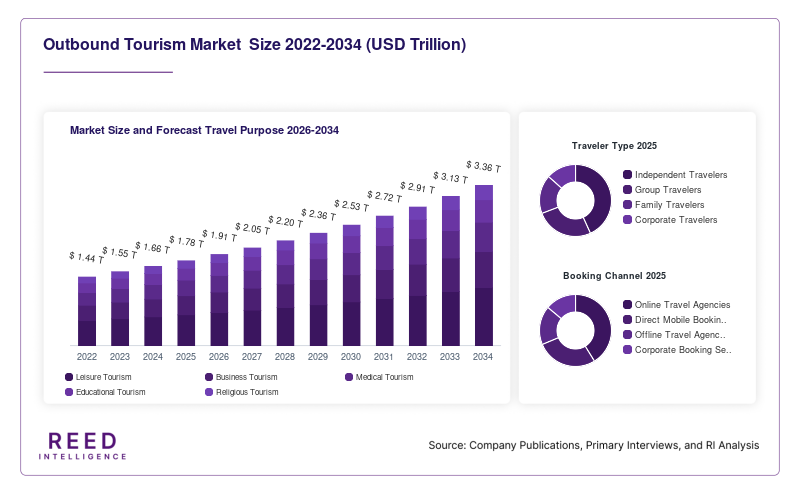
Leisure tourism accounted for the dominant share of the Outbound Tourism Market in 2024, representing 46.1% of total revenue. The segment continues to lead due to growing consumer preference for international vacations, cultural exploration, cruise tourism, and adventure tourism experiences. Increasing disposable income and improved access to affordable travel packages are supporting leisure travel demand across both developed and emerging economies. Travelers are also prioritizing experiential tourism activities that include culinary tourism, heritage tourism, and wellness retreats. Social media influence and digital travel recommendations are encouraging consumers to explore international destinations more frequently. Travel companies are responding by offering customized itineraries, flexible booking options, and integrated accommodation services. The expansion of international airline connectivity and the availability of budget-friendly tourism packages are additionally contributing to the strong performance of the leisure tourism segment.
Medical tourism is projected to register the fastest CAGR of 10.7% during the forecast period due to increasing demand for affordable healthcare services and specialized treatments abroad. Consumers are traveling internationally for cosmetic procedures, dental care, fertility treatments, and advanced medical therapies that may be expensive or unavailable in their home countries. Governments and healthcare providers are investing in internationally accredited hospitals and multilingual patient support services to attract medical travelers. Wellness-focused medical tourism programs that combine treatment with rehabilitation and leisure activities are also gaining popularity. Digital healthcare consultation platforms are simplifying pre-travel medical coordination and improving patient confidence. Countries in Asia Pacific and the Middle East are increasingly positioning themselves as competitive medical tourism hubs through policy support, healthcare infrastructure investments, and tourism promotion campaigns.
By Traveler Type
Independent travelers held the largest share of the Outbound Tourism Market in 2024, accounting for 57.4% of overall revenue. The segment is expanding due to growing consumer preference for personalized and flexible travel experiences. Independent travelers increasingly rely on digital booking platforms, mobile navigation tools, and AI-powered itinerary applications to organize trips without traditional travel agents. Younger consumers and solo travelers are particularly attracted to self-guided tourism experiences that allow greater control over travel schedules and destination selection. Budget airlines and online accommodation platforms are making independent travel more affordable and accessible across international markets. Social media content and travel review platforms are also influencing destination decisions and encouraging spontaneous travel planning. Additionally, remote work flexibility has enabled consumers to combine leisure travel with professional responsibilities, further supporting demand for independent international tourism experiences.
Group travelers are expected to expand at the fastest CAGR of 8.9% during 2026–2034 due to increasing participation in organized tourism packages, educational tours, corporate travel programs, and destination weddings. Travel operators are introducing curated group experiences that include transportation, accommodation, guided tours, and cultural activities at competitive pricing structures. Senior travelers and family tourists often prefer group travel arrangements because of safety, convenience, and cost-sharing benefits. Educational institutions and corporate organizations are also contributing to segment growth through international conferences, training programs, and student exchange tours. The rising popularity of religious tourism and event-based tourism is additionally supporting group travel demand. Travel companies are increasingly using digital coordination platforms and multilingual customer support services to improve the overall group travel experience.
By Booking Channel
Online travel agencies accounted for the largest share of the Outbound Tourism Market in 2024, contributing 52.3% of total revenue. The segment dominates due to the convenience of comparing flights, hotels, transportation, and travel packages through integrated digital platforms. Consumers increasingly prefer online travel agencies because they provide flexible booking options, customer reviews, loyalty rewards, and real-time pricing updates. The expansion of smartphone usage and internet penetration has further accelerated digital booking adoption across emerging economies. Travel agencies are investing in AI-driven recommendation systems, multilingual support, and personalized marketing strategies to improve customer engagement. Dynamic pricing models and bundled tourism services are also helping online platforms attract repeat travelers. Furthermore, digital payment integration and installment-based booking systems are making international travel planning more accessible for a broader consumer base.
Direct mobile booking platforms are projected to witness the fastest CAGR of 11.1% during the forecast period as consumers increasingly use airline and hotel applications for seamless travel management. Mobile-first booking ecosystems allow travelers to access boarding passes, loyalty rewards, destination alerts, and customer support services in real time. Airlines and hospitality providers are promoting direct bookings through exclusive discounts, personalized offers, and reward point programs. The growing popularity of contactless travel experiences and digital wallet integration is further strengthening mobile booking adoption. Younger travelers in particular prefer app-based booking systems due to convenience and faster transaction processing. Technological advancements such as AI chat assistants, predictive travel recommendations, and location-based services are also improving user engagement. The rapid expansion of 5G connectivity is expected to support continued innovation in mobile-based tourism booking platforms.
Regional Analysis
North America
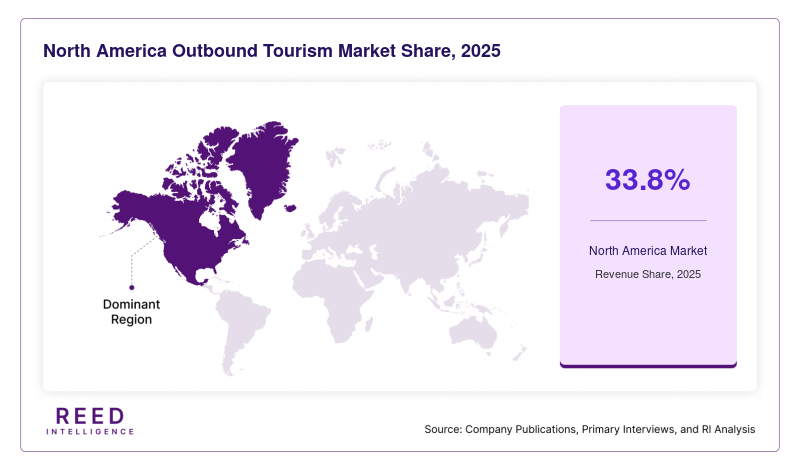
North America accounted for 33.8% of the global Outbound Tourism Market share in 2025, maintaining its position as the largest regional market. The region is expected to expand at a CAGR of 6.4% during the forecast period due to high international travel spending, strong airline connectivity, and a mature digital tourism ecosystem. Consumers in the United States and Canada continue to demonstrate high demand for international leisure vacations, business travel, cruise tourism, and cultural tourism activities. Strong adoption of premium travel services and increasing preference for personalized tourism experiences are also supporting regional growth.
The United States remained the dominant country within North America due to high outbound travel expenditure and extensive international airline networks. A major growth factor supporting the market is the rapid expansion of digital travel platforms that integrate booking, travel insurance, loyalty rewards, and destination management services. American travelers are increasingly exploring destinations across Europe, Asia Pacific, and Latin America for leisure and wellness tourism. Additionally, rising participation in international sports tourism and educational travel programs continues to strengthen outbound tourism demand across the country.
Europe
Europe represented a substantial share of the Outbound Tourism Market in 2025 and is projected to register a CAGR of 6.7% through 2034. The region benefits from strong cross-border mobility, advanced transportation systems, and high consumer spending on international travel. European travelers frequently participate in short-haul and long-haul international trips due to the availability of budget airlines and regional travel agreements. Sustainable tourism preferences and increasing demand for customized travel experiences are also influencing outbound travel trends across the region.
Germany emerged as the leading country in the European market due to high disposable income levels and strong international travel culture among consumers. One unique growth factor driving the market is the increasing adoption of eco-conscious tourism practices among European travelers. Consumers are actively selecting airlines, hotels, and travel agencies that demonstrate environmental sustainability initiatives. Demand for cultural tourism, wellness retreats, and nature-based travel experiences is expanding rapidly. Additionally, European travelers are increasingly participating in multi-country travel itineraries supported by efficient rail and air transportation networks.
Asia Pacific
Asia Pacific is expected to record the fastest growth in the Outbound Tourism Market, with a forecast CAGR of 9.8% during 2026–2034. The region is benefiting from rapid urbanization, rising middle-class income, and expanding international aviation networks. Consumers across China, India, South Korea, and Southeast Asia are increasingly allocating higher budgets toward international vacations, shopping tourism, educational travel, and luxury tourism experiences. Government support for passport issuance and digital visa processing systems is also encouraging outbound travel activity.
China remained the dominant country within Asia Pacific due to its large traveling population and increasing overseas spending capacity. A unique growth factor supporting the Chinese market is the growing popularity of experiential tourism among younger consumers who prioritize customized international travel experiences. Travelers are increasingly seeking luxury shopping destinations, cultural immersion programs, and premium hospitality services abroad. Expansion of international payment solutions and mobile booking applications is also improving travel convenience. India is additionally emerging as a high-growth outbound tourism market supported by rising air passenger traffic and affordable travel financing programs.
Middle East & Africa
The Middle East & Africa region is experiencing steady growth in the Outbound Tourism Market and is projected to expand at a CAGR of 7.1% during the forecast period. Rising international connectivity, infrastructure development, and increasing participation in leisure tourism are contributing to market growth across the region. High-income consumers in Gulf countries continue to spend significantly on luxury tourism, international shopping travel, and family vacations. Improved airline connectivity through regional aviation hubs is also supporting outbound travel expansion.
The United Arab Emirates remained the dominant country in the region due to its strong aviation infrastructure and high outbound travel expenditure. A major growth factor driving the market is the increasing preference for premium and luxury travel experiences among affluent travelers. Consumers from the UAE frequently travel to Europe, Asia, and North America for lifestyle tourism, education, and healthcare services. Regional airlines are also expanding international routes and introducing premium passenger services. In Africa, growing urbanization and improving passport accessibility are gradually supporting outbound tourism demand among middle-income consumers.
Latin America
Latin America accounted for a developing share of the global Outbound Tourism Market in 2025 and is expected to grow at a CAGR of 6.9% during the forecast period. Rising international air connectivity and improving economic stability in selected countries are contributing to increased outbound travel activity. Consumers across the region are increasingly participating in leisure tourism, sports tourism, and international family travel. Online travel platforms and installment-based payment systems are making international tourism more accessible for middle-income travelers.
Brazil emerged as the dominant country in the Latin American market due to its large population base and increasing international tourism spending. One unique growth factor supporting market expansion is the strong demand for international entertainment and sports tourism experiences among younger consumers. Brazilian travelers frequently visit North America and Europe for music festivals, global sporting events, and shopping tourism. The expansion of regional airline partnerships and travel financing services is further improving international travel accessibility. Mexico is also witnessing growing outbound tourism activity supported by rising digital travel adoption and business travel demand.
Competitive Landscape
The Outbound Tourism Market is moderately fragmented, with international travel agencies, online booking platforms, hospitality companies, and airline operators competing through digital innovation, strategic partnerships, and service diversification. Companies are increasingly focusing on AI-powered travel personalization, flexible cancellation policies, and integrated tourism packages to strengthen market positioning. The competitive environment is also influenced by rising investment in mobile booking applications, loyalty programs, and destination-specific travel experiences.
Booking Holdings Inc. remained one of the leading companies in the market due to its extensive digital travel ecosystem and broad international accommodation network. The company continues to expand its AI-based travel recommendation systems and mobile booking capabilities to improve customer engagement. Expedia Group, Trip.com Group, and Airbnb are also strengthening their international tourism portfolios through technology-driven customer services and regional expansion strategies.
Key Players
- Booking Holdings Inc.
- Expedia Group Inc.
- Trip.com Group Limited
- Airbnb Inc.
- American Express Global Business Travel
- TUI Group
- Flight Centre Travel Group
- Tripadvisor LLC
- MakeMyTrip Limited
- Thomas Cook India Limited
- CWT Global B.V.
- Hopper Inc.
- Skyscanner Limited
- Despegar.com Corp.
- Traveloka Holding Limited
Recent Developments
- Booking Holdings Inc. expanded its AI-powered travel assistant platform in 2025 to improve itinerary personalization and multilingual customer support across international destinations.
- Trip.com Group Limited partnered with multiple regional airlines in 2025 to introduce bundled outbound tourism packages targeting travelers across Asia Pacific.
- Airbnb Inc. launched extended-stay international accommodation programs in 2024 to support growing demand from remote workers and digital nomads.
- Expedia Group Inc. introduced sustainable tourism filters in 2025, enabling travelers to identify environmentally responsible hotels and tourism operators.
- MakeMyTrip Limited expanded its international travel financing solutions in 2024 to support outbound tourism growth among middle-income travelers in India.
Outbound Tourism Market Segments
Travel Purpose
- Leisure Tourism
- Business Tourism
- Medical Tourism
- Educational Tourism
- Religious Tourism
Traveler Type
- Independent Travelers
- Group Travelers
- Family Travelers
- Corporate Travelers
Booking Channel
- Online Travel Agencies
- Direct Mobile Booking Platforms
- Offline Travel Agencies
- Corporate Booking Services
By Region
- North America
- Europe
- APAC
- Middle East and Africa
- LATAM