Oviposition Deterring Pheromone Market Size, Share Demand Report By Type (Synthetic Pheromones, Bio-based Pheromones), By Application (Agriculture Crops, Horticulture Crops, Forestry), By End-Use (Commercial Farming, Residential & Small-Scale Farming) By Region & Segment Forecasts, 2026–2034
USD 3950
Market Overview
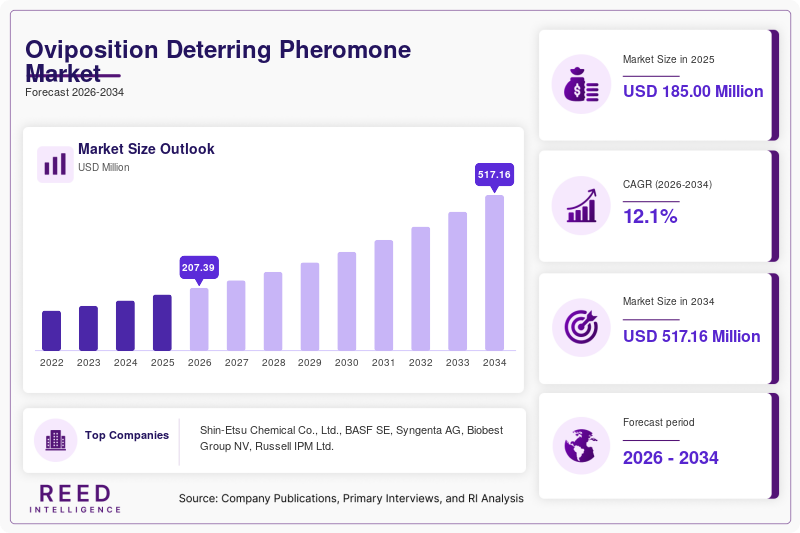
The Oviposition Deterring Pheromone Market size was valued at approximately USD 185 million in 2026 and is projected to reach USD 465 million by 2034, expanding at a CAGR of 12.1% during 2026–2034. The market is gaining traction due to the increasing need for sustainable pest control methods across agriculture, horticulture, and forestry. Oviposition deterring pheromones (ODPs) are semiochemicals that discourage insects from laying eggs on treated surfaces, offering an eco-friendly alternative to synthetic pesticides. Their targeted mode of action reduces environmental impact and supports integrated pest management (IPM) strategies.
A major global factor supporting market growth is the rising regulatory pressure against chemical pesticides. Governments and environmental agencies worldwide are promoting biological and pheromone-based pest control solutions to minimize ecological damage and human health risks. This shift is accelerating adoption among farmers, especially in regions with strict pesticide regulations and high export standards for agricultural produce.
Key Highlights
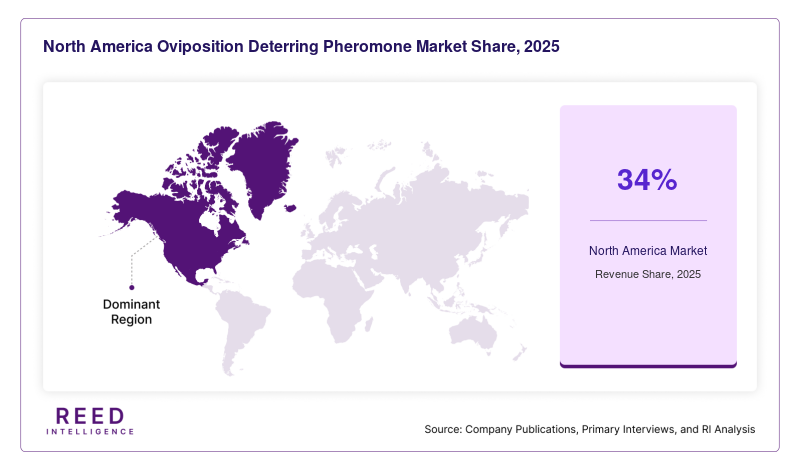
- North America held the dominant market share of 34% in 2025.
- Asia Pacific is expected to grow at the fastest CAGR of 14.3%.
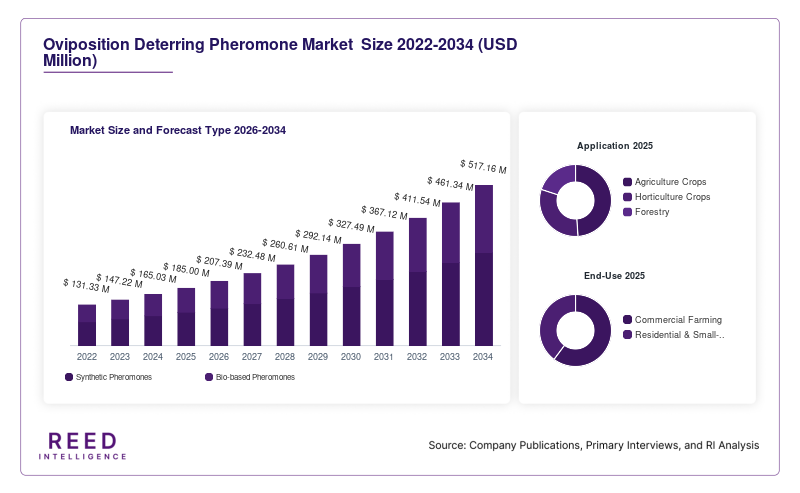
- In Type, synthetic pheromones dominated with over 68% share, while bio-based pheromones are projected to grow at a CAGR of 13.7%.
- In Application, agriculture crops led the segment, whereas horticulture crops are the fastest-growing at 13.2% CAGR.
- The United States recorded market values of USD 58 million in 2024 and USD 64 million in 2025, maintaining its leading position globally.
Market Trends
Increasing Adoption of Integrated Pest Management (IPM) Practices
The integration of oviposition deterring pheromones into Integrated Pest Management systems is becoming a key trend across the agricultural sector. Farmers are shifting toward IPM frameworks that combine biological, cultural, and mechanical pest control methods to reduce reliance on synthetic chemicals. ODPs fit well into these systems as they specifically target insect reproductive behavior, preventing infestation at an early stage. This preventive approach reduces crop damage and lowers the need for reactive pesticide applications. As awareness of sustainable farming grows, agricultural cooperatives and government programs are promoting pheromone-based solutions through subsidies and training initiatives. Additionally, export-oriented farming sectors are adopting IPM practices to meet international food safety standards, further boosting demand for ODPs.
Advancements in Microencapsulation and Controlled Release Technologies
Another prominent trend in the Oviposition Deterring Pheromone Market is the development of advanced delivery systems such as microencapsulation and controlled-release formulations. These technologies allow pheromones to be released gradually over extended periods, improving their effectiveness and reducing the frequency of application. Manufacturers are investing in research to enhance the stability of pheromones under varying environmental conditions such as temperature, humidity, and UV exposure. This has expanded their applicability across diverse climatic regions. Furthermore, innovations in biodegradable carriers and polymer matrices are aligning with sustainability goals, making these products more attractive to environmentally conscious consumers. These advancements are expected to improve product performance and drive long-term market growth.
Market Drivers
Rising Demand for Sustainable and Organic Farming Solutions
The increasing demand for organic and sustainably produced food is a major driver of the Oviposition Deterring Pheromone Market. Consumers are becoming more aware of the health and environmental impacts of chemical pesticides, leading to a shift toward organic produce. This change in consumer preference is encouraging farmers to adopt eco-friendly pest control methods, including pheromone-based solutions. ODPs provide a non-toxic alternative that does not leave harmful residues on crops, making them suitable for organic certification. Additionally, governments and international organizations are supporting sustainable agriculture through subsidies, grants, and policy frameworks, which further accelerates adoption. The expansion of organic farming areas globally is expected to create consistent demand for ODP products over the forecast period.
Stringent Regulations on Chemical Pesticides
Regulatory restrictions on conventional pesticides are significantly driving the growth of the market. Many countries have banned or limited the use of harmful chemical pesticides due to their adverse effects on human health, biodiversity, and soil quality. This has created a need for safer alternatives, such as oviposition deterring pheromones. Regulatory bodies are encouraging the use of biologically derived pest control agents, which comply with environmental safety standards. As a result, agrochemical companies are diversifying their portfolios to include pheromone-based products. These regulatory pressures are particularly strong in developed regions, where compliance requirements for agricultural exports are strict. This dynamic is expected to sustain market growth over the coming years.
Market Restraint
High Production Costs and Limited Awareness in Developing Regions
Despite the advantages of oviposition deterring pheromones, high production costs remain a significant restraint for market growth. The synthesis and formulation of pheromones require specialized processes and advanced technologies, which increase manufacturing expenses. These costs are often passed on to end users, making ODP products more expensive than conventional pesticides. As a result, adoption rates remain low among small-scale farmers, particularly in developing regions where cost sensitivity is high.
In addition to pricing challenges, limited awareness about pheromone-based pest control methods further restricts market penetration. Many farmers are unfamiliar with the benefits and application techniques of ODPs, leading to hesitation in adoption. The lack of proper distribution channels and technical support exacerbates this issue. For example, in parts of Africa and South Asia, traditional pest control methods still dominate due to limited access to modern agricultural inputs. This creates a gap between technological availability and practical implementation.
The combined effect of high costs and low awareness impacts market expansion, especially in emerging economies. Addressing these challenges will require collaborative efforts from governments, industry players, and agricultural extension services to promote education and reduce production costs through technological advancements.
Market Opportunities
Expansion in Emerging Agricultural Economies
Emerging economies present a strong growth opportunity for the Oviposition Deterring Pheromone Market. Countries in Asia Pacific, Latin America, and Africa are witnessing rapid agricultural development, driven by population growth and increasing food demand. These regions are gradually adopting modern farming practices, including sustainable pest management solutions. Governments are investing in agricultural infrastructure and promoting environmentally friendly technologies, creating a favorable environment for ODP adoption. Additionally, international collaborations and funding programs are supporting the introduction of pheromone-based products in these markets. As awareness increases and costs decrease, these regions are expected to contribute significantly to market growth.
Integration with Smart Farming Technologies
The integration of oviposition deterring pheromones with smart farming technologies offers another promising opportunity. Precision agriculture tools such as sensors, drones, and data analytics platforms are enabling farmers to monitor pest activity in real time. By combining these technologies with pheromone-based solutions, farmers can optimize application timing and dosage, improving efficiency and reducing waste. For instance, automated dispensers can release pheromones based on pest population thresholds, enhancing effectiveness. This synergy between digital agriculture and biological pest control is expected to drive innovation and create new revenue streams for market players. As smart farming adoption increases, the demand for advanced pheromone delivery systems is likely to grow.
Segmental Analysis
By Type
Synthetic pheromones dominated the Oviposition Deterring Pheromone Market, accounting for over 68% of the market share in 2024. These pheromones are widely used due to their consistent quality, scalability, and cost-effectiveness compared to natural alternatives. Manufacturers can produce synthetic variants in large quantities, ensuring stable supply for agricultural applications. Their effectiveness in targeting specific insect species makes them a preferred choice for large-scale farming operations. Additionally, advancements in chemical synthesis have improved the purity and performance of synthetic pheromones, further strengthening their market position. Their compatibility with existing pest management systems also contributes to their widespread adoption.
Bio-based pheromones are expected to be the fastest-growing subsegment, with a projected CAGR of 13.7%. Growth is driven by increasing demand for natural and environmentally friendly products. These pheromones are derived from natural sources and are considered safer for ecosystems. The rising popularity of organic farming and stricter environmental regulations are encouraging the adoption of bio-based alternatives. Furthermore, ongoing research is improving extraction methods and reducing production costs, making these products more accessible. As sustainability becomes a priority, the demand for bio-based pheromones is expected to increase significantly.
By Application
Agriculture crops held the dominant share of the market, accounting for approximately 62% in 2024. The widespread use of oviposition deterring pheromones in crops such as cereals, fruits, and vegetables drives this dominance. Farmers are increasingly using ODPs to protect crops from pest infestations while maintaining product quality. The ability of these pheromones to reduce pesticide usage aligns with sustainable farming practices, making them a preferred choice. Additionally, the growing demand for high-quality agricultural produce in global markets supports the adoption of pheromone-based solutions in this segment.
Horticulture crops are the fastest-growing subsegment, with a projected CAGR of 13.2%. Growth is driven by the increasing cultivation of high-value crops such as fruits, flowers, and ornamental plants. These crops require precise pest control methods to maintain quality and appearance. ODPs offer a targeted solution that minimizes damage and enhances yield. The expansion of greenhouse farming and controlled environment agriculture is also contributing to the growth of this segment, as pheromones are highly effective in enclosed spaces.
By End-Use
Commercial farming dominated the market with a share of approximately 70% in 2024. Large-scale agricultural operations are the primary users of oviposition deterring pheromones due to their ability to invest in advanced pest management solutions. These farms benefit from the efficiency and long-term cost savings offered by pheromone-based products. The increasing adoption of precision agriculture techniques further supports the use of ODPs in commercial farming.
Residential and small-scale farming is the fastest-growing subsegment, with a projected CAGR of 12.8%. Growth is driven by increasing awareness of sustainable gardening practices and the availability of user-friendly pheromone products. Home gardeners and small farmers are adopting these solutions to reduce chemical usage and protect their crops. The rise of urban farming and community gardens is also contributing to the growth of this segment.
Regional Analysis
North America
North America accounted for approximately 34% of the global market share in 2025, making it the largest regional market. The region is expected to grow at a CAGR of 11.2% during the forecast period. Growth is driven by strong regulatory support for sustainable agriculture and widespread adoption of integrated pest management practices. The presence of advanced agricultural infrastructure and high awareness among farmers further supports market expansion.
The United States dominates the North American market due to its large-scale agricultural operations and strong focus on innovation. A unique growth factor in the country is the increasing investment in biological crop protection research. Universities and private companies are collaborating to develop advanced pheromone formulations, which enhances product availability and adoption across various crop segments.
Europe
Europe held around 28% market share in 2025 and is projected to grow at a CAGR of 10.8%. The region’s growth is largely influenced by stringent environmental regulations that limit the use of chemical pesticides. The European Union’s policies promoting sustainable farming practices are encouraging the adoption of pheromone-based solutions.
Germany leads the European market due to its strong emphasis on organic farming and environmental sustainability. A key growth factor is the country’s well-established certification system for organic produce, which incentivizes farmers to adopt eco-friendly pest control methods, including oviposition deterring pheromones.
Asia Pacific
Asia Pacific captured approximately 22% of the market share in 2025 and is expected to grow at the fastest CAGR of 14.3%. Rapid population growth and increasing food demand are driving the adoption of modern agricultural practices in the region. Governments are promoting sustainable farming to improve crop yields and reduce environmental impact.
China is the dominant country in this region, supported by its large agricultural sector and government initiatives promoting green agriculture. A unique growth factor is the increasing use of pheromone-based pest control in high-value crops such as fruits and vegetables, which require minimal pesticide residues for export.
Middle East & Africa
The Middle East & Africa region held a 9% market share in 2025 and is projected to grow at a CAGR of 12.5%. Growth is supported by increasing investments in agricultural modernization and the need for efficient pest control solutions in arid climates.
South Africa leads the regional market due to its developed agricultural sector. A key growth factor is the rising adoption of sustainable farming practices in response to climate challenges, which encourages the use of environmentally friendly pest control methods such as ODPs.
Latin America
Latin America accounted for around 7% of the market share in 2025 and is expected to grow at a CAGR of 12.9%. The region’s growth is driven by expanding agricultural exports and increasing adoption of sustainable farming practices.
Brazil dominates the Latin American market due to its large agricultural output. A unique growth factor is the growing demand for residue-free crops in international markets, which encourages farmers to adopt pheromone-based pest control solutions.
Competitive Landscape
The Oviposition Deterring Pheromone Market is moderately fragmented, with several global and regional players competing based on product innovation, pricing, and distribution networks. Key companies are focusing on research and development to enhance pheromone efficacy and develop advanced delivery systems. Strategic partnerships, mergers, and acquisitions are also common strategies to expand market presence.
One of the leading players in the market is Shin-Etsu Chemical Co., Ltd., known for its strong portfolio of pheromone-based products and continuous investment in innovation. The company has recently expanded its production capacity to meet growing demand from the agricultural sector. Other major players are also investing in sustainable solutions and expanding their geographic reach to capture emerging market opportunities.
Key Players
- Shin-Etsu Chemical Co., Ltd.
- BASF SE
- Syngenta AG
- Biobest Group NV
- Russell IPM Ltd.
- Suterra LLC
- ISCA Technologies Inc.
- Koppert Biological Systems
- Pherobank BV
- Bedoukian Research Inc.
- Certis USA LLC
- Hercon Environmental
- AgBiTech Pty Ltd.
- Trécé Inc.
- BioControle
Recent Developments
- In 2025, Shin-Etsu Chemical expanded its pheromone production facility to increase global supply capacity.
- In 2024, BASF SE launched a new controlled-release pheromone formulation for improved field performance.
- In 2025, ISCA Technologies introduced a biodegradable pheromone dispenser to support sustainable agriculture initiatives.
Oviposition Deterring Pheromone Market Segments
Type
- Synthetic Pheromones
- Bio-based Pheromones
Application
- Agriculture Crops
- Horticulture Crops
- Forestry
End-Use
- Commercial Farming
- Residential & Small-Scale Farming
By Region
- North America
- Europe
- APAC
- Middle East and Africa
- LATAM