Oxygen Cylinders Concentrator Market Size, Share Demand Report By Product Type (Oxygen Cylinders, Oxygen Concentrators – Continuous Flow, Portable), By Modality (Stationary, Portable), By Application (COPD, Asthma, Sleep Apnea, Others), By End-Use (Hospitals, Homecare, Ambulatory Surgical Centers), By Distribution Channel (Direct Sales, Retail Sales, Online Sales) & Segment Forecasts, 2025–2034
USD 3950
Market Overview
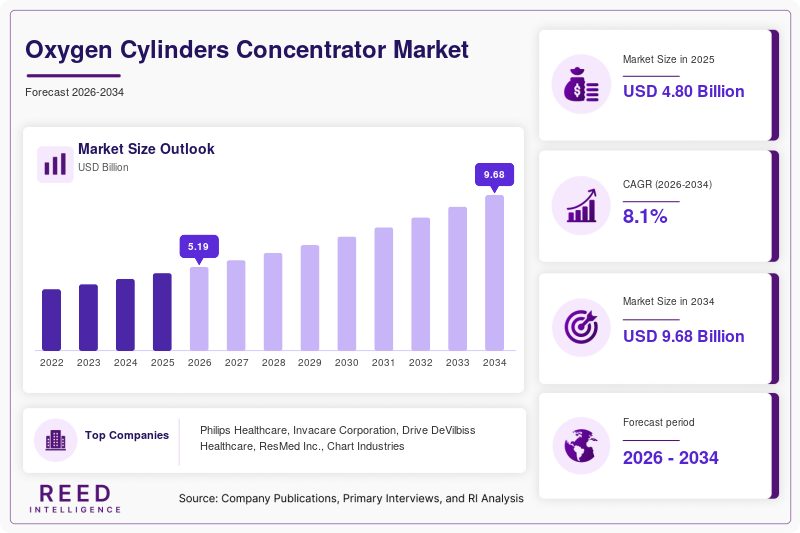
The Oxygen Cylinders Concentrator Market size was valued at approximately USD 4.8 billion in 2025 and is projected to reach USD 9.6 billion by 2034, expanding at a CAGR of 8.1% from 2025 to 2034. The market growth reflects increasing demand for respiratory support devices across healthcare facilities, homecare settings, and emergency response systems. Oxygen cylinders and concentrators remain essential in managing respiratory conditions, surgical procedures, and critical care environments.
A major global factor supporting market expansion has been the sustained focus on healthcare infrastructure strengthening following pandemic-driven investments. Governments and private healthcare providers have continued upgrading oxygen supply systems, ensuring preparedness for respiratory illnesses and chronic disease management. This has driven consistent procurement of oxygen delivery systems across both developed and emerging economies.
Key Highlights
- North America dominated with 38% market share in 2025, while Asia Pacific is expected to register the fastest CAGR of 9.3% through 2034
- Continuous flow concentrators led the product segment with 52% share, while portable concentrators are projected to grow at a CAGR of 9.8%
- Hospitals remained the leading end-use segment with 46% share, while homecare is anticipated to grow at a CAGR of 9.5%
- The U.S. market was valued at USD 1.6 billion in 2025 and is expected to reach USD 1.72 billion in 2026
Market Trends
Shift Toward Portable Oxygen Solutions
The Oxygen Cylinders Concentrator Market is witnessing a notable shift toward portable oxygen concentrators. These devices are lightweight, battery-operated, and designed for mobility, making them ideal for patients requiring oxygen therapy during travel or daily activities. The trend is supported by increasing patient preference for convenience and independence. Manufacturers are investing in compact designs and longer battery life, further accelerating adoption in both developed and emerging markets.
Integration of Smart Monitoring Features
Another emerging trend is the integration of digital technologies into oxygen delivery systems. Modern oxygen concentrators are increasingly equipped with smart sensors, remote monitoring capabilities, and connectivity features. These advancements enable real-time tracking of oxygen levels, device performance, and patient compliance. Healthcare providers benefit from improved patient management, especially in homecare settings. This trend aligns with the broader digital transformation of healthcare, enhancing efficiency and patient outcomes across the Oxygen Cylinders Concentrator Market.
Market Drivers
Rising Prevalence of Respiratory Diseases
The increasing incidence of chronic respiratory conditions such as COPD, asthma, and sleep apnea is a major driver of the Oxygen Cylinders Concentrator Market. Urbanization, pollution, and lifestyle changes have contributed to a higher disease burden globally. As a result, demand for oxygen therapy devices has risen significantly across hospitals and homecare environments.
Expansion of Home Healthcare Services
The growing adoption of home healthcare services is another key driver. Patients and healthcare systems are increasingly shifting toward cost-effective, home-based treatment solutions. Oxygen concentrators, in particular, are well-suited for long-term therapy outside clinical settings. This shift reduces hospital admissions and supports continuous patient care, thereby driving steady demand in the Oxygen Cylinders Concentrator Market.
Market Restraint
High Initial Costs and Maintenance Challenges
One of the primary restraints in the Oxygen Cylinders Concentrator Market is the high initial investment associated with advanced oxygen concentrators. While these devices offer long-term cost benefits, their upfront cost can be a barrier for small healthcare facilities and individual users, particularly in low-income regions.
Additionally, maintenance requirements such as periodic servicing, filter replacement, and power dependency for concentrators pose operational challenges. In remote or underdeveloped areas with unreliable electricity supply, oxygen cylinders are often preferred, limiting the penetration of concentrators. These factors collectively hinder market growth to some extent, especially in price-sensitive markets.
Market Opportunities
Growth in Emerging Economies
Emerging markets present significant opportunities for the Oxygen Cylinders Concentrator Market. Rapid urbanization, improving healthcare infrastructure, and rising healthcare expenditure are driving demand for oxygen therapy devices. Governments are investing in healthcare accessibility, creating favorable conditions for market expansion.
Technological Advancements in Oxygen Delivery Systems
Continuous innovation in oxygen concentrator technology offers strong growth potential. Advancements such as energy-efficient devices, noise reduction, and enhanced oxygen purity levels are improving product performance. Manufacturers focusing on user-friendly designs and advanced features are likely to gain competitive advantage, further expanding the Oxygen Cylinders Concentrator Market.
Segmental Analysis
By Product Type
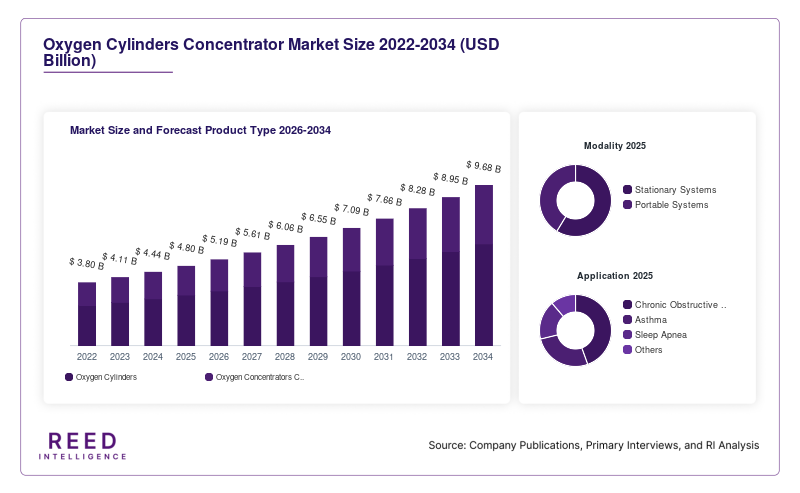
Continuous flow oxygen concentrators dominated the Oxygen Cylinders Concentrator Market with a 52% share in 2025. These devices are widely used in hospitals due to their ability to deliver a constant oxygen supply, making them suitable for critical care settings.
Portable oxygen concentrators are expected to grow at a CAGR of 9.8%, driven by increasing demand for mobility and convenience. Their lightweight design and battery operation make them ideal for homecare and travel use.
By Modality
Stationary oxygen systems held the largest share of 58% in 2025, primarily due to their widespread use in healthcare facilities. These systems provide high-capacity oxygen delivery for multiple patients simultaneously.
Portable systems will grow at a CAGR of 9.6%, supported by the rising trend of home-based care and patient mobility requirements.
By Application
Chronic obstructive pulmonary disease (COPD) accounted for the largest share of 41% in 2025, reflecting the high prevalence of the condition globally. Oxygen therapy is a critical component in managing COPD patients.
Sleep apnea is expected to be the fastest-growing application segment, with a CAGR of 9.2%, driven by increasing diagnosis rates and awareness about sleep disorders.
By End-Use
Hospitals dominated the market with a 46% share in 2025, owing to the high volume of patients requiring oxygen therapy in clinical settings.
Homecare settings are projected to grow at a CAGR of 9.5%, supported by the shift toward decentralized healthcare and patient preference for home treatment.
By Distribution Channel
Direct sales accounted for 55% of the Oxygen Cylinders Concentrator Market share in 2025, as healthcare institutions prefer bulk procurement directly from manufacturers.
Online sales channels are expected to grow at a CAGR of 10.1%, driven by increasing digitalization and ease of product access for consumers.
Regional Analysis
North America
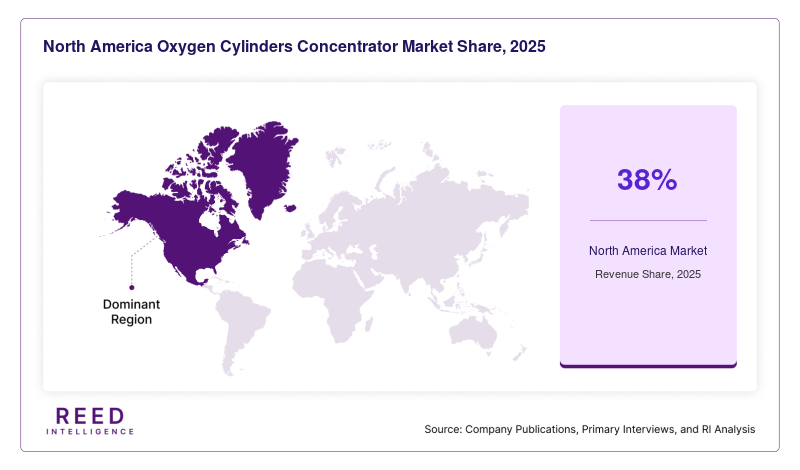
North America accounted for 38% of the Oxygen Cylinders Concentrator Market share in 2025 and will grow at a CAGR of 7.6% through 2034. The region’s growth is supported by advanced healthcare infrastructure and widespread adoption of home healthcare solutions.
The United States dominated the regional market due to strong reimbursement frameworks and high healthcare spending. The presence of established medical device manufacturers and increasing demand for long-term oxygen therapy contributed to sustained growth.
Europe
Europe held approximately 27% market share in 2025 and is expected to grow at a CAGR of 7.4% during the forecast period. The region benefits from strong public healthcare systems and rising awareness about respiratory health.
Germany emerged as the dominant country, driven by its well-developed healthcare system and aging population. Increased focus on chronic disease management has boosted demand for oxygen concentrators across the country.
Asia Pacific
Asia Pacific captured around 22% market share in 2025 and will expand at the fastest CAGR of 9.3% through 2034. Rapid healthcare infrastructure development and increasing patient population are key growth contributors.
China led the regional market due to its large population base and government initiatives to enhance healthcare access. The rising burden of respiratory diseases has further accelerated demand for oxygen therapy devices.
Middle East & Africa
The Middle East & Africa accounted for 7% of the Oxygen Cylinders Concentrator Market share in 2025 and is projected to grow at a CAGR of 8.0%. Investments in healthcare infrastructure and rising awareness are supporting market growth.
Saudi Arabia dominated the region, driven by government-led healthcare modernization programs and increasing adoption of advanced medical technologies.
Latin America
Latin America held approximately 6% market share in 2025 and is expected to grow at a CAGR of 7.8%. Improving healthcare access and rising demand for medical devices are contributing to growth.
Brazil led the regional market due to its expanding healthcare sector and increasing investments in medical infrastructure. The growing prevalence of respiratory conditions has further supported market demand.
Competitive Landscape
The Oxygen Cylinders Concentrator Market is moderately fragmented, with several global and regional players competing on product innovation, pricing, and distribution. Leading companies focus on expanding their product portfolios and strengthening their global presence.
Philips Healthcare emerged as a market leader, driven by its advanced oxygen concentrator solutions and strong distribution network. The company recently introduced next-generation portable concentrators with enhanced battery efficiency and connectivity features.
Other major players are investing in research and development to improve device performance and reduce operational costs. Strategic partnerships, mergers, and product launches remain key competitive strategies in the Oxygen Cylinders Concentrator Market.
Key Players List
- Philips Healthcare
- Invacare Corporation
- Drive DeVilbiss Healthcare
- ResMed Inc.
- Chart Industries
- AirSep Corporation
- Nidek Medical Products
- Inogen Inc.
- O2 Concepts LLC
- Precision Medical Inc.
- GCE Group
- CAIRE Inc.
- Longfian Scitech Co. Ltd.
- Teijin Limited
- Linde plc
Recent Developments
- 2024: Philips Healthcare launched an upgraded portable oxygen concentrator with extended battery life
- 2024: Invacare Corporation expanded its homecare product portfolio in Asia Pacific
- 2023: ResMed Inc. introduced integrated oxygen therapy solutions for sleep apnea patients
- 2023: Inogen Inc. increased production capacity to meet rising global demand
- 2023: Drive DeVilbiss Healthcare partnered with distributors to expand its presence in emerging markets
Oxygen Cylinders Concentrator Market Segments
Product Type
- Oxygen Cylinders
-
Oxygen Concentrators
- Continuous Flow
- Portable
Modality
- Stationary Systems
- Portable Systems
Application
- Chronic Obstructive Pulmonary Disease (COPD)
- Asthma
- Sleep Apnea
- Others
End-Use
- Hospitals
- Homecare Settings
- Ambulatory Surgical Centers
Distribution Channel
- Direct Sales
- Retail Sales
- Online Sales
By Region
- North America
- Europe
- APAC
- Middle East and Africa
- LATAM