Oxygen Gas Sensor Market Size, Share & Demand Report By Technology (Electrochemical Sensors, Zirconia Sensors, Infrared Sensors, Optical Sensors, Semiconductor Sensors), By Application (Industrial Safety Systems, Healthcare Monitoring, Environmental Monitoring), By End Use (Healthcare Facilities, Oil & Gas Industry, Automotive Industry, Mining Industry, Commercial Buildings), By Region & Segment Forecasts, 2026–2034
USD 3950
Market Overview
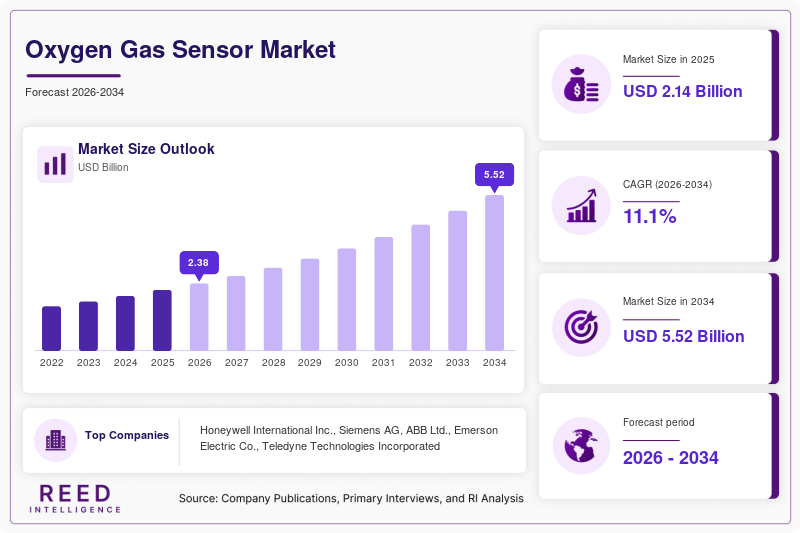
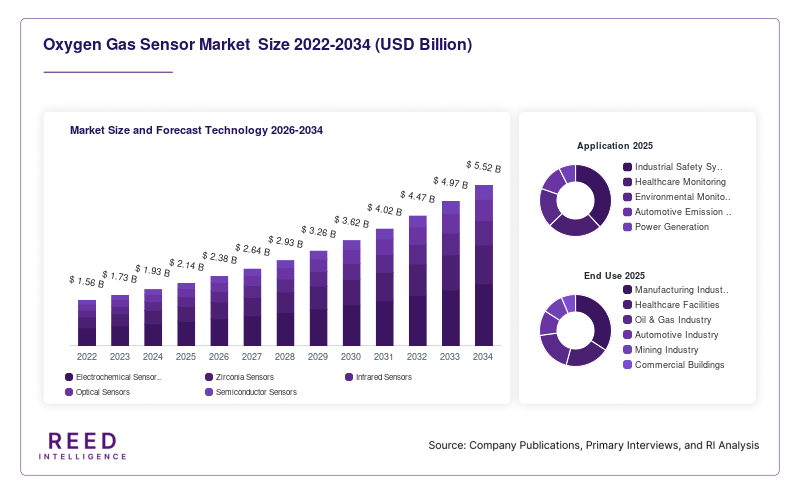
The global Oxygen Gas Sensor Market size was valued at USD 2.14 billion in 2026 and is projected to reach USD 4.98 billion by 2034, expanding at a CAGR of 11.1% during the forecast period. The market is experiencing stable growth due to rising industrial safety regulations, growing use of gas detection systems in healthcare facilities, and increasing deployment of environmental monitoring technologies across manufacturing and energy sectors. Oxygen gas sensors are widely integrated into industrial automation systems, smart monitoring equipment, medical ventilators, mining infrastructure, and automotive emission control systems. Demand continues to increase as industries focus on workplace safety, operational efficiency, and real-time air quality management.
A major global factor supporting market growth is the expansion of industrial automation and connected monitoring systems. Manufacturing plants, chemical processing facilities, and oil & gas operations are increasingly adopting advanced sensing technologies to reduce operational risks and improve compliance with environmental standards. Oxygen gas sensors help monitor oxygen concentration levels in hazardous environments, ensuring worker safety and reducing equipment failure risks. The integration of wireless communication technologies and IoT-enabled monitoring systems has further accelerated the adoption of intelligent gas sensing devices across multiple industries.
Key Highlights
- North America dominated the market with a 34.2% share in 2025, while Asia Pacific is expected to grow at the fastest CAGR of 12.1% during 2026–2034.
- By technology, electrochemical sensors accounted for the largest share of 42.8%, while zirconia sensors are projected to grow at a CAGR of 12.9%.
- By application, industrial safety systems led with a 39.6% share, whereas healthcare monitoring is expected to expand at a CAGR of 13.2%.
- By end use, manufacturing industries held the dominant share of 36.4%, while healthcare facilities are anticipated to witness a CAGR of 13.5% during the forecast period.
Market Trends
Increasing Integration of IoT-Enabled Gas Monitoring Systems
The growing deployment of IoT-enabled industrial monitoring systems is reshaping the Oxygen Gas Sensor Market. Manufacturing facilities, energy plants, and logistics operations are integrating connected gas sensors into centralized monitoring platforms to improve workplace safety and operational visibility. These smart systems allow real-time oxygen concentration tracking, automated alerts, and predictive maintenance capabilities. Companies are increasingly investing in wireless gas detection networks that reduce manual inspection requirements and improve response times during hazardous incidents.
The adoption of Industry 4.0 technologies has accelerated the demand for advanced oxygen gas sensors with cloud connectivity and remote diagnostics. Smart factories are integrating sensors with industrial automation software to monitor air quality across multiple operational zones. In addition, data analytics platforms are helping organizations identify abnormal oxygen fluctuations and optimize ventilation systems. The trend is particularly strong in chemical manufacturing, oil refining, and mining industries where continuous environmental monitoring is essential. As industrial digitalization expands globally, the demand for intelligent oxygen sensing technologies is expected to increase steadily.
Rising Adoption of Oxygen Monitoring in Healthcare Infrastructure
Healthcare facilities are increasingly deploying oxygen gas sensors in respiratory monitoring systems, anesthesia equipment, ventilators, and patient monitoring devices. Hospitals and emergency care centers require precise oxygen level measurement to maintain patient safety and improve treatment outcomes. The expansion of healthcare infrastructure in emerging economies and the growing demand for home healthcare devices are contributing to market growth.
Portable medical equipment manufacturers are integrating compact and low-power oxygen gas sensors into wearable monitoring devices and oxygen concentrators. The trend toward remote patient monitoring and telehealth services has also encouraged innovation in sensor miniaturization and wireless data transmission. Furthermore, aging populations and the rising prevalence of respiratory disorders are increasing the use of oxygen therapy devices globally. Medical technology companies are focusing on improving sensor durability, accuracy, and response speed to support advanced healthcare applications. These developments are expected to strengthen the long-term growth outlook of the market.
Market Drivers
Expansion of Industrial Safety Regulations Across High-Risk Industries
Stringent workplace safety regulations across oil & gas, mining, chemicals, and manufacturing industries are driving the demand for oxygen gas sensors. Regulatory agencies in developed and emerging economies are enforcing stricter standards for gas detection and air quality monitoring to reduce workplace accidents and health hazards. Oxygen deficiency or enrichment can create dangerous working conditions in confined industrial environments, making continuous monitoring essential.
Industrial facilities are investing in advanced sensing systems to comply with occupational safety requirements and minimize operational risks. Oxygen gas sensors are increasingly used in hazardous zones, storage tanks, underground mines, and chemical processing plants to ensure worker safety. Companies are also adopting portable gas detection devices for field workers and maintenance teams. The growing emphasis on employee safety, combined with rising industrial automation, continues to create consistent demand for reliable oxygen sensing technologies across global industrial sectors.
Growing Demand for Emission Monitoring and Environmental Protection
Governments and environmental agencies worldwide are strengthening emission monitoring policies to address rising concerns related to air pollution and climate impact. Oxygen gas sensors play an important role in combustion control systems, exhaust gas analysis, and industrial emission monitoring applications. Accurate oxygen level measurement helps optimize fuel efficiency, reduce harmful emissions, and improve operational performance in industrial systems.
Power generation plants, automotive manufacturers, and waste management facilities are increasingly implementing oxygen monitoring solutions to meet environmental compliance requirements. In automotive applications, oxygen sensors are critical components in engine management systems that regulate air-fuel ratios and reduce emissions. The growing adoption of clean energy systems and sustainable industrial practices is further supporting market growth. As industries continue investing in energy-efficient technologies and environmental monitoring infrastructure, the need for advanced oxygen gas sensors is expected to rise significantly during the forecast period.
Market Restraint
High Calibration and Maintenance Requirements Limiting Adoption
Frequent calibration and maintenance requirements remain a major challenge for the Oxygen Gas Sensor Market. Many oxygen sensing technologies, particularly electrochemical sensors, experience performance degradation over time due to exposure to harsh environmental conditions, humidity, temperature fluctuations, and chemical contaminants. Industries operating in extreme environments often require regular sensor replacement and recalibration to maintain measurement accuracy and compliance with safety standards.
These maintenance requirements increase operational costs for end users, especially in large-scale industrial facilities with extensive monitoring systems. Small and medium-sized enterprises may face difficulties in managing recurring maintenance expenses and technical servicing requirements. In addition, sensor drift and reduced lifespan can affect reliability in mission-critical applications such as healthcare monitoring and industrial safety systems.
The challenge is particularly significant in remote industrial operations where maintenance access is limited. Companies operating offshore platforms, mining sites, and isolated manufacturing facilities often experience delays in servicing sensor networks. Although manufacturers are developing self-diagnostic and low-maintenance sensor technologies, the overall cost of ownership continues to restrain adoption among price-sensitive users. The market also faces competition from alternative sensing technologies with longer operational lifecycles and reduced maintenance needs.
Market Opportunities
Growth Potential in Smart Buildings and Commercial Infrastructure
The increasing development of smart buildings and intelligent commercial infrastructure is creating new opportunities for oxygen gas sensor manufacturers. Modern commercial buildings are integrating advanced air quality monitoring systems to improve indoor environmental conditions, energy efficiency, and occupant safety. Oxygen gas sensors are being deployed in ventilation systems, parking facilities, laboratories, and enclosed public spaces to maintain healthy oxygen levels and optimize airflow management.
Smart city initiatives across Asia Pacific, Europe, and the Middle East are accelerating investments in connected building technologies. Facility management companies are integrating oxygen monitoring systems with building automation platforms to enable real-time environmental control and predictive maintenance. The adoption of energy-efficient HVAC systems and sustainability-focused building standards is also supporting demand for advanced sensing technologies. As urbanization continues to expand globally, commercial infrastructure projects are expected to create long-term growth opportunities for market participants.
Emerging Demand from Hydrogen Economy and Clean Energy Projects
The global transition toward clean energy and hydrogen-based industrial systems is opening new growth avenues for the Oxygen Gas Sensor Market. Hydrogen production facilities, fuel cell systems, and renewable energy storage applications require precise oxygen monitoring to ensure operational safety and efficiency. Oxygen sensors are increasingly integrated into hydrogen processing equipment, electrolysis systems, and energy storage infrastructure.
Governments and private organizations are investing heavily in hydrogen economy projects to reduce carbon emissions and support sustainable energy goals. The development of green hydrogen plants and fuel cell-powered transportation systems is creating demand for high-performance sensing technologies capable of operating in complex environments. Sensor manufacturers are introducing advanced zirconia and optical oxygen sensors designed for high-temperature and high-pressure applications. As hydrogen infrastructure expands across Europe, Asia Pacific, and North America, the market is expected to benefit from increasing investments in clean energy technologies.
Segmental Analysis
By Technology
Electrochemical sensors dominated the Oxygen Gas Sensor Market with a 42.8% revenue share in 2024 due to their high sensitivity, compact design, and cost efficiency. These sensors are widely used across industrial safety systems, healthcare equipment, and portable gas detection devices because they provide accurate oxygen concentration measurement with relatively low power consumption. Industrial operators prefer electrochemical sensors for confined space monitoring, chemical processing plants, and mining applications where reliable oxygen detection is critical for worker safety. The healthcare industry also extensively utilizes these sensors in ventilators, anesthesia systems, and respiratory monitoring devices. Growing investments in industrial automation and safety infrastructure have further strengthened demand for electrochemical sensing technologies across developed and emerging markets.
Zirconia sensors are expected to witness the fastest CAGR of 12.9% during the forecast period owing to their ability to operate efficiently in high-temperature environments. These sensors are increasingly used in automotive exhaust systems, power generation facilities, and industrial combustion monitoring applications. Their durability and resistance to harsh environmental conditions make them suitable for advanced industrial operations requiring continuous oxygen analysis. The rising demand for emission monitoring systems and energy-efficient combustion control technologies is accelerating the adoption of zirconia sensors globally. Manufacturers are also investing in advanced ceramic materials and sensor miniaturization technologies to improve response time and measurement precision. As industries focus on reducing emissions and improving operational efficiency, demand for zirconia-based oxygen sensing technologies is projected to increase significantly.
By Application
Industrial safety systems accounted for the largest share of 39.6% in 2024 due to rising safety compliance requirements across high-risk industries. Oxygen gas sensors are extensively used in oil & gas facilities, mining sites, chemical plants, and manufacturing units to monitor oxygen concentration levels and prevent hazardous incidents. The increasing implementation of occupational safety standards has encouraged industrial operators to deploy fixed and portable gas detection systems across operational environments. Demand for real-time monitoring solutions has also increased as companies seek to improve emergency response capabilities and reduce workplace accidents. Furthermore, industrial automation and smart factory initiatives are supporting the integration of advanced oxygen sensing technologies into centralized monitoring platforms. Continuous investments in industrial infrastructure modernization are expected to sustain the dominance of this application segment.
Healthcare monitoring is projected to register the fastest CAGR of 13.2% during the forecast period due to growing demand for respiratory care equipment and patient monitoring systems. Hospitals, clinics, and home healthcare providers are increasingly adopting oxygen sensing technologies in ventilators, oxygen concentrators, and anesthesia machines. The rising prevalence of respiratory diseases and the growing elderly population are supporting demand for advanced medical monitoring devices. In addition, portable healthcare equipment manufacturers are focusing on compact and energy-efficient sensor integration to support wearable monitoring solutions. Governments across developing economies are expanding healthcare infrastructure and increasing investments in emergency care facilities. These factors are expected to accelerate the adoption of oxygen gas sensors within healthcare applications over the coming years.
By End Use
Manufacturing industries held the dominant market share of 36.4% in 2024 due to increasing adoption of industrial automation and workplace safety systems. Manufacturing facilities require oxygen gas sensors for air quality monitoring, combustion control, and hazardous environment management. Industries such as chemicals, electronics, pharmaceuticals, and metal processing depend on accurate oxygen monitoring to maintain operational safety and production efficiency. The expansion of smart manufacturing initiatives has further increased demand for connected sensing technologies capable of supporting predictive maintenance and automated process control. In addition, industrial operators are investing in advanced environmental monitoring systems to comply with regulatory standards and reduce operational downtime. The growing integration of IoT-enabled monitoring platforms across manufacturing facilities is expected to sustain the segment’s strong market position.
Healthcare facilities are anticipated to witness the fastest CAGR of 13.5% during the forecast period owing to rising investments in medical infrastructure and respiratory care technologies. Hospitals and diagnostic centers increasingly rely on oxygen gas sensors for patient monitoring systems, emergency care devices, and oxygen therapy equipment. The demand for home healthcare services is also contributing to the adoption of portable oxygen monitoring devices and compact respiratory support systems. Medical device manufacturers are focusing on developing highly accurate and low-maintenance sensing technologies to support advanced clinical applications. In emerging economies, government initiatives aimed at improving healthcare accessibility are driving investments in critical care infrastructure. These developments are expected to create strong growth opportunities for oxygen gas sensor manufacturers serving the healthcare sector.
Regional Analysis
North America
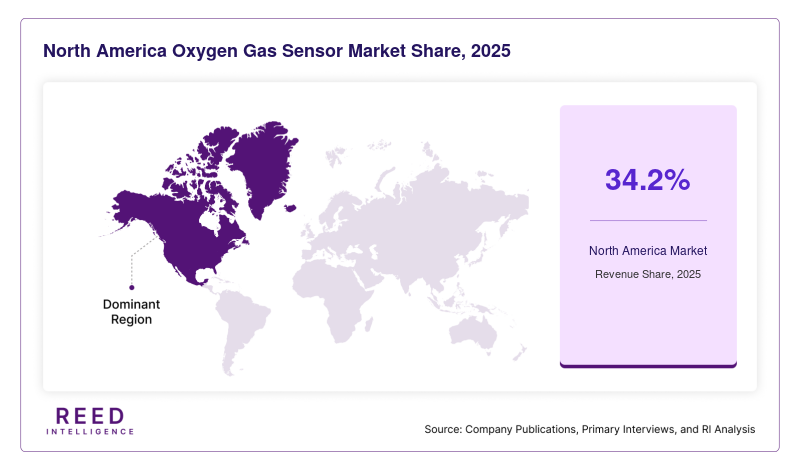
North America accounted for 34.2% of the global Oxygen Gas Sensor Market share in 2025 and is expected to maintain stable growth with a CAGR of 10.4% during the forecast period. The region benefits from strong industrial automation adoption, advanced healthcare infrastructure, and strict workplace safety standards. Industrial sectors such as oil & gas, chemicals, and manufacturing continue to invest heavily in gas detection systems to improve operational safety and regulatory compliance. The increasing use of connected monitoring systems and wireless sensing technologies is further supporting regional market growth.
The United States remains the dominant country in North America due to large-scale industrial operations and advanced environmental monitoring regulations. The country has witnessed rising demand for oxygen sensors in healthcare facilities, emission control systems, and smart manufacturing plants. A unique growth factor supporting the U.S. market is the rapid expansion of industrial IoT infrastructure across manufacturing facilities. Companies are increasingly integrating intelligent sensing technologies into automated production systems to improve efficiency and reduce operational risks.
Europe
Europe represented 27.5% of the global Oxygen Gas Sensor Market in 2025 and is projected to expand at a CAGR of 10.8% through 2034. The region’s market growth is supported by strong environmental regulations, increasing adoption of clean energy technologies, and rising investments in industrial safety systems. Countries across Europe are implementing strict emission control policies that require accurate oxygen monitoring solutions in power generation and manufacturing facilities. Demand for advanced gas sensing systems is also increasing in pharmaceutical and food processing industries.
Germany continues to dominate the European market due to its advanced industrial manufacturing sector and strong automotive industry presence. The country has experienced growing demand for oxygen sensors in automotive emission monitoring systems and industrial automation applications. A key growth factor in Germany is the increasing investment in hydrogen energy infrastructure and fuel cell development projects. Industrial companies are deploying advanced oxygen monitoring systems to support clean energy production and improve operational efficiency in high-temperature industrial environments.
Asia Pacific
Asia Pacific held 24.6% of the global market share in 2025 and is anticipated to register the fastest CAGR of 12.1% during the forecast period. Rapid industrialization, expanding healthcare infrastructure, and increasing investments in manufacturing automation are supporting market growth across the region. Countries such as China, India, Japan, and South Korea are experiencing rising demand for gas detection systems in industrial facilities, mining operations, and commercial infrastructure projects. The growing focus on workplace safety and environmental monitoring is further accelerating adoption.
China dominates the Asia Pacific market due to its large manufacturing base and significant investments in industrial automation technologies. The country has witnessed increasing deployment of oxygen gas sensors in electronics manufacturing, chemical processing, and energy generation facilities. A unique growth factor supporting the Chinese market is the rapid expansion of semiconductor manufacturing operations. High-precision oxygen monitoring systems are becoming essential in semiconductor fabrication plants to maintain controlled production environments and improve process stability.
Middle East & Africa
The Middle East & Africa accounted for 7.1% of the global Oxygen Gas Sensor Market in 2025 and is expected to grow at a CAGR of 9.7% during the forecast period. The region’s growth is primarily driven by expanding oil & gas operations, mining activities, and infrastructure development projects. Industrial operators are increasingly deploying oxygen monitoring systems to improve workplace safety and comply with international operational standards. Investments in healthcare infrastructure and environmental monitoring projects are also contributing to rising market demand.
Saudi Arabia remains the dominant country within the region due to large-scale energy production and petrochemical activities. The country has experienced increased adoption of oxygen gas sensors across refineries, offshore platforms, and industrial processing facilities. A distinct growth factor in Saudi Arabia is the implementation of industrial diversification initiatives aimed at expanding non-oil manufacturing sectors. New industrial projects and smart city developments are creating additional demand for advanced environmental monitoring and gas detection technologies.
Latin America
Latin America captured 6.6% of the global market share in 2025 and is projected to expand at a CAGR of 9.9% through 2034. Market growth in the region is supported by increasing mining activities, industrial modernization, and rising adoption of workplace safety technologies. Countries across Latin America are investing in industrial automation systems and environmental monitoring solutions to improve productivity and regulatory compliance. Demand for oxygen gas sensors is also increasing in healthcare institutions and energy generation facilities.
Brazil continues to lead the Latin American market due to its strong industrial manufacturing and mining sectors. The country has seen growing deployment of oxygen monitoring systems in mining operations, steel manufacturing plants, and healthcare facilities. A unique growth factor supporting the Brazilian market is the increasing investment in renewable energy projects and biofuel production facilities. These industries require efficient oxygen monitoring systems to optimize combustion processes and maintain operational safety standards.
Competitive Landscape
The Oxygen Gas Sensor Market is moderately competitive, with global and regional manufacturers focusing on product innovation, sensor miniaturization, and strategic partnerships to strengthen market presence. Companies are investing in advanced sensing technologies that provide higher accuracy, faster response times, and lower maintenance requirements. The competitive environment is also shaped by increasing demand for IoT-enabled gas detection systems and integrated monitoring platforms.
Honeywell International Inc. remains one of the leading companies in the market due to its extensive industrial safety portfolio and strong global distribution network. The company continues to expand its connected gas detection solutions for industrial automation and smart facility applications. Other major players are focusing on healthcare monitoring systems, automotive emission technologies, and environmental sensing solutions to diversify revenue streams.
Recent developments within the market include the launch of wireless gas monitoring systems, expansion of production facilities in Asia Pacific, and increased investment in hydrogen energy applications. Companies are also collaborating with industrial automation providers and healthcare equipment manufacturers to strengthen product integration capabilities. The growing demand for smart sensing technologies is expected to intensify competition and encourage further innovation across the market.
Key Players
- Honeywell International Inc.
- Siemens AG
- ABB Ltd.
- Emerson Electric Co.
- Teledyne Technologies Incorporated
- Amphenol Corporation
- AlphaSense Inc.
- Figaro Engineering Inc.
- Bosch Sensortec GmbH
- Membrapor AG
- Yokogawa Electric Corporation
- Dynament Ltd.
- Aeroqual Limited
- MSA Safety Incorporated
- Drägerwerk AG & Co. KGaA
Recent Developments
- Honeywell International Inc. introduced an advanced wireless oxygen monitoring platform for industrial facilities in 2025, improving remote safety management capabilities.
- Siemens AG expanded its gas sensor manufacturing operations in Asia Pacific in 2024 to address rising demand from industrial automation and healthcare sectors.
- ABB Ltd. launched a next-generation zirconia oxygen sensor designed for high-temperature combustion monitoring applications in power generation facilities.
- Drägerwerk AG & Co. KGaA developed a portable oxygen detection device with enhanced battery performance for mining and confined space monitoring applications.
Oxygen Gas Sensor Market Segments
Technology
- Electrochemical Sensors
- Zirconia Sensors
- Infrared Sensors
- Optical Sensors
- Semiconductor Sensors
Application
- Industrial Safety Systems
- Healthcare Monitoring
- Environmental Monitoring
- Automotive Emission Control
- Power Generation
End Use
- Manufacturing Industries
- Healthcare Facilities
- Oil & Gas Industry
- Automotive Industry
- Mining Industry
- Commercial Buildings
By Region
- North America
- Europe
- APAC
- Middle East and Africa
- LATAM