Ozone Sensor Market Size, Share Demand Report By Type (Electrochemical Ozone Sensors, Ultraviolet (UV) Ozone Sensors, Semiconductor Ozone Sensors, Others), By Application (Environmental Monitoring, Industrial Safety, Medical and Healthcare, Others), By End-Use (Industrial, Healthcare, Commercial, Residential), By Region & Segment Forecasts, 2025–2034
USD 3950
Market Overview
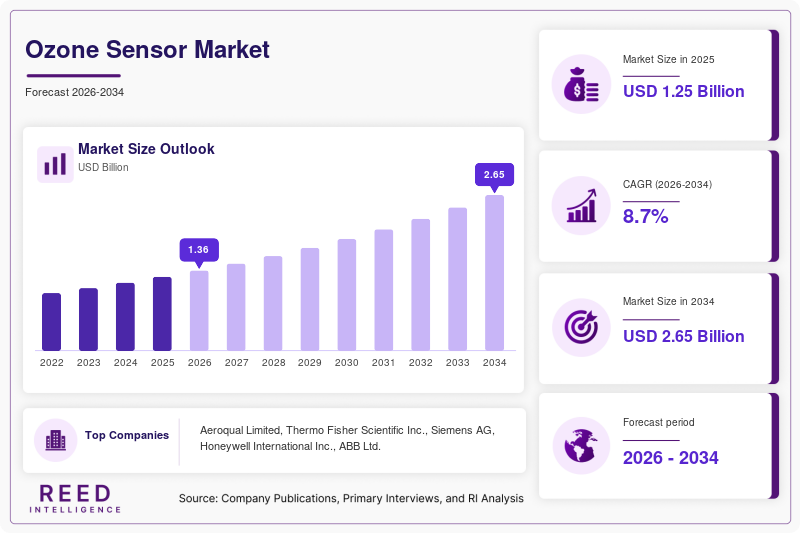
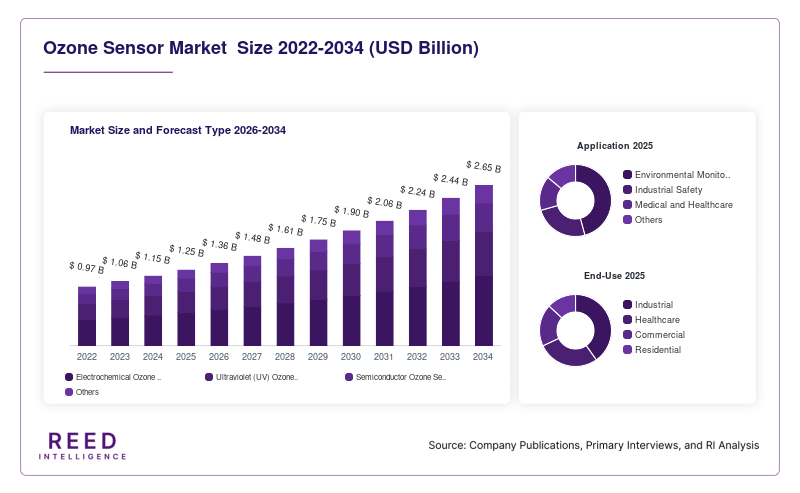
The global Ozone Sensor Market size is witnessing steady expansion due to increasing environmental monitoring needs and growing industrial safety requirements. In 2025, the market size is estimated to reach approximately USD 1.25 billion, with further growth to USD 1.36 billion in 2026. The market is projected to achieve a value of USD 2.85 billion by 2034, registering a compound annual growth rate (CAGR) of 8.7% during the forecast period (2025–2034). This growth reflects the rising emphasis on air quality monitoring, particularly in urban environments, industrial facilities, and healthcare applications.
One of the primary growth factors is the rising global awareness regarding air pollution and its impact on human health. Governments across developed and developing economies are implementing stricter regulations to monitor ozone levels, which is driving demand for advanced sensing technologies. Additionally, the expansion of smart city initiatives is accelerating the adoption of ozone sensors in environmental monitoring systems. These sensors are increasingly integrated into IoT-enabled platforms, providing real-time data for decision-making.
Key Highlights
- Market size projected to reach USD 2.85 billion by 2034
- CAGR of 8.7% from 2025 to 2034
- Increasing adoption in environmental monitoring and industrial safety
- Rising demand driven by smart city initiatives and regulatory compliance
Market Trends
Integration of IoT and Smart Monitoring Systems
The integration of Internet of Things (IoT) technologies into ozone sensing systems is transforming the market landscape. Modern ozone sensors are increasingly being embedded with wireless connectivity features, enabling real-time data transmission and remote monitoring. This trend is particularly prominent in smart city projects, where environmental data is collected continuously to improve urban living conditions. IoT-enabled ozone sensors provide actionable insights for authorities, helping them manage pollution levels more effectively. In addition, cloud-based platforms allow for advanced analytics and predictive maintenance, reducing operational costs. The demand for such intelligent systems is expected to grow steadily as industries and municipalities seek efficient monitoring solutions.
Miniaturization and Portable Sensor Development
Another significant trend in the ozone sensor market is the development of compact and portable devices. Manufacturers are focusing on reducing sensor size while maintaining accuracy and sensitivity. Portable ozone sensors are gaining traction in personal safety applications, field research, and on-site industrial inspections. These devices are easy to deploy and offer flexibility in various environments, including confined spaces and remote locations. The trend toward miniaturization is supported by advancements in microelectromechanical systems (MEMS) technology, which enables high-performance sensing in smaller form factors. This shift is expanding the user base and creating new opportunities in consumer and professional applications.
Market Drivers
Increasing Environmental Regulations and Air Quality Standards
Stringent environmental regulations imposed by governments worldwide are a major driver for the ozone sensor market. Regulatory bodies are setting strict limits on ozone emissions and ambient air quality, requiring continuous monitoring across industrial and urban areas. Compliance with these standards necessitates the deployment of reliable ozone sensors. Industries such as manufacturing, chemical processing, and energy production are particularly affected, as they must ensure adherence to emission norms. The growing focus on sustainability and environmental protection is encouraging organizations to invest in advanced monitoring technologies. This regulatory push is expected to sustain demand for ozone sensors over the forecast period.
Rising Demand in Water and Wastewater Treatment Applications
The increasing use of ozone in water and wastewater treatment processes is another key driver of market growth. Ozone is widely used for disinfection due to its strong oxidizing properties, making it effective in eliminating bacteria, viruses, and other contaminants. Accurate monitoring of ozone concentration is essential to ensure treatment efficiency and safety. As global concerns over water scarcity and quality intensify, investments in water treatment infrastructure are rising. This, in turn, is boosting the demand for ozone sensors. The adoption of advanced treatment technologies in both municipal and industrial sectors further supports market expansion.
Market Restraints
High Cost and Maintenance Requirements of Advanced Sensors
One of the primary restraints in the ozone sensor market is the relatively high cost associated with advanced sensing technologies. High-precision ozone sensors, particularly those used in industrial and healthcare applications, often require sophisticated components and calibration processes, leading to increased initial investment. In addition, these sensors require regular maintenance and recalibration to ensure accuracy, which adds to the operational costs. Small and medium-sized enterprises may find it challenging to adopt such technologies due to budget constraints. For example, in developing regions, industries often rely on basic monitoring systems or manual methods, limiting the adoption of advanced ozone sensors. This cost barrier can hinder market growth, especially in price-sensitive markets, despite the long-term benefits offered by these devices.
Market Opportunities
Expansion of Smart City Projects
The rapid expansion of smart city initiatives presents a significant opportunity for the ozone sensor market. Governments are investing heavily in infrastructure that incorporates advanced environmental monitoring systems. Ozone sensors play a crucial role in these systems by providing real-time data on air quality. This data helps city planners and authorities implement effective pollution control measures. The integration of sensors with IoT platforms enhances their functionality, enabling predictive analysis and automated responses. As more cities adopt smart technologies, the demand for ozone sensors is expected to rise substantially, creating new growth avenues for market players.
Growing Adoption in Healthcare and Indoor Air Quality Monitoring
The increasing focus on indoor air quality and healthcare applications offers another promising opportunity for the ozone sensor market. Hospitals, laboratories, and commercial buildings are prioritizing air quality monitoring to ensure a safe environment for occupants. Ozone sensors are used to detect harmful levels of ozone generated by equipment such as air purifiers and sterilization systems. The growing awareness of indoor pollution and its health impacts is driving demand for these sensors. Additionally, the adoption of ozone-based sterilization methods in healthcare settings is further boosting market growth. This trend is expected to continue as health and safety standards become more stringent.
Segmental Analysis
By Type
Electrochemical ozone sensors dominated the market in 2024, accounting for approximately 42% of the total share. These sensors are widely used due to their high accuracy, sensitivity, and cost-effectiveness. They are commonly deployed in industrial applications, environmental monitoring, and healthcare settings. Their ability to provide real-time measurements and low power consumption makes them suitable for continuous monitoring systems. Additionally, advancements in electrochemical technology have improved sensor lifespan and reliability, further strengthening their market position. The demand for these sensors is expected to remain strong due to their versatility and ease of integration into various systems.
Ultraviolet (UV) ozone sensors are the fastest-growing subsegment, with a projected CAGR of 9.8% during the forecast period. These sensors offer high precision and are particularly suitable for applications requiring accurate and stable measurements over long periods. A key growth factor is their increasing adoption in water treatment and laboratory environments, where precise ozone concentration monitoring is critical. The ability of UV sensors to operate without frequent calibration also enhances their appeal, driving their adoption across various industries.
By Application
Environmental monitoring emerged as the dominant application segment in 2024, capturing around 38% of the market share. The growing need to monitor air quality in urban and industrial areas is driving demand for ozone sensors in this segment. Governments and organizations are deploying these sensors to track pollution levels and implement effective control measures. The integration of sensors with smart city infrastructure further supports segment growth. Continuous monitoring capabilities and real-time data analysis make ozone sensors essential tools for environmental management.
Industrial safety is the fastest-growing application segment, with a CAGR of 9.2%. The increasing use of ozone in industrial processes necessitates accurate monitoring to ensure worker safety and regulatory compliance. Industries such as manufacturing, chemical processing, and food production rely on ozone sensors to detect hazardous levels and prevent accidents. A key growth factor is the rising awareness of workplace safety and the implementation of strict safety standards across industries.
By End-Use
The industrial sector dominated the ozone sensor market in 2024, accounting for approximately 45% of the total share. This dominance is attributed to the widespread use of ozone sensors in manufacturing, water treatment, and chemical processing industries. These sensors help ensure safe operations by monitoring ozone levels and preventing exposure to harmful concentrations. The growing emphasis on automation and process optimization further drives demand in this segment. Industrial users benefit from the reliability and efficiency of advanced ozone sensing technologies.
The healthcare sector is the fastest-growing end-use segment, with a projected CAGR of 9.5%. The increasing use of ozone in sterilization and therapeutic applications is driving demand for accurate monitoring solutions. Hospitals and laboratories require precise measurement of ozone levels to ensure patient safety and compliance with health standards. A key growth factor is the adoption of advanced medical technologies and the rising focus on infection control, which supports the expansion of ozone sensor usage in healthcare settings.
Regional Analysis
North America
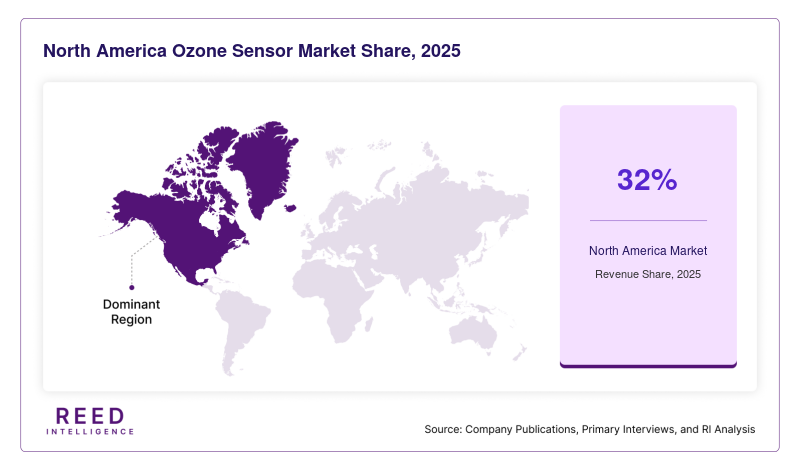
North America held a significant share of the ozone sensor market in 2025, accounting for approximately 32% of the global revenue. The region is expected to maintain steady growth with a CAGR of 7.9% during the forecast period. The presence of strict environmental regulations and advanced industrial infrastructure supports market expansion. Increasing investments in environmental monitoring systems also contribute to growth.
The United States dominates the regional market due to its strong regulatory framework and technological advancements. A key growth factor is the widespread adoption of smart environmental monitoring systems across urban areas. These systems rely on ozone sensors to track air quality in real time, supporting public health initiatives and compliance with environmental standards.
Europe
Europe accounted for around 26% of the ozone sensor market share in 2025 and is projected to grow at a CAGR of 8.2% through 2034. The region’s focus on sustainability and environmental protection drives demand for advanced monitoring solutions. Government policies aimed at reducing air pollution further support market growth.
Germany is a leading country in the European market, driven by its strong industrial base and commitment to environmental standards. A unique growth factor is the integration of ozone sensors in renewable energy and green infrastructure projects, where monitoring emissions and maintaining air quality are critical components.
Asia Pacific
Asia Pacific is the fastest-growing region in the ozone sensor market, with a CAGR of 10.1% during the forecast period. The region held approximately 24% of the market share in 2025. Rapid urbanization and industrialization are key factors driving demand for air quality monitoring solutions.
China dominates the Asia Pacific market due to its large industrial sector and increasing focus on pollution control. A significant growth factor is the government’s investment in large-scale environmental monitoring networks, which incorporate ozone sensors to address severe air pollution challenges in urban areas.
Middle East & Africa
The Middle East & Africa region accounted for about 10% of the global ozone sensor market in 2025 and is expected to grow at a CAGR of 7.5%. The market is supported by increasing investments in infrastructure and environmental monitoring systems.
Saudi Arabia leads the regional market, driven by its focus on industrial development and environmental sustainability. A unique growth factor is the use of ozone sensors in oil and gas facilities to monitor emissions and ensure compliance with environmental regulations, enhancing operational safety.
Latin America
Latin America held approximately 8% of the ozone sensor market share in 2025 and is projected to grow at a CAGR of 8.0%. The region is experiencing increased demand for environmental monitoring solutions due to rising pollution levels.
Brazil dominates the market in this region, supported by its expanding industrial sector and environmental initiatives. A key growth factor is the adoption of ozone sensors in water treatment facilities, where they are used to monitor disinfection processes and ensure water quality standards.
Competitive Landscape
The ozone sensor market is moderately competitive, with several established players and emerging companies contributing to innovation and market expansion. Key companies are focusing on product development, strategic partnerships, and technological advancements to strengthen their market position. The market leader, Aeroqual Limited, has established a strong presence through its comprehensive range of air quality monitoring solutions.
Recent developments include the introduction of advanced IoT-enabled ozone sensors with enhanced accuracy and connectivity features. Companies are also investing in research and development to improve sensor performance and reduce costs. Strategic collaborations with government agencies and industrial clients are further supporting market growth. The competitive landscape is characterized by continuous innovation and a focus on meeting evolving customer requirements.
Key Players
- Aeroqual Limited
- Thermo Fisher Scientific Inc.
- Siemens AG
- Honeywell International Inc.
- ABB Ltd.
- Eco Sensors, Inc.
- Ozone Solutions Inc.
- Figaro Engineering Inc.
- Drägerwerk AG & Co. KGaA
- Teledyne Technologies Incorporated
- Membrapor AG
- SGX Sensortech
- Alphasense Ltd.
- Aeroqual Limited
- Horiba Ltd.
Recent Developments
- A leading manufacturer launched a new IoT-enabled ozone sensor platform designed for smart city applications, offering real-time monitoring and cloud integration.
- A global technology company introduced a compact UV-based ozone sensor with improved accuracy and reduced maintenance requirements.
- An industrial solutions provider partnered with a municipal authority to deploy large-scale air quality monitoring systems incorporating advanced ozone sensors.
Ozone Sensor Market Segments
Type
- Electrochemical Ozone Sensors
- Ultraviolet (UV) Ozone Sensors
- Semiconductor Ozone Sensors
- Others
Application
- Environmental Monitoring
- Industrial Safety
- Medical and Healthcare
- Others
End-Use
- Industrial
- Healthcare
- Commercial
- Residential
By Region
- North America
- Europe
- APAC
- Middle East and Africa
- LATAM