P Tert Butylphenol Market Size, Share Demand Report By Type (Solid P Tert Butylphenol, Liquid P Tert Butylphenol), By Application (Adhesives and Sealants, Lubricant Additives, Coatings, Rubber Processing Chemicals), By End-Use Industry (Automotive, Construction, Electrical & Electronics, Industrial Manufacturing) By Region & Segment Forecasts, 2025–2034
USD 3950
Market Overview
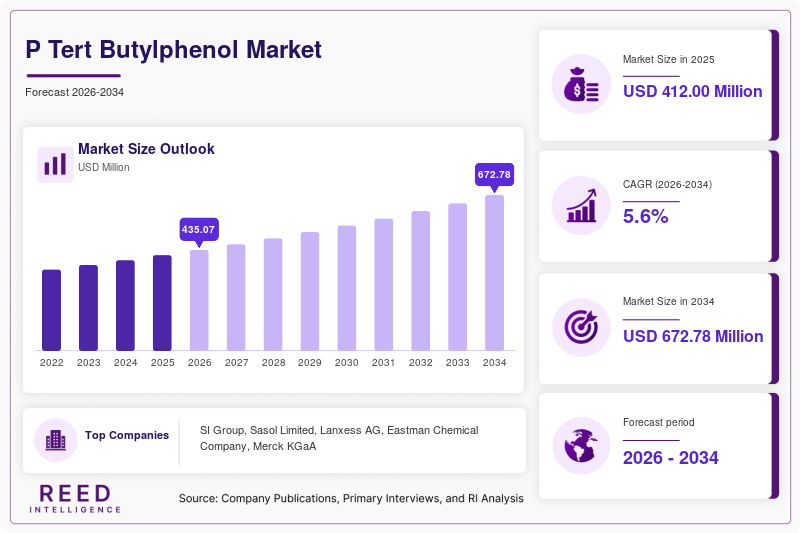
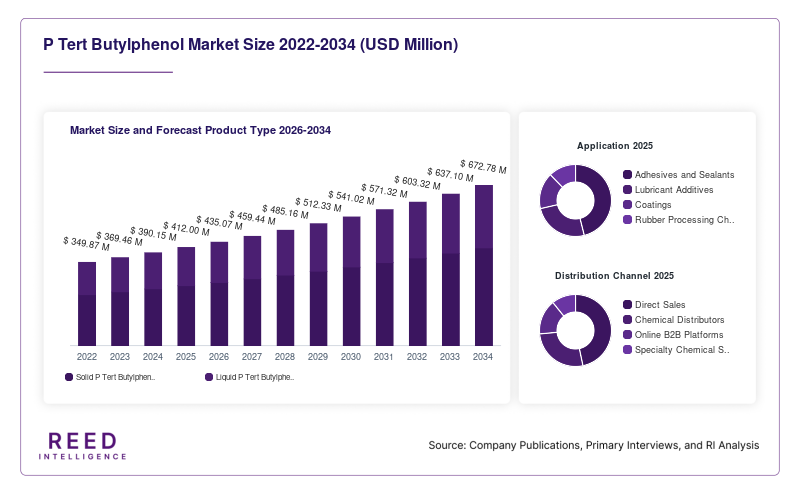
The P Tert Butylphenol Market size was valued at approximately USD 412 million in 2025 and is expected to reach USD 435 million in 2026, reflecting consistent industrial consumption. Over the forecast period from 2025 to 2034, the market is projected to expand to USD 712 million by 2034, registering a compound annual growth rate (CAGR) of 5.6%.
P-tert-butylphenol (PTBP) is widely used as an intermediate in the production of phenolic resins, which are essential in automotive components, electrical insulation materials, and construction adhesives. The market growth is supported by increasing industrialization, especially in emerging economies, where manufacturing activities are expanding rapidly. Additionally, the rising use of PTBP in specialty chemicals and coatings is contributing to its consistent demand.
Key Highlights
- Market size estimated at USD 412 million in 2025 and USD 435 million in 2026, reflecting a year-on-year growth of 5.6% driven by steady industrial demand
- Forecasted to reach USD 712 million by 2034 at a CAGR of 5.6%, adding nearly USD 300 million in incremental revenue over the forecast period
- Growth driven by rising demand in adhesives, resins, and lubricant additives, with adhesives accounting for over 48% share in 2024
- Increasing industrialization in emerging economies supports consumption, particularly in Asia Pacific contributing around 38% of global demand
- Technological advancements enhancing production efficiency and cost-effectiveness, reducing manufacturing costs by approximately 8–10% across key producers
Market Trends
Increasing Use of PTBP in High-Performance Adhesives
The growing demand for high-performance adhesives across automotive, construction, and electronics sectors is a notable trend in the P Tert Butylphenol Market. PTBP-based phenolic resins are widely used in adhesives due to their excellent bonding strength, resistance to heat, and chemical stability. As industries focus on lightweight materials and structural integrity, these adhesives are becoming essential components. In automotive manufacturing, for instance, PTBP-based adhesives are used in bonding metal and composite parts, improving durability and reducing vehicle weight. This trend is expected to sustain long-term demand.
Shift Toward Specialty Chemical Applications
Another key trend is the increasing utilization of PTBP in specialty chemical formulations. Industries are exploring its use in niche applications such as coatings, varnishes, and rubber processing chemicals. The ability of PTBP to enhance performance characteristics such as resistance to oxidation and improved shelf life is driving its adoption. Manufacturers are also investing in product customization to cater to specific industrial requirements. This shift toward value-added applications is helping companies diversify their product portfolios and maintain competitive positioning in the market.
Market Drivers
Growing Demand from Automotive and Construction Industries
The expansion of automotive and construction sectors is a major driver for the P Tert Butylphenol Market. PTBP-based resins are widely used in adhesives and coatings that are essential for assembling vehicle components and building materials. The increasing focus on infrastructure development and urbanization is boosting the demand for construction adhesives and sealants. Similarly, the automotive industry is adopting advanced materials that require strong bonding solutions. This rising demand across key industries is significantly contributing to the growth of the market.
Rising Consumption of Lubricants and Additives
Another important driver is the increasing use of PTBP in lubricants and fuel additives. It acts as an antioxidant and stabilizer, improving the performance and longevity of lubricants. With the growth of industrial machinery and transportation sectors, the demand for high-quality lubricants is rising. PTBP helps in maintaining the chemical stability of these products under extreme conditions. This functional advantage is encouraging its widespread adoption, thereby supporting market growth over the forecast period.
Market Restraint
Stringent Environmental and Regulatory Standards
The P Tert Butylphenol Market faces challenges due to stringent environmental and regulatory requirements associated with chemical manufacturing and usage. Governments and regulatory bodies are imposing strict guidelines on the production, handling, and disposal of phenolic compounds due to their potential environmental and health impacts. Compliance with these regulations often increases operational costs for manufacturers, particularly small and medium-sized enterprises.
For example, restrictions on volatile organic compound (VOC) emissions in coatings and adhesives can limit the use of certain PTBP-based formulations. Companies are required to invest in cleaner production technologies and alternative materials, which may not always be cost-effective. Additionally, regulatory approvals for new applications can be time-consuming, delaying market entry for innovative products. These factors collectively act as a restraint, potentially slowing down market expansion despite growing demand in various end-use industries.
Market Opportunities
Expansion in Emerging Economies
Emerging economies present significant growth opportunities for the P Tert Butylphenol Market. Rapid industrialization, urbanization, and infrastructure development in countries across Asia, Latin America, and Africa are driving demand for adhesives, coatings, and resins. Governments in these regions are investing heavily in construction and manufacturing sectors, which in turn boosts the consumption of PTBP-based products. The availability of low-cost labor and raw materials also encourages manufacturers to expand their production facilities in these regions, creating favorable market conditions.
Development of Eco-Friendly Formulations
The increasing focus on sustainability is creating opportunities for the development of eco-friendly PTBP formulations. Manufacturers are investing in research and development to produce low-emission and environmentally safe products that comply with regulatory standards. This includes the use of advanced catalysts and cleaner production processes. Companies that successfully develop sustainable alternatives can gain a competitive advantage and expand their customer base. This trend is expected to open new avenues for growth, particularly in regions with strict environmental regulations.
Segmental Analysis
By Type
The solid PTBP segment dominated the market in 2024, accounting for approximately 62% of the total share. Solid PTBP is widely used in the production of phenolic resins and adhesives due to its stability and ease of handling. It is preferred in industrial applications where consistent quality and performance are required. The demand for solid PTBP is particularly high in construction and automotive industries, where it is used in high-strength bonding solutions. Its ability to provide excellent thermal resistance and durability makes it a key component in various formulations.
The liquid PTBP segment is expected to be the fastest-growing, registering a CAGR of 6.4% during the forecast period. Liquid PTBP offers advantages such as ease of mixing and better compatibility with other chemicals. It is increasingly used in specialty applications, including coatings and lubricant additives. The growing demand for customized formulations and advanced chemical solutions is driving the adoption of liquid PTBP, particularly in high-performance industrial applications.
By Application
Adhesives and sealants represented the largest application segment in 2024, with a 48% market share. PTBP-based resins are extensively used in adhesives due to their strong bonding properties and resistance to environmental factors. This segment benefits from the growing demand in construction and automotive industries, where durable bonding solutions are essential. The increasing use of lightweight materials in manufacturing further supports the demand for advanced adhesives.
The lubricant additives segment is projected to grow at the fastest CAGR of 6.1%. PTBP is used as an antioxidant in lubricants, enhancing their performance and longevity. The rising demand for high-quality lubricants in industrial machinery and transportation sectors is driving this growth. As industries focus on improving efficiency and reducing maintenance costs, the adoption of PTBP-based additives is expected to increase significantly.
By End-Use Industry
The automotive industry dominated the market in 2024, accounting for 35% of the total share. PTBP is widely used in automotive adhesives, coatings, and fuel additives. The demand is driven by the need for durable and lightweight materials that improve vehicle performance and fuel efficiency. The increasing production of vehicles, particularly in emerging economies, continues to support this segment’s growth.
The construction industry is expected to be the fastest-growing segment, with a CAGR of 6.3%. The rising number of infrastructure projects and urban development initiatives is driving the demand for adhesives and coatings. PTBP-based products are widely used in construction applications due to their durability and resistance to environmental conditions. This trend is expected to continue, supporting long-term market growth.
Regional Analysis
North America
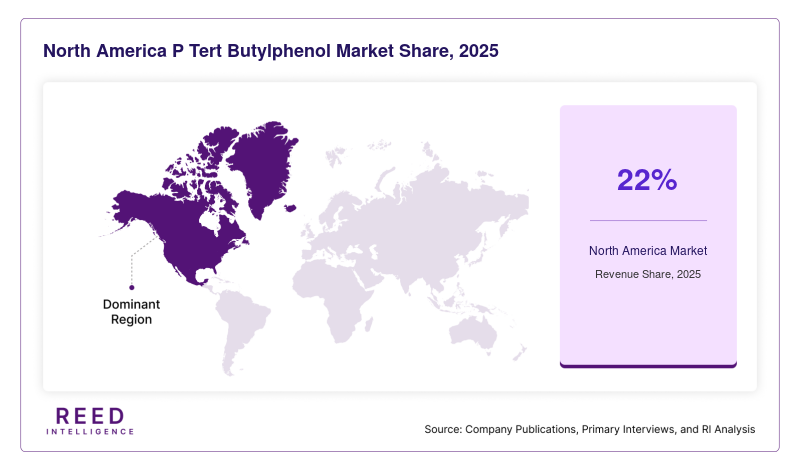
North America accounted for approximately 22% of the global P Tert Butylphenol Market share in 2025, with a projected CAGR of 4.8% during the forecast period. The region’s growth is driven by the presence of well-established automotive and construction industries. The demand for high-performance adhesives and coatings is consistent, supported by ongoing infrastructure projects and technological advancements in manufacturing processes.
The United States dominates the regional market due to its strong industrial base and focus on innovation. A unique growth factor is the increasing adoption of advanced adhesive technologies in aerospace and defense sectors. These industries require materials with high thermal resistance and durability, which boosts the demand for PTBP-based resins.
Europe
Europe held around 20% market share in 2025, with a forecast CAGR of 4.5%. The region’s market growth is influenced by strict environmental regulations and the increasing demand for sustainable chemical products. Industries are focusing on reducing emissions and improving product efficiency, which is shaping the adoption of PTBP in eco-friendly formulations.
Germany is the leading country in this region, driven by its strong automotive and chemical industries. A key growth factor is the country’s emphasis on high-quality engineering and advanced materials. The demand for durable adhesives and coatings in automotive manufacturing continues to support market expansion.
Asia Pacific
Asia Pacific led the global market with a 38% share in 2025 and is expected to grow at the fastest CAGR of 6.8%. Rapid industrialization, urbanization, and expanding manufacturing sectors are driving the demand for PTBP in this region. The increasing use of adhesives, coatings, and resins in construction and automotive industries is a major growth driver.
China dominates the Asia Pacific market due to its large-scale manufacturing capabilities and strong chemical industry. A unique growth factor is the availability of cost-effective raw materials and labor, which attracts global manufacturers to set up production facilities in the country.
Middle East & Africa
The Middle East & Africa region accounted for approximately 10% market share in 2025, with a CAGR of 5.2%. The market is driven by increasing investments in construction and infrastructure development, particularly in Gulf countries. The demand for adhesives and coatings is rising as governments focus on urban development projects.
Saudi Arabia is a key contributor to the regional market. A unique growth factor is the country’s diversification strategy under economic transformation initiatives, which promotes industrial development and increases demand for specialty chemicals like PTBP.
Latin America
Latin America held about 10% market share in 2025, with a projected CAGR of 5.0%. The region’s growth is supported by expanding industrial activities and increasing investments in construction and automotive sectors. The demand for PTBP-based products is gradually rising as industries adopt advanced materials.
Brazil leads the market in this region. A key growth factor is the country’s growing automotive manufacturing sector, which drives the demand for adhesives and coatings. This trend is expected to continue, supporting steady market growth.
Competitive Landscape
The P Tert Butylphenol Market is moderately fragmented, with several global and regional players competing based on product quality, pricing, and technological innovation. Companies are focusing on expanding their production capacities and improving product formulations to meet evolving industry requirements. Strategic collaborations and investments in research and development are common strategies adopted by market participants.
A leading player in the market is SI Group, which has a strong presence in specialty chemicals and phenolic resins. The company focuses on innovation and sustainability, offering advanced PTBP-based solutions for various industrial applications. Recently, the company announced the expansion of its production facilities to meet growing global demand, reflecting its commitment to market growth.
Other key players are also investing in advanced manufacturing technologies and exploring new applications for PTBP. This competitive environment encourages continuous improvement and innovation, contributing to the overall development of the market.
Key Players
- SI Group
- Sasol Limited
- Lanxess AG
- Eastman Chemical Company
- Merck KGaA
- Songwon Industrial Co., Ltd.
- Deepak Novochem Technologies Ltd.
- Shandong Lanhai Industry Co., Ltd.
- Sasol Phenolics
- Zhejiang Xieshi New Materials Co., Ltd.
- Atul Ltd.
- Tokyo Chemical Industry Co., Ltd.
- KH Chemicals
- SABIC
- Formosa Chemicals & Fibre Corporation
Recent Developments
- In 2024, a major chemical manufacturer expanded its PTBP production capacity in Asia Pacific to meet increasing regional demand.
- In 2023, a leading company introduced a new eco-friendly PTBP formulation designed to reduce environmental impact while maintaining performance.
- In 2025, a strategic partnership was formed between two chemical firms to develop advanced PTBP-based additives for high-performance lubricants.
P Tert Butylphenol Market Segments
Product Type
- Solid P Tert Butylphenol
- Liquid P Tert Butylphenol
Application
- Adhesives and Sealants
- Lubricant Additives
- Coatings
- Rubber Processing Chemicals
Distribution Channel
- Direct Sales
- Chemical Distributors
- Online B2B Platforms
- Specialty Chemical Suppliers
By Region
- North America
- Europe
- APAC
- Middle East and Africa
- LATAM