Packaged Coconut Water Market Size, Share & Trends Analysis Report By Product Type (Original/Plain Coconut Water, Flavored Coconut Water, Coconut Water Blends), By Packaging Type (Cartons, PET Bottles, Cans, Glass Bottles), By Distribution Channel (Supermarkets & Hypermarkets, Convenience Stores, Online Retail, Foodservice & Specialty Stores), By End Use (Household/Individual Consumption, Sports & Fitness, Foodservice & Hospitality, Other Commercial Uses) and By Region (North America, Europe, AP
USD 3950
Packaged Coconut Water Market Size
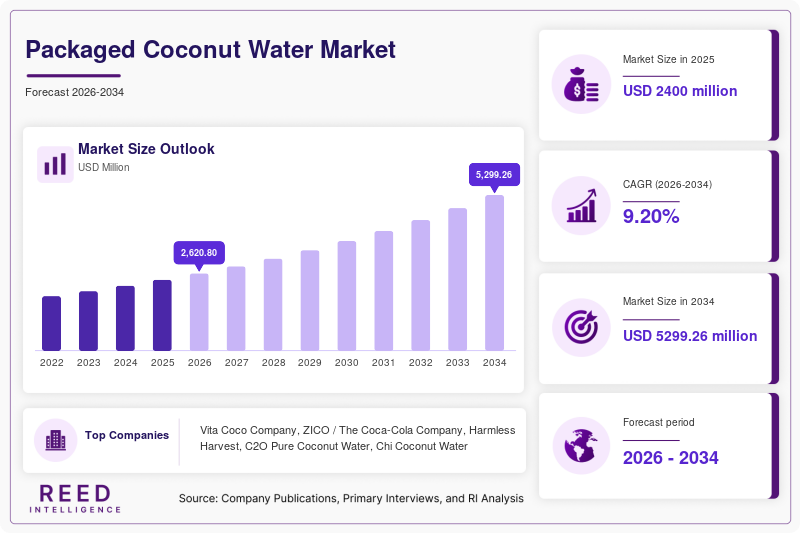
The global packaged coconut water market size was valued at USD 2,400 million in 2025 and is projected to grow from USD 2,620 million in 2026 to USD 5,280 million by 2034, registering a CAGR of 9.20% during the forecast period from 2026 to 2034.
Packaged coconut water is moving from a niche natural beverage into a broader hydration category, supported by its positioning around electrolytes, low-calorie refreshment, plant-based consumption and convenience. Tetra Pak reports that global coconut water grew at 12.6% annually from 2020 to 2025 and identifies hydration and wellness as important consumer associations. Its research also indicates that 89% of consumers are positive toward coconut products, while relatively few new food and beverage launches currently feature coconut ingredients, leaving room for further product development.
The commercial signal is particularly visible in branded sales. The Vita Coco Company reported 26% growth in Vita Coco Coconut Water net sales during 2025, followed by 42% growth in Q1 2026 and 21% growth in Q2 2026. The company also reported strong private-label volume growth, showing that category expansion is occurring beyond premium branded products.
Packaging technology is equally important because coconut water is sensitive after extraction. Aseptic processing allows coconut beverages to be distributed at ambient temperature for extended periods, reducing dependence on refrigerated logistics and widening access to export and modern-retail channels. Tetra Pak identifies cartons as a major format for global coconut water distribution.
The main market tension is therefore between rising consumer adoption and supply-chain complexity. Coconut sourcing, ocean freight, tariffs, product quality, packaging costs and cold-chain requirements can affect final pricing and margins. Vita Coco's 2026 filings specifically identify transportation, tariffs and coconut-water sourcing as material commercial considerations.
Packaged Coconut Water Market Drivers
Hydration and electrolyte positioning are expanding the consumption occasion
Coconut water is increasingly marketed beyond traditional juice consumption as a convenient hydration beverage for exercise, travel, work and everyday refreshment. Retail positioning reflects this shift: Vita Coco's UK products are marketed for workout refreshment, on-the-go consumption, smoothies and other daily occasions, while the brand also emphasizes naturally occurring potassium and vitamin C. Vita Coco's 2026 partnership with professional tennis league INTENNSE further demonstrates how brands are connecting coconut water with sports hydration and electrolyte use. This expands the addressable consumer base from juice buyers toward consumers who might otherwise purchase sports drinks, flavored water or functional beverages. The commercial mechanism is higher consumption frequency across multiple occasions rather than dependence on a single beverage occasion.
Branded and private-label distribution is increasing category visibility
Packaged coconut water is gaining shelf space through supermarkets, convenience channels, online grocery and foodservice. Tesco's current UK assortment includes multiple Vita Coco formats alongside Tropicana Hydrate, innocent, UFC and other coconut-water products, showing that the category now spans branded, mainstream and value-oriented offerings. Vita Coco reported particularly strong private-label volume growth in 2026, with private-label volume increasing 50.2% year-to-date through June. This matters because private-label participation can lower price barriers and increase retailer control over shelf positioning, while branded companies continue investing in differentiation, marketing and distribution.
Aseptic packaging is reducing geographic distribution constraints
Fresh coconut water is highly perishable after extraction, making processing and packaging technology central to international commercialization. Tetra Pak notes that coconut liquid products can require rapid processing after extraction, while UHT treatment combined with aseptic packaging can provide approximately six to eight months of ambient shelf life. Aseptic cartons therefore allow manufacturers to move products across longer distances without the same refrigerated logistics requirements. This expands potential distribution into markets where local coconut production is limited and makes supermarkets, convenience stores and export markets commercially easier to serve.
Packaged Coconut Water Market Restraints
Coconut sourcing and logistics create margin volatility
Packaged coconut water depends on agricultural supply from coconut-producing regions and international movement of finished or semi-processed product. Vita Coco's 2026 annual filing reported that transportation disruptions, ocean freight volatility, tariffs and sourcing constraints had affected costs and margins. The company also noted that, because its products are price-sensitive, it may not always be able to pass cost increases to consumers without affecting volume and revenue. This creates a direct margin risk for packaged-water companies: higher coconut or freight costs can either compress gross margins or force retail-price increases that make the product less competitive against sports drinks, juice and other functional beverages.
Product quality limits processing flexibility
Coconut water has a delicate flavor profile and can deteriorate rapidly after the coconut is opened. Processing therefore has to balance microbial safety and shelf life against taste, color and perceived freshness. Tetra Pak notes that thermal treatment can affect coconut water quality and that processing must occur within a narrow window after extraction. Refrigerated products can preserve a fresh positioning but require a more expensive cold chain, while ambient products gain distribution efficiency but require controlled UHT and aseptic processing. This trade-off increases technical requirements for producers and can raise capital and operating costs.
Packaged Coconut Water Market Opportunities
Premium and Super-Premium Coconut Water
The premium segment is gaining a clearer supply-chain and product proposition. In July 2026, Vita Coco acquired Copra, a producer of Thai Nam Hom coconut water, adding a Thailand factory, access to Nam Hom coconuts and an extract-and-fill-on-site model. The acquisition also gives Vita Coco access to a super-premium cold-chain segment and private-label production. This creates an opportunity for differentiated products based on coconut variety, origin, freshness and processing method rather than competing only on price.
Flavor Innovation and Functional Blends
Product innovation can broaden coconut water's consumer base. Vita Coco's current portfolio includes flavored and coconut-water-plus products, while its 2026 Treats launch demonstrates how coconut-derived beverages can be positioned around indulgent flavor occasions. The opportunity extends to fruit blends, electrolyte-enhanced formulations and products positioned for sports, travel and everyday hydration. The mechanism is straightforward: flavor variety reduces reliance on consumers who already prefer the natural taste of coconut water and increases the number of consumption occasions.
Segmental Analysis
Product Type
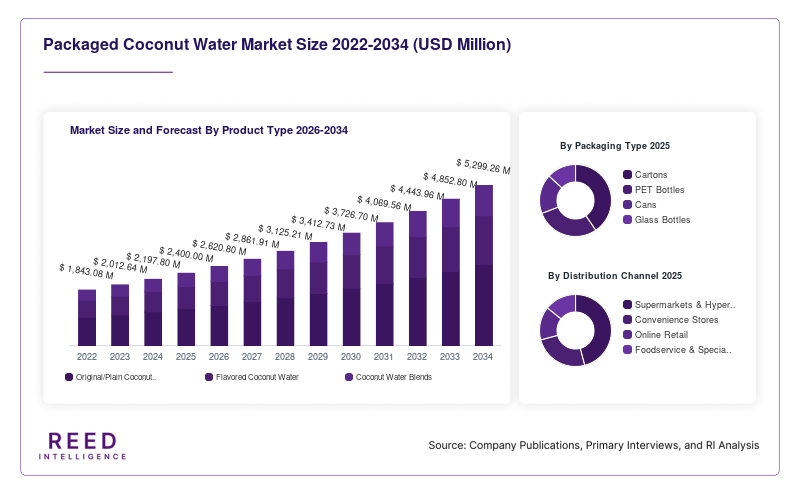
Original/Plain Coconut Water represents the dominant product category with approximately 61% market share in 2025. Its position is supported by a simple ingredient proposition and direct association with natural hydration. Mainstream products commonly emphasize coconut water as the primary ingredient and highlight potassium, vitamin C, low-calorie characteristics and plant-based suitability.
Flavored Coconut Water accounts for approximately 23%, while Coconut Water Blends represent about 16%. Flavored and blended products provide a mechanism for attracting consumers who find plain coconut water too distinctive in taste. The segment also gives brands more flexibility to compete in the functional and flavored-water space.
Coconut Water Blends are the fastest-growing product segment, with a CAGR of approximately 11.0%, supported by products combining coconut water with fruit, coconut cream or other functional ingredients. Vita Coco's current portfolio already illustrates this move toward differentiated formulations.
Packaging Type
Cartons hold approximately 59% of the global market, making them the dominant packaging format. Tetra Pak identifies cartons as a major coconut-water package and highlights aseptic formats as a way to deliver ambient shelf life while reducing cold-chain requirements.
PET bottles account for around 23%, supported by portability and visibility, while cans and glass bottles represent approximately 11% and 7%, respectively.
PET Bottles are the fastest-growing packaging segment, with a CAGR of approximately 10.4%, supported by single-serve consumption, convenience-store distribution and sports-oriented consumption. Cartons, however, retain an important advantage in long-life products and international distribution.
Distribution Channel
Supermarkets & Hypermarkets account for approximately 43% of sales, reflecting the category's dependence on established grocery distribution and refrigerated or ambient beverage aisles. Tesco's current assortment illustrates the presence of multiple coconut-water brands and package sizes within mainstream grocery retail.
Convenience Stores account for approximately 23%, while Online Retail represents 19% and Foodservice & Specialty Stores approximately 15%.
Online Retail is the fastest-growing channel, with a CAGR of approximately 12.2%, supported by subscription purchasing, multipack sales and the ability to compare premium and functional beverage products.
End Use
Household/Individual Consumption represents approximately 54% of the market, reflecting the broadest consumer base and the availability of single-serve and family-size formats.
Sports & Fitness accounts for approximately 22%, supported by the category's electrolyte and hydration positioning. Vita Coco's 2026 professional-tennis partnership illustrates the use of sports platforms to connect coconut water with active lifestyles.
Foodservice & Hospitality represents approximately 16%, while other commercial uses account for about 8%.
Sports & Fitness is the fastest-growing end-use segment, with a CAGR of approximately 11.5%, as coconut water competes more directly with conventional sports and electrolyte beverages.
Regional Analysis
North America Packaged Coconut Water Market
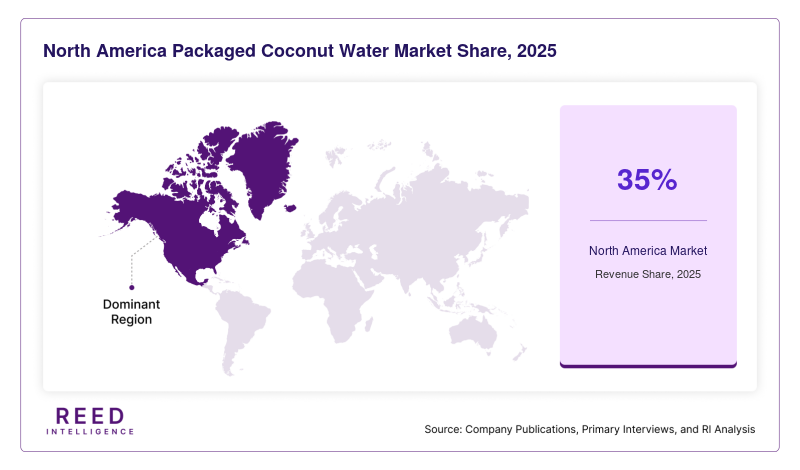
North America represents approximately 35% of the global market in 2025, supported by strong brand recognition, developed modern retail infrastructure and established consumer familiarity with coconut water. The U.S. is the region's principal commercial market, with Vita Coco reporting substantial domestic coconut-water growth during 2025 and 2026. The market also benefits from sports and wellness positioning, where coconut water competes with sports drinks, enhanced waters and functional beverages. Large retailers provide national distribution while online grocery enables multipack and repeat purchasing. However, North American producers remain exposed to imported coconut supply, freight costs and tariffs because much of the raw material originates outside the region. Vita Coco's filings demonstrate how these factors can affect pricing and margins. North America is projected to grow at approximately 8.3% CAGR through 2034.
Europe Packaged Coconut Water Market
Europe accounts for approximately 27% of the global market in 2025, supported by established natural-beverage consumption, supermarket penetration and strong availability of ambient carton formats. Retail listings in the UK show coconut water positioned alongside juices and wellness beverages, with Vita Coco, innocent, Tropicana and other brands competing across package sizes and price points. The region's extensive aseptic packaging infrastructure supports long-distance distribution without the full cost of refrigerated logistics. Sustainability and packaging recyclability are also increasingly relevant purchasing considerations, placing pressure on producers to improve packaging performance. Europe is projected to grow at approximately 8.6% CAGR, with the UK, Germany, France, Italy and Spain representing important consumption markets.
Asia-Pacific Packaged Coconut Water Market
APAC represents approximately 23% of the global market and is the fastest-growing region, with a CAGR of approximately 12.4%. The region combines major coconut-producing countries with rapidly expanding urban beverage markets. Thailand, the Philippines, India, Indonesia and other Southeast Asian economies provide important raw-material and processing bases. Philippine statistics show continued coconut production across major producing provinces, while Thailand is becoming increasingly important for premium Nam Hom coconut water. The region also supports multiple consumption models, ranging from fresh coconut consumption and traditional beverages to packaged retail products. Vita Coco's acquisition of Copra demonstrates how international brands are increasing their exposure to Thai sourcing and premium cold-chain coconut water.
Middle East and Africa Packaged Coconut Water Market
Middle East and Africa accounts for approximately 8% of the global market and is projected to grow at approximately 10.2% CAGR. Demand is supported by urbanization, modern grocery retail, tourism, hospitality and interest in functional hydration products. Hot climates also create natural occasions for chilled beverages, while imported packaged products can serve markets where local coconut production is limited. Distribution economics remain an important constraint because products may need to travel significant distances from coconut-producing countries. Ambient aseptic formats can reduce this pressure by eliminating the need for continuous refrigeration, making shelf-stable cartons particularly relevant to import-dependent markets.
Latin America Packaged Coconut Water Market
Latin America represents approximately 7% of the market and is projected to grow at approximately 9.7% CAGR. Brazil provides the region's most important coconut production base. Brazil recorded approximately 2.02 billion coconut fruits in 2025, with Ceará identified as the leading producing state by volume/value indicators. The combination of local coconut availability, established juice consumption and tropical beverage preferences creates a favorable foundation for packaged coconut water. Brazil can also function as a sourcing base for export-oriented supply chains, with current retail products in Europe showing Brazilian production for some packaged coconut-water formats.
Competitive Landscape
The competitive landscape combines specialist coconut-water companies, large beverage groups, private-label suppliers and regional producers. Vita Coco has built a strong specialist position and its recent financial results show that coconut water remains the core growth engine. Its 2025 coconut-water sales increased 26%, followed by 42% growth in Q1 2026 and 21% in Q2 2026.
The company's July 2026 acquisition of Copra materially changes its competitive position by adding access to Thai Nam Hom coconuts, a Thailand production facility, cold-chain capabilities and super-premium/private-label exposure. This moves competition beyond branding toward control of sourcing, product quality and supply-chain architecture.
Large beverage companies provide another competitive layer. The Coca-Cola Company previously acquired ZICO outright after investing in the brand, explicitly citing opportunities to use its marketing, manufacturing, innovation and distribution infrastructure. This illustrates the value of scale distribution when competing in emerging beverage categories.
Key Market Players
- Vita Coco Company
- ZICO / The Coca-Cola Company
- Harmless Harvest
- C2O Pure Coconut Water
- Chi Coconut Water
- innocent Drinks
- UFC Coconut Water
- Taste Nirvana
- Amy & Brian Naturals
- Once Upon a Coconut
- Tropicana Brands Group
- PepsiCo
Recent Market Developments
- July 2026 – Vita Coco acquired Copra, Inc., adding Thai Nam Hom coconut-water sourcing, a Thailand factory, cold-chain capabilities and exposure to the super-premium coconut-water segment.
- June 2026 – Danone announced the acquisition of Australia’s Made Group, whose portfolio includes Cocobella coconut water. Made reported more than €300 million in sales for the year ending June 2026 and strong double-digit growth. The transaction expands Danone's exposure to Australia, New Zealand and Southeast Asia and strengthens its position in health-oriented beverages.
Packaged Coconut Water Market Segments
By Product Type
- Original/Plain Coconut Water
- Flavored Coconut Water
- Coconut Water Blends
By Packaging Type
- Cartons
- PET Bottles
- Cans
- Glass Bottles
By Distribution Channel
- Supermarkets & Hypermarkets
- Convenience Stores
- Online Retail
- Foodservice & Specialty Stores
By End Use
- Household/Individual Consumption
- Sports & Fitness
- Foodservice & Hospitality
- Other Commercial Uses
By Region
- North America
- Europe
- APAC
- Middle East and Africa
- LATAM