Packaged Pretzels Market Size, Share & Demand Report By Product Type (Hard Pretzels, Soft Pretzels, Filled Pretzels, Pretzel Crisps), By Distribution Channel (Supermarkets & Hypermarkets, Convenience Stores, Online Retail, Specialty Stores), By Flavor Type (Salted Pretzels, Cheese Flavored, Sweet Flavored, Spicy Flavored, Others), By Region & Segment Forecasts, 2026–2034
USD 3950
Market Overview
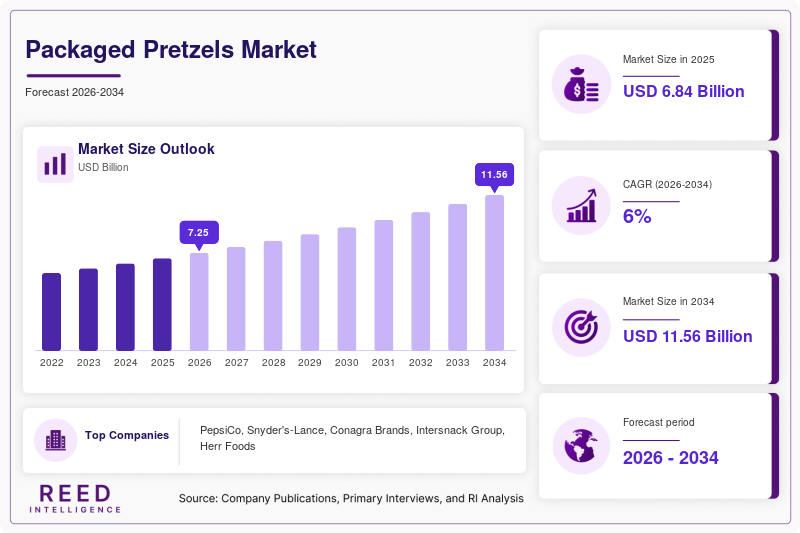
The global Packaged Pretzels Market size was valued at USD 6.84 billion in 2026 and is projected to reach USD 10.91 billion by 2034, expanding at a CAGR of 6.0% during the forecast period from 2026 to 2034. The market continues to gain momentum due to rising consumer preference for convenient savory snacks with extended shelf life and portable packaging formats. Increasing urbanization, evolving snacking behavior, and demand for ready-to-eat bakery products have contributed to the expansion of packaged pretzel consumption across both developed and emerging economies.
The growing influence of organized retail and e-commerce platforms has strengthened product accessibility and consumer engagement worldwide. Manufacturers are introducing innovative flavors, gluten-free varieties, low-sodium formulations, and protein-enriched pretzels to attract health-conscious consumers. In addition, rising demand for premium snack assortments and mixed snack packs has expanded shelf visibility in supermarkets and convenience stores. The increasing adoption of western-style snacking habits in Asia Pacific and Latin America has further supported market penetration.
Key Highlights
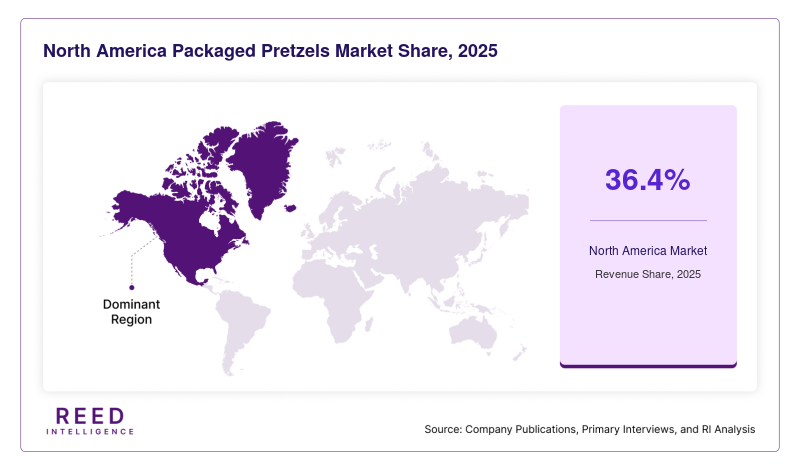
- North America dominated the market with a 36.4% share in 2025, while Asia Pacific is expected to grow at the fastest CAGR of 8.4% during 2026–2034.
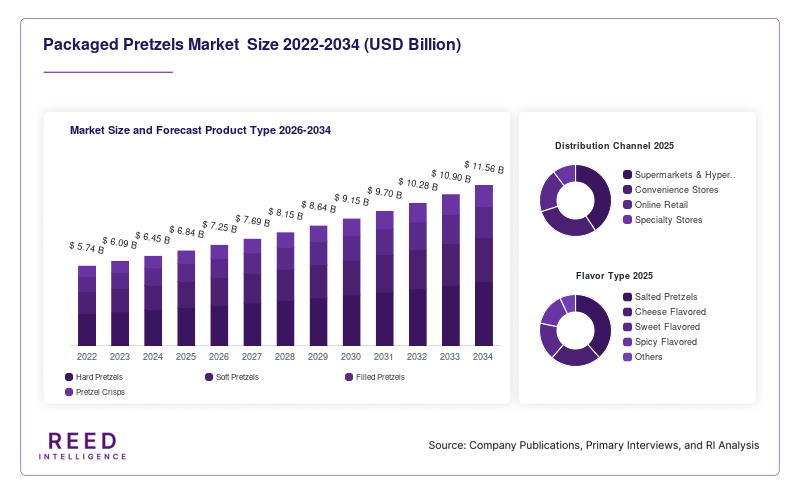
- By product type, hard pretzels accounted for the largest share of 44.1%, while filled pretzels are projected to grow at a CAGR of 8.8%.
- By distribution channel, supermarkets and hypermarkets led with a 47.3% share, whereas online retail is expected to expand at a CAGR of 9.6%.
- By flavor type, salted pretzels held a 40.6% share, while flavored pretzels are anticipated to grow at a CAGR of 8.1%.
- The United States remained the dominant country, with market values of USD 1.92 billion in 2024 and USD 2.05 billion in 2025.
Market Trends
Rising Demand for Health-Oriented Pretzel Variants
Consumer preference for healthier snack alternatives is influencing innovation in the Packaged Pretzels Market. Manufacturers are increasingly introducing baked pretzels with reduced fat, lower sodium content, and whole-grain ingredients to address growing health awareness among consumers. Demand for gluten-free and organic pretzel products is also increasing due to dietary restrictions and clean-label preferences. Brands are incorporating ingredients such as quinoa, flaxseed, and chickpea flour to improve nutritional value while maintaining texture and taste. This trend is particularly visible among millennials and urban consumers seeking balanced snacking options without compromising convenience. Retailers are expanding shelf space for functional snacks, which is encouraging companies to diversify their pretzel portfolios and launch premium health-focused product lines.
Expansion of Innovative Flavor Profiles and Snack Mixes
Flavor innovation has emerged as a major trend supporting product differentiation in the Packaged Pretzels Market. Consumers are showing strong interest in bold and globally inspired flavors including honey mustard, jalapeño cheddar, garlic parmesan, cinnamon sugar, and barbecue seasoning. Manufacturers are also combining pretzels with nuts, crackers, dried fruits, and chocolate coatings to create mixed snack assortments targeting varied taste preferences. Seasonal flavors and limited-edition launches are helping companies strengthen brand engagement and repeat purchases. Younger demographics are driving experimentation with sweet-and-savory combinations and fusion snack concepts. The increasing popularity of gourmet snacking and premium packaged food products has encouraged brands to invest in flavor research and attractive packaging designs that improve shelf appeal and customer retention.
Market Drivers
Growth in On-the-Go Snacking Consumption
The growing demand for portable and ready-to-consume food products is a key factor driving the Packaged Pretzels Market. Busy work schedules, increasing urban lifestyles, and rising travel frequency have accelerated the adoption of convenient snack products that require minimal preparation. Packaged pretzels offer long shelf life, easy portability, and portion-controlled packaging, making them suitable for office consumption, school lunches, and travel retail channels. Convenience stores and vending machine networks are also contributing to higher product visibility and impulse purchases. The demand for individually packed snack servings has increased significantly among younger consumers and working professionals. As a result, manufacturers are expanding product availability across supermarkets, airports, educational institutions, and digital grocery platforms to strengthen market penetration and improve sales volumes globally.
Increasing Retail Penetration and E-Commerce Expansion
The expansion of modern retail infrastructure and online grocery platforms has significantly contributed to the growth of the Packaged Pretzels Market. Supermarkets, hypermarkets, and convenience chains continue to increase shelf availability for packaged snack products due to strong consumer demand. At the same time, e-commerce channels are enabling brands to reach a wider customer base through subscription snack boxes, promotional discounts, and direct-to-consumer sales strategies. Online platforms allow manufacturers to introduce niche products and premium pretzel varieties without depending entirely on physical retail distribution. The availability of customer reviews, personalized recommendations, and digital advertising campaigns has also improved consumer engagement. Emerging economies are witnessing rapid growth in organized retail networks, further supporting accessibility and consistent product supply across urban and semi-urban regions.
Market Restraint
Volatility in Raw Material Prices and Health Concerns
Fluctuations in the prices of wheat flour, edible oils, seasonings, and packaging materials continue to create operational challenges for manufacturers in the Packaged Pretzels Market. Rising transportation and energy costs have also affected overall production expenses, reducing profit margins for small and medium-scale producers. Frequent changes in commodity prices can disrupt supply chain planning and pricing strategies, particularly in price-sensitive markets. In addition, growing consumer concerns regarding sodium content, refined flour usage, and processed snack consumption may restrict market growth among health-focused buyers. Some consumers are shifting toward natural snack alternatives such as dried fruits, granola products, and vegetable chips. Regulatory scrutiny regarding food labeling and nutritional transparency is also increasing across several countries. Companies must therefore invest in healthier formulations and efficient sourcing strategies to maintain competitiveness while managing production costs and evolving consumer expectations.
Market Opportunities
Growing Demand in Emerging Economies
Emerging economies across Asia Pacific, Latin America, and the Middle East are creating substantial growth opportunities for the Packaged Pretzels Market. Rising disposable income, increasing urbanization, and changing dietary habits are encouraging consumers to adopt western-style savory snacks. International snack brands are expanding their presence in developing regions through local partnerships, regional manufacturing facilities, and affordable product variants. Growing supermarket penetration and digital grocery services are improving product availability in secondary cities and suburban markets. Younger populations in countries such as India, Indonesia, Brazil, and Saudi Arabia are increasingly experimenting with packaged snack products and international flavors. Companies that introduce cost-effective packaging sizes and region-specific taste profiles are expected to benefit from expanding consumer demand and growing retail accessibility throughout the forecast period.
Innovation in Premium and Functional Snack Categories
The rising popularity of premium snacking presents strong opportunities for manufacturers operating in the Packaged Pretzels Market. Consumers are increasingly seeking products that combine indulgence with nutritional benefits, encouraging companies to launch protein-rich, fiber-enhanced, and low-calorie pretzel variants. Functional ingredients such as probiotics, plant proteins, and fortified grains are gaining attention in the snack food industry. Premium coated pretzels featuring chocolate, yogurt, caramel, or exotic spice blends are also witnessing increasing demand among younger demographics and high-income consumers. Subscription snack services and gourmet food retailers are helping brands promote premium product lines more effectively. Manufacturers that focus on innovative textures, artisanal production methods, and sustainable packaging solutions are expected to gain competitive advantages in the evolving packaged snack industry landscape.
Segmental Analysis
By Product Type
Hard pretzels accounted for the largest share of the Packaged Pretzels Market in 2024, representing 44.1% of total revenue. The dominance of this segment is attributed to its wide availability, long shelf life, and strong consumer familiarity across both developed and emerging economies. Hard pretzels are commonly sold in supermarkets, convenience stores, vending machines, and entertainment venues, making them one of the most accessible savory snack options. Manufacturers continue to expand flavor assortments and packaging sizes to attract diverse consumer groups. Salted hard pretzels remain highly preferred due to their affordability and compatibility with dips, spreads, and snack mixes. The segment also benefits from lower production costs compared to filled or coated pretzel varieties, enabling companies to maintain competitive pricing strategies in mass retail markets.
Filled pretzels are projected to grow at the fastest CAGR of 8.8% during the forecast period due to increasing demand for premium and indulgent snack experiences. Consumers are showing growing interest in pretzels filled with cheese, peanut butter, chocolate, caramel, and cream-based ingredients. This segment is gaining popularity among younger consumers seeking convenient snacks with unique textures and flavor combinations. Manufacturers are introducing innovative packaging formats and portion-controlled offerings to improve product appeal in urban markets. The expansion of gourmet snack stores and e-commerce channels is further supporting the growth of premium filled pretzel products. In addition, the rising influence of social media food trends and visually appealing snack concepts is encouraging brands to launch limited-edition and seasonal flavor variants to strengthen customer engagement.
By Distribution Channel
Supermarkets and hypermarkets dominated the Packaged Pretzels Market in 2024 with a share of 47.3% due to strong product visibility and extensive consumer foot traffic. These retail formats offer a broad selection of snack products, promotional discounts, and bundled offers that encourage impulse purchases. Consumers prefer supermarkets because they provide convenient access to multiple brands, flavor options, and packaging sizes in a single location. Large retail chains also support manufacturers through shelf placement strategies, in-store marketing campaigns, and private-label product development. The segment benefits from rising urbanization and increasing penetration of organized retail infrastructure in developing economies. Additionally, supermarkets continue to expand their healthy snack sections, which has improved the visibility of organic, gluten-free, and low-sodium pretzel products among health-conscious buyers.
Online retail is expected to witness the fastest CAGR of 9.6% during the forecast period due to rapid digitalization and changing consumer shopping habits. E-commerce platforms enable consumers to compare products, explore niche snack brands, and purchase in bulk through subscription-based services. The growing popularity of direct-to-consumer business models has encouraged manufacturers to strengthen their digital marketing strategies and personalized promotions. Online channels also provide improved accessibility to imported and specialty pretzel products that may not be widely available in physical stores. Mobile shopping applications, same-day delivery services, and digital payment systems are further supporting consumer convenience. Rising internet penetration in emerging economies and increased adoption of online grocery shopping are expected to accelerate the expansion of this segment over the coming years.
By Flavor Type
Salted pretzels held the largest share of the Packaged Pretzels Market in 2024, accounting for 40.6% of total revenue. The popularity of salted pretzels is largely driven by their traditional taste profile, affordability, and widespread acceptance across all age groups. Consumers continue to prefer classic salted variants as everyday snack options due to their balanced flavor and compatibility with beverages, dips, and snack platters. Foodservice establishments, sports venues, and cinemas also contribute significantly to the sales of salted pretzel products. Manufacturers are focusing on improved texture, reduced sodium formulations, and resealable packaging to maintain consumer interest. The segment benefits from strong brand loyalty and large-scale production capabilities, enabling companies to distribute products efficiently across supermarkets, convenience stores, and wholesale retail channels worldwide.
Flavored pretzels are anticipated to expand at the fastest CAGR of 8.1% during the forecast period owing to increasing consumer demand for innovative and premium snack experiences. Manufacturers are introducing flavors such as sour cream and onion, spicy chili, honey mustard, cinnamon sugar, and barbecue to appeal to evolving taste preferences. The growing popularity of international cuisines and fusion snacks is also supporting experimentation with globally inspired seasoning blends. Younger demographics are particularly attracted to bold and unconventional flavor combinations that offer variety and novelty. Brands are investing in attractive packaging designs and social media promotions to strengthen product visibility among digital consumers. In addition, limited-edition seasonal launches and collaborative flavor campaigns are helping companies improve customer retention and encourage repeat purchases across competitive snack food markets.
Regional Analysis
North America
North America accounted for the largest share of the Packaged Pretzels Market in 2025, representing 36.4% of global revenue. The regional market is projected to expand at a CAGR of 5.7% during the forecast period due to strong consumer preference for savory snacks and established snack food manufacturing infrastructure. The United States and Canada continue to witness high consumption of packaged bakery snacks across supermarkets, convenience stores, and online retail channels. Product innovation involving flavored, gluten-free, and protein-enriched pretzels is contributing to sustained demand. The region also benefits from advanced food processing technologies and widespread brand awareness.
The United States remained the dominant country in the regional market due to high per capita snack consumption and extensive retail distribution networks. One major growth factor supporting the market is the increasing demand for healthier packaged snacks among millennials and working professionals. Food manufacturers are introducing low-fat and organic pretzel varieties to align with evolving dietary preferences. Strong promotional campaigns, celebrity endorsements, and seasonal product launches are also strengthening consumer engagement. In addition, sports events and entertainment gatherings continue to increase demand for shareable snack packaging formats throughout the country.
Europe
Europe held a substantial share of the Packaged Pretzels Market in 2025 and is expected to register a CAGR of 5.5% through 2034. The region benefits from strong bakery traditions and established consumer familiarity with pretzel-based snacks. Germany, the United Kingdom, and France are major contributors to regional demand due to growing consumption of packaged convenience foods. Retailers are increasing shelf space for premium and artisanal pretzel products, while private-label snack brands continue to gain popularity among cost-conscious consumers. Sustainable packaging initiatives and stricter food quality regulations are also shaping product development strategies across European markets.
Germany dominated the European market due to its cultural association with pretzel products and large-scale bakery manufacturing industry. A major growth factor in the country is the increasing export demand for packaged snack products across neighboring European nations. German manufacturers are focusing on product diversification through innovative seasoning blends and healthier baking methods. Rising demand for organic and non-GMO snacks has encouraged companies to reformulate traditional pretzel recipes using natural ingredients. Expanding e-commerce grocery services and premium snack retail formats are also supporting sales growth among urban consumers across the country.
Asia Pacific
Asia Pacific is anticipated to witness the fastest growth in the Packaged Pretzels Market, with a forecast CAGR of 8.4% during 2026–2034. The regional market is expanding rapidly due to increasing urbanization, rising disposable income, and growing exposure to western-style snacking habits. Countries including China, India, Japan, and South Korea are experiencing increasing demand for packaged bakery snacks among younger consumers. International snack brands are expanding regional manufacturing operations and introducing affordable packaging formats to strengthen market presence. The rapid growth of organized retail chains and digital grocery platforms is further improving accessibility to packaged pretzel products.
China emerged as the dominant country in the regional market due to its large consumer base and expanding snack food industry. One important growth factor is the increasing influence of social media marketing and online food delivery platforms, which are accelerating product awareness and impulse purchases. Younger consumers are showing strong interest in imported snack products and innovative flavor combinations. Local manufacturers are also introducing region-specific seasonings and fusion snack concepts to attract domestic buyers. Rising demand for convenient office and school snacks is expected to continue supporting market expansion throughout the forecast period.
Middle East & Africa
The Middle East & Africa Packaged Pretzels Market is witnessing steady growth supported by rising urban populations and increasing retail modernization. The region is projected to expand at a CAGR of 6.1% during the forecast period as international snack brands strengthen distribution networks across major metropolitan areas. Countries such as the United Arab Emirates, Saudi Arabia, and South Africa are experiencing increased demand for convenient packaged foods among younger demographics. Expanding supermarket chains, tourism activity, and growing expatriate populations are contributing to higher consumption of western-style snack products. Manufacturers are also introducing halal-certified pretzel variants to improve regional acceptance.
Saudi Arabia accounted for the largest market share within the region due to rapid retail expansion and growing consumer spending on packaged food products. A significant growth factor is the increasing popularity of convenience snacks among the country’s young population and working professionals. International brands are investing in localized marketing campaigns and partnerships with regional distributors to improve product penetration. The development of modern shopping malls and entertainment centers has also increased impulse snack purchases. In addition, rising adoption of online grocery platforms is helping manufacturers expand product reach beyond major urban locations.
Latin America
Latin America represented a growing share of the Packaged Pretzels Market in 2025 and is expected to record a CAGR of 6.3% through 2034. The region is benefiting from changing consumer lifestyles, increasing urbanization, and growing interest in affordable packaged snacks. Brazil, Mexico, and Argentina are among the major contributors to regional demand due to expanding retail infrastructure and rising youth population. Manufacturers are introducing smaller and budget-friendly packaging formats to attract middle-income consumers. Increasing promotional activities through supermarkets and digital retail channels are also supporting product visibility and customer engagement across the region.
Brazil remained the dominant country in the regional market due to strong snack food consumption and a large domestic retail sector. One major growth factor is the increasing popularity of flavored and sweet-coated pretzel products among younger consumers. Local snack manufacturers are investing in product innovation and region-specific taste preferences to compete with international brands. Expanding convenience store networks and growing demand for ready-to-eat snacks during social gatherings are further contributing to market growth. The country’s evolving foodservice and entertainment industries are also creating new opportunities for packaged snack manufacturers.
Competitive Landscape
The Packaged Pretzels Market is moderately consolidated, with several multinational snack manufacturers competing alongside regional and private-label producers. Companies are focusing on flavor innovation, healthier product formulations, sustainable packaging, and strategic retail partnerships to strengthen their market positions. Product diversification and premium snack launches remain important strategies for attracting younger and health-conscious consumers. Major manufacturers are also investing in digital marketing campaigns and direct-to-consumer distribution channels to improve customer engagement and sales performance.
PepsiCo remained one of the leading participants in the market through its extensive savory snack portfolio and strong retail distribution network. The company recently expanded its baked snack offerings with new low-sodium pretzel varieties targeting health-focused consumers. Other important companies including Snyder's-Lance, Conagra Brands, Intersnack Group, and Herr Foods are actively introducing flavored and premium pretzel products to strengthen competitive positioning. Partnerships with e-commerce retailers and investments in automated production facilities are also shaping the competitive environment.
Key Players
- PepsiCo
- Snyder's-Lance
- Conagra Brands
- Intersnack Group
- Herr Foods
- Mars Incorporated
- Old Dutch Foods
- Utz Brands
- General Mills
- J&J Snack Foods
- Pretzels Inc.
- Lance Incorporated
- Bachman Company
- Unique Pretzel Bakery
- Snack Factory
Recent Developments
- In March 2026, PepsiCo expanded its packaged pretzel portfolio with new baked whole-grain pretzel varieties aimed at health-conscious consumers across North America and Europe.
- In November 2025, Utz Brands introduced limited-edition spicy flavored pretzels featuring regional seasoning blends to strengthen its premium snack offerings in the United States market.
- In July 2025, Conagra Brands upgraded its snack production facilities with automated packaging systems to improve manufacturing efficiency and support growing retail demand for packaged pretzels.
- In January 2026, Snack Factory launched a new range of protein-enriched pretzel crisps through online retail channels targeting younger consumers seeking functional snack products.
- In October 2025, Intersnack Group expanded its distribution partnership network across Asia Pacific to increase the availability of flavored packaged pretzel products in emerging urban markets.
Packaged Pretzels Market Segments
Product Type
- Hard Pretzels
- Soft Pretzels
- Filled Pretzels
- Pretzel Crisps
Distribution Channel
- Supermarkets & Hypermarkets
- Convenience Stores
- Online Retail
- Specialty Stores
Flavor Type
- Salted Pretzels
- Cheese Flavored
- Sweet Flavored
- Spicy Flavored
- Others
By Region
- North America
- Europe
- APAC
- Middle East and Africa
- LATAM