Padel Market Size, Share & Trends Analysis Report By Product Type (Padel Rackets, Padel Balls, Padel Apparel & Footwear, Court Equipment, Accessories), By Application (Recreational, Professional & Competitive, Clubs & Academies), By Distribution Channel (Online, Offline) and By Region (North America, Europe, APAC, Middle East and Africa, LATAM) Forecasts, 2026–2034
USD 3950
Padel Market Market Size
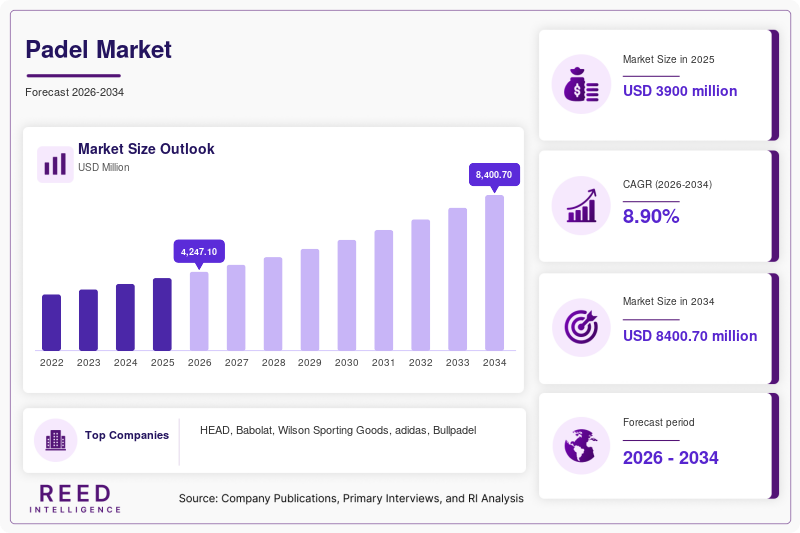
The global padel market size was valued at USD 3,900 million in 2025 and is projected to grow from USD 4,250 million in 2026 to USD 8,480 million by 2034, registering a CAGR of 8.90% during the forecast period from 2026 to 2034.
The market is moving beyond its traditional European and Latin American base as participation, court construction, professional tournaments, equipment innovation, and commercial club development expand into Asia, the Middle East, North America, and other emerging markets. The International Padel Federation (FIP) reported more than 35 million active players, 24,600+ clubs and 77,300 courts across 150 nations and 20 dependent territories in 2025. By August 2026, FIP reported approximately 38 million players, 85,000 courts and 27,000 clubs across 178 countries and territories, indicating that the addressable customer base is expanding through both participation and infrastructure.
Padel has developed into a broader sports-consumption ecosystem involving rackets, balls, apparel, footwear, accessories, court construction, club operations, tournaments, coaching and digital booking services. The commercial mechanism is straightforward: more players create recurring demand for equipment, while more clubs and courts create an additional infrastructure and replacement market. FIP reported that 14,355 courts were built during 2025, while the number of clubs increased by 4,775 during the year.
Europe remains the largest established market. FIP reported more than 18 million European players and more than 45,000 courts in October 2025, while Spain and Italy remain major mature markets. At the same time, growth is shifting toward markets where padel is still in the facility-development phase. Asia had about 2.2 million amateur players and 4,600 courts across 1,700 clubs in 2025, with FIP reporting approximately 20% year-on-year growth in players and courts.
Padel Market Drivers
Expansion of Padel Participation and Court Infrastructure
The strongest demand mechanism is the expansion of the player and facility base. FIP's 2025 World Padel Report recorded more than 35 million players, 77,300 courts and more than 24,600 clubs worldwide. By August 2026, FIP reported approximately 38 million players, 85,000 courts and 27,000 clubs across 178 countries and territories. This creates two linked revenue pools: initial equipment purchases from new participants and recurring replacement purchases from established players.
Court development is particularly important because every new facility requires courts, turf, nets, lighting, glass, fencing and associated equipment before generating recurring demand for balls, rackets, apparel and maintenance. FIP reported 14,355 new courts in 2025 alone. The commercial effect therefore extends beyond sporting-goods sales into construction, facility management and club services.
Professionalization of Padel and International Tournament Expansion
The professionalization of padel is creating stronger visibility for equipment brands and giving manufacturers more opportunities to differentiate products around professional player requirements. Premier Padel completed a unified professional-tour structure following its merger with the World Padel Tour, while its tournament ecosystem has expanded across multiple countries. The 2025 Premier Padel season included 24 tournaments in 16 nations and more than 700 players from 35 countries.
In 2026, Premier Padel and FIP also adjusted the calendar, upgraded tournaments and introduced changes to ranking and participation structures. These developments increase the number of organized competitive environments where approved balls, professional-grade rackets, court surfaces and specialized footwear are required.
Product Innovation Across Rackets, Balls and Footwear
Manufacturers are increasingly segmenting equipment according to playing level and style. HEAD's Radical 2026 collection covers competitive, intermediate and casual users, while Babolat's 2026 Technical range differentiates products according to power, responsiveness and tolerance. Wilson has introduced its ENDURE control franchise with new face-texture technology, and adidas continues to develop customizable weight and balance systems.
This product segmentation increases replacement and upgrade demand because players can move from entry-level products toward specialized equipment rather than making only one purchase when they enter the sport.
Padel Market Restraints
Infrastructure and Operating Costs
Padel's expansion depends on suitable real estate, construction capacity, climate-appropriate facilities and access to sufficient playing hours. Court development can therefore be slower in locations where land is expensive, permitting is complex or indoor facilities are required because of weather conditions. The constraint is particularly relevant in new markets where the sport does not yet have a large installed club network.
Uneven Market Maturity
The global market contains highly mature markets alongside countries that are only beginning to develop clubs and competitive structures. FIP's 2025 research identifies Spain and Italy as more consolidated European markets while countries such as Poland, Romania, Croatia and other Eastern European markets remain in earlier growth phases. This uneven maturity affects purchasing behavior: mature markets generate replacement and premium-equipment demand, while emerging markets depend more heavily on facility creation and entry-level participation.
Padel Market Opportunities
Asia-Pacific Facility Development
Asia-Pacific provides an important expansion route because its installed infrastructure remains much smaller than Europe's while participation is increasing. FIP reported 2.2 million amateur players, 4,600 courts and 1,700 clubs across Asia in 2025, with players and courts growing by approximately 20% year over year. The region is also receiving more international tournaments, including FIP events in Mumbai, Doha and other Asian locations.
The commercial opportunity extends beyond rackets and balls. New clubs require complete court installations, lighting, surfaces, nets and ancillary equipment, followed by recurring demand for consumables and player equipment. India, Japan, China, Southeast Asia and Gulf-linked Asian markets can therefore support multiple layers of the padel value chain as local participation develops.
Digital and Online Equipment Distribution
Online channels can capture demand from emerging markets where specialist padel retailers are less developed. Digital commerce also allows manufacturers to present equipment according to player level, racket shape, balance, foam and playing style. Wilson's online product architecture, for example, separates its racket offering into power, versatility and control categories, while HEAD provides tournament, recreational and junior racket categories.
This creates an opportunity for manufacturers and specialist retailers to combine equipment sales with educational content, player-level guidance, club partnerships and digital booking ecosystems. The opportunity is particularly relevant in newer markets where consumers may first encounter the sport online before purchasing equipment.
Segmental Analysis
By Product Type
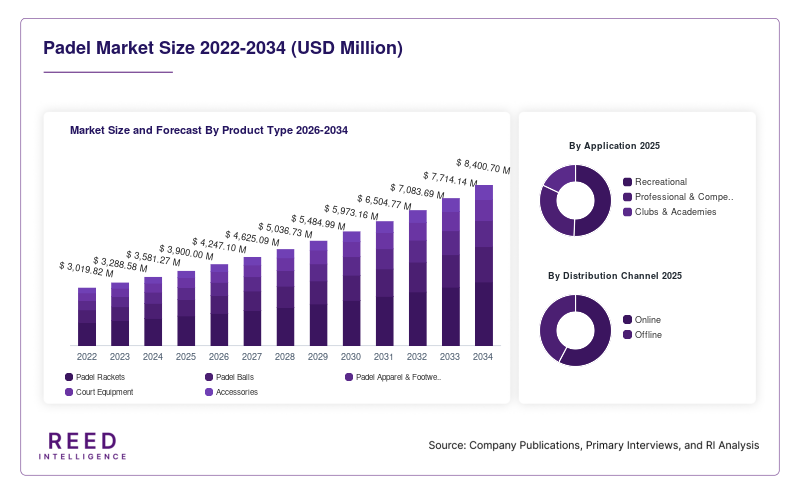
Padel Rackets represent the largest product category, accounting for approximately 38% of the global market in 2025. Rackets generate relatively high purchase values compared with consumable products and have a strong replacement and upgrade cycle as players move from beginner equipment toward models optimized for power, control, weight and playing style. Current product portfolios from HEAD, Babolat, Wilson and adidas demonstrate this segmentation, with products ranging from recreational and junior models to carbon-based professional rackets.
Padel Balls maintain recurring demand because they are consumable products used by clubs, tournament organizers and individual players. FIP approval requirements also create a formal product specification framework for official competition balls, covering weight, dimensions, bounce and other technical characteristics.
Padel Apparel & Footwear benefit from the sport's specialized movement requirements. ASICS, for example, markets padel footwear around traction, lateral stability and cushioning, while specialist brands increasingly develop shoes specifically for padel rather than adapting tennis footwear.
By Application
Recreational use accounts for approximately 56% of the global market in 2025, reflecting the large amateur player population. FIP reported more than 35 million players globally in 2025, with participation extending across 150 nations and 20 dependent territories.
Professional & Competitive use represents a smaller but commercially important segment. Professional tournaments create demand for approved balls, competition-grade courts and high-performance rackets while player endorsements influence equipment product development.
Clubs & Academies account for approximately 26% and generate multi-product demand because facilities purchase balls, nets, court equipment, maintenance products and sometimes rental or demonstration rackets. This segment also has a direct relationship with court construction and facility utilization.
By Distribution Channel
Offline distribution holds approximately 58% market share in 2025, supported by specialist sporting-goods retailers, club pro shops and physical stores where customers can test rackets and receive advice about weight, balance and playing style.
Online distribution accounts for approximately 42% but is the fastest-growing channel, with a CAGR of about 11.5%. The channel benefits from wider product availability and increasingly sophisticated product descriptions. Wilson, HEAD and adidas all provide extensive direct-to-consumer padel catalogues, including rackets, shoes, bags and accessories.
Regional Analysis
Europe Padel Market
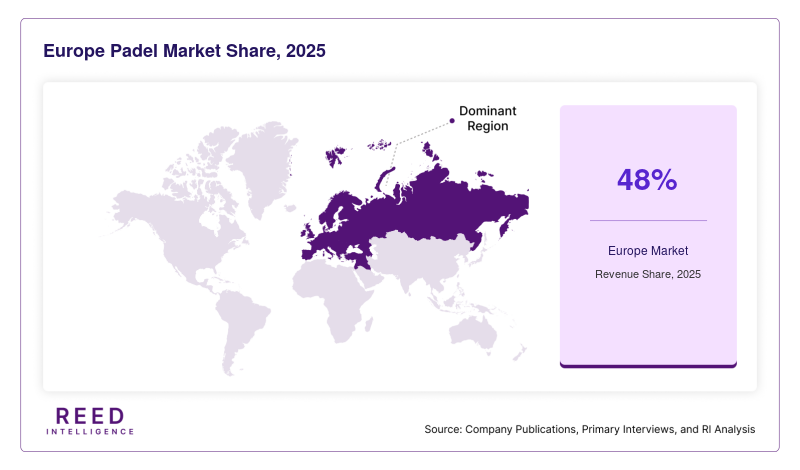
Europe is the dominant regional market, representing approximately 48% of the global padel market in 2025. The region has the deepest installed base of clubs, courts and players. FIP reported more than 18 million players and over 45,000 courts in Europe in October 2025, representing approximately 65% of the world's courts at that point.
Spain remains the core mature market, with FIP reporting more than 17,300 courts and over 6 million players. Italy had surpassed 10,200 courts, while France, Great Britain and Germany continued to expand. France added approximately 1,850 courts over an 18-month period, while Great Britain exceeded 1,000 courts in mid-2025.
The European market is increasingly characterized by replacement purchases, premium rackets, professional competition, specialized footwear and club-based consumption rather than first-time infrastructure alone. This creates demand for product differentiation and recurring equipment purchases.
Europe is expected to maintain a CAGR of approximately 8.1%. The main limitation is market maturity in countries such as Spain and Italy, where expansion rates are becoming more moderate after several years of rapid facility development. Growth therefore depends increasingly on emerging European markets and higher-value equipment categories.
North America Padel Market
North America represents approximately 18% of the global market in 2025, supported by increasing awareness of padel and the development of new facilities. The region benefits from its established sporting-goods distribution infrastructure and consumer familiarity with racket sports.
The United States is particularly relevant because professional padel operators and international tournament organizers have targeted the market as part of the sport's geographic expansion. Premier Padel previously identified the United States as an expansion market, alongside a broader strategy of increasing tournament reach and international broadcasting.
The regional demand mechanism is still more infrastructure-oriented than in mature European markets. New clubs create demand for courts and associated equipment before generating recurring spending on balls, rackets, footwear and accessories. Professional events and international players can further increase consumer awareness.
North America is projected to register a CAGR of approximately 9.4%. The main constraint is competition for court space and consumer attention from established racket sports, including tennis and pickleball. Padel operators therefore need sufficient facility utilization to support expansion economics.
Asia-Pacific Padel Market
Asia-Pacific accounts for approximately 17% of the global market in 2025 and is the fastest-growing region, with a CAGR of approximately 14.2%. FIP reported around 2.2 million amateur players across Asia and 4,600 courts in 1,700 clubs in 2025, with participation and court numbers growing about 20% year over year.
The region is transitioning from a relatively small installed base toward broader club development. India provides an example of this transition: Mumbai hosted FIP Promises and FIP Bronze events in January 2026, demonstrating the development of both senior and youth competition infrastructure.
Asia's growth mechanism includes new courts, specialist clubs, tournaments, youth programs and equipment distribution. Japan, India, China, Southeast Asia and Gulf-connected Asian markets offer different stages of adoption, allowing manufacturers to address both premium and entry-level customers.
The primary constraint is uneven availability of courts and specialist retailers. Nevertheless, the low installed base relative to participation potential gives Asia-Pacific the strongest infrastructure-led expansion profile.
Middle East and Africa Padel Market
Middle East and Africa represents approximately 7% of the global market in 2025 and is projected to grow at approximately 10.8% CAGR. The region benefits from investment in sports infrastructure, international events and premium leisure facilities, particularly in Gulf markets.
Qatar and the UAE are already part of the international tournament ecosystem. FIP's 2026 calendar included tournaments and youth events in Doha and Dubai, while Egypt has developed into an important African padel hub. FIP reported approximately 1,500 courts and 380,000 players in Egypt and identified the country as a leading African market.
The commercial model is closely tied to private clubs, hospitality developments, premium sports facilities and international tournaments. Indoor courts are particularly important in locations where high temperatures constrain outdoor participation for parts of the year.
The main constraint is the relatively small organized player base in many African countries. Market development will therefore depend on facility investment, local federations, coaching networks and affordable access to equipment.
LATAM Padel Market
LATAM accounts for approximately 10% of the global market in 2025 and is projected to grow at approximately 10.1% CAGR. The region has strong cultural familiarity with padel, led by Argentina and supported by Brazil, Mexico, Chile, Paraguay and Uruguay.
FIP's 2025 research identified the Americas as the second-most-developed continental padel market, with approximately 18,100 courts across 6,400 clubs. Argentina remains the leading country in the region, while Mexico has been experiencing strong growth and had more than one million players according to FIP's research.
The region's established player base supports recurring racket, ball, footwear and accessory demand, while emerging countries provide additional facility-development potential. Professional players from Argentina and other Latin American markets also remain important to the international competitive ecosystem.
The main limitation is economic variability across countries, which can affect premium-equipment purchasing and investment in new facilities. Demand is therefore likely to remain differentiated between mature padel countries and emerging markets.
Competitive Landscape
The padel market is fragmented across specialist padel manufacturers, multinational sporting-goods companies, court-equipment suppliers, and professional-tour partners. Competition is shifting from basic racket availability toward product engineering, player segmentation, professional endorsements, digital distribution and integration with the growing club ecosystem.
Racket manufacturers are differentiating products through carbon-fiber construction, foam technology, racket geometry, balance systems, spin surfaces and weight distribution. HEAD's 2026 Radical and Extreme collections, Babolat's Technical 2026 range, Wilson's ENDURE franchise and adidas's 2026 Metalbone products demonstrate this move toward highly segmented product architectures.
Key Market Players
Recent Market Developments
September 2026 – HEAD introduced updated Extreme Pro and Extreme Motion 2026 rackets with Auxetic 2.0, unidirectional carbon fiber, Extreme Spin technology and Power Foam. The launch shows continued movement toward differentiated equipment for aggressive and competitive players.
August 2026 – Padel made its debut at the 2026 Mediterranean Games in Taranto, with 88 athletes from 18 countries participating. FIP reported approximately 38 million players, 85,000 courts and 27,000 clubs across 178 countries and territories at the time, demonstrating the sport's expansion into broader multi-sport competition.
Padel Market Segments
By Product Type
- Padel Rackets
- Padel Balls
- Padel Apparel & Footwear
- Court Equipment
- Accessories
By Application
- Recreational
- Professional & Competitive
- Clubs & Academies
By Distribution Channel
- Online
- Offline
By Region
- North America
- Europe
- APAC
- Middle East and Africa
- LATAM