Pagets Disease Treatment Market Size, Share & Demand Report By Drug Class (Bisphosphonates, Calcitonin, Biologics), By Route of Administration (Oral, Intravenous, Subcutaneous), By Distribution Channel (Hospital Pharmacies, Retail Pharmacies, Online Pharmacies), By End-User (Hospitals, Specialty Clinics, Homecare Settings), By Region & Segment Forecasts, 2025–2034
USD 3950
Market Overview
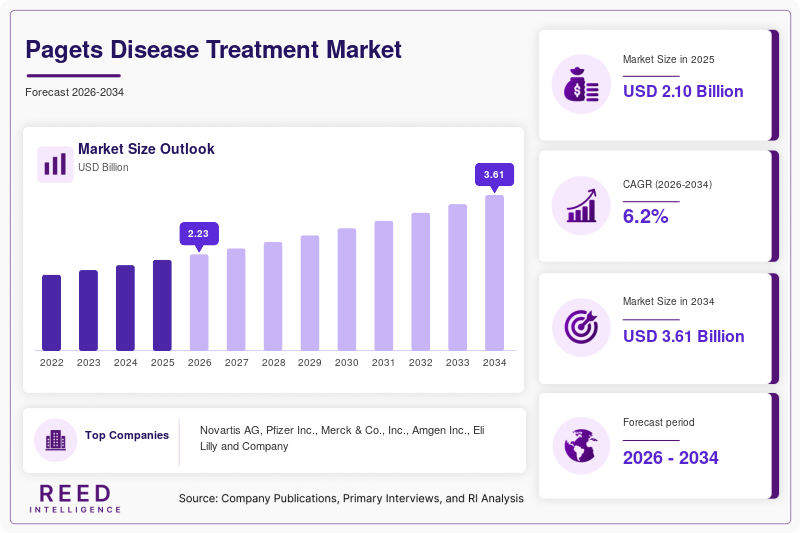
The global Pagets Disease Treatment Market size was valued at approximately USD 2.1 billion in 2025 and is projected to reach USD 3.6 billion by 2034, expanding at a CAGR of 6.2% during the forecast period (2025–2034). The market growth is primarily supported by the increasing aging population worldwide, as Paget’s disease of bone is more prevalent among individuals aged above 50 years. The rising awareness of rare bone disorders and improved diagnostic capabilities have also contributed to steady market expansion.
A key global factor supporting the growth of the Pagets Disease Treatment Market is the advancement in pharmaceutical formulations, particularly the development of more effective bisphosphonate therapies. These therapies offer improved symptom management and long-term disease control, encouraging higher adoption among healthcare providers and patients.
Key Highlights:
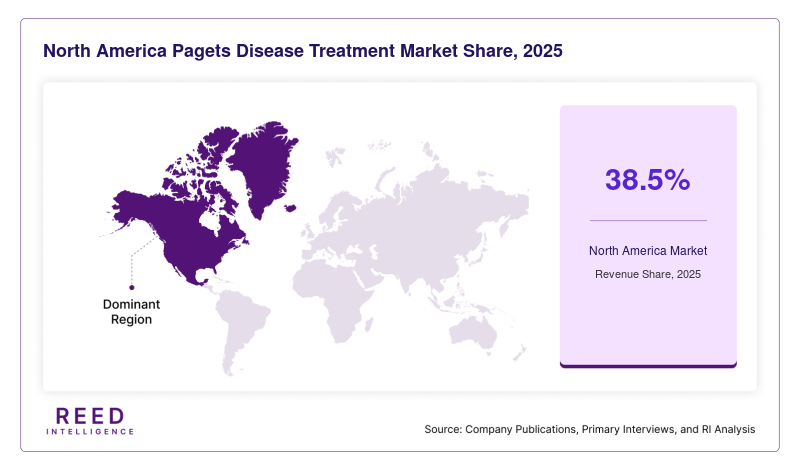
- North America dominated the market with a 38.5% share, while Asia Pacific is expected to grow at the fastest CAGR of 7.4%.
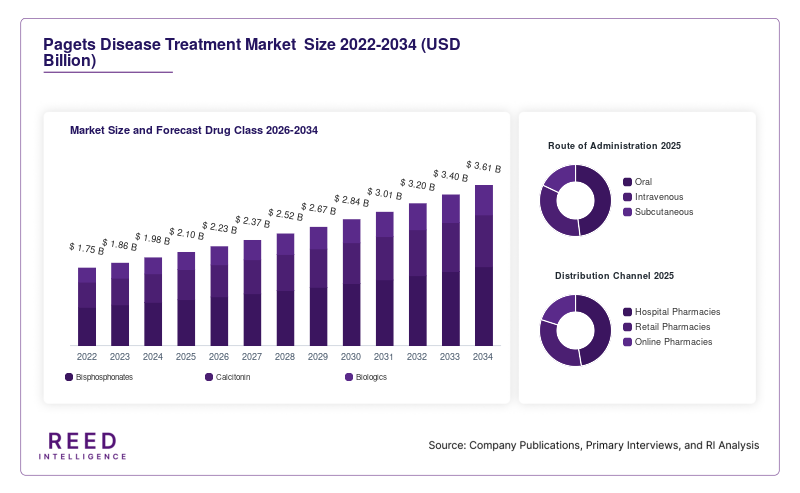
- Bisphosphonates emerged as the leading drug class segment with a 64% share, while biologics are anticipated to grow at the fastest CAGR of 7.9%.
- Oral administration led the route of administration segment with a 58% share, while intravenous therapies are projected to grow at a CAGR of 6.8%.
- The U.S. remained the dominant country with market values of USD 780 million in 2024 and USD 810 million in 2025.
Market Trends
Shift Toward Advanced Bisphosphonate Therapies
The Pagets Disease Treatment Market is witnessing a transition toward advanced bisphosphonate formulations with improved efficacy and reduced dosing frequency. New-generation drugs are designed to provide prolonged remission, reducing the need for repeated treatment cycles. This trend is influencing prescribing patterns, particularly in developed healthcare systems where treatment optimization is prioritized. The focus on patient compliance and long-term disease control continues to shape this trend.
Growing Integration of Digital Health Monitoring
Another notable trend is the integration of digital health technologies in disease management. Remote monitoring tools and telemedicine platforms are increasingly being used to track patient symptoms, treatment response, and bone turnover markers. This trend is particularly relevant in chronic conditions like Paget’s disease, where long-term monitoring is essential. Healthcare providers are leveraging digital solutions to improve patient engagement and optimize treatment outcomes, thereby supporting the overall growth of the Pagets Disease Treatment Market.
Market Drivers
Rising Geriatric Population
The increasing global geriatric population is a major driver of the Pagets Disease Treatment Market. As the prevalence of Paget’s disease rises significantly with age, the expanding elderly demographic directly contributes to higher demand for treatment. Countries with aging populations are witnessing increased diagnosis rates, leading to greater demand for pharmacological interventions.
Improved Diagnostic and Screening Practices
Advancements in diagnostic technologies, including imaging techniques and biochemical markers, have enhanced early detection of Paget’s disease. Improved screening practices enable timely treatment initiation, reducing complications associated with the disease. This has led to higher treatment adoption rates, thereby driving market growth. Healthcare systems are increasingly emphasizing early diagnosis, which continues to support the expansion of the Pagets Disease Treatment Market.
Market Restraints
Limited Awareness in Developing Regions
A significant restraint in the Pagets Disease Treatment Market is the limited awareness and underdiagnosis in developing regions. Many patients remain undiagnosed due to lack of knowledge about the disease among both the general population and primary healthcare providers. This results in delayed treatment or complete absence of therapeutic intervention.
Additionally, limited access to specialized diagnostic tools and trained professionals further restricts market growth in low- and middle-income countries. Healthcare infrastructure constraints and competing priorities in public health spending also contribute to the challenge.
The lack of widespread awareness campaigns and insufficient integration of rare disease education into primary care systems exacerbate the issue. As a result, a substantial portion of the potential patient population remains untapped, limiting the overall growth potential of the Pagets Disease Treatment Market.
Market Opportunities
Expansion in Emerging Markets
Emerging economies present significant growth opportunities for the Pagets Disease Treatment Market. Increasing healthcare investments, improving infrastructure, and expanding access to diagnostic services are enabling better disease detection and treatment. Governments and private organizations are focusing on strengthening healthcare systems, which is expected to drive market penetration in these regions.
Development of Targeted Therapies
The development of targeted therapies and novel treatment approaches offers promising opportunities for market expansion. Research efforts are increasingly focused on understanding the molecular mechanisms of Paget’s disease, leading to the identification of new therapeutic targets. The introduction of innovative drugs with improved safety profiles and efficacy is expected to attract investment and enhance treatment outcomes, thereby supporting the growth of the Pagets Disease Treatment Market.
Segmental Analysis
By Drug Class
Bisphosphonates dominated the Pagets Disease Treatment Market in 2024, accounting for approximately 64% of the market share. Their widespread use is attributed to their effectiveness in reducing bone turnover and managing symptoms associated with Paget’s disease. These drugs have become the standard of care due to their proven clinical efficacy and relatively favorable safety profile.
Biologics are expected to be the fastest-growing subsegment, with a projected CAGR of 7.9% during the forecast period. The growth of this segment will be driven by ongoing research into targeted therapies and the increasing focus on precision medicine. Biologics offer potential advantages in cases where traditional treatments are less effective, supporting their adoption.
By Route of Administration
Oral administration held the largest share of 58% in 2024 within the Pagets Disease Treatment Market. The convenience of oral medications and higher patient compliance contributed to their dominance. Patients prefer oral therapies due to ease of use and reduced need for hospital visits.
Intravenous administration is projected to grow at the fastest CAGR of 6.8%. This growth will be driven by the increasing use of injectable therapies that provide rapid and sustained therapeutic effects. Intravenous treatments are particularly beneficial for patients with severe disease or those who do not respond well to oral medications.
By Distribution Channel
Hospital pharmacies dominated the market in 2024, capturing around 46% of the share. The availability of specialized treatments and the presence of healthcare professionals contributed to the dominance of this segment. Hospitals play a crucial role in administering advanced therapies and managing complex cases.
Online pharmacies are expected to be the fastest-growing segment, with a CAGR of 7.2%. The growth will be driven by increasing digitalization and the convenience of home delivery services. Patients are increasingly opting for online platforms to access medications, especially in urban areas with high internet penetration.
By End-User
Hospitals accounted for the largest share of 52% in 2024 in the Pagets Disease Treatment Market. The dominance of hospitals is attributed to their comprehensive treatment capabilities and access to advanced diagnostic tools. Hospitals serve as primary centers for managing severe and complicated cases.
Specialty clinics are projected to grow at the fastest CAGR of 6.9%. The growth will be driven by the increasing number of specialized healthcare providers focusing on bone disorders. These clinics offer personalized treatment plans and improved patient care, contributing to their rising popularity.
Regional Analysis
North America
North America accounted for 38.5% of the Pagets Disease Treatment Market share in 2025 and is expected to grow at a CAGR of 5.8% during the forecast period. The region’s dominance was attributed to advanced healthcare infrastructure, high awareness levels, and strong presence of pharmaceutical companies. Favorable reimbursement policies and widespread availability of treatment options further supported market growth.
The United States emerged as the dominant country due to its well-established healthcare system and high adoption of advanced therapies. Increased research activities and strong clinical pipeline development contributed to sustained market expansion. The presence of specialized treatment centers and continuous innovation in drug development have strengthened the country’s leadership position.
Europe
Europe held a 27.2% share of the Pagets Disease Treatment Market in 2025 and is projected to grow at a CAGR of 5.6%. The region benefited from strong public healthcare systems and increasing focus on rare disease management. Government initiatives aimed at improving early diagnosis have contributed to market growth.
The United Kingdom led the regional market, supported by structured healthcare services and robust diagnostic capabilities. Increased awareness programs and collaborations between research institutions have enhanced treatment accessibility. The country’s emphasis on early intervention has played a key role in driving demand.
Asia Pacific
Asia Pacific captured 18.4% of the market share in 2025 and is expected to register the fastest CAGR of 7.4% during the forecast period. Rapid economic development, improving healthcare infrastructure, and increasing awareness are key factors driving growth in this region.
China dominated the regional market due to its large population base and expanding healthcare investments. The government’s focus on improving diagnostic facilities and increasing access to treatment has supported market growth. Rising healthcare expenditure and growing adoption of modern therapies are expected to further boost the Pagets Disease Treatment Market in the country.
Middle East & Africa
The Middle East & Africa accounted for 8.1% of the market share in 2025 and is projected to grow at a CAGR of 6.1%. The region is gradually improving its healthcare infrastructure, which is contributing to increased diagnosis and treatment rates.
Saudi Arabia emerged as the dominant country, driven by government initiatives to enhance healthcare services. Investments in hospital infrastructure and increasing awareness about bone disorders have supported market growth. The country’s efforts to modernize its healthcare system are expected to create new opportunities.
Latin America
Latin America held a 7.8% share of the Pagets Disease Treatment Market in 2025 and is expected to grow at a CAGR of 6.3%. The region is experiencing steady growth due to improving healthcare access and increasing awareness of chronic diseases.
Brazil led the regional market, supported by expanding healthcare coverage and rising investments in medical infrastructure. Government initiatives aimed at improving disease management and increasing access to treatment have contributed to market expansion. The growing focus on early diagnosis is expected to further drive growth.
Competitive Landscape
The Pagets Disease Treatment Market is moderately consolidated, with several global and regional players competing based on product offerings, innovation, and geographic presence. Leading companies are focusing on research and development to introduce advanced therapies and strengthen their market position.
Novartis AG is recognized as a market leader, driven by its strong portfolio of bisphosphonate therapies and continuous investment in research. The company recently announced advancements in next-generation bone disorder treatments, aiming to enhance therapeutic outcomes.
Other key players are actively expanding their product pipelines and engaging in strategic collaborations to gain a competitive edge. Market participants are also focusing on geographic expansion to tap into emerging markets and increase their customer base.
Key Players
- Novartis AG
- Pfizer Inc.
- Merck & Co., Inc.
- Amgen Inc.
- Eli Lilly and Company
- GlaxoSmithKline plc
- Sanofi S.A.
- Bayer AG
- Teva Pharmaceutical Industries Ltd.
- Mylan N.V.
Recent Developments
- In 2024, Novartis AG expanded its research initiatives focused on bone metabolism disorders, enhancing its pipeline in the Pagets Disease Treatment Market.
- Pfizer Inc. introduced updated clinical data supporting the long-term efficacy of its osteoporosis-related therapies, which have implications for Paget’s disease treatment.
- Amgen Inc. increased investment in biologics research targeting bone remodeling pathways.
- Teva Pharmaceutical Industries Ltd. expanded its generic bisphosphonate portfolio to improve accessibility in emerging markets.
- Sun Pharmaceutical Industries Ltd. strengthened its distribution network across Asia Pacific to enhance market reach.
Pagets Disease Treatment Market Segments
Drug Class
- Bisphosphonates
- Calcitonin
- Biologics
Route of Administration
- Oral
- Intravenous
- Subcutaneous
Distribution Channel
- Hospital Pharmacies
- Retail Pharmacies
- Online Pharmacies
End-User
- Hospitals
- Specialty Clinics
- Homecare Settings
By Region
- North America
- Europe
- APAC
- Middle East and Africa
- LATAM