Paint And Coatings Market Size, Share & Demand Report By Resin Type (Acrylic, Alkyd, Epoxy, Polyurethane, Polyester, Others), By Application (Architectural Coatings, Industrial Coatings, Automotive Coatings, Marine Coatings, Packaging Coatings, Wood Coatings), By End-Use Industry (Construction, Automotive, Aerospace, Industrial Manufacturing, Marine, Energy and Utilities) By Region & Segment Forecasts, 2026–2034
USD 3950
Market Overview
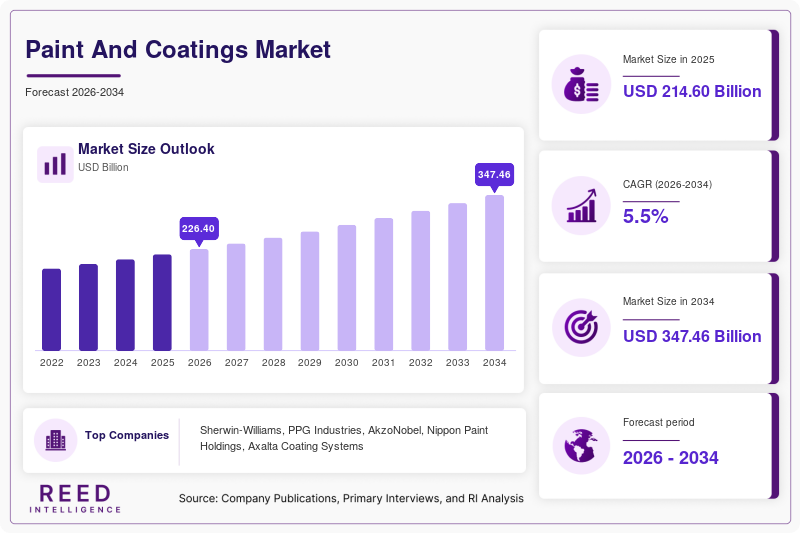
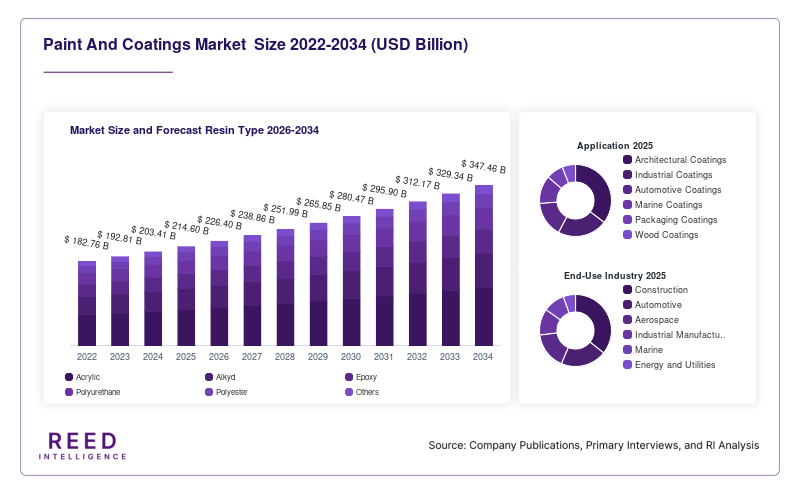
The global Paint And Coatings Market size was valued at USD 214.6 billion in 2026 and is projected to reach USD 328.9 billion by 2034, expanding at a CAGR of 5.5% during the forecast period from 2026 to 2034. The market continues to benefit from rising construction activities, increasing industrial output, and expanding automotive production across both developed and emerging economies. Paints and coatings are widely used to improve surface durability, corrosion resistance, weather protection, and decorative appeal across residential, commercial, industrial, and infrastructure applications. Rapid urban expansion and investments in smart city projects have also strengthened long-term demand for architectural coatings and industrial finishes.
One of the major global factors supporting market growth is the steady increase in infrastructure modernization projects worldwide. Governments in Asia Pacific, North America, and the Middle East are investing heavily in transportation networks, commercial facilities, energy infrastructure, and public housing developments. These projects require large volumes of protective coatings and decorative paints for steel structures, concrete surfaces, bridges, railways, and industrial machinery. In addition, technological advancements in low-VOC coatings, waterborne formulations, and powder coatings are helping manufacturers comply with environmental regulations while improving product performance. The growing preference for sustainable and energy-efficient building materials is further supporting innovation across the industry.
Key Highlights
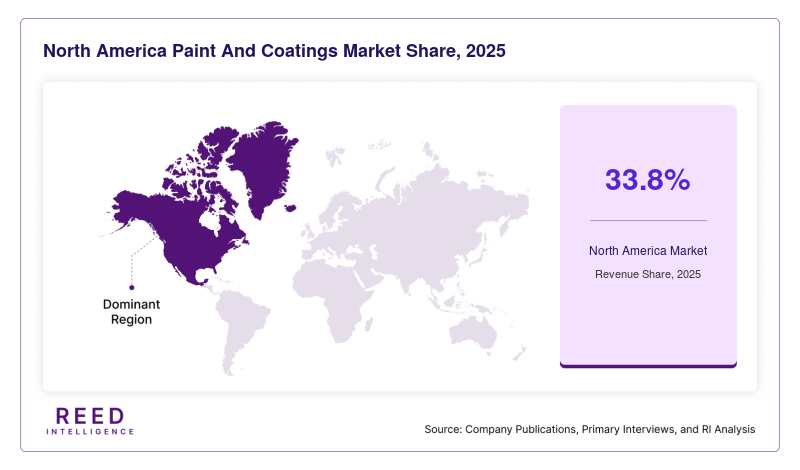
- North America dominated the market with a 33.8% share in 2025.
- Asia Pacific is expected to grow at the fastest CAGR of 7.2% during 2026–2034.
- By resin type, acrylic coatings accounted for the largest share of 36.4%, while polyurethane coatings are projected to grow at a CAGR of 6.9%.
- By application, architectural coatings led with a 44.8% share, whereas automotive coatings are expected to expand at a CAGR of 6.7%.
- The United States remained the dominant country, with market values of USD 49.8 billion in 2024 and USD 52.4 billion in 2025.
Market Trends
Expansion of Sustainable and Low-VOC Coating Technologies
Environmental sustainability has become one of the most important trends influencing the Paint And Coatings Market. Manufacturers are increasingly shifting toward low-VOC, waterborne, and bio-based coating formulations to meet tightening environmental regulations and changing consumer preferences. Governments across Europe and North America continue to implement strict emission standards for industrial solvents and hazardous air pollutants, encouraging companies to reduce the use of solvent-based products. This transition has accelerated research and development investments focused on eco-friendly coating technologies that deliver similar durability and finish quality while lowering environmental impact.
The trend is particularly visible in architectural and industrial applications where customers are prioritizing indoor air quality and sustainable construction practices. Builders and contractors are adopting green-certified paints for residential and commercial projects to comply with environmental certification systems. In addition, industrial users are adopting powder coatings and UV-curable coatings due to their lower waste generation and improved efficiency. The increasing availability of advanced waterborne coatings with improved scratch resistance, faster drying times, and higher weather protection is expected to support continued market expansion during the forecast period.
Rising Demand for Smart and Functional Coatings
The Paint And Coatings Market is also witnessing growing interest in functional and smart coatings designed to provide more than decorative protection. End-use industries are increasingly adopting coatings with specialized properties such as anti-corrosion performance, self-cleaning capability, antimicrobial resistance, thermal insulation, and UV protection. These coatings are gaining traction in healthcare facilities, automotive manufacturing, aerospace components, electronics, and infrastructure projects where surface performance plays a critical role in operational efficiency and maintenance reduction.
The construction sector has emerged as a major adopter of reflective and energy-efficient coatings that help reduce heat absorption and improve building energy performance. In the automotive industry, manufacturers are integrating scratch-resistant and self-healing coatings to enhance vehicle durability and appearance. Industrial facilities are also investing in anti-corrosion coatings to extend the operational life of pipelines, offshore platforms, and heavy machinery. Advancements in nanotechnology and polymer engineering are further supporting the commercialization of innovative coatings with enhanced adhesion, durability, and environmental resistance, creating new revenue opportunities for manufacturers globally.
Market Drivers
Growth in Global Construction and Infrastructure Activities
The expansion of residential, commercial, and industrial construction activities remains one of the primary growth drivers for the Paint And Coatings Market. Rapid urbanization in emerging economies has increased the demand for housing projects, office buildings, transportation infrastructure, and industrial facilities. Governments across Asia Pacific and the Middle East are allocating substantial investments toward smart cities, highways, airports, and rail networks, creating strong demand for architectural paints and protective coatings. These products are essential for improving structural longevity, corrosion resistance, and visual appeal in both interior and exterior applications.
The rise in renovation and remodeling projects has also contributed significantly to market growth. Consumers are increasingly investing in home improvement activities that involve repainting walls, furniture, and exterior surfaces. Commercial property owners are adopting premium coatings to improve building aesthetics and reduce long-term maintenance costs. Industrial infrastructure projects, including oil and gas facilities, power plants, and manufacturing units, are generating additional demand for high-performance protective coatings. The consistent expansion of global infrastructure spending is expected to maintain strong consumption levels across the paint and coatings industry throughout the forecast period.
Increasing Automotive Production and Industrial Manufacturing
The growing automotive and industrial manufacturing sectors are supporting sustained demand for advanced coating solutions worldwide. Automotive coatings are widely used for corrosion protection, scratch resistance, weather durability, and surface appearance enhancement in passenger and commercial vehicles. Rising vehicle production in countries such as China, India, Mexico, and Southeast Asian nations has created favorable conditions for coating manufacturers. Electric vehicle production is also contributing to demand for specialized coatings designed for battery systems, lightweight materials, and thermal management applications.
Industrial manufacturing activities have also expanded significantly across sectors including machinery, marine, aerospace, electronics, and consumer appliances. Protective coatings help improve equipment lifespan and operational efficiency by minimizing corrosion, chemical exposure, and wear-related damage. Manufacturers are increasingly adopting powder coatings and high-performance industrial coatings to reduce maintenance expenses and improve sustainability performance. In addition, rising investments in renewable energy projects such as wind turbines and solar infrastructure are creating additional opportunities for protective and weather-resistant coating products in global markets.
Market Restraint
Volatility in Raw Material Prices and Environmental Compliance Costs
Fluctuations in raw material prices continue to present a major challenge for participants operating in the Paint And Coatings Market. The industry relies heavily on petrochemical derivatives, pigments, resins, solvents, additives, and specialty chemicals, many of which experience significant price instability due to supply chain disruptions, geopolitical uncertainty, and changes in crude oil prices. Sudden increases in raw material costs can reduce manufacturer profit margins and create pricing pressure across the value chain. Small and medium-sized coating producers are particularly vulnerable because they often have limited purchasing power and lower flexibility in adjusting product prices.
Environmental regulations also increase operational complexity and compliance costs for manufacturers. Regulatory agencies in Europe and North America have implemented strict standards regarding VOC emissions, hazardous substances, and waste disposal associated with paint production and application processes. Companies are required to invest in advanced production technologies, reformulated products, emission control systems, and sustainable packaging solutions to meet regulatory expectations. These investments can increase overall production expenses and lengthen product development timelines. In some developing regions, limited technical infrastructure and inconsistent environmental enforcement create additional operational challenges for global coating suppliers attempting to standardize sustainable manufacturing practices.
Market Opportunities
Expansion of Infrastructure Projects in Emerging Economies
Emerging economies continue to provide strong growth opportunities for the Paint And Coatings Market due to rapid industrialization and infrastructure development. Countries across Asia Pacific, Latin America, and Africa are investing heavily in transportation systems, housing projects, industrial parks, airports, and energy facilities to support economic expansion and urban population growth. These projects require large volumes of decorative paints, waterproof coatings, anti-corrosion products, and industrial finishes for long-term structural protection and visual enhancement.
Governments are also introducing public-private partnership programs aimed at accelerating infrastructure modernization and affordable housing construction. Rising disposable incomes in urban populations are supporting increased spending on residential renovation and premium decorative paints. International coating manufacturers are expanding production facilities and distribution networks in emerging markets to strengthen regional supply capabilities and reduce transportation costs. The growing demand for durable and climate-resistant coatings in tropical and high-humidity regions is expected to create significant opportunities for advanced coating technologies during the forecast period.
Advancements in Smart Manufacturing and Digital Coating Technologies
Technological innovation in manufacturing and application processes is creating new opportunities across the Paint And Coatings Market. Companies are increasingly adopting automation, robotics, and digital monitoring systems to improve coating precision, reduce material waste, and enhance production efficiency. Automated spray systems and smart application technologies are helping industrial users achieve consistent coating thickness and improved surface quality in automotive, aerospace, and industrial manufacturing environments.
Digital color-matching technologies and AI-based formulation systems are also improving product customization capabilities for commercial and residential customers. Coating manufacturers are developing data-driven solutions that optimize curing performance, surface inspection, and predictive maintenance for industrial coatings. In addition, advancements in nanotechnology are enabling the development of multifunctional coatings with enhanced thermal insulation, antimicrobial protection, and self-cleaning properties. These innovations are expected to improve operational efficiency while expanding the range of coating applications across multiple industries over the coming years.
Segmental Analysis
By Resin Type
Acrylic coatings represented the dominant subsegment in the Paint And Coatings Market and accounted for 36.4% of the global market share in 2024. Acrylic-based coatings are widely used across architectural, automotive, and industrial applications due to their excellent weather resistance, color retention, and durability. These coatings provide strong adhesion properties and resistance against UV radiation, making them highly suitable for exterior construction surfaces and transportation equipment. The increasing use of waterborne acrylic coatings in residential and commercial projects has also contributed to segment expansion. Builders and contractors prefer acrylic formulations because they offer faster drying times, improved flexibility, and lower environmental impact compared to conventional solvent-based alternatives. Rising renovation activities and infrastructure development across emerging economies continue to support steady demand for acrylic coatings globally.
Polyurethane coatings are expected to register the fastest CAGR of 6.9% during the forecast period due to their superior mechanical strength and chemical resistance. These coatings are increasingly used in industrial machinery, marine equipment, automotive components, and aerospace applications where high-performance protection is required. Polyurethane coatings provide enhanced abrasion resistance, corrosion protection, and gloss retention, making them suitable for harsh operating environments. The growing focus on long-term infrastructure durability and industrial asset maintenance is supporting higher adoption rates. Manufacturers are also developing low-VOC polyurethane formulations to comply with environmental regulations while maintaining coating performance standards. Increasing investments in renewable energy infrastructure and heavy industrial projects are expected to further accelerate demand for advanced polyurethane coating technologies worldwide.
By Application
Architectural coatings accounted for the largest share of the Paint And Coatings Market in 2024, representing 44.8% of total revenue. These coatings are extensively used in residential, commercial, and institutional buildings for decorative enhancement and surface protection. Rising urbanization and increasing construction activities across developing economies have significantly boosted demand for interior and exterior architectural paints. Consumers are increasingly adopting premium decorative coatings that offer stain resistance, antimicrobial protection, and low odor characteristics. The growing popularity of smart homes and modern interior design trends has further encouraged the use of customized color solutions and specialty finishes. Government investments in affordable housing programs and commercial infrastructure development are also contributing to sustained demand for architectural coatings in both developed and emerging regions.
Automotive coatings are projected to expand at the fastest CAGR of 6.7% during the forecast period due to increasing vehicle production and rising consumer demand for durable surface finishes. Automotive manufacturers require advanced coatings to protect vehicles against corrosion, UV exposure, and environmental wear while improving aesthetic appearance. The growth of electric vehicle production has created additional opportunities for lightweight and heat-resistant coating technologies. Consumers are also showing increased interest in customized vehicle colors and premium finishes, encouraging innovation in coating formulations. In addition, repair and refinishing activities within the aftermarket automotive sector are generating consistent demand for high-performance coatings. Expanding automotive manufacturing capacity in Asia Pacific and Latin America is expected to strengthen long-term growth prospects for this application segment.
By End-Use Industry
The construction industry emerged as the dominant end-use segment in the Paint And Coatings Market and held 41.2% of the global market share in 2024. Construction projects require a wide range of coatings for walls, roofing systems, steel structures, flooring, bridges, and concrete surfaces. Rapid urban expansion and population growth have increased the need for residential housing, office complexes, healthcare facilities, and transportation infrastructure. Decorative paints remain highly demanded in both new construction and renovation activities due to changing consumer preferences regarding interior aesthetics and property maintenance. Protective coatings are also increasingly used in commercial infrastructure projects to improve structural durability and reduce maintenance expenses. Rising investments in green building technologies and sustainable construction materials are further supporting demand for environmentally friendly coating products across the construction industry.
The industrial sector is anticipated to witness the fastest CAGR of 6.5% during the forecast period due to expanding manufacturing activities and increasing demand for asset protection solutions. Industrial coatings are widely applied in machinery, pipelines, marine vessels, power plants, and processing equipment to improve resistance against chemicals, corrosion, and mechanical wear. Rapid industrialization in emerging economies has increased investments in factories, logistics facilities, and energy infrastructure, supporting demand for high-performance coatings. Manufacturers are increasingly adopting advanced coating systems that extend equipment lifespan and improve operational reliability under extreme conditions. In addition, the expansion of renewable energy projects such as wind turbines and solar facilities has created new growth opportunities for weather-resistant industrial coatings designed to withstand harsh environmental exposure.
Regional Analysis
North America
North America accounted for 33.8% of the global Paint And Coatings Market in 2025 and is projected to expand at a CAGR of 4.8% during the forecast period. The region benefits from strong demand across residential construction, commercial infrastructure, and automotive manufacturing sectors. The United States and Canada continue to witness stable renovation and remodeling activities, supporting consumption of architectural paints and specialty coatings. Increasing investments in industrial maintenance and protective coatings for energy infrastructure have also strengthened regional demand for high-performance products.
The United States remains the dominant country within the regional market due to its large construction sector and advanced manufacturing base. One unique growth factor supporting the country’s market expansion is the increasing adoption of sustainable building materials and green-certified infrastructure projects. Builders and developers are increasingly selecting low-VOC coatings and energy-efficient paint technologies to comply with environmental standards and improve indoor air quality. The expansion of electric vehicle manufacturing facilities is also contributing to rising demand for automotive coatings across the country.
Europe
Europe represented 27.1% of the global Paint And Coatings Market in 2025 and is expected to register a CAGR of 4.5% through 2034. The regional market is supported by stringent environmental regulations, strong automotive production, and stable industrial activity. Countries across Western Europe are focusing heavily on sustainable construction practices and low-emission manufacturing technologies. Waterborne coatings and powder coatings have gained significant popularity as manufacturers attempt to reduce solvent emissions and improve sustainability performance across industrial operations.
Germany remains the leading country within the European market due to its advanced automotive and industrial manufacturing industries. A unique growth factor driving demand in Germany is the rapid modernization of industrial machinery and production facilities. Manufacturers are increasingly investing in corrosion-resistant and high-durability coatings to extend equipment lifespan and improve operational reliability. In addition, the country’s focus on renewable energy infrastructure, including offshore wind farms and energy storage systems, has increased demand for specialized protective coatings designed for harsh environmental conditions.
Asia Pacific
Asia Pacific held 24.9% of the global Paint And Coatings Market in 2025 and is projected to grow at the fastest CAGR of 7.2% during the forecast period. Rapid urbanization, industrialization, and infrastructure expansion continue to support strong regional growth. Countries including China, India, Indonesia, and Vietnam are witnessing substantial investments in residential housing, transportation infrastructure, and industrial development projects. The increasing availability of affordable raw materials and labor has also encouraged multinational coating manufacturers to establish production facilities across the region.
China continues to dominate the Asia Pacific market due to its extensive manufacturing capabilities and large construction industry. One unique growth factor supporting the Chinese market is the government’s ongoing investment in smart city development and urban infrastructure modernization. Large-scale railway networks, industrial corridors, and public housing initiatives are generating substantial demand for decorative and protective coatings. Rising middle-class income levels and growing automotive ownership rates are also increasing consumption of premium paints and automotive finishes across urban areas.
Middle East & Africa
The Middle East & Africa region accounted for 7.5% of the global Paint And Coatings Market in 2025 and is anticipated to grow at a CAGR of 5.6% during the forecast period. Infrastructure development and industrial diversification strategies are supporting demand for coatings across commercial construction, oil and gas facilities, and transportation projects. Gulf countries are investing heavily in tourism infrastructure, airports, entertainment complexes, and smart city projects, creating favorable conditions for decorative and industrial coating suppliers.
Saudi Arabia remains the dominant country in the regional market due to large-scale infrastructure investments under national economic diversification initiatives. One unique growth factor driving the country’s coating demand is the rapid expansion of mega construction projects involving residential communities, entertainment districts, and industrial zones. Harsh climatic conditions in the region also increase the need for heat-resistant, UV-resistant, and anti-corrosion coatings capable of protecting buildings and industrial equipment from extreme temperatures and sand exposure.
Latin America
Latin America captured 6.7% of the global Paint And Coatings Market in 2025 and is expected to expand at a CAGR of 5.1% over the forecast period. The region is experiencing gradual recovery in construction activity, automotive production, and industrial investments. Demand for decorative paints has increased due to rising urban housing development and home renovation activities. Countries across the region are also investing in transportation infrastructure upgrades and industrial modernization projects that require protective and anti-corrosion coating solutions.
Brazil remains the leading country within the Latin American market due to its large manufacturing sector and expanding residential construction activities. One unique growth factor supporting market growth in Brazil is the increasing adoption of locally produced waterborne coatings aimed at reducing environmental impact and lowering production costs. Government support for domestic industrial development and infrastructure improvements has also encouraged investments in coating production facilities and regional distribution networks, strengthening long-term market growth potential.
Competitive Landscape
The Paint And Coatings Market remains moderately consolidated, with global companies competing through product innovation, regional expansion, sustainability initiatives, and strategic acquisitions. Major market participants are investing heavily in research and development to introduce environmentally compliant coatings with improved durability and application performance. Companies are also strengthening supply chain capabilities and expanding manufacturing facilities in emerging markets to improve production efficiency and market reach.
Sherwin-Williams continues to maintain a leading position in the global market due to its extensive product portfolio, strong retail distribution network, and broad presence across architectural and industrial coating applications. The company recently expanded its waterborne industrial coatings portfolio to address rising demand for low-emission protective coating technologies.
Key Players
- Sherwin-Williams
- PPG Industries
- AkzoNobel
- Nippon Paint Holdings
- Axalta Coating Systems
- BASF SE
- Asian Paints
- Kansai Paint Co., Ltd.
- Jotun Group
- RPM International Inc.
- Berger Paints India Limited
- Hempel A/S
- DAW SE
- Masco Corporation
- Tikkurila Oyj
Recent Developments
- Sherwin-Williams introduced a new range of low-VOC industrial coatings in 2025 designed for heavy equipment and infrastructure applications.
- AkzoNobel expanded its powder coating production capacity in Asia Pacific in 2024 to support increasing regional demand for sustainable coating technologies.
- PPG Industries launched advanced automotive refinish coatings with faster curing capabilities and improved scratch resistance in 2025.
- Nippon Paint Holdings established a new research center focused on smart coating technologies and energy-efficient paint formulations in 2024.
- Axalta Coating Systems partnered with electric vehicle manufacturers in 2025 to develop lightweight coating solutions for battery protection and thermal management.
Paint And Coatings Market Segments
Resin Type
- Acrylic
- Alkyd
- Epoxy
- Polyurethane
- Polyester
- Others
Application
- Architectural Coatings
- Industrial Coatings
- Automotive Coatings
- Marine Coatings
- Packaging Coatings
- Wood Coatings
End-Use Industry
- Construction
- Automotive
- Aerospace
- Industrial Manufacturing
- Marine
- Energy and Utilities
By Region
- North America
- Europe
- APAC
- Middle East and Africa
- LATAM