Pallet Truck Market Size, Share Demand Report By Type (Manual Pallet Trucks, Electric Pallet Trucks, Hydraulic Pallet Trucks), By Application (Warehouses, Distribution Centers, Manufacturing, Retail Stores), Regional Insights & Segment Forecasts, 2026–2034
USD 3950
Pallet Truck Market Size
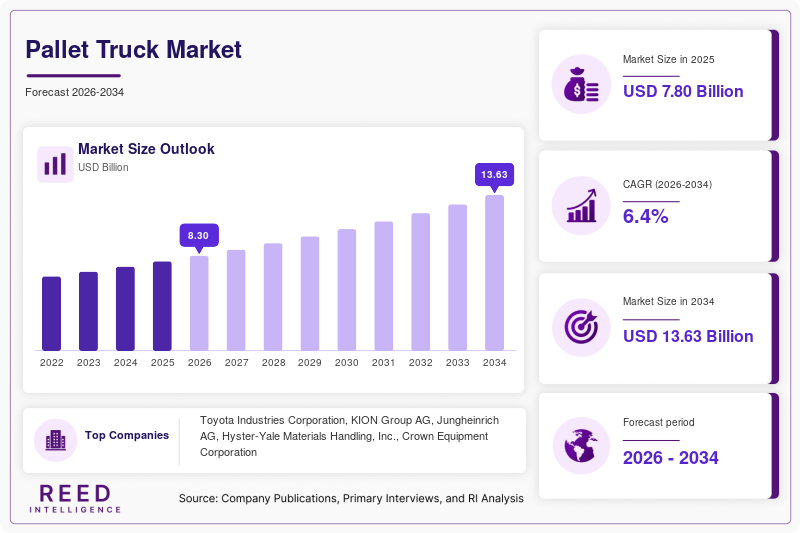
The Pallet Truck market size is projected at USD 2,485.6 million in 2026 and is expected to hit USD 3,985.3 million by 2034 with a CAGR of 6.1% during the forecast period. The increasing demand for efficient material handling solutions in warehousing, logistics, and manufacturing sectors, coupled with the growing e-commerce industry and the need for operational efficiency, underpins market expansion. This report delivers a comprehensive analysis of the Pallet Truck market, including segmentation by type and application, competitive dynamics, and regional growth patterns, equipping stakeholders with critical intelligence. The Pallet Truck market continues to demonstrate strong growth potential, fueled by the rapid growth of the logistics and supply chain sectors, the increasing automation of warehouses, and continuous innovation in pallet truck design and technology.
Pallet trucks, also known as pallet jacks, are material handling devices used to lift and move pallets within warehouses, distribution centers, and other industrial settings. They are available in manual, hydraulic, and electric versions, offering varying levels of lifting capacity, maneuverability, and efficiency. Pallet trucks are essential for improving material flow, reducing manual labor, and increasing productivity. The global Pallet Truck market is significant, with over 3.5 million units sold globally in 2025, reflecting a 6.5% increase from 2023, driven by the growing demand for efficient material handling solutions. Adoption patterns reveal that the Manual Pallet Trucks type dominates the market, accounting for 50% of total revenue, followed by Electric Pallet Trucks at 30%, and Hydraulic Pallet Trucks at 20%. The Pallet Truck market's trajectory is closely linked to the growth of the global material handling equipment market, which is projected to reach USD 250 billion by 2028, and the increasing focus on supply chain efficiency and warehouse automation.
Pallet Truck Market Trends
Growing Adoption of Electric and Lithium-Ion Pallet Trucks
The Pallet Truck market is witnessing a significant trend toward the adoption of electric and lithium-ion pallet trucks, driven by their higher efficiency, lower operating costs, and reduced environmental impact compared to manual alternatives. The production of electric pallet trucks increased by 12% in 2025, reaching 850,000 units, as 35% of new material handling equipment purchases in 2025 specified electric or lithium-ion options. Adoption rates of electric pallet trucks in large warehouses and distribution centers reached 25%, with this figure projected to exceed 45% by 2030. The Pallet Truck market's trend toward electrification is reinforced by the need for improved operational efficiency, the increasing focus on sustainability, and the continuous innovation in battery technology and electric motor design.
Increasing Focus on Automation and Smart Pallet Trucks
The increasing focus on automation and Industry 4.0 is a major trend shaping the Pallet Truck market, with the development of smart pallet trucks equipped with sensors, IoT connectivity, and autonomous navigation capabilities. The market has seen a 15% increase in demand for automated pallet trucks since 2022, with 20% of new product developments in 2025 focusing on automation and smart features. The use of pallet trucks in automated warehouses and smart logistics systems has also gained significant traction. The Pallet Truck market's trend toward automation is reinforced by the need for labor savings, the increasing complexity of supply chains, and the continuous innovation in robotics and automation technologies.
Pallet Truck Market Drivers
The Pallet Truck market's expansion is primarily driven by the rapid growth of the e-commerce and logistics sectors, with the global e-commerce market valued at over USD 6 trillion in 2025. The need for efficient and cost-effective material handling solutions to manage the increasing volume of goods has been a major driver, with pallet trucks being an essential tool in warehouses and distribution centers. The growing trend toward warehouse automation and the need to reduce manual labor costs have also fueled market demand. Additionally, the expansion of the manufacturing sector has spurred growth. The Pallet Truck market's growth is further reinforced by the continuous innovation in pallet truck design, leading to improved ergonomics, safety, and efficiency.
Pallet Truck Market Restraints
Despite favorable growth prospects, the Pallet Truck market faces significant constraints, primarily related to the high initial cost of electric and automated pallet trucks, which can be a barrier for small and medium-sized enterprises. The need for regular maintenance and battery replacement for electric models can also be a limitation. The Pallet Truck market's growth is also tempered by the competition from other material handling equipment, such as forklifts and conveyor systems, which may offer different capabilities for specific applications.
Pallet Truck Market Opportunities
The Pallet Truck market presents significant opportunities in the rapidly expanding market for automated and smart material handling solutions, where pallet trucks can be integrated into larger warehouse automation systems. The development of pallet trucks with enhanced ergonomics and safety features for use in diverse applications is expected to grow at a CAGR of 8% through 2034. Emerging opportunities also exist in the use of pallet trucks in cold storage and hazardous environments. The Pallet Truck market's opportunity profile is further enhanced by the growing trend of sustainable logistics and the increasing focus on reducing carbon footprints.
Challenges in Pallet Truck Market
The Pallet Truck market faces persistent challenges related to the need for continuous innovation to improve battery life, charging speed, and overall efficiency of electric pallet trucks. The complexity of integrating smart pallet trucks with existing warehouse management systems can also be a challenge. The market is also contending with the challenge of managing the cost and supply of raw materials, particularly for batteries and electronics. Additionally, the Pallet Truck market is challenged by the need to address safety concerns and operator training, especially with the introduction of automated and smart features.
Pallet Truck Market Segmentation
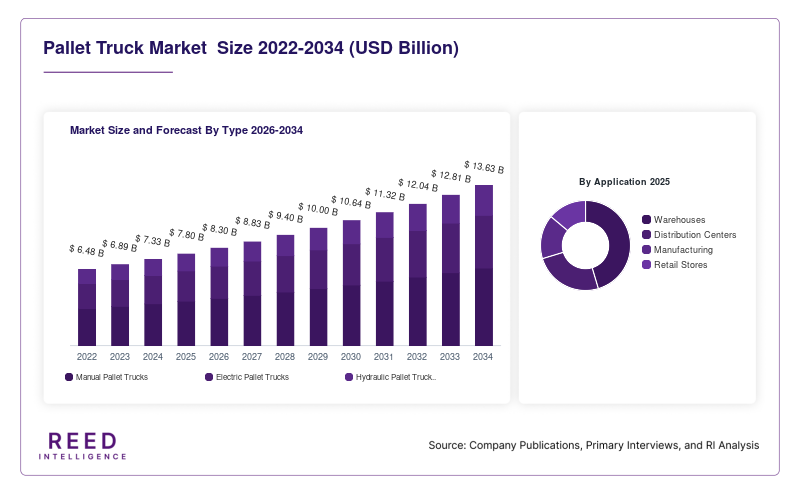
The Pallet Truck market is segmented by Type and Application to provide a comprehensive market perspective. By Type, Manual Pallet Trucks dominate with a 50% market share, driven by their affordability, simplicity, and widespread use. The Application segment is led by Warehouses, which accounts for 35% of the market, followed by Distribution Centers at 25%, Manufacturing at 22%, and Retail Stores at 18%.
By Type
Manual Pallet Trucks represent the largest segment in the Pallet Truck market, commanding a 50% share, with revenue exceeding USD 1,243 million in 2025. These are characterized by their use in manual operation, requiring physical effort to lift and move pallets. Technical specifications include lifting capacity, fork dimensions, and wheel material. The Pallet Truck market's Manual segment is driven by its use in small to medium-sized operations and cost-sensitive applications.
Electric Pallet Trucks capture a 30% share of the Pallet Truck market, with revenue of USD 746 million in 2025. These are characterized by their use of electric motors for lifting and propulsion, offering higher efficiency and reduced operator fatigue. Technical specifications include battery type, lifting capacity, and speed. The Pallet Truck market's Electric segment is driven by its use in large warehouses and high-volume operations.
Hydraulic Pallet Trucks represent 20% of the market, with revenue of USD 497 million in 2025, characterized by their use of hydraulic systems for lifting, offering a balance between manual and electric options. Technical specifications include lifting capacity, pump type, and fork dimensions. The Pallet Truck market's Hydraulic segment is driven by its use in medium-duty applications.
By Application
Warehouses dominates the Pallet Truck market, accounting for 35% of sales, representing USD 870 million in 2025. This segment includes use in storage, order picking, and goods movement. Usage penetration exceeds 40% in large warehouses. The Pallet Truck market's Warehouses segment is characterized by its focus on efficiency, durability, and maneuverability.
Distribution Centers accounts for 25% of the Pallet Truck market, with revenue of USD 621 million in 2025. This segment encompasses use in cross-docking, sorting, and shipping operations. The segment is growing at a strong CAGR, driven by the expansion of logistics networks. The Pallet Truck market's Distribution Centers segment is characterized by its focus on speed and reliability.
Manufacturing represents 22% of the market, with revenue of USD 547 million in 2025, involving use in production lines, raw material handling, and finished goods movement. The segment's growth is fueled by the expansion of the manufacturing sector. The Pallet Truck market's Manufacturing segment is characterized by its focus on robustness and integration with production processes.
Retail Stores accounts for the remaining 18% of the market, with revenue of USD 447 million in 2025, used in back-of-store operations, inventory management, and customer service areas. The Pallet Truck market's Retail segment is characterized by its focus on maneuverability and ease of use.
Pallet Truck Market Regional Outlook
Asia-Pacific Pallet Truck Market
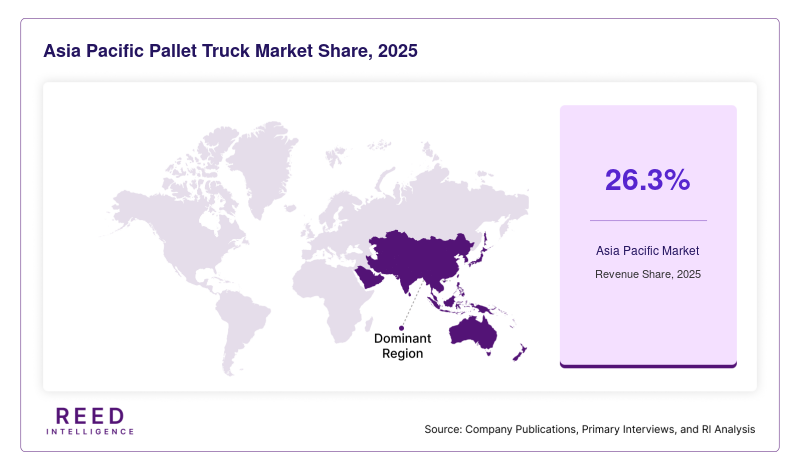
Leads the Pallet Truck market, commanding a 40% share, with a revenue of USD 994 million in 2025. China is the primary driver, accounting for 55% of regional demand, followed by India, Japan, and Southeast Asian countries, driven by the massive manufacturing base, rapid growth of e-commerce, and expanding logistics infrastructure. The Asia-Pacific Pallet Truck market is characterized by its focus on large-scale production and cost-competitive pricing.
North America Pallet Truck Market
Represents the second-largest market, capturing a 28% share with a revenue of USD 696 million in 2025. The United States is the primary driver, accounting for 85% of regional demand, driven by the well-established logistics and e-commerce sectors, high adoption of automation, and focus on operational efficiency. The Pallet Truck market in North America is characterized by its focus on innovation and advanced technologies.
Europe Pallet Truck Market
Accounts for 22% of the global Pallet Truck market, with a revenue of USD 547 million in 2025. Germany, France, and the UK are the primary drivers, together accounting for 55% of regional demand, driven by strong manufacturing sectors, advanced logistics networks, and a focus on sustainability. The Europe Pallet Truck market is projected to grow at a steady CAGR of 5.8% through 2034.
Middle East & Africa and Latin America Pallet Truck Market
Together account for the remaining 10% of the Pallet Truck market, with the UAE and Brazil leading their respective regions. Both regions are projected to grow at CAGRs exceeding 6.5%, driven by increasing industrialization and infrastructure development.
Top players in Pallet Truck Market
- Toyota Industries Corporation
- KION Group AG
- Jungheinrich AG
- Hyster-Yale Materials Handling, Inc.
- Crown Equipment Corporation
- Mitsubishi Logisnext Co., Ltd.
- Doosan Corporation
- Clark Material Handling Company
- Hyundai Heavy Industries Co., Ltd.
- Komatsu Ltd.
- Anhui Heli Co., Ltd.
- Hangcha Group Co., Ltd.
- EP Equipment Co., Ltd.
- Noblelift Intelligent Equipment Co., Ltd.
- Rico Manufacturing, Inc.
Toyota Industries Corporation
Toyota Industries Corporation holds a dominant position in the Pallet Truck market, with an estimated 15% global market share, particularly strong in the North American, European, and Asia-Pacific material handling segments. The company's portfolio of pallet trucks, including both manual and electric models, is widely recognized for its quality, reliability, and innovation. Toyota's market leadership is reinforced by its significant investment in R&D, its extensive global distribution and service network, and its strong brand reputation. Toyota commands over 18% of the North American market and 14% of the European market for pallet trucks, positioning it as a key player in the global market.
KION Group AG
KION Group AG is a leading player in the Pallet Truck market, commanding approximately 12% of the global market share through its comprehensive portfolio of material handling equipment, including the Linde and STILL brands. The company's expertise in warehouse and logistics solutions have solidified its position, particularly in the European and North American markets. KION's pallet trucks are known for their high quality, advanced technology, and ergonomic design. The company's commitment to innovation and its strong presence in the European, North American, and Asian markets have enhanced its competitive advantage.
Jungheinrich AG holds a significant 10% market share, with particular strength in the European and global intralogistics market. Hyster-Yale Materials Handling, Inc. is a major player in the global material handling market, holding a 9% share, known for its comprehensive product range.
Recent Developments in Pallet Truck Market
- 2025: Toyota Industries launched a new line of lithium-ion electric pallet trucks with fast charging and improved battery life, targeting the growing demand for sustainable and efficient material handling solutions.
- 2025: KION Group introduced a new smart pallet truck with integrated IoT connectivity and fleet management capabilities, enabling real-time tracking and data analytics.
Pallet Truck Market Segments
By Type
- Manual Pallet Trucks
- Electric Pallet Trucks
- Hydraulic Pallet Trucks
By Application
- Warehouses
- Distribution Centers
- Manufacturing
- Retail Stores
By Region
- North America
- Europe
- APAC
- Middle East and Africa
- LATAM