Palm Vein Biometric Market Size, Share & Demand Report By Component (Hardware, Software), By Technology (Near-Infrared Imaging, Contactless Imaging), By Application (Banking & Financial Services, Healthcare, Government, Retail, Others), By End-Use Industry (Government, BFSI, Healthcare, Retail, Enterprise), By Deployment Mode (On-Premise, Cloud-Based) & Segment Forecasts, 2025–2034
USD 3950
Market Overview
The Palm Vein Biometric Market size was valued at approximately USD 1.85 billion in 2025 and is projected to reach USD 6.12 billion by 2034, expanding at a compound annual growth rate (CAGR) of 14.2% from 2025 to 2034. The market has experienced steady growth due to the increasing demand for secure, contactless authentication technologies across industries such as banking, healthcare, government, and enterprise security systems.
A key global factor supporting market expansion has been the growing emphasis on contactless identity verification solutions following heightened awareness of hygiene and security risks in public and private environments. Palm vein recognition, which uses near-infrared light to capture vein patterns beneath the skin, offers higher accuracy and resistance to spoofing compared to traditional biometric methods such as fingerprints and facial recognition.
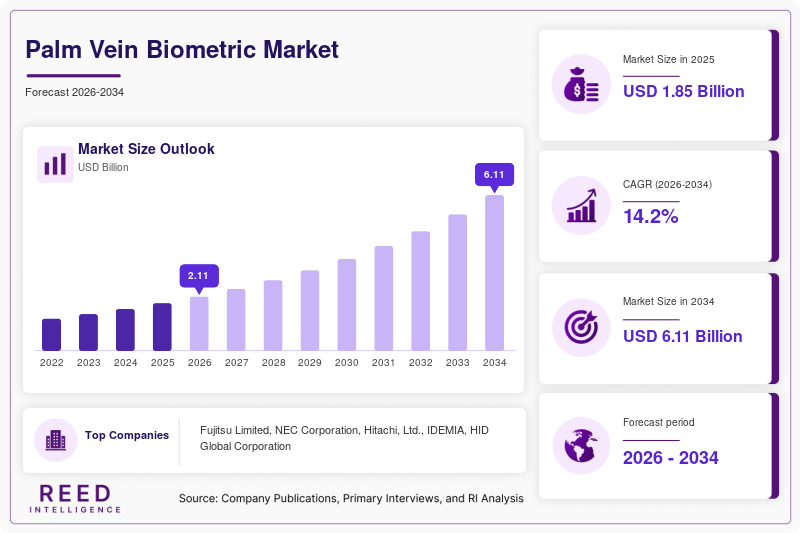
Key Highlights:
- North America dominated the market with a 36.4% share in 2025, while Asia Pacific is projected to grow at the fastest CAGR of 16.1% (2025–2034)
- Hardware segment led with 52.7% share, while software solutions are expected to grow fastest at a CAGR of 15.6%
- Banking & Financial Services was the dominant application segment with 31.8% share, while healthcare is forecasted to grow at 15.9% CAGR
- The United States led the market with values of USD 620 million in 2024 and USD 685 million in 2025
Market Trends
Integration with Multi-Modal Biometric Systems
The Palm Vein Biometric Market is witnessing increasing integration with multi-modal biometric systems that combine palm vein recognition with facial, iris, or fingerprint authentication. This trend is driven by the need for layered security frameworks in high-risk environments such as airports, financial institutions, and government facilities. Multi-modal systems reduce false acceptance rates and enhance system reliability, particularly in identity verification processes requiring stringent compliance standards.
Expansion in Contactless Payment and Banking Systems
Palm vein authentication is gaining traction in contactless payment systems, particularly in retail and banking environments. Financial institutions are deploying palm vein scanners at ATMs and POS terminals to streamline customer authentication while reducing fraud risks. The technology enables seamless transactions without the need for physical cards or mobile devices, enhancing user convenience and operational efficiency. This trend is expected to strengthen as digital banking ecosystems expand globally and consumers demand frictionless payment experiences.
Market Drivers
Rising Demand for Advanced Security Solutions
The increasing frequency of data breaches and identity fraud has accelerated demand for highly secure biometric technologies. Palm vein recognition offers superior security due to its internal biometric pattern, which is difficult to replicate or forge. Organizations across sectors are adopting this technology to protect sensitive data and ensure secure access control, driving market growth.
Growth in Smart Infrastructure and Digital Transformation
Rapid urbanization and the development of smart cities have created opportunities for advanced authentication systems. Palm vein biometrics are being integrated into access control systems for offices, residential complexes, and transportation hubs. The shift toward digital transformation across industries has further fueled demand for reliable and scalable biometric solutions, supporting the growth of the Palm Vein Biometric Market.
Market Restraint
High Initial Implementation Costs
One of the primary challenges limiting the growth of the Palm Vein Biometric Market is the high cost associated with deployment. The technology requires specialized hardware such as infrared sensors and imaging devices, which increases upfront investment. Additionally, integration with existing IT infrastructure and training personnel adds to operational expenses.
Small and medium-sized enterprises often find it difficult to justify these costs, especially when alternative biometric solutions such as fingerprint or facial recognition systems are available at lower prices. Furthermore, maintenance and system upgrades contribute to long-term expenditures.
While prices are expected to decline with technological advancements and increased adoption, cost sensitivity remains a barrier in price-conscious markets. Addressing this restraint will be critical for vendors aiming to expand their presence in emerging economies.
Market Opportunities
Adoption in Healthcare Identity Management
The healthcare sector presents a significant growth opportunity for the Palm Vein Biometric Market. Hospitals and clinics are increasingly implementing biometric systems to accurately identify patients, reduce medical errors, and streamline administrative processes. Palm vein recognition ensures precise identification even in cases where patients are unconscious or unable to communicate, making it highly valuable in emergency care settings.
Expansion in Emerging Economies
Emerging markets in Asia, Africa, and Latin America offer substantial growth potential due to increasing investments in digital infrastructure and financial inclusion initiatives. Governments in these regions are adopting biometric technologies for identity verification in public welfare programs and banking services. As awareness and affordability improve, the adoption of palm vein biometric systems is expected to accelerate, creating new revenue streams for market players.
Segmental Analysis
By Component
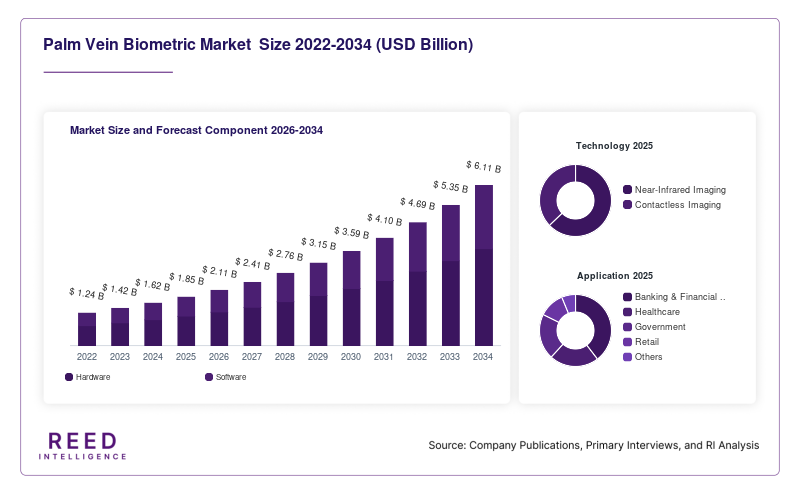
The hardware segment dominated the market with a 52.7% share in 2024, driven by the widespread deployment of palm vein scanners and imaging devices. Organizations across industries invested heavily in physical biometric infrastructure to enhance security and authentication processes.
The software segment is expected to grow at the fastest CAGR of 15.6% during the forecast period. This growth will be driven by increasing demand for advanced analytics, cloud-based biometric solutions, and integration capabilities. Software platforms that enable real-time data processing and seamless system interoperability will play a critical role in expanding market adoption.
By Technology
Near-infrared imaging technology held the dominant share of 64.3% in 2024, as it forms the core mechanism for capturing vein patterns. Its accuracy and reliability have made it the preferred choice for most applications.
Contactless imaging technology is projected to grow at a CAGR of 15.8%, driven by rising demand for hygienic and user-friendly authentication systems. The ability to capture biometric data without physical contact will support its adoption in healthcare, retail, and public spaces.
By Application
Banking & Financial Services accounted for the largest share of 31.8% in 2024, as financial institutions prioritized secure authentication methods to prevent fraud. The deployment of palm vein scanners in ATMs and payment systems contributed significantly to this segment’s dominance.
Healthcare is expected to be the fastest-growing application segment, with a CAGR of 15.9%. The need for accurate patient identification and secure access to medical records will drive adoption in hospitals and clinics.
By End-Use Industry
The government sector held a dominant share of 28.6% in 2024, driven by the implementation of biometric systems for identity verification and public services. Governments worldwide are investing in advanced technologies to enhance security and streamline administrative processes.
The retail sector is projected to grow at a CAGR of 15.4%, supported by the increasing adoption of contactless payment systems and personalized customer experiences. Retailers are leveraging palm vein biometrics to improve transaction efficiency and reduce fraud.
By Deployment Mode
On-premise deployment accounted for 57.2% of the market share in 2024, as organizations preferred maintaining control over sensitive biometric data. This model offered higher security and customization options.
Cloud-based deployment is expected to grow at a CAGR of 16.0%, driven by scalability, cost efficiency, and ease of integration. Cloud solutions will enable organizations to deploy biometric systems without significant infrastructure investments.
Regional Analysis
North America
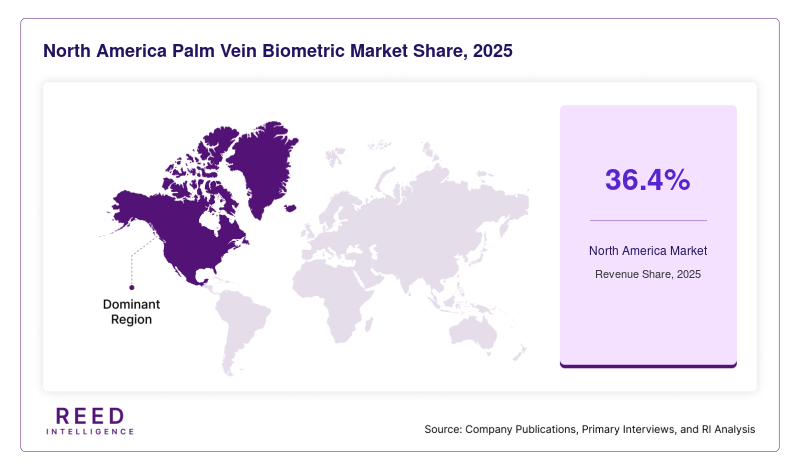
North America accounted for a 36.4% share of the Palm Vein Biometric Market in 2025 and is expected to grow at a CAGR of 13.5% from 2025 to 2034. The region’s growth will be supported by strong technological infrastructure and widespread adoption of advanced security systems across industries.
The United States dominated the regional market due to its early adoption of biometric technologies and significant investments in cybersecurity. The presence of major financial institutions and technology providers has accelerated the deployment of palm vein authentication systems. Additionally, government initiatives aimed at enhancing border security and identity verification systems have contributed to market expansion.
Europe
Europe held a 24.1% market share in 2025 and will grow at a CAGR of 13.2% during the forecast period. The region’s focus on data privacy and regulatory compliance has driven the adoption of secure biometric solutions.
Germany emerged as the leading country due to its strong industrial base and emphasis on secure access control systems in manufacturing and enterprise environments. The implementation of strict data protection regulations has encouraged organizations to adopt reliable biometric technologies such as palm vein recognition.
Asia Pacific
Asia Pacific accounted for 21.7% of the market in 2025 and is projected to grow at the fastest CAGR of 16.1% through 2034. Rapid urbanization and increasing digitalization are key factors driving growth in this region.
Japan dominated the regional market, supported by its advanced technology ecosystem and widespread adoption of biometric systems in banking and transportation sectors. The country has been a pioneer in palm vein technology, with extensive use in ATMs and payment systems. Rising investments in smart city projects across countries such as China and India are expected to further boost regional growth.
Middle East & Africa
The Middle East & Africa held a 10.3% share in 2025 and will expand at a CAGR of 14.0% during the forecast period. Increasing investments in infrastructure and security systems are driving market growth.
The United Arab Emirates led the region due to its focus on smart government initiatives and advanced security solutions. The adoption of biometric technologies in airports, public services, and financial institutions has significantly contributed to market expansion.
Latin America
Latin America captured 7.5% of the Palm Vein Biometric Market in 2025 and is expected to grow at a CAGR of 13.8% from 2025 to 2034. The region is witnessing gradual adoption of biometric technologies driven by digital transformation initiatives.
Brazil dominated the regional market due to its large population and increasing use of biometric systems in banking and government programs. The expansion of digital payment systems and efforts to improve financial inclusion are expected to support market growth in the coming years.
Competitive Landscape
The Palm Vein Biometric Market is moderately competitive, with several global and regional players focusing on innovation and strategic partnerships. Companies are investing in research and development to enhance accuracy, speed, and integration capabilities of biometric systems.
A leading player in the market is Fujitsu Limited, known for its advanced palm vein authentication technology. The company recently introduced an upgraded biometric solution with improved recognition speed and enhanced compatibility with mobile devices, strengthening its market position.
Other key players are focusing on expanding their product portfolios and entering emerging markets to increase their global presence. Strategic collaborations with financial institutions and government agencies are also shaping the competitive dynamics of the market.
Key Players List
- Fujitsu Limited
- NEC Corporation
- Hitachi, Ltd.
- M2SYS Technology
- BioEnable Technologies Pvt. Ltd.
- Mantra Softech
- IDEMIA
- Suprema Inc.
- HID Global Corporation
- ZKTeco Co., Ltd.
- Thales Group
- Cognitec Systems
- Daon Inc.
- SecuGen Corporation
- Integrated Biometrics
Recent Developments
- Fujitsu Limited launched a next-generation palm vein authentication system with enhanced AI-based recognition capabilities.
- NEC Corporation expanded its biometric portfolio by integrating palm vein recognition into multi-modal authentication platforms.
- HID Global introduced a new contactless biometric solution aimed at enterprise access control systems.
- IDEMIA partnered with financial institutions to deploy palm vein-based authentication in banking applications.
- Suprema Inc. developed a cloud-based biometric platform supporting palm vein recognition for scalable deployments.
Palm Vein Biometric Market Segments
Component
- Hardware
- Software
Technology
- Near-Infrared Imaging
- Contactless Imaging
Application
- Banking & Financial Services
- Healthcare
- Government
- Retail
- Others
End-Use Industry
- Government
- BFSI
- Healthcare
- Retail
- Enterprise
Deployment Mode
- On-Premise
- Cloud-Based
By Region
- North America
- Europe
- APAC
- Middle East and Africa
- LATAM