Palm Vein Scanner Market Size, Share Demand Report By Component (Hardware, Software), By Application (Access Control, Payment Authentication, Time & Attendance, Identity Verification), By End-Use (BFSI, Healthcare, Government, Retail, IT & Telecom), By Distribution Channel (Direct Sales, System Integrators, Online Channels, Specialty Security Providers), By Region & Segment Forecasts, 2026–2034
USD 3950
Market Overview
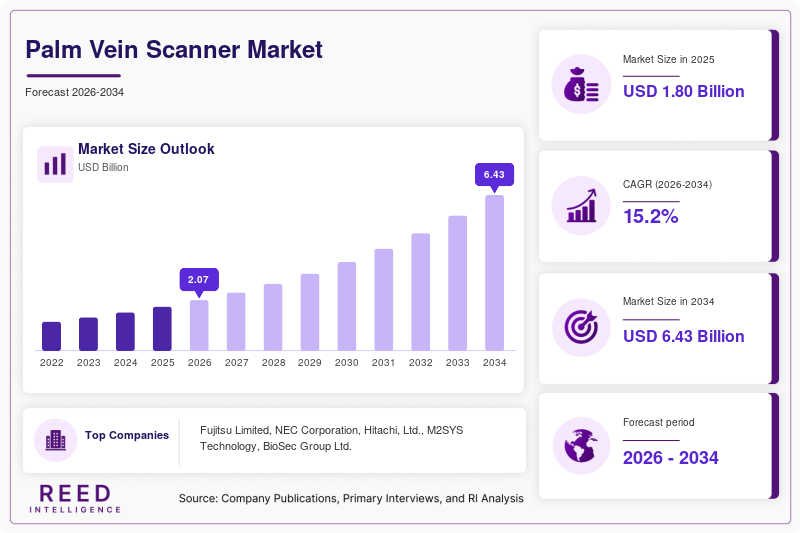
The global Palm Vein Scanner Market size was valued at approximately USD 1.8 billion in 2026 and is projected to reach USD 5.6 billion by 2034, expanding at a CAGR of 15.2% during the forecast period (2026–2034). The market growth is being driven by the increasing demand for secure, contactless biometric authentication solutions across various sectors including banking, healthcare, government, and enterprise security systems.
A major global factor supporting the growth of the Palm Vein Scanner Market is the rising emphasis on advanced identity verification technologies to combat fraud and data breaches. Palm vein recognition, which uses near-infrared light to map unique vein patterns beneath the skin, offers a highly accurate and hygienic alternative to traditional fingerprint or facial recognition systems. The post-pandemic shift toward contactless authentication further accelerated adoption across public and private sectors.
Key Highlights:
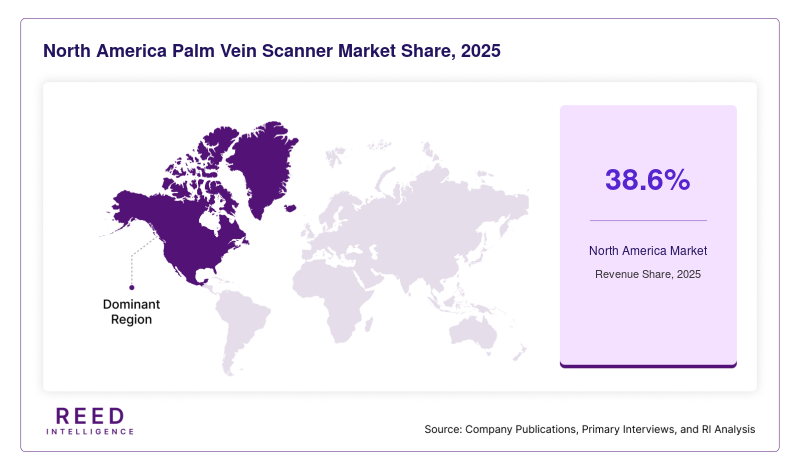
- North America dominated the market with a share of 38.6% in 2025, while Asia Pacific is expected to register the fastest growth at a CAGR of 17.8%.
- The hardware segment led the market in 2025, while software solutions are anticipated to be the fastest-growing subsegment with a CAGR of 16.5%.
- Banking & Financial Services (BFSI) emerged as the dominant end-use sector, whereas healthcare is projected to grow at the fastest CAGR of 18.2%.
- The United States remained the leading country, with market values of USD 620 million in 2024 and USD 710 million in 2025.
Market Trends
Integration with Multi-Factor Authentication Systems
The Palm Vein Scanner Market is witnessing a growing trend toward integration with multi-factor authentication (MFA) systems. Organizations are increasingly combining palm vein recognition with PINs, facial recognition, or mobile-based authentication to enhance security layers. This trend is particularly evident in banking and government sectors where sensitive data protection is critical. The combination of biometric modalities reduces the risk of spoofing and improves authentication accuracy, thereby increasing adoption across high-security environments.
Expansion of Contactless Biometric Solutions
Another key trend shaping the Palm Vein Scanner Market is the rapid expansion of contactless biometric technologies. With heightened awareness around hygiene and safety, industries such as healthcare, retail, and transportation are shifting toward touchless systems. Palm vein scanners, which do not require physical contact, have gained preference over fingerprint scanners. This shift is also supported by advancements in sensor technology, improved scanning speed, and reduced device costs, making palm vein authentication more accessible for small and medium enterprises.
Market Drivers
Rising Cybersecurity Threats and Identity Fraud
The increasing incidence of cyberattacks and identity fraud is a primary driver of the Palm Vein Scanner Market. Organizations are investing in advanced biometric systems to secure access to sensitive data and infrastructure. Palm vein recognition offers higher accuracy and lower false acceptance rates compared to traditional methods, making it a preferred solution for high-security applications. Financial institutions, in particular, are adopting this technology to prevent unauthorized access and fraudulent transactions.
Growing Adoption in Banking and Financial Services
The banking sector has emerged as a significant driver for the Palm Vein Scanner Market. Banks are integrating palm vein authentication into ATMs, branch access systems, and mobile banking platforms to enhance customer security and streamline operations. The ability to provide secure, fast, and user-friendly authentication has encouraged widespread adoption. Additionally, government initiatives promoting digital banking and financial inclusion are further supporting market expansion.
Market Restraint
High Initial Investment and Integration Costs
One of the major restraints in the Palm Vein Scanner Market is the high initial cost associated with device deployment and system integration. Palm vein scanners require specialized hardware components, including infrared sensors and imaging systems, which increase the overall cost compared to traditional biometric solutions. Additionally, integrating these systems into existing IT infrastructure can be complex and resource-intensive.
Small and medium enterprises often face budget constraints, limiting their ability to adopt advanced biometric technologies. Maintenance costs, software updates, and training requirements further add to the financial burden. Moreover, in developing regions, limited awareness and infrastructure challenges hinder widespread adoption. These factors collectively restrain market growth, particularly in price-sensitive markets.
Market Opportunities
Expansion in Healthcare Sector
The healthcare sector presents a significant growth opportunity for the Palm Vein Scanner Market. Hospitals and clinics are increasingly adopting biometric systems for patient identification, access control, and electronic health record management. Palm vein recognition ensures accurate patient identification, reducing medical errors and improving operational efficiency. The technology also supports hygienic authentication, which is critical in clinical environments.
Emerging Smart City Initiatives
The rise of smart city projects globally is creating new opportunities for the Palm Vein Scanner Market. Governments are investing in advanced security and surveillance systems to enhance urban infrastructure. Palm vein scanners can be integrated into public transportation systems, access control in government buildings, and citizen identification programs. The demand for secure and efficient authentication systems in smart cities is expected to drive market growth significantly.
Segmental Analysis
By Component
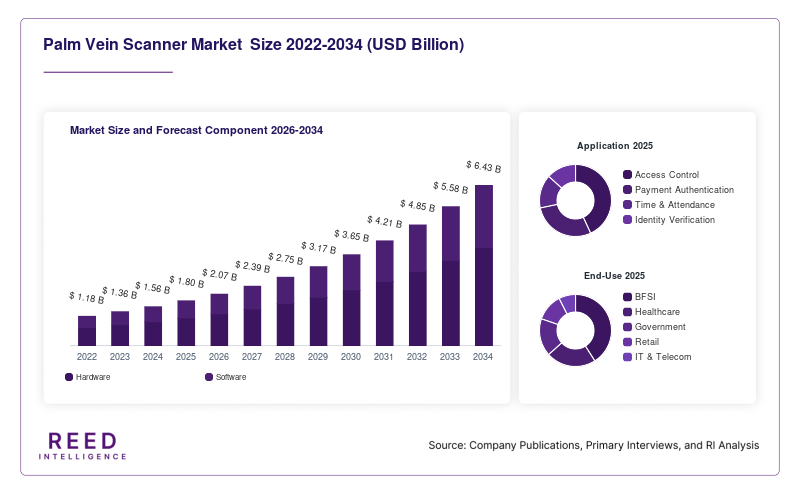
The hardware segment dominated the Palm Vein Scanner Market in 2025, accounting for 62.3% of the total share. This dominance was attributed to the high demand for scanning devices equipped with infrared sensors and imaging technologies. Organizations prioritized hardware investments to establish secure authentication systems across various applications.
The software segment is expected to grow at the fastest CAGR of 16.5% during the forecast period. This growth will be driven by increasing demand for advanced analytics, cloud-based solutions, and integration capabilities. Software solutions enable seamless data management, real-time authentication, and scalability, making them essential for modern biometric systems.
By Application
The access control segment held the largest market share of 41.7% in 2025. The widespread use of palm vein scanners in corporate offices, government buildings, and restricted areas contributed to its dominance. The need for secure and efficient access management systems supported the segment’s growth.
The payment authentication segment is projected to grow at a CAGR of 17.2%. The increasing adoption of biometric payment systems and digital banking solutions will drive this growth. Palm vein authentication offers a secure and convenient method for transactions, reducing reliance on passwords and cards.
By End-Use
The BFSI sector dominated the market with a share of 36.5% in 2025. Banks and financial institutions extensively used palm vein scanners for customer authentication, fraud prevention, and secure transactions. The sector’s focus on enhancing security and customer experience contributed to its leading position.
The healthcare sector is expected to grow at the fastest CAGR of 18.2%. The need for accurate patient identification and secure access to medical records will drive adoption. Palm vein scanners will play a crucial role in improving healthcare efficiency and reducing errors.
By Technology
The near-infrared imaging segment accounted for 100% of the market in 2025, as it is the core technology used in palm vein scanners. The technology’s ability to capture unique vein patterns beneath the skin ensures high accuracy and reliability.
Advancements in imaging technology are expected to drive future growth, with improvements in resolution, speed, and cost efficiency. These advancements will enable wider adoption across various industries.
Regional Analysis
North America
North America accounted for a market share of 38.6% in 2025 and is expected to grow at a CAGR of 14.8% during the forecast period. The region’s growth will be driven by strong adoption of advanced biometric technologies across banking, healthcare, and government sectors. The presence of established technology providers and high investment in cybersecurity infrastructure will further support market expansion.
The United States dominated the regional market due to its advanced financial systems and high demand for secure authentication solutions. The country’s focus on digital transformation and data protection regulations has encouraged the adoption of palm vein scanners in both public and private sectors.
Europe
Europe held a market share of 26.4% in 2025 and will grow at a CAGR of 13.9% from 2026 to 2034. The region’s growth will be supported by stringent data protection regulations and increasing adoption of biometric technologies in government and enterprise applications.
Germany emerged as the leading country in Europe due to its strong industrial base and focus on technological innovation. The country’s emphasis on secure access control systems in manufacturing and corporate environments has driven demand for palm vein scanners.
Asia Pacific
Asia Pacific accounted for 22.8% of the market share in 2025 and is projected to grow at the fastest CAGR of 17.8% during the forecast period. Rapid urbanization, increasing digitalization, and government initiatives promoting biometric authentication will drive market growth in the region.
Japan led the regional market due to its early adoption of palm vein technology and strong presence of technology providers. The country’s focus on innovation and widespread use of biometric systems in banking and public services has contributed to market growth.
Middle East & Africa
The Middle East & Africa region held a market share of 7.2% in 2025 and is expected to grow at a CAGR of 14.5%. The growth will be driven by increasing investments in security infrastructure and smart city projects.
The United Arab Emirates dominated the regional market due to its focus on advanced security systems and digital transformation initiatives. The country’s investments in smart city development and public safety have supported the adoption of palm vein scanners.
Latin America
Latin America accounted for 5.0% of the market share in 2025 and will grow at a CAGR of 13.2% during the forecast period. The region’s growth will be driven by increasing adoption of biometric technologies in banking and government sectors.
Brazil emerged as the leading country due to its expanding financial sector and growing focus on digital security. The country’s initiatives to enhance financial inclusion and reduce fraud have encouraged the adoption of palm vein scanners.
Competitive Landscape
The Palm Vein Scanner Market is characterized by the presence of several global and regional players focusing on innovation and strategic partnerships. Companies are investing in research and development to enhance product capabilities and expand their market presence.
Fujitsu Limited emerged as a market leader due to its advanced palm vein recognition technology and strong global presence. The company recently introduced a next-generation palm vein authentication system with improved accuracy and faster processing speed, strengthening its competitive position.
Other key players are focusing on expanding their product portfolios and entering new markets through collaborations and acquisitions. The competitive landscape remains dynamic, with continuous technological advancements shaping market growth.
Key Players List
- Fujitsu Limited
- NEC Corporation
- Hitachi, Ltd.
- M2SYS Technology
- BioSec Group Ltd.
- IdentyTech Solutions
- Mantra Softech Pvt. Ltd.
- Suprema Inc.
- Thales Group
- IDEMIA
- ZKTeco Co., Ltd.
- Matrix Comsec
- Recogtech
- Dermalog Identification Systems
- HID Global
Recent Developments
- In 2025, Fujitsu Limited launched an upgraded palm vein authentication system with enhanced AI capabilities.
- In 2024, NEC Corporation partnered with financial institutions to deploy biometric payment solutions.
- In 2025, IDEMIA expanded its biometric portfolio with new contactless authentication devices.
- In 2024, Suprema Inc. introduced integrated biometric solutions for enterprise applications.
- In 2025, Thales Group focused on expanding its presence in emerging markets through strategic collaborations.
Palm Vein Scanner Market Segments
Component
- Hardware
- Software
Application
- Access Control
- Payment Authentication
- Time & Attendance
- Identity Verification
End-Use
- BFSI
- Healthcare
- Government
- Retail
- IT & Telecom
Distribution Channel
- Direct Sales
- System Integrators
- Online Channels
- Specialty Security Providers
By Region
- North America
- Europe
- APAC
- Middle East and Africa
- LATAM