PAN Based Carbon Fiber Cloth Market Size, Share Demand Report By Weave Type (Plain Weave, Twill Weave, Satin Weave), By Application (Aerospace & Defense, Automotive, Wind Energy, Sports & Leisure, Construction), By End-Use Industry (Aerospace, Automotive, Energy, Construction, Marine), By Fiber Grade (Standard Modulus, Intermediate Modulus, High Modulus), By Region & Segment Forecasts, 2026–2034
USD 3950
Market Overview
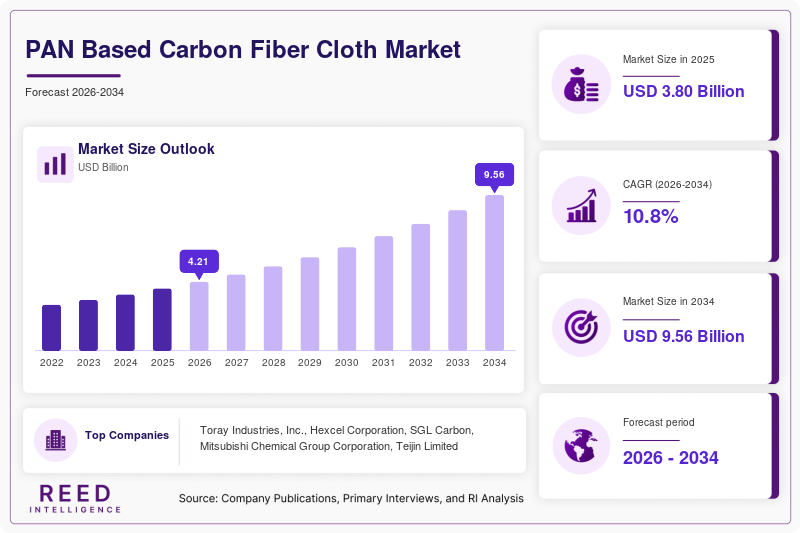
The global PAN Based Carbon Fiber Cloth Market size was valued at USD 3.8 billion in 2026 and is projected to reach USD 8.6 billion by 2034, expanding at a CAGR of 10.8% during 2026–2034. The market has experienced consistent expansion due to increasing adoption of lightweight, high-strength composite materials across aerospace, automotive, wind energy, and construction industries. One major global factor supporting growth is the ongoing shift toward fuel-efficient and low-emission transportation systems, which has accelerated the use of carbon fiber cloth in structural and semi-structural components.
The superior mechanical properties of PAN-based carbon fiber cloth, including high tensile strength, corrosion resistance, and thermal stability, continue to position it as a preferred material in high-performance applications. Additionally, advancements in manufacturing technologies such as automated fiber placement and resin infusion are improving production efficiency and reducing overall costs.
Key Highlights:
- Asia Pacific dominated the market with 41.6% share in 2025, while Europe is projected to grow at the fastest CAGR of 11.6% during the forecast period.
- By weave type, plain weave accounted for the largest share of 38.9% in 2025, while twill weave is expected to grow at a CAGR of 11.9%.
- By application, aerospace & defense held the dominant share of 34.2% in 2025, whereas wind energy is projected to expand at a CAGR of 12.4%.
- The United States remained the dominant country, with market values of USD 780 million in 2024 and USD 835 million in 2025.
Market Trends
Increasing Integration in Electric Vehicles (EVs)
The growing demand for electric vehicles has significantly increased the use of PAN-based carbon fiber cloth in battery enclosures, chassis, and structural reinforcements. Automakers are focusing on reducing vehicle weight to improve battery efficiency and driving range, driving the adoption of advanced composite materials.
Rising Demand in Renewable Energy Infrastructure
The expansion of wind energy installations has driven demand for carbon fiber cloth in turbine blades. The material’s lightweight and high stiffness properties enable longer blade designs, improving energy output and operational efficiency.
Market Drivers
Growing Demand for Lightweight Materials in Aerospace
The aerospace sector has increasingly relied on PAN-based carbon fiber cloth to reduce aircraft weight and improve fuel efficiency. Aircraft manufacturers are incorporating composite materials into fuselage and wing structures to meet regulatory requirements for emissions and performance. This trend has created sustained demand for high-quality carbon fiber cloth.
Expansion of Wind Energy Sector
The rapid growth of wind power capacity globally has driven the need for durable and lightweight materials. PAN-based carbon fiber cloth is widely used in manufacturing longer and stronger turbine blades, enhancing energy generation efficiency and supporting the transition to renewable energy.
Market Restraint
High Production Costs
The manufacturing process of PAN-based carbon fiber cloth involves complex precursor processing and high energy consumption, resulting in elevated production costs. This factor limits adoption in cost-sensitive applications and creates barriers for new market entrants.
Market Opportunities
Advancements in Recycling Technologies
Emerging recycling techniques for carbon fiber materials are expected to reduce waste and production costs. The development of reclaimed carbon fiber cloth is creating new opportunities for sustainable manufacturing and circular economy practices.
Increasing Use in Construction Reinforcement
The construction industry is increasingly adopting carbon fiber cloth for structural strengthening and seismic retrofitting. Its durability and corrosion resistance make it suitable for infrastructure upgrades, particularly in urban development projects.
Segmental Analysis
By Weave Type
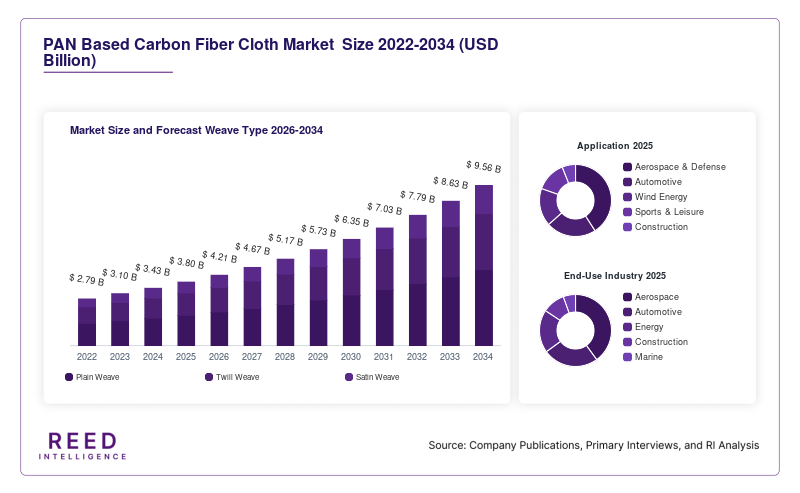
Plain weave dominated the PAN Based Carbon Fiber Cloth Market with a 38.9% share in 2025, owing to its balanced strength and ease of handling in various applications.
Twill weave is projected to grow at the fastest CAGR of 11.9%, driven by its superior drapability and aesthetic appeal. It will be increasingly used in automotive and sports equipment applications where complex shapes and surface finish are critical.
By Application
Aerospace & defense accounted for the largest share of 34.2% in 2025, supported by the extensive use of carbon fiber cloth in aircraft structures and defense equipment.
Wind energy is expected to grow at a CAGR of 12.4%, driven by increasing investments in renewable energy infrastructure. The need for longer and more efficient turbine blades will accelerate demand.
By End-Use Industry
The aerospace industry held a dominant share of 32.7% in 2025, reflecting high demand for lightweight materials in aircraft manufacturing.
The automotive industry is projected to grow at a CAGR of 11.5%, supported by the increasing adoption of electric vehicles and the need for weight reduction to enhance efficiency.
By Fiber Grade
Standard modulus fiber dominated with a 44.1% share in 2025, as it offers a balance between cost and performance for general applications.
Intermediate modulus fiber is expected to grow at a CAGR of 11.3%, driven by its increasing use in high-performance applications requiring enhanced strength and stiffness.
Regional Analysis
North America
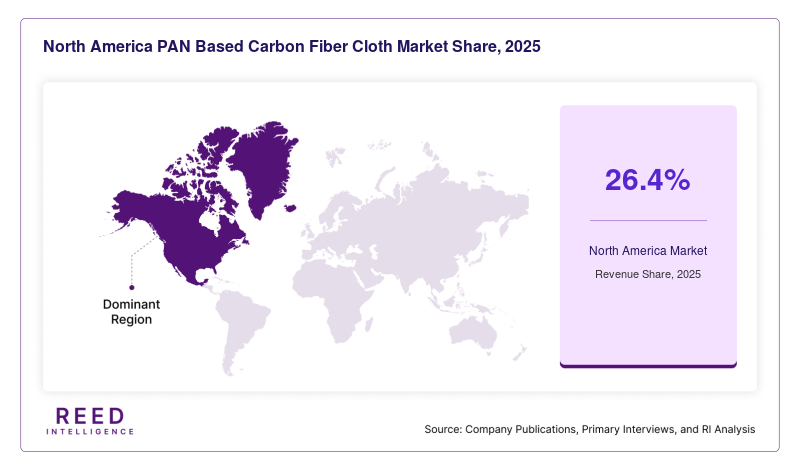
North America held 26.4% market share in 2025 and is expected to grow at a CAGR of 10.2% during the forecast period. The United States dominated the regional market due to strong aerospace manufacturing capabilities. The presence of major aircraft manufacturers has supported steady demand for advanced composite materials.
Europe
Europe accounted for 21.8% share in 2025 and will grow at a CAGR of 11.6%. Germany led the region due to its advanced automotive engineering sector. The increasing focus on lightweight vehicle production has driven the adoption of carbon fiber cloth in structural components.
Asia Pacific
Asia Pacific captured 41.6% share in 2025 and will expand at a CAGR of 11.1%. China dominated the region due to large-scale industrial production and investments in renewable energy. Rapid expansion of wind energy projects has significantly contributed to market growth.
Middle East & Africa
The Middle East & Africa held 5.7% share in 2025 and is projected to grow at a CAGR of 9.4%. The United Arab Emirates led the region due to infrastructure modernization initiatives. Increased use of advanced materials in construction has supported demand.
Latin America
Latin America accounted for 4.5% share in 2025 and is expected to grow at a CAGR of 9.8%. Brazil dominated the market due to growing aerospace manufacturing activities. The expansion of regional aviation infrastructure has contributed to steady growth.
Competitive Landscape
The PAN Based Carbon Fiber Cloth Market is moderately consolidated, with key players focusing on product innovation, capacity expansion, and strategic partnerships. Leading companies are investing in advanced manufacturing technologies to improve efficiency and reduce production costs.
Toray Industries, Inc. is a leading player in the market, known for its extensive product portfolio and strong global presence. The company has recently expanded its production capacity to meet rising demand from aerospace and automotive sectors. Hexcel Corporation focuses on high-performance composite materials and continues to strengthen its position through collaborations with aircraft manufacturers. SGL Carbon emphasizes sustainable production processes and has introduced new carbon fiber solutions for industrial applications. Mitsubishi Chemical Group Corporation is actively expanding its footprint in Asia Pacific through strategic investments. Teijin Limited is enhancing its product offerings by developing advanced carbon fiber materials for mobility applications.
Key Players List
- Toray Industries, Inc.
- Hexcel Corporation
- SGL Carbon
- Mitsubishi Chemical Group Corporation
- Teijin Limited
- Solvay S.A.
- Hyosung Advanced Materials
- Formosa Plastics Corporation
- Zhongfu Shenying Carbon Fiber Co., Ltd.
- Jiangsu Hengshen Co., Ltd.
- DowAksa
- Nippon Graphite Fiber Corporation
- Weihai Guangwei Composites Co., Ltd.
- Rock West Composites
- Gurit Holding AG
Recent Developments
- In 2025, Toray Industries expanded its carbon fiber production capacity in Asia to meet increasing demand from aerospace manufacturers.
- Hexcel Corporation introduced a new range of lightweight carbon fiber fabrics designed for electric vehicle applications.
- SGL Carbon launched sustainable carbon fiber solutions incorporating recycled materials.
- Mitsubishi Chemical Group announced investments in advanced composite manufacturing facilities.
- Teijin Limited developed next-generation carbon fiber materials for high-performance mobility applications.
PAN Based Carbon Fiber Cloth Market Segments
Weave Type
- Plain Weave
- Twill Weave
- Satin Weave
Application
- Aerospace & Defense
- Automotive
- Wind Energy
- Sports & Leisure
- Construction
End-Use Industry
- Aerospace
- Automotive
- Energy
- Construction
- Marine
Fiber Grade
- Standard Modulus
- Intermediate Modulus
- High Modulus
By Region
- North America
- Europe
- APAC
- Middle East and Africa
- LATAM