Pancreatic Biliary Stent Market Size, Share & Demand Report By Product Type (Plastic Stents, Metallic Stents, Biodegradable Stents), By Application (Biliary Obstruction Treatment, Pancreatic Cancer Management, Chronic Pancreatitis, Benign Biliary Strictures), By End User (Hospitals, Ambulatory Surgical Centers, Specialty Clinics), By Region & Segment Forecasts, 2026–2034
USD 3950
Market Overview
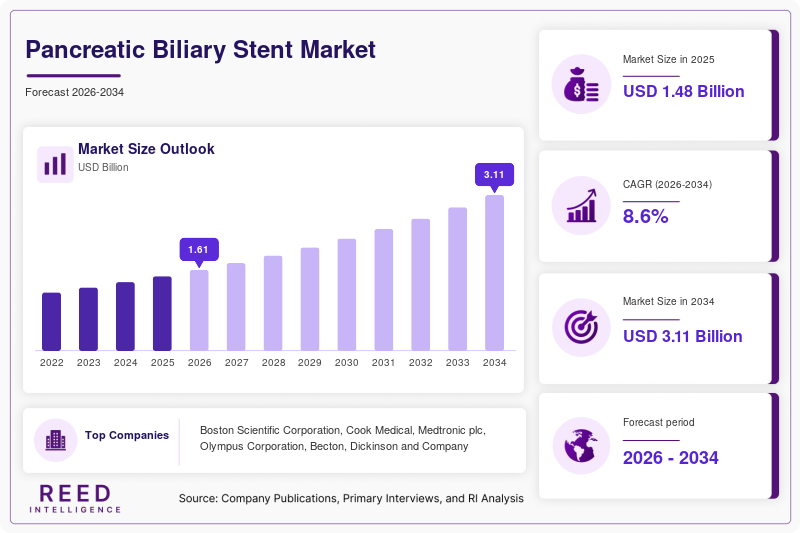
The global Pancreatic Biliary Stent Market size was valued at approximately USD 1.48 billion in 2026 and is projected to reach nearly USD 2.87 billion by 2034, expanding at a compound annual growth rate (CAGR) of 8.6% during the forecast period from 2026 to 2034. The market continues to expand steadily due to the increasing prevalence of pancreatic cancer, biliary tract disorders, and chronic gastrointestinal diseases that require minimally invasive treatment procedures. Rising healthcare spending, wider adoption of endoscopic retrograde cholangiopancreatography procedures, and continuous improvements in stent materials have further strengthened the industry outlook across developed and emerging healthcare systems.
A major global factor supporting market growth is the increasing shift toward minimally invasive procedures in gastroenterology and hepatobiliary care. Hospitals and specialty clinics are adopting advanced pancreatic biliary stents because they reduce recovery time, lower post-operative complications, and improve patient comfort when compared with conventional surgical interventions. Healthcare providers are also integrating technologically advanced self-expanding metallic stents and drug-eluting variants to improve long-term patency and treatment efficiency. In addition, the growing aging population worldwide has increased the number of patients diagnosed with obstructive jaundice, pancreatic duct strictures, and malignant biliary obstruction, creating sustained demand for advanced stenting procedures.
Key Highlights
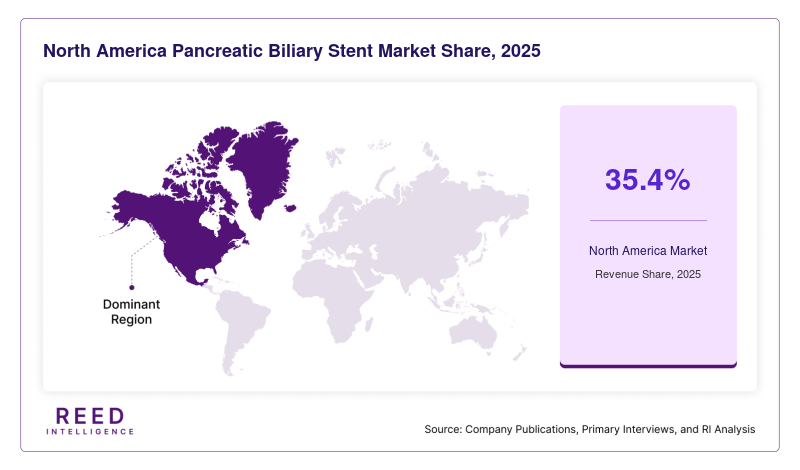
- North America dominated the market with a 35.4% share in 2025.
- Asia Pacific is expected to grow at the fastest CAGR of 10.8% during 2026–2034.
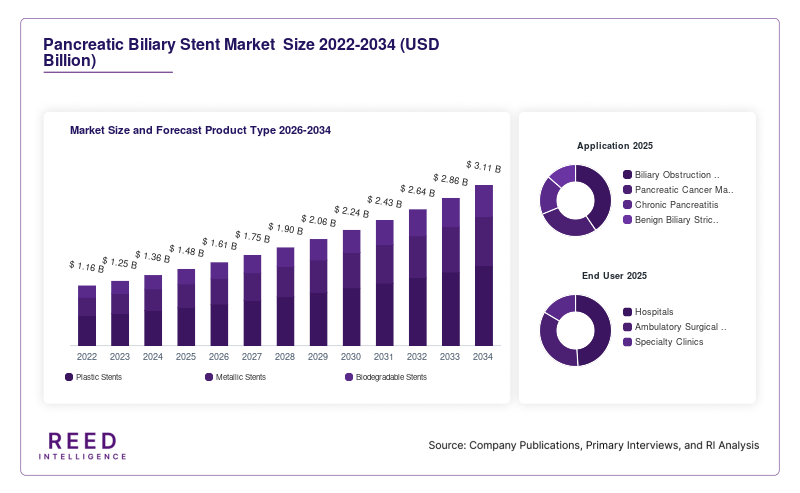
- By product type, metallic stents accounted for the largest share of 56.8%.
- while biodegradable stents are projected to grow at a CAGR of 11.7%.
- By application, biliary obstruction treatment led with a 44.6% share.
- whereas pancreatic cancer management is expected to expand at a CAGR of 10.9%.
- By end user, hospitals held the dominant share of 61.2%.
- while ambulatory surgical centers are anticipated to grow at a CAGR of 9.8%.
- The United States remained the dominant country, with market values of USD 468 million in 2024 and USD 512 million in 2025.
Market Trends
Growing Preference for Self-Expanding Metallic Stents
The Pancreatic Biliary Stent Market is witnessing increasing adoption of self-expanding metallic stents due to their improved durability, longer patency period, and lower replacement frequency. Healthcare professionals are increasingly preferring metallic variants for patients suffering from malignant biliary obstruction and pancreatic duct complications because these stents reduce the need for repeated procedures. Hospitals are also focusing on cost optimization by reducing long-term treatment complications, which supports the transition from conventional plastic stents to advanced metallic solutions. Technological innovations involving anti-migration designs, covered metallic stents, and enhanced flexibility are improving procedural outcomes and patient comfort. Manufacturers are actively introducing thinner delivery systems and more precise deployment mechanisms to strengthen clinical performance and physician confidence.
Increasing Integration of Biodegradable and Drug-Eluting Technologies
Another important trend shaping the Pancreatic Biliary Stent Market is the integration of biodegradable materials and drug-eluting technologies. Biodegradable stents are gaining attention because they eliminate the need for secondary removal procedures, which lowers healthcare costs and improves patient convenience. Research institutions and medical device companies are investing in bioresorbable polymers and anti-inflammatory coatings to improve treatment outcomes in benign biliary strictures and chronic pancreatitis cases. Drug-eluting technologies are also being explored to reduce tissue inflammation, bacterial growth, and restenosis risks. These innovations are attracting interest from specialty gastroenterology centers aiming to improve post-procedure recovery rates. The growing focus on personalized medicine and patient-specific treatment solutions is expected to accelerate the commercial adoption of advanced stent technologies over the coming years.
Market Drivers
Rising Incidence of Pancreatic and Biliary Diseases
The increasing prevalence of pancreatic cancer, gallstones, chronic pancreatitis, and bile duct obstruction is a major factor driving the Pancreatic Biliary Stent Market. Aging populations across North America, Europe, and Asia Pacific are contributing to a higher incidence of gastrointestinal disorders that require interventional endoscopic procedures. In many countries, healthcare providers are reporting a steady increase in patients diagnosed with malignant biliary obstruction linked to liver and pancreatic tumors. Pancreatic biliary stents are widely used to restore bile flow, relieve pain, and support palliative care in advanced cancer patients. Early diagnosis programs and greater awareness regarding minimally invasive treatment options have also increased the number of elective procedures performed in hospitals and specialty gastroenterology clinics.
Expansion of Advanced Endoscopic Infrastructure
Healthcare systems worldwide are rapidly expanding advanced endoscopic infrastructure, which is positively influencing the Pancreatic Biliary Stent Market. Hospitals are investing in modern imaging systems, high-definition endoscopy platforms, and specialized gastroenterology units to improve procedural efficiency. The growing availability of trained endoscopists and interventional gastroenterologists has further increased the adoption of pancreatic biliary stenting procedures. In emerging economies, governments and private healthcare organizations are modernizing tertiary care hospitals to support advanced gastrointestinal treatment capabilities. Reimbursement improvements for minimally invasive procedures are also encouraging healthcare providers to adopt technologically advanced stents. Device manufacturers are collaborating with hospitals to provide physician training programs and procedural support, strengthening overall market penetration.
Market Restraint
High Procedure Costs and Risk of Post-Operative Complications
One of the primary restraints affecting the Pancreatic Biliary Stent Market is the high cost associated with advanced stenting procedures and premium metallic devices. Self-expanding metallic stents and drug-coated variants often involve higher procurement costs, which can limit adoption in cost-sensitive healthcare systems. Smaller hospitals and rural healthcare centers in developing countries may continue relying on conventional plastic stents because of budget constraints and reimbursement limitations. In addition, pancreatic biliary stenting procedures may involve complications such as stent migration, infection, pancreatitis, perforation, and restenosis. These complications can increase hospitalization duration and overall treatment expenses. Concerns related to repeated interventions and inconsistent patient outcomes may reduce physician preference for certain products. Regulatory approval timelines for innovative biodegradable and drug-eluting stents also create commercialization delays for manufacturers seeking rapid market expansion.
Market Opportunities
Expanding Healthcare Access in Emerging Economies
Emerging economies are creating substantial opportunities for the Pancreatic Biliary Stent Market due to rising healthcare investments and expanding access to advanced gastroenterology services. Countries across Asia Pacific, Latin America, and the Middle East are improving healthcare infrastructure through public and private investments focused on tertiary care hospitals and specialty treatment centers. Growing urbanization and rising middle-class populations are increasing demand for minimally invasive procedures with shorter recovery periods. Governments are also promoting cancer screening programs and digestive disease awareness campaigns that support earlier diagnosis of pancreatic and biliary disorders. International medical device manufacturers are establishing regional partnerships and distribution networks to strengthen market presence and improve affordability across developing healthcare systems.
Development of Next-Generation Smart and Infection-Resistant Stents
The development of next-generation smart stents and infection-resistant technologies presents another important opportunity for market participants. Medical device companies are increasingly investing in advanced biomaterials, antimicrobial coatings, and sensor-enabled stents designed to improve patient monitoring and reduce complications. Smart stents capable of tracking bile flow and detecting blockages are being explored to improve post-operative care efficiency and reduce emergency hospital admissions. Infection-resistant coatings are gaining attention because hospital-acquired infections remain a concern in gastrointestinal procedures. These innovations may significantly improve patient safety and long-term clinical outcomes. Growing collaboration between biotechnology firms, academic institutions, and medical device manufacturers is expected to accelerate commercialization of highly differentiated products during the forecast period.
Segmental Analysis
By Product Type
Metallic stents represented the dominant subsegment within the Pancreatic Biliary Stent Market, accounting for nearly 56.8% of global revenue in 2024. The widespread adoption of metallic stents is mainly linked to their superior durability, improved bile drainage efficiency, and reduced need for replacement procedures when compared with plastic alternatives. Self-expanding metallic stents are commonly preferred in malignant biliary obstruction cases because they provide longer patency and lower rates of occlusion. Hospitals and specialty gastroenterology centers continue to increase their use of covered metallic stents for advanced cancer management and chronic bile duct complications. In developed healthcare systems, physicians are increasingly selecting metallic variants because they reduce repeat hospital visits and support improved long-term clinical outcomes for high-risk patients.
Biodegradable stents are projected to emerge as the fastest-growing product subsegment, advancing at a CAGR of 11.7% during the forecast period. Growing interest in biodegradable solutions is associated with their ability to dissolve naturally after completing therapeutic functions, reducing the requirement for secondary removal procedures. Healthcare providers are increasingly exploring these devices for benign biliary strictures and recurrent pancreatitis management because they can lower procedural burden and improve patient convenience. Research and development investments focused on bioresorbable polymers and antimicrobial coatings are accelerating commercialization opportunities. Academic institutions and medical device manufacturers are also collaborating to improve mechanical strength and degradation control, which may enhance physician confidence and support broader adoption in clinical practice.
By Application
Biliary obstruction treatment remained the leading application segment in the Pancreatic Biliary Stent Market, contributing approximately 44.6% of total revenue in 2024. The dominance of this segment is driven by the increasing prevalence of malignant and benign biliary obstructions associated with pancreatic cancer, gallstones, and liver diseases. Endoscopic stenting procedures are widely preferred because they offer faster recovery, reduced hospital stays, and lower complication risks compared with traditional surgery. Hospitals are increasingly adopting advanced self-expanding metallic stents for obstructive jaundice management due to their improved drainage performance and longer patency periods. The rising number of elderly patients suffering from bile duct disorders continues to strengthen demand for therapeutic biliary interventions across major healthcare markets.
Pancreatic cancer management is expected to register the fastest CAGR of 10.9% during the forecast period due to rising global cancer incidence and growing focus on palliative care solutions. Pancreatic biliary stents play a crucial role in relieving duct obstruction, improving digestive function, and enhancing patient quality of life during cancer treatment. Healthcare providers are increasingly integrating minimally invasive stenting procedures into multidisciplinary oncology care programs to reduce surgical complications and shorten recovery periods. Research initiatives aimed at combining drug-eluting stents with targeted cancer therapies are also contributing to innovation within this segment. Expanding cancer awareness programs and improved diagnostic capabilities are expected to support higher treatment volumes in both developed and emerging healthcare systems.
By End User
Hospitals accounted for the largest share of the Pancreatic Biliary Stent Market in 2024, representing nearly 61.2% of global revenue. The dominance of hospitals is supported by their ability to manage complex gastrointestinal conditions requiring advanced imaging systems, endoscopic platforms, and multidisciplinary care teams. Large tertiary care hospitals frequently perform pancreaticobiliary interventions because they possess experienced gastroenterologists and access to high-quality post-operative care facilities. Hospitals are also more likely to adopt premium metallic and drug-coated stents for patients with malignant biliary obstruction and severe pancreatic disorders. Increasing investments in specialized gastroenterology departments and minimally invasive surgical units are further strengthening the role of hospitals within the global market landscape.
Ambulatory surgical centers are anticipated to witness the fastest growth, with a projected CAGR of 9.8% from 2026 to 2034. The expansion of these facilities is linked to rising demand for cost-effective outpatient procedures and shorter patient recovery times. Ambulatory centers are increasingly equipped with modern endoscopic technologies capable of supporting routine pancreaticobiliary interventions without extended hospitalization. Patients and insurers are showing growing preference for outpatient treatment settings because they reduce healthcare expenditure and improve scheduling flexibility. In addition, advancements in minimally invasive stenting procedures and sedation techniques are enabling ambulatory surgical centers to perform a larger share of low-risk gastrointestinal procedures. This trend is expected to create new business opportunities for device manufacturers targeting outpatient healthcare providers.
Regional Analysis
North America
North America accounted for the largest share of the Pancreatic Biliary Stent Market in 2025, contributing nearly 35.4% of global revenue. The region is projected to maintain steady growth at a CAGR of 7.9% through 2034 due to high healthcare spending and widespread adoption of minimally invasive gastrointestinal procedures. The presence of established medical device manufacturers and advanced hospital infrastructure has strengthened procedural volumes across the United States and Canada. Increasing demand for self-expanding metallic stents and rising diagnosis rates for pancreatic cancer continue to support regional market expansion.
The United States remained the dominant country within North America because of its advanced reimbursement framework and strong concentration of gastroenterology specialists. The country recorded market values of USD 468 million in 2024 and USD 512 million in 2025. One unique growth factor driving the national market is the increasing integration of robotic-assisted endoscopic procedures in tertiary care hospitals. Healthcare providers are investing in precision-guided endoscopic technologies to improve procedural efficiency and reduce post-operative complications, creating stronger demand for advanced pancreatic biliary stents.
Europe
Europe represented a significant share of the Pancreatic Biliary Stent Market in 2025, supported by expanding gastrointestinal disease treatment programs and strong public healthcare systems. The region is anticipated to grow at a CAGR of 7.6% during the forecast period due to increasing adoption of advanced metallic and biodegradable stents. Countries across Western Europe continue to modernize hospital infrastructure and invest in specialized digestive disease treatment centers. The growing elderly population and rising incidence of chronic pancreatitis and bile duct disorders are supporting sustained demand for endoscopic interventions.
Germany emerged as the dominant country in the European market because of its advanced medical technology ecosystem and large patient base requiring minimally invasive gastrointestinal procedures. A unique factor contributing to growth in Germany is the increasing collaboration between hospitals and medical research institutes focused on biodegradable stent innovation. Clinical studies evaluating bioresorbable pancreatic biliary stents are encouraging greater physician awareness and supporting early commercialization of innovative products. France and the United Kingdom are also experiencing stable growth due to expanding cancer screening initiatives.
Asia Pacific
Asia Pacific is expected to register the fastest growth in the Pancreatic Biliary Stent Market, with a projected CAGR of 10.8% during 2026–2034. The region accounted for nearly 24.8% of global revenue in 2025 and continues to gain momentum because of improving healthcare infrastructure and increasing procedural volumes. Rapid urbanization, rising healthcare expenditure, and expanding medical tourism are supporting adoption of advanced endoscopic devices across China, India, Japan, and South Korea. Hospitals in the region are increasingly investing in modern gastroenterology departments to address the growing burden of digestive disorders.
China dominated the Asia Pacific market due to its large patient population and rapid healthcare modernization initiatives. One unique growth factor in China is the strong expansion of domestic medical device manufacturing capabilities. Local manufacturers are introducing cost-effective pancreatic biliary stents tailored for regional healthcare systems, improving product accessibility in secondary and tertiary hospitals. Government support for cancer care expansion and increased physician training programs are also strengthening procedural adoption. India is witnessing growing demand because of rising awareness regarding minimally invasive gastrointestinal treatment options.
Middle East & Africa
The Middle East & Africa region accounted for a smaller but steadily expanding share of the Pancreatic Biliary Stent Market in 2025. The regional market is projected to grow at a CAGR of 6.9% through 2034 due to increasing investments in healthcare infrastructure and specialty treatment centers. Countries within the Gulf Cooperation Council are focusing on modernizing tertiary care hospitals and expanding access to advanced gastroenterology services. Demand for pancreatic biliary stents is also increasing because of rising lifestyle-related digestive disorders and greater awareness regarding minimally invasive procedures.
Saudi Arabia remained the leading country within the regional market because of ongoing healthcare transformation initiatives and higher adoption of advanced medical technologies. A unique factor driving growth in the country is the expansion of government-funded specialized digestive disease centers equipped with advanced endoscopy units. Hospitals are increasingly collaborating with international medical device companies to improve procedural capabilities and physician training. South Africa is also contributing to regional growth through gradual expansion of private healthcare facilities and greater availability of interventional gastroenterology procedures.
Latin America
Latin America held a moderate share of the Pancreatic Biliary Stent Market in 2025 and is forecast to expand at a CAGR of 7.2% during the assessment period. Growing healthcare investments and increasing diagnosis rates for biliary disorders are contributing to market growth across Brazil, Mexico, and Argentina. Public healthcare systems are gradually improving access to minimally invasive procedures, while private hospitals are expanding adoption of advanced metallic stents for complex gastrointestinal conditions. Medical tourism growth in selected countries is also supporting regional demand for endoscopic treatment procedures.
Brazil dominated the Latin American market due to its large healthcare network and increasing focus on advanced gastrointestinal treatment services. One distinctive growth factor in Brazil is the expansion of public-private healthcare partnerships aimed at improving cancer care accessibility. Hospitals are increasingly adopting modern endoscopic technologies to reduce surgical waiting times and improve treatment outcomes for patients with pancreatic and biliary diseases. Mexico is also emerging as an attractive market because of rising physician training initiatives and improving reimbursement support for minimally invasive procedures.
Competitive Landscape
The Pancreatic Biliary Stent Market remains moderately consolidated, with global and regional medical device manufacturers competing through technological innovation, product expansion, and strategic collaborations with healthcare providers. Companies are focusing on developing advanced self-expanding metallic stents, biodegradable variants, and infection-resistant technologies to improve long-term clinical performance. Market participants are also investing in physician education programs and hospital partnerships to strengthen procedural adoption rates across emerging healthcare markets.
Boston Scientific Corporation continues to maintain a leading position due to its broad gastrointestinal device portfolio, extensive distribution network, and continuous investment in minimally invasive treatment technologies. The company recently expanded its pancreaticobiliary product line with enhanced covered metallic stent systems designed to improve flexibility and reduce migration risks. Other major companies are increasingly pursuing acquisitions and research collaborations to strengthen product innovation and geographic presence. Competitive intensity is expected to increase further as manufacturers focus on smart stent technologies, personalized treatment solutions, and next-generation biodegradable materials.
Key Players
- Boston Scientific Corporation
- Cook Medical
- Medtronic plc
- Olympus Corporation
- Becton, Dickinson and Company
- CONMED Corporation
- Merit Medical Systems
- Taewoong Medical
- Micro-Tech Endoscopy
- ENDO-FLEX GmbH
- Hobbs Medical Inc.
- ELLA-CS s.r.o.
- M.I. Tech Co., Ltd.
- C.R. Bard Medical
- Sewoon Medical Co., Ltd.
Recent Developments
- Boston Scientific Corporation introduced an upgraded covered metallic biliary stent system in 2025 featuring enhanced anti-migration technology for complex gastrointestinal procedures.
- Olympus Corporation expanded its endoscopic device manufacturing capabilities in Asia Pacific during 2024 to strengthen regional supply chain efficiency for pancreaticobiliary treatment products.
- Cook Medical partnered with multiple specialty hospitals in Europe in 2025 to conduct clinical evaluations for biodegradable pancreatic biliary stents designed for benign biliary strictures.
- Medtronic plc announced additional investments in smart gastrointestinal device research focused on integrating monitoring capabilities into advanced stent systems.
Pancreatic Biliary Stent Market Segments
Product Type
- Plastic Stents
- Metallic Stents
- Biodegradable Stents
Application
- Biliary Obstruction Treatment
- Pancreatic Cancer Management
- Chronic Pancreatitis
- Benign Biliary Strictures
End User
- Hospitals
- Ambulatory Surgical Centers
- Specialty Clinics
By Region
- North America
- Europe
- APAC
- Middle East and Africa
- LATAM