Panel Filter Market Size, Share Demand Report By Type (Disposable Panel Filters, Washable Panel Filters), By Material (Synthetic Fiber, Fiberglass, Activated Carbon), By Application (HVAC Systems, Cleanrooms, Industrial Ventilation), By End-Use Industry (Residential, Commercial, Industrial) & Segment Forecasts, 2026–2034
USD 3950
Market Overview
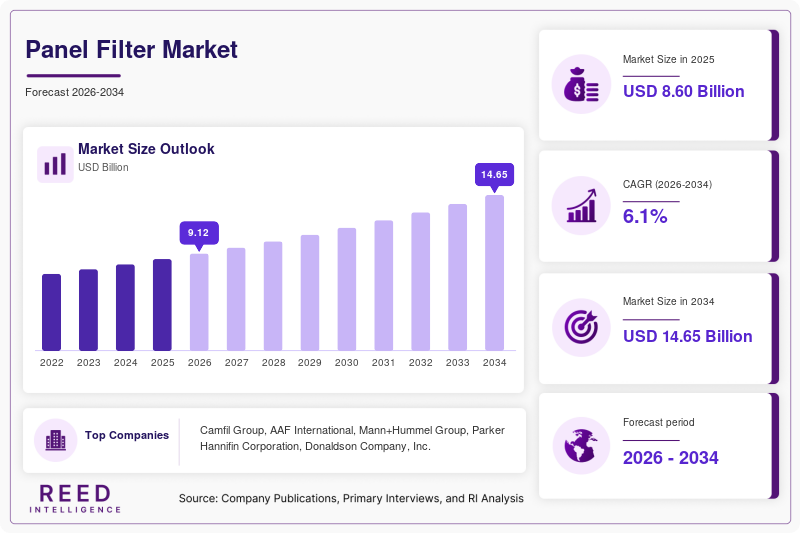
The Panel Filter Market size was valued at approximately USD 8.6 billion in 2026 and is projected to reach USD 13.9 billion by 2034, expanding at a CAGR of 6.1% during the forecast period (2026–2034). The market growth has been consistently supported by the increasing emphasis on indoor air quality standards across residential, commercial, and industrial spaces worldwide. Rising awareness regarding airborne contaminants, coupled with stricter environmental and occupational health regulations, has encouraged industries and building operators to adopt efficient filtration systems.
Panel filters, known for their cost-effectiveness and ease of installation, have become a preferred choice in HVAC systems, cleanrooms, and industrial ventilation units. Their ability to capture dust, pollen, and other particulate matter while maintaining low pressure drop has further strengthened their demand across sectors.
Key Highlights:
- North America dominated the market with a share of 34% in 2025, while Asia Pacific is projected to grow at the fastest CAGR of 7.3% during the forecast period.
- In the type segment, disposable panel filters held the leading share of 58% in 2025, while washable panel filters are expected to grow at a CAGR of 6.8%.
- By application, HVAC systems accounted for the largest share of 46%, while cleanroom applications are projected to expand at a CAGR of 7.5%.
- The U.S. remained the dominant country with market values of USD 2.1 billion in 2024 and USD 2.2 billion in 2025.
Market Trends
Rising Demand for Energy-Efficient Filtration Solutions
The Panel Filter Market is experiencing a notable shift toward energy-efficient filtration technologies. Manufacturers are increasingly focusing on designing filters that reduce airflow resistance while maintaining high filtration efficiency. This trend is driven by the need to optimize HVAC system performance and reduce energy consumption in commercial buildings. Energy-efficient panel filters contribute to lower operational costs, making them attractive for large-scale facilities such as hospitals, airports, and office complexes.
Growing Adoption of Sustainable and Reusable Filters
Sustainability has become a key trend shaping the Panel Filter Market. End-users are showing a preference for washable and reusable panel filters to minimize waste generation and reduce long-term costs. Companies are investing in eco-friendly filter materials such as synthetic fibers and recyclable frames. This trend is particularly prominent in developed regions where environmental regulations are stringent. Additionally, organizations are aligning their procurement strategies with sustainability goals, which is further accelerating the adoption of reusable panel filters across various industries.
Market Drivers
Increasing Focus on Indoor Air Quality (IAQ) Standards
The growing importance of indoor air quality is a primary driver of the Panel Filter Market. Regulatory bodies and health organizations have established stringent guidelines to control airborne pollutants in indoor environments. This has led to increased adoption of panel filters in residential, commercial, and industrial settings. The need to maintain clean air in healthcare facilities, educational institutions, and office spaces has further fueled demand for efficient filtration solutions.
Expansion of HVAC Infrastructure Globally
The rapid expansion of HVAC systems in both developed and developing economies is significantly driving the Panel Filter Market. Urbanization, rising disposable incomes, and the construction of smart buildings have contributed to the increased installation of HVAC systems. Panel filters serve as essential components in these systems, ensuring optimal performance and air quality. The continuous growth of the construction and real estate sectors is expected to sustain this demand over the forecast period.
Market Restraint
Limited Efficiency for Fine Particle Filtration
One of the key challenges in the Panel Filter Market is the limited efficiency of standard panel filters in capturing ultra-fine particles. While these filters are effective for larger particulates such as dust and pollen, they may not perform adequately in environments requiring high-efficiency filtration, such as pharmaceutical manufacturing or semiconductor production. This limitation has led to the adoption of advanced filtration technologies such as HEPA and ULPA filters in critical applications.
Additionally, frequent replacement requirements for disposable panel filters can increase operational costs for end-users. This may discourage adoption in cost-sensitive markets, particularly in small-scale industries and residential sectors. Manufacturers are addressing this challenge by developing hybrid filtration systems and improving filter media performance, but the constraint continues to impact overall market growth to some extent.
Market Opportunities
Growth in Emerging Economies
Emerging economies present significant growth opportunities for the Panel Filter Market. Rapid industrialization, urban expansion, and increasing awareness about air pollution are driving demand for filtration systems in countries across Asia Pacific, Latin America, and Africa. Governments in these regions are implementing policies to improve air quality, which is expected to boost market penetration. The expansion of manufacturing facilities and commercial infrastructure further supports this growth.
Integration with Smart HVAC Systems
The integration of panel filters with smart HVAC systems is an emerging opportunity in the market. Advanced monitoring technologies, including IoT-enabled sensors, allow real-time tracking of filter performance and air quality. This enables predictive maintenance and enhances system efficiency. The adoption of smart building solutions is increasing globally, creating a favorable environment for innovative panel filtration products. Companies that invest in digital integration and smart technologies are likely to gain a competitive advantage in the evolving market landscape.
By Type
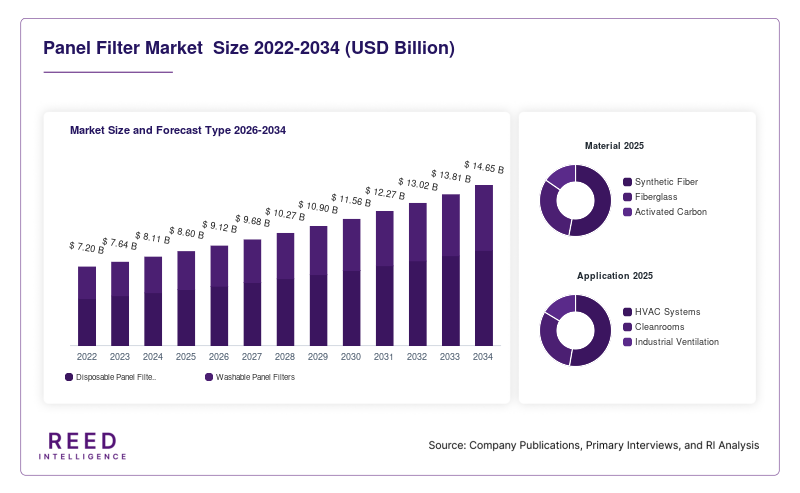
Disposable panel filters dominated the Panel Filter Market in 2025, accounting for approximately 58% of the total share. Their widespread use in residential and commercial applications was attributed to their low cost and ease of replacement. These filters were commonly used in HVAC systems where frequent maintenance cycles were manageable.
Washable panel filters will grow at a CAGR of 6.8% during the forecast period. Their reusability and cost-effectiveness over time will drive adoption, particularly in commercial and industrial settings where sustainability and operational efficiency are prioritized.
By Material
Synthetic fiber-based filters held the largest share of 52% in 2025 due to their durability and high dust-holding capacity. These materials provided consistent performance across various applications, making them a preferred choice among manufacturers and end-users.
Activated carbon filters are projected to grow at a CAGR of 7.1% owing to their ability to remove odors and gaseous pollutants. Their application in specialized environments such as healthcare and food processing industries will drive their demand.
By Application
HVAC systems accounted for the dominant share of 46% in 2025. The extensive use of panel filters in air conditioning and ventilation systems across residential and commercial buildings contributed to this dominance.
Cleanroom applications will expand at a CAGR of 7.5% due to the increasing need for controlled environments in pharmaceutical and electronics industries. The demand for high-quality air filtration in these sectors will support segment growth.
By End-Use Industry
The commercial sector led the market with a share of 41% in 2025. Office buildings, shopping centers, and healthcare facilities extensively used panel filters to maintain indoor air quality.
The industrial sector is expected to grow at a CAGR of 6.9%, driven by the need for air filtration in manufacturing processes and worker safety regulations.
Regional Analysis
North America
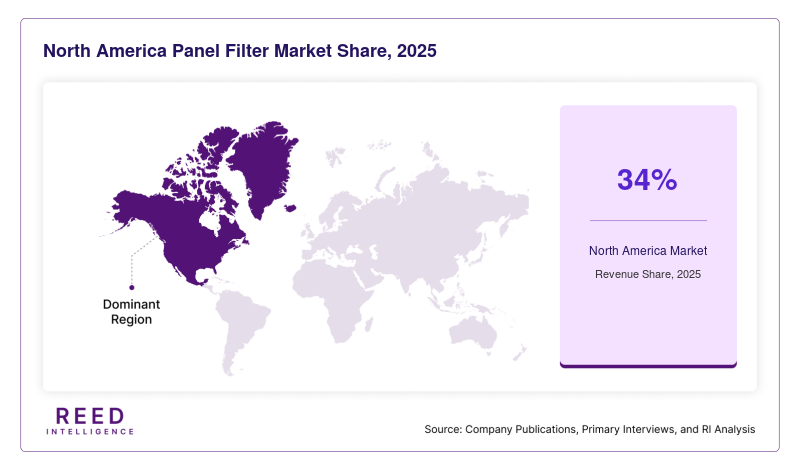
North America accounted for approximately 34% of the Panel Filter Market share in 2025. The region will expand at a CAGR of 5.8% from 2026 to 2034. Growth in this region is driven by stringent indoor air quality standards and widespread adoption of advanced HVAC systems across commercial and residential sectors.
The United States dominated the regional market due to strong regulatory frameworks and high awareness of air quality. The presence of established infrastructure and continuous investment in building upgrades has supported consistent demand for panel filters.
Europe
Europe held around 27% of the market share in 2025 and will grow at a CAGR of 5.6% during the forecast period. The region has emphasized environmental sustainability and energy efficiency, encouraging the adoption of advanced filtration systems.
Germany emerged as the dominant country, supported by its strong industrial base and focus on energy-efficient building solutions. The country’s emphasis on reducing emissions and improving workplace air quality has contributed to steady market growth.
Asia Pacific
Asia Pacific represented approximately 23% of the Panel Filter Market in 2025 and is projected to grow at the fastest CAGR of 7.3%. Rapid urbanization and industrial expansion are key factors driving regional demand.
China led the market due to large-scale manufacturing activities and increasing government initiatives to combat air pollution. The expansion of infrastructure projects and rising adoption of HVAC systems in urban areas have further accelerated market growth.
Middle East & Africa
The Middle East & Africa accounted for nearly 9% of the market share in 2025 and is expected to grow at a CAGR of 6.5%. The region’s growth is influenced by rising construction activities and the need for efficient cooling systems in extreme climatic conditions.
The United Arab Emirates dominated the regional market, driven by investments in commercial infrastructure and smart city projects. The increasing demand for high-performance HVAC systems has supported the adoption of panel filters.
Latin America
Latin America held around 7% of the market share in 2025 and will grow at a CAGR of 6.2% during the forecast period. The region is witnessing gradual improvements in industrial and commercial infrastructure.
Brazil emerged as the leading country due to expanding urban areas and growing awareness of indoor air quality. The development of commercial spaces and healthcare facilities has contributed to the steady demand for panel filtration systems.
Competitive Landscape
The Panel Filter Market is characterized by the presence of several global and regional players focusing on product innovation and strategic partnerships. The market leader, Camfil Group, has maintained a strong position through continuous investment in advanced filtration technologies and sustainable solutions. The company recently introduced energy-efficient panel filters designed to reduce operational costs in large HVAC systems.
Other prominent players are emphasizing product diversification and geographic expansion to strengthen their market presence. Collaborations with construction companies and HVAC system manufacturers are also common strategies adopted to enhance distribution networks and customer reach.
Key Players List
- Camfil Group
- AAF International
- Mann+Hummel Group
- Parker Hannifin Corporation
- Donaldson Company, Inc.
- Freudenberg Filtration Technologies
- Koch Filter Corporation
- Troy Filters Ltd.
- Nordic Air Filtration
- Filtration Group Corporation
- Glasfloss Industries
- Airguard Industries
- Purafil Inc.
- K&N Engineering
- Spectrum Filtration Pvt. Ltd.
Recent Developments
- Camfil Group launched a new range of low-energy panel filters for commercial HVAC systems in 2025.
- Mann+Hummel expanded its production capacity in Asia to meet rising regional demand.
- Parker Hannifin introduced smart filtration solutions integrated with monitoring systems.
- Freudenberg Filtration Technologies developed eco-friendly filter materials to support sustainability initiatives.
- AAF International partnered with construction firms to supply filtration systems for large infrastructure projects.
Panel Filter Market Segments
Type
- Disposable Panel Filters
- Washable Panel Filters
Material
- Synthetic Fiber
- Fiberglass
- Activated Carbon
Application
- HVAC Systems
- Cleanrooms
- Industrial Ventilation
End-Use Industry
- Residential
- Commercial
- Industrial
By Region
- North America
- Europe
- APAC
- Middle East and Africa
- LATAM