Panini Market Size, Share & Demand Report By Product Type (Frozen Ready-to-Cook Panini, Refrigerated Ready-to-Eat Panini, Vegan and Plant-Based Panini), By Distribution Channel (Quick-Service Restaurants, Cafés and Coffee Chains, Supermarkets and Hypermarkets), By End User (Commercial Foodservice Establishments, Household Consumers, Institutional Buyers) By Region & Segment Forecasts, 2026–2034
USD 3950
Market Overview
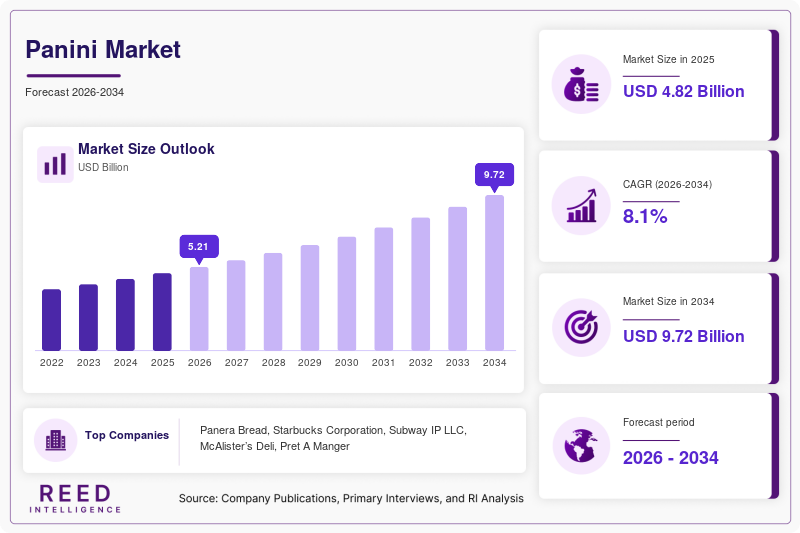
The global Panini Market size was valued at USD 4.82 billion in 2026 and is projected to reach USD 8.96 billion by 2034, expanding at a CAGR of 8.1% during the forecast period from 2026 to 2034. The market is witnessing consistent expansion due to the growing preference for convenient gourmet-style food products among urban consumers. Panini products, including grilled sandwiches, frozen panini meals, ready-to-eat panini snacks, and café-style offerings, are increasingly popular across quick-service restaurants, supermarkets, cafés, and institutional food chains. Rising disposable income, changing eating patterns, and increasing demand for premium fast-food products are contributing to the steady growth trajectory of the market.
A major global factor supporting market growth is the increasing adoption of Western-style café culture across developing economies. Consumers in metropolitan areas are shifting toward premium sandwich products prepared with artisanal bread, cheese blends, and protein-rich fillings. In addition, expansion of food delivery platforms has improved accessibility to customized panini meals, further accelerating market penetration. Foodservice operators are also investing in automated sandwich grills and ingredient innovation to improve preparation speed and product quality.
Key Highlights
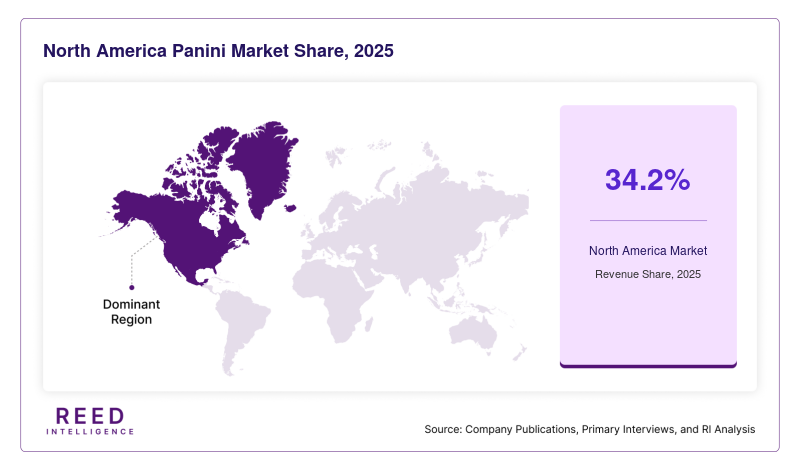
- North America dominated the market with a 34.2% share in 2025.
- Asia Pacific is expected to grow at the fastest CAGR of 10.8% during 2026–2034.
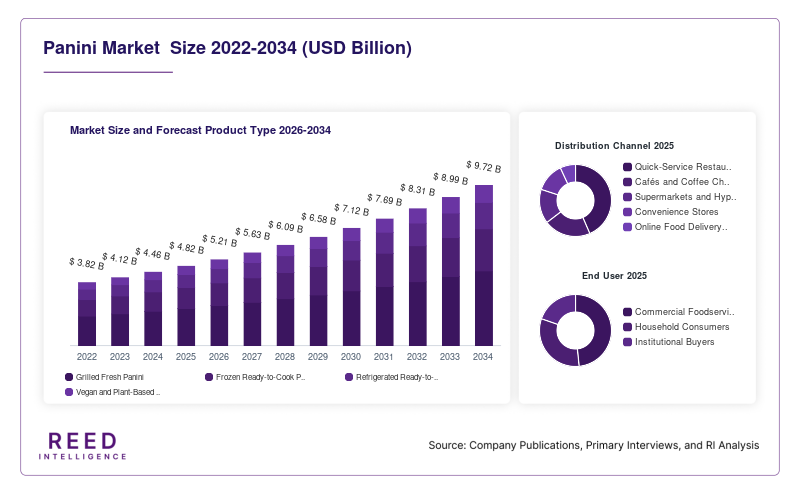
- By product type, grilled fresh panini accounted for the largest share of 42.7%.
- while frozen ready-to-cook panini products are projected to grow at a CAGR of 11.3%.
- By distribution channel, quick-service restaurants led with a 39.5% share.
- whereas online food delivery platforms are expected to expand at a CAGR of 12.1%.
- The United States remained the dominant country, with market values of USD 1.18 billion in 2024 and USD 1.29 billion in 2025.
Market Trends
Expansion of Premium and Artisanal Ingredient Offerings
The Panini Market is experiencing strong momentum from the rising popularity of premium and artisanal ingredient combinations. Consumers increasingly prefer high-quality breads such as ciabatta, focaccia, sourdough, and multigrain varieties that enhance flavor and texture. Foodservice providers are integrating gourmet cheeses, smoked meats, roasted vegetables, and specialty sauces into panini menus to attract customers seeking elevated café-style dining experiences. This trend is especially visible in urban cafés and premium quick-service restaurant chains where differentiation through menu innovation has become essential. Businesses are also promoting regional flavors and limited-edition offerings to strengthen customer engagement and encourage repeat purchases.
The growing demand for clean-label and natural ingredients is further shaping product innovation within the market. Restaurants and packaged food companies are highlighting preservative-free fillings, organic vegetables, and locally sourced ingredients to improve brand positioning. Consumers are willing to pay higher prices for premium sandwiches perceived as healthier and more authentic. As a result, manufacturers are focusing on ingredient transparency, sustainable packaging, and customizable meal solutions. These developments are helping brands expand profit margins while meeting the evolving expectations of health-conscious and experience-driven consumers.
Increasing Adoption of Frozen and Ready-to-Eat Panini Products
Frozen and ready-to-eat panini products are becoming more popular due to the growing need for convenience-based meal solutions. Busy work schedules, increasing urbanization, and rising participation in hybrid work environments have strengthened demand for quick meal preparation products. Supermarkets and convenience stores are expanding frozen sandwich sections with microwave-friendly panini offerings that provide restaurant-style taste with minimal preparation time. Consumers are increasingly purchasing ready-to-eat products for breakfast, lunch, and evening snacks, supporting higher sales volume across retail channels.
Food manufacturers are investing in advanced freezing technologies and improved packaging formats to preserve taste, texture, and freshness. Demand for portable food items among students and office workers is also contributing to category growth. The rapid expansion of e-commerce grocery platforms has improved product visibility and accessibility for frozen panini products across multiple regions. In addition, several companies are introducing vegetarian and plant-based ready-to-eat panini variants to attract younger consumers and flexitarian households. These factors are expected to support sustained market growth throughout the forecast period.
Market Drivers
Growth of Café Chains and Quick-Service Restaurant Networks
The expansion of café chains and quick-service restaurant networks is a major factor driving the Panini Market. International and regional café brands are increasingly including panini products in their core menus to attract customers seeking premium fast-food alternatives. Panini sandwiches are viewed as versatile menu items that can be customized with various fillings, sauces, and bread options. Their ability to serve breakfast, lunch, and snack occasions makes them highly profitable for foodservice operators. Growing consumer preference for convenient dining experiences is encouraging restaurants to expand sandwich-based offerings across urban and suburban locations.
Restaurant operators are also adopting advanced grilling equipment that improves operational efficiency and reduces preparation time. The expansion of franchise-based café models across Asia Pacific, the Middle East, and Latin America is creating additional demand for panini ingredients and equipment. Seasonal promotions, meal combo offers, and digital ordering applications are increasing consumer engagement and supporting higher sales frequency. Furthermore, the popularity of café culture among younger consumers is strengthening long-term demand for innovative sandwich products across both developed and emerging markets.
Rising Consumer Demand for Convenient and Portable Meals
Growing consumer demand for convenient and portable meal options is significantly supporting market growth. Modern consumers are increasingly prioritizing time-saving food products that can be consumed during travel, office breaks, or academic schedules. Panini products provide a balance of convenience, flavor variety, and nutritional value, making them suitable for multiple consumption occasions. This trend is especially strong among urban professionals and students who prefer ready-to-eat or quickly prepared meals without compromising on taste or quality.
Food manufacturers and restaurant operators are responding by introducing compact packaging formats, meal kits, and grab-and-go solutions tailored for busy lifestyles. The expansion of food delivery applications has further improved access to customized panini products across metropolitan regions. In addition, increasing consumer interest in healthier eating has encouraged brands to offer low-calorie breads, protein-rich fillings, and vegetable-based options. The combination of portability, customization, and premium taste positioning continues to strengthen consumer adoption of panini products worldwide.
Market Restraint
Volatility in Raw Material Prices and Supply Chain Costs
The Panini Market faces challenges due to fluctuations in raw material prices and increasing supply chain expenses. Bread, cheese, meat products, vegetables, and specialty sauces represent critical ingredients within the market, and changes in agricultural production costs directly influence profitability. Rising transportation expenses, energy costs, and packaging material prices are creating financial pressure for manufacturers and foodservice providers. Small and medium-sized cafés are particularly vulnerable because they often operate with lower purchasing power and limited pricing flexibility.
Frequent price fluctuations can also impact consumer purchasing behavior, especially in price-sensitive regions where premium sandwich products are considered discretionary food items. Inflationary conditions in several economies have increased operational costs for restaurants and frozen food producers, forcing businesses to either reduce margins or increase retail prices. Supply chain disruptions affecting imported cheeses, meats, and specialty breads can additionally lead to inconsistent product availability. These factors may slow expansion plans for smaller operators and reduce the pace of market penetration in developing economies. Companies are increasingly seeking local sourcing strategies and long-term supplier agreements to minimize cost-related risks and stabilize operations.
Market Opportunities
Rising Demand for Plant-Based and Health-Focused Panini Products
The increasing popularity of plant-based diets presents a major growth opportunity for the Panini Market. Consumers are actively seeking healthier meal options that contain lower fat levels, reduced preservatives, and natural ingredients. This shift is encouraging food manufacturers and restaurant chains to introduce panini products featuring plant-based cheese, grilled vegetables, tofu, mushroom protein, and vegan sauces. Younger consumers, particularly millennials and Generation Z, are driving demand for sustainable and health-oriented food products across urban markets.
Restaurants are also highlighting calorie-conscious menu items and functional ingredients to strengthen brand positioning. Gluten-free breads, multigrain bases, and organic vegetables are becoming more common within premium sandwich menus. Retail chains are responding by expanding shelf space for refrigerated and frozen vegetarian panini products. The growing popularity of fitness-focused diets and flexitarian eating habits is expected to create long-term revenue opportunities for manufacturers capable of delivering healthy yet flavorful product offerings.
Expansion of Digital Food Delivery and Cloud Kitchen Models
The rapid development of digital food delivery platforms and cloud kitchen operations is creating significant opportunities for the Panini Market. Online ordering applications have expanded consumer access to customized sandwich products, enabling restaurants to reach larger customer bases without extensive physical expansion. Panini products are particularly suitable for delivery services because they maintain texture and flavor quality during transportation when packaged properly. This characteristic has encouraged several café brands and fast-food chains to prioritize panini offerings within digital menus.
Cloud kitchen operators are increasingly incorporating sandwich-focused concepts to capitalize on rising demand for quick and affordable meals. Digital marketing campaigns, subscription meal plans, and app-based loyalty programs are helping brands strengthen customer retention. The availability of consumer data analytics through online platforms is also allowing companies to tailor menus based on regional preferences and purchasing patterns. As internet penetration and smartphone adoption continue to rise across emerging economies, online food ordering channels are expected to become an increasingly important revenue contributor for the industry.
Segmental Analysis
By Product Type
Grilled fresh panini products accounted for the largest share of the market in 2024, representing 42.7% of global revenue. The dominance of this segment is largely attributed to strong consumer preference for freshly prepared sandwiches served in cafés, restaurants, and quick-service outlets. Fresh panini products are widely perceived as premium meal solutions due to their use of artisanal bread, fresh vegetables, melted cheese, and customized fillings. Urban consumers increasingly prefer restaurant-style sandwiches that provide convenience without sacrificing taste or quality. Foodservice operators benefit from high profit margins associated with fresh panini products, encouraging broader menu adoption across café chains and institutional dining facilities.
The frozen ready-to-cook panini segment is expected to register the fastest CAGR of 11.3% during the forecast period. Growth is being supported by rising consumer demand for convenient meal products that can be prepared quickly at home or in office settings. Advances in freezing technology and packaging solutions are helping manufacturers maintain product freshness and texture for longer durations. Retailers are expanding frozen food sections to accommodate increasing demand for premium convenience meals. Consumers with busy lifestyles are also purchasing frozen panini products for breakfast and evening snacks, contributing to higher retail sales across supermarkets and online grocery platforms.
By Distribution Channel
Quick-service restaurants held the largest market share in 2024, accounting for 39.5% of overall revenue. The segment benefits from high consumer traffic, rapid service models, and growing preference for affordable premium sandwiches. Panini products have become an important menu category for quick-service restaurants because they are easy to customize and suitable for multiple meal occasions. Restaurant operators are introducing localized flavors, seasonal ingredients, and meal combination offers to attract diverse consumer groups. Strong expansion of café franchises and urban foodservice networks across developed economies is also contributing to segment dominance.
Online food delivery platforms are projected to witness the fastest CAGR of 12.1% through 2034. Increasing smartphone usage, digital payment adoption, and changing consumer purchasing behavior are driving growth within this segment. Panini products are particularly well suited for online delivery because they retain quality during transportation when packaged efficiently. Restaurant brands are investing in app-based promotions, loyalty programs, and digital advertising campaigns to increase online sales. Cloud kitchens specializing in sandwich-based menus are additionally strengthening segment expansion by offering customized products and faster delivery times across metropolitan areas.
By End User
Commercial foodservice establishments accounted for the largest market share in 2024, representing 46.8% of global revenue. This segment includes cafés, restaurants, hotels, institutional cafeterias, and quick-service chains that rely heavily on sandwich-based menu offerings. The growing popularity of café culture and social dining experiences is increasing demand for premium panini products across urban centers. Foodservice operators are investing in advanced grilling equipment and ingredient innovation to improve product quality and operational efficiency. The segment also benefits from rising tourism activity and expansion of hospitality infrastructure in major economies.
Household consumers are expected to register the fastest CAGR of 10.5% during the forecast period. Rising adoption of frozen and refrigerated ready-to-eat products is encouraging consumers to prepare panini meals at home. Working professionals and students increasingly prefer convenient meal solutions that require minimal preparation time. Manufacturers are introducing compact packaging, microwave-friendly formats, and health-focused ingredient combinations to attract retail consumers. Growth in e-commerce grocery platforms and subscription-based meal services is further supporting household adoption of packaged panini products across both developed and emerging markets.
Regional Analysis
North America
North America accounted for 34.2% of the global Panini Market share in 2025 and maintained its position as the leading regional market. The region is projected to grow at a CAGR of 7.6% during the forecast period due to strong consumer demand for premium convenience food products. The presence of established café chains, extensive quick-service restaurant networks, and high consumer spending on ready-to-eat meals supports market expansion. Frozen panini products are also gaining traction in supermarkets and retail stores as consumers increasingly prefer convenient meal preparation solutions.
The United States remains the dominant country within the regional market due to its advanced foodservice industry and widespread café culture. Rising demand for gourmet sandwiches prepared with specialty bread and premium fillings continues to drive product innovation across restaurant chains. The expansion of food delivery applications and increasing consumer preference for customized meal options are supporting sales growth. Canada is also witnessing increasing demand for vegetarian and organic panini products as health-conscious eating patterns continue to evolve.
Europe
Europe represented a substantial share of the Panini Market in 2025 and is expected to register a CAGR of 7.4% through 2034. The market benefits from strong consumption of bakery-based food products and the region’s long-established café traditions. Consumers in countries such as Italy, France, Germany, and the United Kingdom increasingly prefer premium sandwiches made with artisanal breads and locally sourced ingredients. Growth in tourism activity and the expansion of café franchises are also contributing to higher demand for panini products across urban centers and transportation hubs.
Italy continues to dominate the European market because of its strong culinary heritage and consumer familiarity with panini-style sandwiches. Italian cafés and restaurants play an important role in shaping product trends, including the use of regional cheeses, cured meats, and specialty sauces. Demand for healthier meal alternatives is additionally supporting the introduction of gluten-free and vegan panini options. Germany and the United Kingdom are also experiencing rising sales through convenience stores and supermarket chains offering refrigerated ready-to-eat sandwiches.
Asia Pacific
Asia Pacific is anticipated to register the fastest CAGR of 10.8% during the forecast period due to rapid urbanization, rising disposable income, and increasing exposure to Western food culture. Consumers across China, India, Japan, South Korea, and Southeast Asian countries are increasingly adopting café-style dining habits. International quick-service restaurant chains are aggressively expanding across metropolitan areas, driving demand for premium sandwich products. The region is also witnessing rapid growth in online food delivery services, supporting broader accessibility for customized panini meals.
China remains the dominant country within the regional market due to its large urban population and expanding café industry. Young consumers are increasingly attracted to convenient meal products that combine international flavors with local ingredients. The expansion of shopping malls, business districts, and transportation infrastructure is supporting higher demand for portable food products such as panini sandwiches. India is also emerging as a promising market due to growing middle-class income levels and increasing consumer interest in café-based social dining experiences.
Middle East & Africa
The Middle East & Africa region is experiencing steady growth within the Panini Market and is projected to expand at a CAGR of 6.9% through 2034. Rising tourism activity, urban development, and the expansion of international café brands are supporting demand for premium sandwich products. Consumers in major cities increasingly prefer quick yet high-quality meals that fit modern lifestyles. Shopping malls, airports, and business centers are becoming important sales channels for panini products, particularly in Gulf Cooperation Council countries.
The United Arab Emirates dominates the regional market due to its strong hospitality industry and growing café culture. International restaurant chains are continuously introducing premium menu offerings tailored to multicultural consumer preferences. Increasing expatriate populations and rising demand for convenient dining options are contributing to market growth. South Africa is also witnessing gradual expansion in frozen and packaged panini product sales through supermarkets and convenience retail outlets as urban consumers seek affordable meal alternatives.
Latin America
Latin America accounted for a moderate share of the global Panini Market in 2025 and is expected to grow at a CAGR of 7.1% during the forecast period. Rising urbanization and changing dietary preferences are supporting increased consumption of quick-service food products across the region. Consumers are showing growing interest in premium sandwiches and café-style meals, particularly in metropolitan cities. Retailers are expanding refrigerated and frozen convenience food sections to meet rising demand for ready-to-eat meal products.
Brazil remains the dominant country in the Latin American market due to its large population and expanding foodservice sector. The growth of shopping centers, café franchises, and delivery-based restaurant models is contributing to higher product visibility. Consumers are increasingly adopting Western-style eating habits, particularly among younger demographics. Mexico is also experiencing rising demand for customized sandwich products featuring regional flavors and locally sourced ingredients, supporting broader market expansion across the region.
Competitive Landscape
The Panini Market is moderately fragmented, with several international café chains, frozen food manufacturers, and regional sandwich brands competing through product innovation, pricing strategies, and distribution expansion. Companies are increasingly focusing on premium ingredients, health-oriented menu options, and digital ordering integration to strengthen market presence. Product differentiation through artisanal bread varieties, plant-based fillings, and regional flavor customization remains a key competitive strategy across the industry.
Leading companies are investing in automated grilling systems, advanced freezing technologies, and sustainable packaging solutions to improve operational efficiency and consumer appeal. Strategic partnerships with food delivery platforms and retail chains are also helping manufacturers expand their customer reach. Many businesses are introducing limited-time menu offerings and seasonal products to improve customer retention and increase repeat purchases.
Panera Bread remains one of the leading participants in the market due to its strong café network and focus on premium sandwich offerings. In 2025, the company expanded its menu portfolio by introducing protein-rich grilled panini products featuring clean-label ingredients and whole-grain bread options. Other major companies are also strengthening investments in digital ordering systems and cloud kitchen partnerships to support long-term revenue growth.
Key Players
- Panera Bread
- Starbucks Corporation
- Subway IP LLC
- McAlister’s Deli
- Pret A Manger
- Costa Coffee
- Au Bon Pain
- Tim Hortons
- Dunkin’ Brands Group
- Greggs plc
- Arby’s Restaurant Group
- Caffè Nero
- Brioche Dorée
- Le Pain Quotidien
- Sodexo S.A.
Recent Developments
- In 2025, Panera Bread launched a new range of high-protein grilled panini products featuring whole-grain bread and antibiotic-free chicken fillings.
- In 2024, Starbucks Corporation expanded its ready-to-eat sandwich portfolio across North America with new vegetarian panini options designed for online delivery channels.
- In 2025, Nestlé S.A. increased investment in frozen convenience foods by introducing premium frozen panini products in selected European retail markets.
- In 2024, Pret A Manger partnered with multiple food delivery platforms in Asia Pacific to strengthen digital sales of customized panini meals.
- In 2025, Subway IP LLC introduced limited-edition artisanal bread options for grilled sandwich products across selected metropolitan markets.
Panini Market Segments
Product Type
- Grilled Fresh Panini
- Frozen Ready-to-Cook Panini
- Refrigerated Ready-to-Eat Panini
- Vegan and Plant-Based Panini
Distribution Channel
- Quick-Service Restaurants
- Cafés and Coffee Chains
- Supermarkets and Hypermarkets
- Convenience Stores
- Online Food Delivery Platforms
End User
- Commercial Foodservice Establishments
- Household Consumers
- Institutional Buyers
By Region
- North America
- Europe
- APAC
- Middle East and Africa
- LATAM