Pannus Retraction Device Market Size, Share & Demand Report By Product Type (Adjustable Pannus Retraction Devices, Fixed Pannus Retraction Devices, Disposable Pannus Retraction Devices), By Application (Bariatric Surgery, Gynecological Surgery, General Surgery), By End-Use (Hospitals, Ambulatory Surgical Centers, Specialty Clinics), By Material (Metal, Polymer, Hybrid) & Segment Forecasts, 2025–2034
USD 3950
Market Overview
The Pannus Retraction Device Market size was estimated at USD 285 million in 2025 and is projected to reach approximately USD 515 million by 2034, expanding at a CAGR of 6.8% during the forecast period (2025–2034). The market growth is primarily supported by the rising prevalence of obesity worldwide, which has increased the number of surgical procedures requiring improved access and visualization. Pannus retraction devices are widely used in bariatric, gynecological, and abdominal surgeries to enhance surgical precision and patient safety.
A major global factor driving the market is the increasing adoption of minimally invasive surgical techniques. These procedures require specialized instruments, including pannus retraction devices, to maintain optimal surgical exposure while minimizing tissue trauma. Healthcare providers are investing in ergonomic and patient-friendly surgical tools, further supporting market expansion.
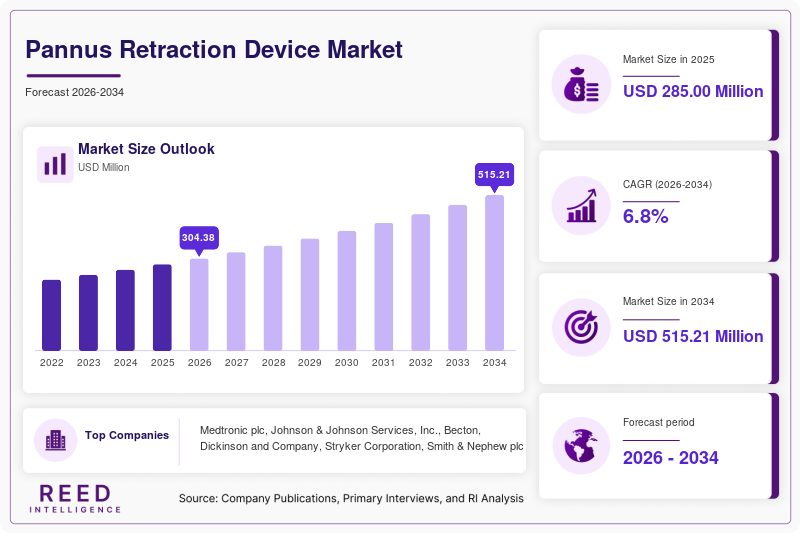
Key Highlights:
- North America dominated the market with a 38% share, while Asia Pacific is expected to grow at the fastest CAGR of 8.2% during the forecast period.
- By product type, adjustable pannus retractors held the largest share, while disposable devices are projected to grow at a CAGR of 7.5%.
- By end-use, hospitals accounted for the largest share, whereas ambulatory surgical centers are expected to witness the fastest growth at 7.9% CAGR.
- The United States remained the dominant country, with market values of USD 102 million in 2024 and USD 108 million in 2025.
Market Trends
Increasing Adoption of Disposable Surgical Devices
The market is witnessing a shift toward disposable pannus retraction devices due to growing concerns regarding infection control and cross-contamination. Healthcare facilities are prioritizing single-use devices to comply with strict sterilization protocols and reduce hospital-acquired infections. This trend is particularly evident in developed regions where regulatory standards are stringent. Disposable devices also reduce the operational burden of sterilization and maintenance, making them a practical choice for high-volume surgical centers.
Integration of Ergonomic and Patient-Centric Designs
Manufacturers are focusing on designing pannus retraction devices that enhance surgeon comfort and improve patient outcomes. Ergonomic handles, adjustable tension mechanisms, and lightweight materials are being incorporated to reduce fatigue during prolonged procedures. Additionally, devices are being developed to accommodate diverse patient anatomies, especially in bariatric cases. This trend is encouraging innovation and differentiation among manufacturers, contributing to increased adoption rates across healthcare settings.
Market Drivers
Rising Prevalence of Obesity and Related Surgeries
The global increase in obesity rates has led to a surge in bariatric and abdominal surgeries, directly driving demand for pannus retraction devices. These devices play a critical role in managing excess abdominal tissue during surgical procedures, ensuring better access and visibility for surgeons. As obesity continues to be a major public health concern, the volume of related surgeries is expected to rise steadily, supporting market growth.
Growth in Surgical Procedures Worldwide
The overall increase in surgical procedures, including gynecological and general surgeries, is another key driver. Aging populations and the rising burden of chronic diseases are contributing to higher surgical volumes globally. Pannus retraction devices are essential tools in many of these procedures, enhancing surgical efficiency and safety. This consistent demand across multiple surgical specialties is strengthening the market outlook.
Market Restraint
High Cost of Advanced Surgical Devices
One of the primary challenges in the Pannus Retraction Device Market is the high cost associated with advanced and technologically enhanced devices. Hospitals and healthcare facilities, particularly in developing regions, often face budget constraints that limit the adoption of premium surgical instruments. Reusable devices require additional investment in sterilization infrastructure, while disposable devices increase recurring costs.
Furthermore, smaller healthcare facilities may rely on traditional retraction methods due to cost considerations, reducing the adoption of specialized pannus retraction devices. Price sensitivity among healthcare providers can also affect purchasing decisions, especially in regions with limited reimbursement frameworks.
Although technological advancements have improved device efficiency and usability, they have also contributed to increased manufacturing costs, which are passed on to end users. This cost barrier may slow down market penetration in price-sensitive regions, posing a restraint to overall growth.
Market Opportunities
Expansion in Emerging Markets
Emerging economies present significant growth opportunities for the Pannus Retraction Device Market due to improving healthcare infrastructure and increasing access to surgical care. Governments and private investors are expanding hospital networks and upgrading medical facilities, creating demand for advanced surgical instruments. As awareness of modern surgical techniques grows, adoption of pannus retraction devices is expected to increase in these regions.
Technological Innovations in Device Design
Continuous innovation in device design offers substantial growth potential. Manufacturers are investing in research and development to create more efficient, cost-effective, and user-friendly devices. Innovations such as adjustable tension systems, improved materials, and hybrid reusable-disposable models are gaining traction. These advancements can address existing limitations and expand the application scope of pannus retraction devices, opening new revenue streams for market players.
Segmental Analysis
By Product Type
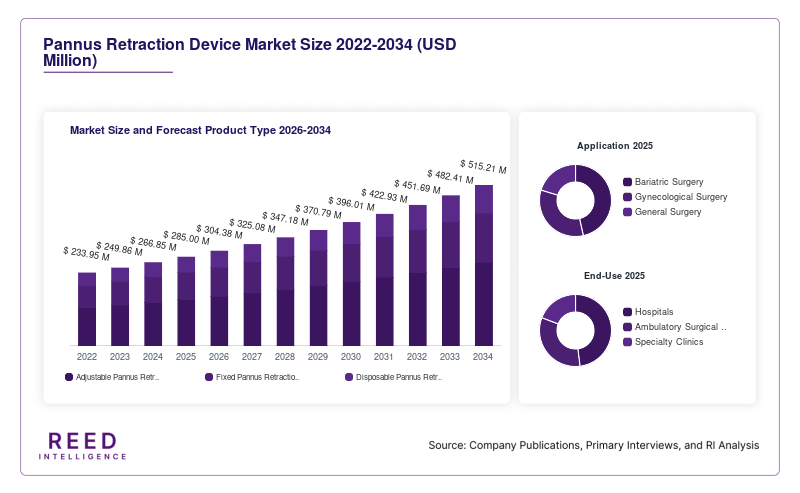
Adjustable pannus retraction devices dominated the market with a share of approximately 58% in 2024. Their flexibility and ability to accommodate different patient anatomies made them widely preferred in surgical procedures.
Disposable pannus retraction devices are expected to grow at the fastest CAGR of 7.5% during the forecast period. Their increasing adoption is driven by infection control requirements and reduced need for sterilization.
By Material
Metal-based devices held the largest share of around 52% in 2024 due to their durability and widespread use in reusable surgical instruments.
Polymer-based devices are projected to grow at a CAGR of 7.8% owing to their lightweight nature and cost-effectiveness. These materials are gaining popularity in disposable device manufacturing.
By Application
Bariatric surgery accounted for the largest share of approximately 46% in 2024, driven by the increasing prevalence of obesity and related surgical procedures.
Gynecological surgery is expected to grow at the fastest CAGR of 7.3% due to rising awareness and increasing number of procedures in this segment.
By End-Use
Hospitals dominated the market with a share of 62% in 2024, as they handle a high volume of complex surgical procedures requiring advanced equipment.
Ambulatory surgical centers are projected to grow at a CAGR of 7.9%, supported by the shift toward outpatient procedures and cost-effective surgical care.
Regional Analysis
North America
North America accounted for approximately 38% of the Pannus Retraction Device Market share in 2025 and will grow at a CAGR of 6.2% through 2034. The region benefited from advanced healthcare infrastructure and high surgical procedure volumes.
The United States dominated the regional market due to strong adoption of advanced surgical tools. The presence of well-established healthcare systems and a high prevalence of obesity contributed to consistent demand for pannus retraction devices.
Europe
Europe held around 27% of the market share in 2025 and is expected to grow at a CAGR of 6.5% during the forecast period. The region experienced steady growth driven by increasing healthcare expenditure and surgical advancements.
Germany emerged as the leading country, supported by a robust healthcare system and growing demand for innovative surgical devices. The country’s focus on improving surgical outcomes contributed to higher adoption rates.
Asia Pacific
Asia Pacific captured nearly 20% of the market share in 2025 and is projected to expand at the fastest CAGR of 8.2% through 2034. Rapid urbanization and healthcare development supported market growth.
China led the region due to increasing investments in healthcare infrastructure and a rising number of surgical procedures. The expanding patient population and improving access to medical services further boosted demand.
Middle East & Africa
The Middle East & Africa region held about 8% of the market share in 2025 and is expected to grow at a CAGR of 7.0%. Growth was supported by gradual improvements in healthcare facilities.
Saudi Arabia dominated the region, driven by government initiatives to modernize healthcare infrastructure and increase surgical capacity. The adoption of advanced medical devices is expected to continue rising.
Latin America
Latin America accounted for approximately 7% of the market share in 2025 and is projected to grow at a CAGR of 6.9%. Increasing healthcare awareness and infrastructure development contributed to market expansion.
Brazil was the leading country in the region, supported by a growing number of surgical procedures and improving access to healthcare services. The country’s expanding medical sector is expected to drive future demand.

Competitive Landscape
The Pannus Retraction Device Market is moderately competitive, with several established players focusing on product innovation and strategic expansion. Companies are investing in research and development to enhance device functionality and improve patient outcomes.
A leading player in the market has strengthened its position through the introduction of advanced adjustable retraction systems designed for improved surgical efficiency. This development reflects the increasing emphasis on ergonomic design and ease of use.
Other key players are expanding their global presence through partnerships, mergers, and distribution agreements. The competitive landscape is characterized by a mix of established manufacturers and emerging companies, all aiming to capture a larger share of the growing market.
Key Players
- Medtronic plc
- Johnson & Johnson Services, Inc.
- Becton, Dickinson and Company
- Stryker Corporation
- Smith & Nephew plc
- Cardinal Health, Inc.
- Integra LifeSciences Corporation
- CooperSurgical, Inc.
- Applied Medical Resources Corporation
- Teleflex Incorporated
Recent Developments
- 2024: A major manufacturer launched a next-generation adjustable pannus retraction system with enhanced ergonomic features.
- 2024: Several companies expanded their presence in Asia Pacific through distribution partnerships.
- 2025: New disposable device variants were introduced to meet increasing demand for infection control solutions.
- 2025: Strategic collaborations were formed to improve product availability in emerging markets.
Pannus Retraction Device Market Segments
Product Type
- Adjustable Pannus Retraction Devices
- Fixed Pannus Retraction Devices
- Disposable Pannus Retraction Devices
Application
- Bariatric Surgery
- Gynecological Surgery
- General Surgery
End-Use
- Hospitals
- Ambulatory Surgical Centers
- Specialty Clinics
Material
- Metal-Based Devices
- Polymer-Based Devices
- Hybrid Materials
By Region
- North America
- Europe
- APAC
- Middle East and Africa
- LATAM