Paper Based Biofuel Cell Market Size, Share & Demand Report By Type (Enzymatic Biofuel Cells, Microbial Biofuel Cells), By Application (Medical Diagnostics, Environmental Monitoring, Wearable Electronics, Smart Packaging), By Material (Carbon-Based Materials, Nanomaterials, Conductive Polymers), By End-Use Industry (Healthcare, Consumer Electronics, Environmental Sector, Food & Packaging) By Region & Segment Forecasts, 2025–2034
USD 3950
Market Overview
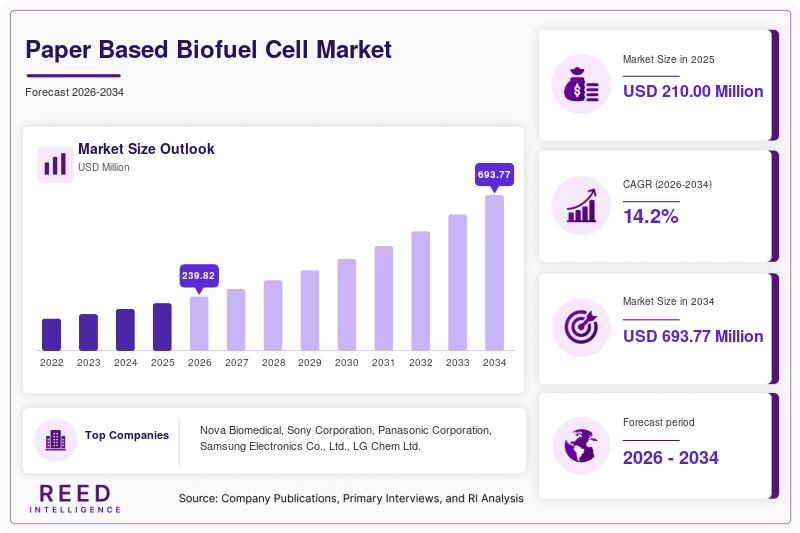
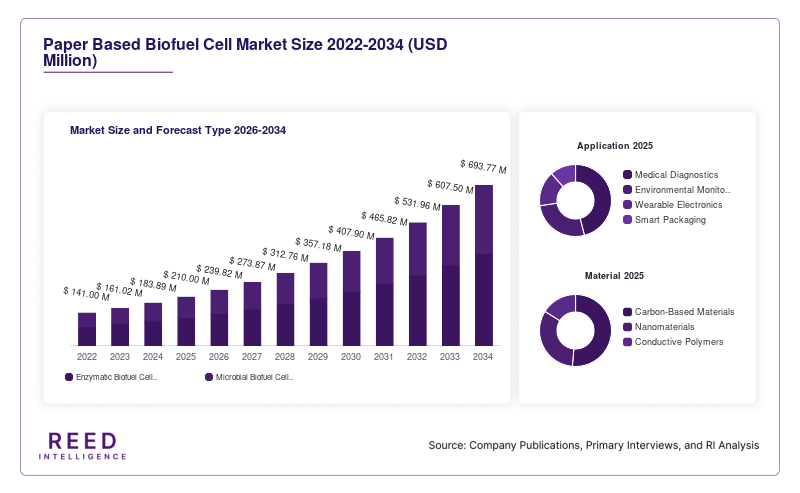
The global Paper Based Biofuel Cell Market size was valued at approximately USD 210 million in 2025 and is projected to reach USD 685 million by 2034, expanding at a CAGR of 14.2% during 2025–2034. The market is gaining momentum due to increasing demand for sustainable, low-cost, and disposable energy solutions across healthcare diagnostics, environmental monitoring, and wearable electronics. Paper-based biofuel cells, which utilize organic substrates and enzymes to generate electricity, offer a biodegradable and eco-friendly alternative to conventional batteries.
One of the primary global factors supporting market growth is the rising emphasis on green energy solutions and circular economy initiatives. Governments and industries worldwide are shifting toward environmentally responsible technologies, driving the adoption of biodegradable power sources in point-of-care devices and smart packaging applications.
Key Highlights:
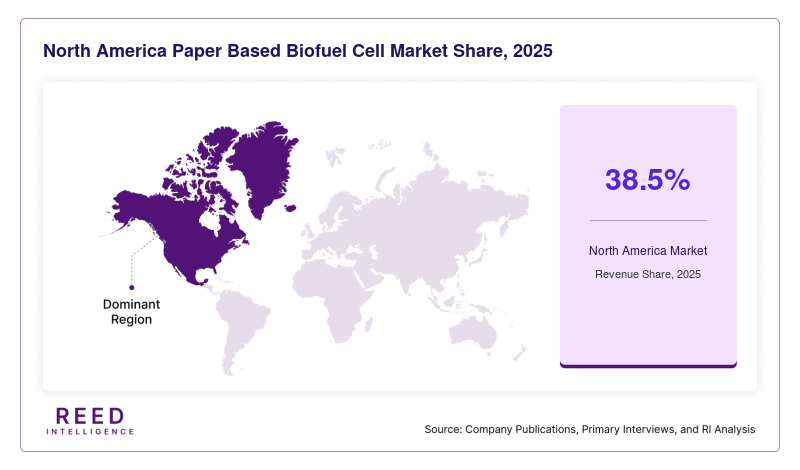
- North America dominated the market with 38.5% share in 2025, while Asia Pacific is expected to register the fastest CAGR of 16.8%.
- By application, medical diagnostics led with 42% share, while wearable electronics is projected to grow fastest at 17.5% CAGR.
- By type, enzymatic biofuel cells dominated, while microbial biofuel cells are expected to grow rapidly at 15.9% CAGR.
- The U.S. remained the dominant country, with market values of USD 62 million in 2024 and USD 70 million in 2025.
Market Trends
Integration with Wearable and Flexible Electronics
The integration of paper-based biofuel cells into wearable and flexible electronics is a key trend shaping the Paper Based Biofuel Cell Market. These cells are lightweight, flexible, and compatible with skin-contact applications, making them ideal for powering biosensors, fitness trackers, and medical monitoring devices. The trend is further supported by the growing demand for continuous health monitoring systems that require low-power, sustainable energy sources.
Advancements in Printed Electronics and Microfluidics
Technological progress in printed electronics and microfluidic platforms is enhancing the performance and scalability of paper-based biofuel cells. Manufacturers are increasingly leveraging inkjet and screen-printing techniques to fabricate cost-effective and high-precision biofuel cells. These innovations are enabling mass production while maintaining consistent quality, thus expanding the commercial viability of these systems across industries such as environmental sensing and smart packaging.
Market Drivers
Growing Demand for Sustainable Energy Solutions
The rising global focus on sustainability is significantly driving the Paper Based Biofuel Cell Market. Industries are seeking alternatives to conventional batteries that contribute to environmental pollution. Paper-based biofuel cells, being biodegradable and non-toxic, align with sustainability goals and regulatory frameworks, encouraging their adoption across healthcare, packaging, and consumer electronics sectors.
Increasing Adoption in Point-of-Care Diagnostics
The expansion of point-of-care diagnostic applications is another major driver. Paper-based biofuel cells provide a reliable and cost-effective power source for disposable diagnostic devices, particularly in remote and resource-limited settings. Their ability to operate using biological fluids such as glucose or sweat enhances their practicality, making them highly suitable for rapid testing kits and biosensors.
Market Restraint
Limited Power Output and Efficiency Constraints
One of the key challenges in the Paper Based Biofuel Cell Market is the relatively low power output compared to traditional energy storage solutions. While these cells are suitable for low-power applications, their efficiency limitations restrict their use in high-energy-demand devices. The dependence on biological catalysts such as enzymes also introduces stability issues, as these components can degrade over time, affecting performance and lifespan.
Furthermore, scaling up production while maintaining consistent efficiency remains a technical hurdle. Variability in paper substrates and environmental conditions can impact performance, posing challenges for large-scale commercialization. These limitations may hinder adoption in applications requiring long-term reliability and higher energy density.
Market Opportunities
Expansion in Smart Packaging Applications
The integration of paper-based biofuel cells in smart packaging presents a significant growth opportunity. These cells can power sensors that monitor temperature, humidity, and product freshness in real time. With the increasing demand for intelligent packaging solutions in the food and pharmaceutical industries, the Paper Based Biofuel Cell Market is poised to benefit from this emerging application area.
Development of Hybrid Biofuel Cell Systems
The development of hybrid systems combining biofuel cells with other energy storage technologies offers promising potential. By integrating supercapacitors or thin-film batteries, manufacturers can overcome power limitations and enhance overall performance. This approach is expected to expand the application scope of paper-based biofuel cells, particularly in advanced wearable devices and IoT applications.
Segmental Analysis
By Type
Enzymatic biofuel cells dominated the Paper Based Biofuel Cell Market with a 68% share in 2024. Their high specificity and efficiency in converting biochemical energy into electrical energy made them the preferred choice for medical and wearable applications.
Microbial biofuel cells are expected to grow at the fastest CAGR of 15.9% during the forecast period. Their ability to utilize a wide range of organic substrates and operate in diverse environments will drive their adoption in environmental monitoring applications.
By Application
Medical diagnostics emerged as the dominant application segment, accounting for 42% of the market share in 2024. The increasing use of disposable diagnostic devices and biosensors has significantly contributed to this segment’s growth.
Wearable electronics are projected to grow at the fastest CAGR of 17.5%. The rising demand for continuous health monitoring and fitness tracking devices is expected to drive the adoption of paper-based biofuel cells in this segment.
By Material
Carbon-based materials dominated the market with a 55% share in 2024, owing to their excellent conductivity and compatibility with paper substrates.
Nanomaterial-based electrodes are expected to witness the fastest growth, with a CAGR of 16.2%, driven by their enhanced surface area and improved electron transfer capabilities.
By End-Use Industry
The healthcare sector held the largest share at 48% in 2024, driven by the increasing adoption of point-of-care diagnostic devices.
The consumer electronics segment is anticipated to grow at a CAGR of 16.7%, supported by the rising demand for sustainable and flexible power sources in wearable devices.
Regional Analysis
North America
North America accounted for 38.5% of the Paper Based Biofuel Cell Market share in 2025 and is expected to grow at a CAGR of 13.5% through 2034. The region’s growth is supported by strong research infrastructure and early adoption of advanced technologies.
The United States dominated the regional market due to significant investments in biomedical research and sustainable energy technologies. The presence of leading research institutions and funding for innovative healthcare solutions has accelerated the development and commercialization of paper-based biofuel cells.
Europe
Europe held approximately 27.2% market share in 2025 and is projected to expand at a CAGR of 13.8% during the forecast period. The region benefits from stringent environmental regulations and a strong focus on green technologies.
Germany emerged as the dominant country, driven by its emphasis on sustainable manufacturing and advanced materials research. The country’s robust industrial base and commitment to environmental sustainability have facilitated the adoption of biodegradable energy solutions.
Asia Pacific
Asia Pacific captured 22.8% of the market share in 2025 and is anticipated to register the fastest CAGR of 16.8%. Rapid industrialization and increasing investments in healthcare infrastructure are key growth factors.
China led the regional market due to its expanding electronics manufacturing sector and growing focus on renewable energy technologies. Government initiatives promoting innovation and sustainability have further accelerated market growth.
Middle East & Africa
The Middle East & Africa accounted for 6.5% of the market share in 2025 and is expected to grow at a CAGR of 12.6%. The region is gradually adopting sustainable technologies, particularly in healthcare and environmental monitoring.
The United Arab Emirates dominated the market, driven by investments in smart healthcare solutions and sustainability initiatives. The country’s focus on innovation and infrastructure development is supporting market expansion.
Latin America
Latin America held 5.0% market share in 2025 and is projected to grow at a CAGR of 12.9%. The region is witnessing increasing adoption of cost-effective and eco-friendly technologies.
Brazil led the regional market due to its growing healthcare sector and emphasis on sustainable development. Government support for renewable energy and technological innovation is driving the adoption of paper-based biofuel cells.
Competitive Landscape
The Paper Based Biofuel Cell Market is characterized by a mix of established players and emerging startups focusing on innovation and product development. Companies are investing in research to improve efficiency and scalability while expanding their application portfolios.
A leading player in the market is Nova Biomedical, which has been actively developing advanced biofuel cell technologies for healthcare applications. The company recently introduced a new paper-based biofuel cell prototype with improved energy output and stability, enhancing its competitive position.
Other key players are focusing on strategic collaborations, product launches, and technological advancements to strengthen their market presence. The competitive landscape remains dynamic, with continuous innovation driving growth.
Key Players
- Nova Biomedical
- Sony Corporation
- Panasonic Corporation
- Samsung Electronics Co., Ltd.
- LG Chem Ltd.
- Renesas Electronics Corporation
- STMicroelectronics
- ABB Ltd.
- Siemens AG
- Medtronic plc
Recent Developments
- 2024: Nova Biomedical launched a new enzymatic paper-based biofuel cell with enhanced durability.
- 2024: Sony Corporation invested in printed bioelectronics for wearable applications.
- 2025: Panasonic Corporation developed a hybrid biofuel cell system integrating paper substrates.
- 2025: Samsung Electronics expanded research into flexible energy solutions for IoT devices.
- 2025: DuPont introduced advanced nanomaterials for improving biofuel cell efficiency.
Paper Based Biofuel Cell Market Segments
Type
- Enzymatic Biofuel Cells
- Microbial Biofuel Cells
Application
- Medical Diagnostics
- Environmental Monitoring
- Wearable Electronics
- Smart Packaging
Material
- Carbon-Based Materials
- Nanomaterials
- Conductive Polymers
End-Use Industry
- Healthcare
- Consumer Electronics
- Environmental Sector
- Food & Packaging
By Region
- North America
- Europe
- APAC
- Middle East and Africa
- LATAM