Paraquat Market Size, Share, Demand Report By Formulation (Liquid, Granular, Others), By Application (Agricultural Use, Non-Agricultural Use), By End-Use Crop (Row Crops, Plantation Crops, Horticultural Crops, Others), By Distribution Channel (Direct Sales, Retail Sales, Online Channels), By Region & Segment Forecasts, 2026–2034
USD 3950
Market Overview
The Paraquat Market size is estimated at USD 1.42 billion, and it is expected to reach USD 2.31 billion by 2034, registering a CAGR of 6.2% during the forecast period (2026–2034).The growth of the Paraquat Market is primarily supported by rising global food demand, which has intensified the need for high-yield farming practices and effective weed management solutions. Paraquat, known for its fast-acting and broad-spectrum weed control properties, continues to be widely adopted in plantation crops and pre-harvest applications across developing economies.
Key agricultural intensification policies in emerging economies, along with mechanized farming expansion, have further contributed to Paraquat Market growth. However, regulatory restrictions in certain developed countries continue to influence market dynamics.
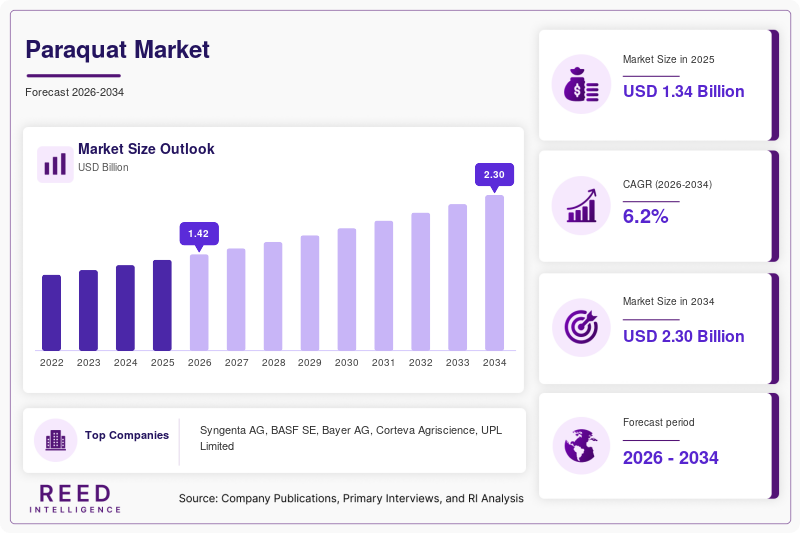
Key Highlights
- Dominant region share (2025): Asia Pacific held 38.4% of the Paraquat Market
- Fastest-growing region CAGR (2026–2034): Latin America at 7.1%
- Leading subsegment (Type): Liquid formulation held 64.7% share in 2025
- Fastest-growing subsegment: Granular formulation at 6.8% CAGR (2026–2034)
- Dominant country (2024–2025): China market value increased from USD 0.31 billion (2024) to USD 0.33 billion (2025)
Market Trends
Shift Toward Precision Agriculture Integration
The Paraquat Market is increasingly influenced by the adoption of precision agriculture technologies. Farmers are integrating herbicide application with GPS-based spraying systems and drone-assisted field monitoring. This trend reduces chemical wastage and improves application efficiency, thereby optimizing herbicide usage patterns. The integration of data-driven farming practices is expected to improve the controlled use of paraquat, especially in large commercial farms across Asia Pacific and Latin America.
Rising Demand for Fast-Acting Weed Control Solutions
Another significant trend in the Paraquat Market is the growing preference for fast-acting herbicides. Paraquat’s ability to rapidly desiccate weeds within hours makes it highly valuable in pre-harvest crop management. This trend is particularly evident in plantation crops such as oil palm, tea, and rubber, where quick weed suppression is essential to maintain yield efficiency and reduce labor costs.
Market Drivers
Expansion of Commercial Agriculture
The expansion of commercial-scale farming is a major driver of the Paraquat Market. Large agricultural enterprises require cost-effective and high-performance herbicides to manage extensive farmland. Paraquat’s effectiveness in controlling a wide range of weeds makes it a preferred choice in plantation agriculture and non-crop land management.
Increasing Global Food Demand
Rising population levels and food security concerns are driving the need for improved agricultural productivity. The Paraquat Market benefits from this trend as farmers seek efficient weed control solutions to maximize crop yield per hectare. Developing regions, in particular, are increasing herbicide consumption to enhance agricultural output and reduce post-harvest losses.
Market Restraint
Regulatory Restrictions and Environmental Concerns
A major restraint affecting the Paraquat Market is the increasing regulatory scrutiny due to toxicity concerns. Several countries have either banned or strictly regulated paraquat usage due to its environmental persistence and health risks. These regulatory constraints limit market expansion in developed regions and push manufacturers to focus on safer formulation alternatives or restricted-use classifications.
Market Opportunities
Growth in Emerging Agricultural Economies
Emerging economies in Asia, Africa, and Latin America present significant opportunities for the Paraquat Market. Increasing agricultural modernization, coupled with government support for crop productivity enhancement, is expected to drive herbicide demand. Countries with large plantation crop sectors are particularly attractive for paraquat suppliers.
Development of Safer Formulations and Tank Mix Solutions
Innovation in formulation chemistry presents another opportunity in the Paraquat Market. Manufacturers are investing in safer handling formulations and combination products that reduce environmental impact while maintaining efficacy. Tank mix compatibility with other herbicides is also gaining traction, improving operational efficiency for farmers.
Segmental Analysis
By Formulation Type
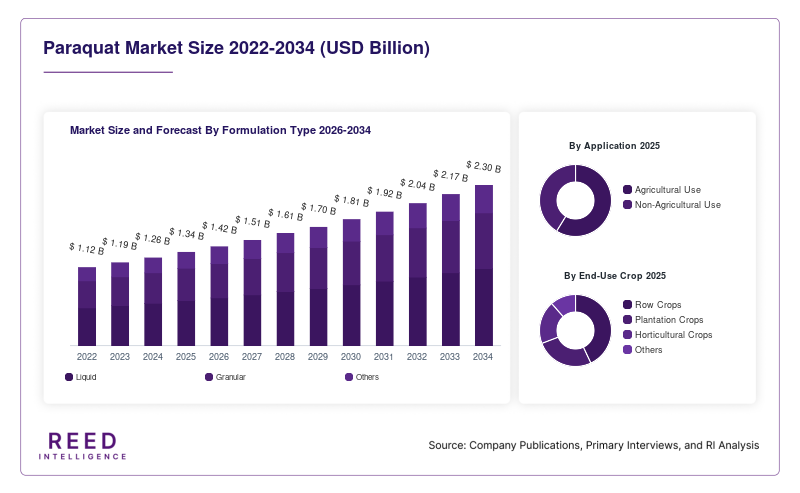
In 2025, the liquid formulation segment dominated the Paraquat Market with 64.7% share, driven by ease of application and rapid absorption in foliar spraying systems. Liquid paraquat remains the preferred choice for plantation and row crops. Meanwhile, the granular formulation segment is expected to grow at a CAGR of 6.8% (2026–2034) due to improved handling safety, reduced drift risk, and increasing adoption in mechanized farming systems.
By Application
The agriculture segment held the dominant position in the Paraquat Market, accounting for 71.3% share in 2025, primarily due to its widespread use in pre-harvest desiccation and weed control in crops such as cotton, oil palm, and cereals. The non-agricultural application segment, including industrial vegetation management and roadside weed control, is projected to grow at a CAGR of 5.9%, supported by infrastructure development and land maintenance requirements.
By End-Use Crop
Row crops dominated the Paraquat Market in 2025 with 46.8% share, driven by large-scale cultivation of corn, soybean, and wheat. Plantation crops are expected to be the fastest-growing subsegment at a CAGR of 7.3%, supported by expanding palm oil, tea, and rubber plantations in Asia and Latin America.
By Distribution Channel
Direct sales accounted for 58.2% share of the Paraquat Market in 2025, primarily due to bulk procurement by large agricultural enterprises. However, retail distribution channels are expected to grow at a CAGR of 6.1% as small and medium farmers increasingly access agrochemical products through local distributors and digital agriculture platforms.
Regional Analysis
North America
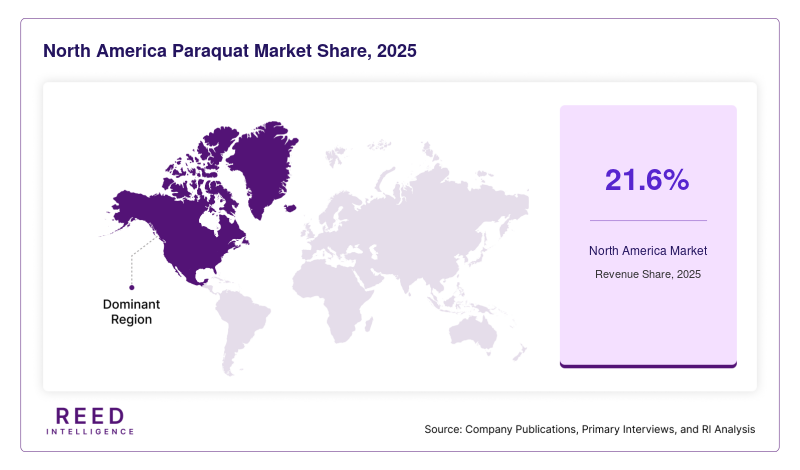
North America accounted for 21.6% of the Paraquat Market share in 2025, with a forecast CAGR of 5.1% (2026–2034). The region’s demand is primarily driven by large-scale grain farming and strict weed management requirements. The United States remains the dominant country, supported by mechanized agriculture and high herbicide application efficiency in corn and soybean cultivation.
Europe
Europe held 15.2% share of the Paraquat Market in 2025, and is expected to grow at a CAGR of 4.3%. Growth remains moderate due to stringent regulatory frameworks restricting paraquat usage. However, selective applications in permitted agricultural zones and controlled environments continue to support limited demand. Spain and Italy are key contributors due to Mediterranean crop cultivation systems.
Asia Pacific
Asia Pacific dominated the Paraquat Market with 38.4% share in 2025, and is projected to grow at a CAGR of 6.9%. China and India are the leading contributors due to extensive agricultural land and high dependency on herbicides for weed control in rice, tea, and plantation crops. China remains the dominant country due to large-scale agrochemical production and domestic consumption expansion.
Middle East & Africa
The Middle East & Africa region accounted for 12.1% share in 2025, with a projected CAGR of 6.4% (2026–2034). Growth is supported by increasing agricultural investments in irrigation-based farming systems. South Africa leads the region, driven by commercial farming expansion and increasing adoption of herbicide-based weed management.
Latin America
Latin America held 12.7% share of the Paraquat Market in 2025, and is expected to grow at the fastest CAGR of 7.1%. Brazil is the dominant country, driven by large-scale soybean and sugarcane production. Expanding export-oriented agriculture and favorable climatic conditions continue to boost herbicide demand.
Competitive Landscape
The Paraquat Market is moderately consolidated, with a mix of multinational agrochemical corporations and regional manufacturers competing on formulation efficiency, pricing strategies, and distribution networks. The market leader maintains a strong position through extensive product portfolios and global supply chain integration. Key players focus on regulatory compliance, sustainable formulation development, and strategic partnerships with agricultural distributors.
Recent developments indicate increased investment in safer herbicide formulations and improved packaging standards to meet regulatory expectations in developed markets. Companies are also expanding their presence in Asia Pacific and Latin America to capture rising demand. Digital agriculture partnerships and farmer education initiatives are becoming important competitive strategies. Mergers and acquisitions are also shaping the competitive environment, enabling firms to strengthen regional footprints and enhance production capabilities. Overall, competition in the Paraquat Market is driven by innovation, regulatory adaptation, and geographic expansion strategies.
Key Players List
- Syngenta AG
- BASF SE
- Corteva Agriscience
- Bayer AG
- UPL Limited
- ADAMA Agricultural Solutions
- Nufarm Limited
- FMC Corporation
- SinoHarvest Corporation
- Jiangsu Yangnong Chemical Group
- Limin Chemical Co., Ltd.
- Zhejiang Yongnong Chem. Ind. Co.
- Nissan Chemical Corporation
- Shandong Luba Chemical Co.
- Rainbow Agro Sciences Co., Ltd.
Recent Developments
- In 2025, several manufacturers expanded production capacity for liquid herbicide formulations to meet rising demand in Asia Pacific.
- Regulatory updates in select Latin American countries permitted controlled usage of paraquat under restricted application guidelines.
- Agrochemical companies increased investment in precision spraying technologies to improve application efficiency in the Paraquat Market.
- Strategic collaborations between agrochemical firms and digital farming platforms were introduced to enhance farmer access to herbicide advisory services.
- New packaging innovations focusing on spill reduction and safe handling were introduced across major manufacturing facilities.
Paraquat Market Segments
By Formulation Type
- Liquid
- Granular
- Others
By Application
- Agricultural Use
- Non-Agricultural Use
By End-Use Crop
- Row Crops
- Plantation Crops
- Horticultural Crops
- Others
By Distribution Channel
- Direct Sales
- Retail Sales
- Online Channels
By Region
- North America
- Europe
- APAC
- Middle East and Africa
- LATAM