Parathyroid Adenoma Market Size, Share & Demand Report By Diagnosis Type (Imaging Diagnostics, Blood Tests, Nuclear Imaging, Molecular Diagnostics), By Treatment Type (Minimally Invasive Parathyroidectomy, Bilateral Neck Exploration Surgery), By End User (Hospitals, Ambulatory Surgical Centers), By Patient Type (Adult Patients, Geriatric Patients) & Regional Forecasts, 2026–2034
USD 3950
Market Overview
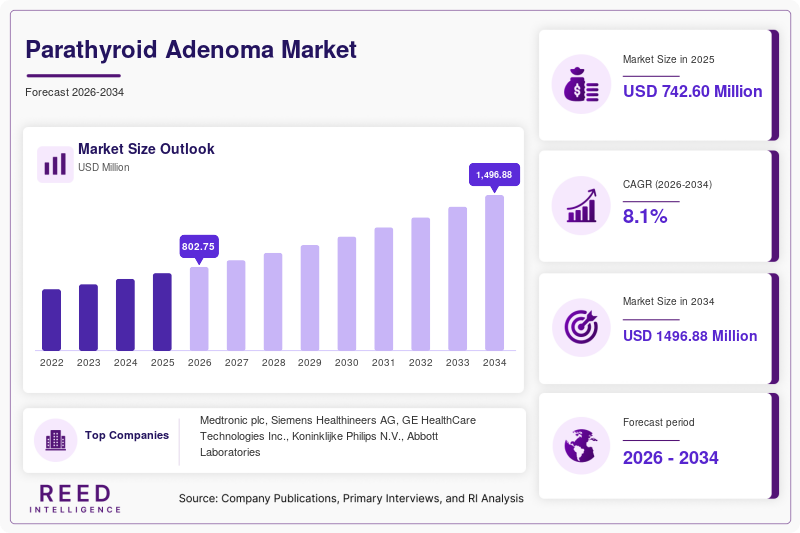
The Parathyroid Adenoma Market size was valued at USD 742.6 million in 2026 and is projected to reach USD 1.38 billion by 2034, expanding at a CAGR of 8.1% during the forecast period (2026–2034). The market growth is being supported by the increasing prevalence of endocrine disorders and the growing adoption of advanced diagnostic imaging technologies across hospitals and specialty endocrine centers. Rising awareness regarding calcium imbalance disorders and improved access to minimally invasive surgical procedures have also contributed to the expansion of the Parathyroid Adenoma Market across developed and emerging healthcare systems.
The growing elderly population worldwide has played a significant role in supporting demand for parathyroid adenoma diagnosis and treatment services. Aging populations are more susceptible to hyperparathyroidism and calcium metabolism disorders, resulting in increased screening rates and surgical interventions. Healthcare providers are increasingly focusing on early disease detection through blood testing, ultrasound imaging, sestamibi scans, and advanced nuclear imaging solutions. These developments have enhanced diagnostic accuracy and improved patient outcomes, thereby strengthening the overall outlook of the Parathyroid Adenoma Market.
Key Highlights
- North America dominated the Parathyroid Adenoma Market with a 38.7% share in 2025, while Asia Pacific is projected to register the fastest CAGR of 9.4% during 2026–2034.
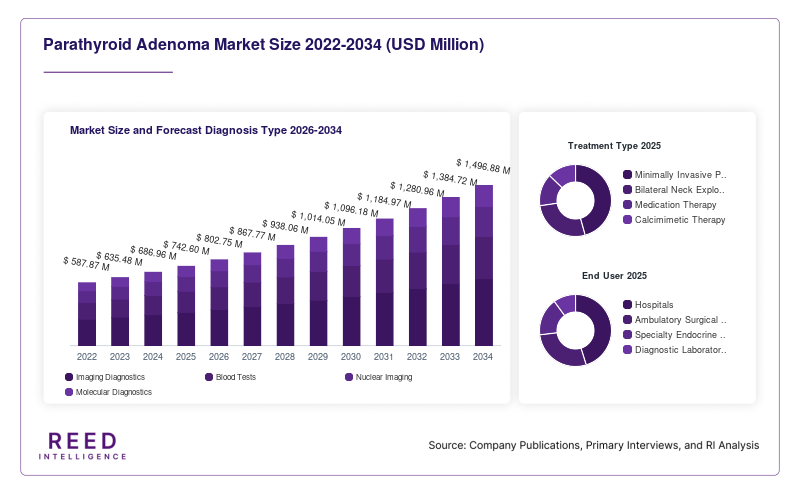
- By diagnosis type, imaging diagnostics held the largest market share of 46.2% in 2025, while molecular diagnostics is anticipated to grow at a CAGR of 9.8% during the forecast period.
- By treatment type, minimally invasive parathyroidectomy accounted for 51.6% market share in 2025, whereas calcimimetic therapy is projected to expand at a CAGR of 8.9%.
- By end user, hospitals represented 57.4% of the market share in 2025, while specialty endocrine clinics are expected to grow at a CAGR of 9.1% through 2034.
- The U.S. Parathyroid Adenoma Market was valued at USD 196.4 million in 2024 and reached USD 211.8 million in 2025.
Market Trends
Increasing Adoption of Minimally Invasive Surgical Techniques
One of the major trends shaping the Parathyroid Adenoma Market is the increasing preference for minimally invasive surgical procedures. Surgeons are increasingly using image-guided and focused parathyroidectomy procedures to improve precision and reduce recovery periods. These procedures minimize tissue damage, reduce hospital stays, and lower postoperative complications. Hospitals and ambulatory surgical centers are investing in advanced intraoperative monitoring systems and real-time imaging tools to improve procedural efficiency. The trend is expected to continue as healthcare providers focus on patient-centric surgical outcomes and cost optimization.
Rising Integration of Advanced Diagnostic Imaging
Advanced diagnostic imaging technologies are becoming increasingly important in the Parathyroid Adenoma Market. Healthcare facilities are integrating 4D CT scans, high-resolution ultrasound systems, and nuclear imaging technologies for accurate adenoma localization. Improved imaging precision is helping physicians identify abnormal parathyroid glands earlier and reduce surgical exploration time. This trend is supporting earlier diagnosis and increasing the success rate of minimally invasive procedures. The growing availability of AI-supported diagnostic imaging platforms is also expected to improve detection efficiency over the forecast period.
Market Drivers
Growing Prevalence of Hyperparathyroidism Disorders
The increasing incidence of primary hyperparathyroidism is a major factor driving the Parathyroid Adenoma Market. Lifestyle changes, aging populations, and rising vitamin D deficiency rates are contributing to higher disease occurrence globally. Patients are increasingly undergoing blood calcium testing and endocrine evaluations, resulting in greater diagnosis rates. Healthcare organizations are also launching awareness programs to encourage early screening for endocrine disorders, which is supporting market growth.
Expansion of Specialized Endocrine Care Infrastructure
The rapid development of specialty endocrine care centers is another major growth driver for the market. Hospitals and healthcare networks are establishing dedicated endocrine surgery departments equipped with advanced diagnostic and surgical technologies. Improved access to endocrinologists and specialized surgeons is increasing the number of successful treatment procedures. In addition, healthcare providers are emphasizing multidisciplinary treatment approaches, improving patient management and long-term follow-up care.
Market Restraint
High Cost of Advanced Diagnostic and Surgical Procedures
One of the major restraints affecting the Parathyroid Adenoma Market is the high cost associated with advanced imaging systems and minimally invasive surgeries. Many developing healthcare systems face budget limitations that restrict access to sophisticated diagnostic technologies and specialized surgical expertise. Patients without comprehensive insurance coverage may also delay treatment due to financial concerns, which can limit market penetration in cost-sensitive regions.
Market Opportunities
Expansion of AI-Based Endocrine Diagnostic Platforms
Artificial intelligence integration in endocrine diagnostics presents a significant opportunity for the Parathyroid Adenoma Market. AI-assisted imaging analysis systems are improving lesion detection and supporting faster clinical decision-making. Healthcare providers are increasingly adopting predictive analytics and automated reporting systems to enhance diagnostic workflows. These innovations are expected to create new growth opportunities for imaging equipment manufacturers and software developers.
Growth in Ambulatory Surgical Centers
The rising number of ambulatory surgical centers is creating strong opportunities within the market. Outpatient endocrine procedures are gaining popularity due to lower treatment costs and shorter recovery times. Ambulatory centers are investing in specialized endocrine surgical capabilities to meet increasing patient demand. This trend is expected to expand treatment accessibility and reduce healthcare system burden over the forecast period.
Segmental Analysis
By Diagnosis Type
Based on diagnosis type, the market is segmented into imaging diagnostics, blood tests, nuclear imaging, and molecular diagnostics.
Imaging diagnostics dominated the Parathyroid Adenoma Market with a 46.2% share in 2025. The segment growth was supported by widespread adoption of ultrasound imaging and CT-based localization procedures in hospitals and endocrine clinics. Healthcare providers increasingly relied on imaging diagnostics to improve surgical planning and reduce operative complications.
Molecular diagnostics is expected to witness the fastest CAGR of 9.8% during the forecast period. The segment growth will be driven by advancements in genetic testing and biomarker analysis technologies. Increased research activities focused on endocrine tumor profiling are expected to strengthen demand for molecular diagnostic tools.
By Treatment Type
Based on treatment type, the market is categorized into minimally invasive parathyroidectomy, bilateral neck exploration surgery, medication therapy, and calcimimetic therapy.
Minimally invasive parathyroidectomy held the largest market share of 51.6% in 2025 due to growing physician preference for targeted surgical procedures with shorter recovery times. Hospitals increasingly adopted image-guided surgical systems to improve precision and reduce hospitalization duration.
Calcimimetic therapy is projected to grow at the fastest CAGR of 8.9% during the forecast period. The segment expansion will be supported by increasing demand for non-surgical management options among elderly patients and individuals unsuitable for surgery. Pharmaceutical companies are also investing in advanced calcium regulation therapies.
By End User
Based on end user, the market is segmented into hospitals, ambulatory surgical centers, specialty endocrine clinics, and diagnostic laboratories.
Hospitals accounted for 57.4% of the Parathyroid Adenoma Market share in 2025 owing to the availability of advanced imaging technologies and specialized endocrine surgery teams. Large healthcare institutions also handled a higher volume of complex surgical procedures.
Specialty endocrine clinics are anticipated to register the fastest CAGR of 9.1% during 2026–2034. Increasing patient preference for focused endocrine treatment facilities and personalized care models will drive segment growth. Expanding private healthcare investments are expected to support clinic network expansion globally.
By Patient Type
Based on patient type, the market is divided into adult patients and geriatric patients.
Adult patients represented the dominant market share of 63.5% in 2025 due to increasing diagnosis rates among middle-aged individuals with primary hyperparathyroidism. Routine blood testing and preventive health screenings contributed to higher treatment adoption within this group.
The geriatric patient segment is forecast to grow at a CAGR of 8.7% over the forecast period. The aging global population and increasing incidence of endocrine dysfunction among elderly individuals will continue supporting segment expansion.
Regional Analysis
North America
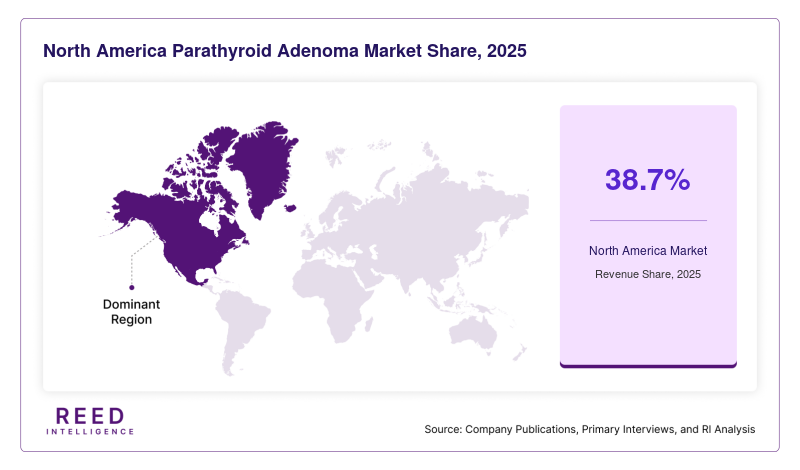
North America accounted for 38.7% of the Parathyroid Adenoma Market share in 2025 and is expected to maintain steady growth during the forecast period at a CAGR of 7.8%. The region benefits from advanced healthcare infrastructure, strong reimbursement policies, and high adoption of minimally invasive surgeries. The United States remained the dominant country in the regional market due to the widespread presence of endocrine specialists and high screening rates for calcium metabolism disorders. Increased use of advanced nuclear imaging technologies has also strengthened regional market expansion.
Europe
Europe held 27.4% of the global Parathyroid Adenoma Market share in 2025 and is projected to grow at a CAGR of 7.6% during 2026–2034. The regional market is supported by expanding healthcare investments and increasing awareness regarding endocrine disorders. Germany emerged as the leading country in Europe due to the strong presence of specialized endocrine surgery centers and growing adoption of robotic-assisted procedures. Public healthcare support for endocrine diagnostics has further enhanced market accessibility.
Asia Pacific
Asia Pacific represented 21.8% of the Parathyroid Adenoma Market share in 2025 and is forecast to register the fastest CAGR of 9.4% during the study period. Rising healthcare expenditure, improving diagnostic accessibility, and expanding medical tourism are contributing to regional growth. China dominated the regional market due to the rapid modernization of hospital infrastructure and increasing investments in endocrine disease management programs. The growing middle-class population and expanding health insurance coverage are also improving treatment adoption.
Middle East & Africa
The Middle East & Africa accounted for 6.2% of the market share in 2025 and is anticipated to grow at a CAGR of 6.9% during the forecast period. Increasing healthcare modernization projects and rising investments in specialty care facilities are supporting market growth in the region. Saudi Arabia led the regional market due to government healthcare expansion initiatives and increased adoption of advanced diagnostic imaging technologies. Improved physician training programs are also supporting disease diagnosis rates.
Latin America
Latin America captured 5.9% of the Parathyroid Adenoma Market share in 2025 and is expected to expand at a CAGR of 7.1% during 2026–2034. The regional market is benefiting from improving healthcare infrastructure and rising patient awareness regarding endocrine disorders. Brazil emerged as the dominant country due to increased investments in hospital modernization and growing access to specialized endocrine care services. The expansion of private healthcare networks is further contributing to market development.
Competitive Landscape
The Parathyroid Adenoma Market is moderately consolidated with the presence of established medical device manufacturers, pharmaceutical companies, and diagnostic imaging providers. Market participants are focusing on strategic collaborations, technological advancements, and expansion of endocrine care product portfolios to strengthen their competitive position.
Medtronic plc remains one of the leading companies in the market due to its strong surgical technology portfolio and extensive global healthcare presence. The company recently expanded its minimally invasive endocrine surgery solutions through the launch of advanced intraoperative nerve monitoring technologies designed for precision endocrine procedures.
Siemens Healthineers continues to strengthen its diagnostic imaging capabilities by introducing enhanced nuclear imaging platforms for endocrine localization procedures. GE HealthCare is focusing on AI-enabled imaging solutions for endocrine diagnostics, while Koninklijke Philips N.V. is investing in integrated ultrasound systems for endocrine applications. Abbott Laboratories continues to expand its endocrine testing portfolio through advanced biochemical assay development.
Key Players List
- Medtronic plc
- Siemens Healthineers AG
- GE HealthCare Technologies Inc.
- Koninklijke Philips N.V.
- Abbott Laboratories
- Hologic Inc.
- Canon Medical Systems Corporation
- FUJIFILM Holdings Corporation
- Stryker Corporation
- Boston Scientific Corporation
- Intuitive Surgical Inc.
- B. Braun SE
- Thermo Fisher Scientific Inc.
- Cardinal Health Inc.
- Zimmer Biomet Holdings Inc.
Recent Developments
- In January 2025, Medtronic plc introduced an upgraded intraoperative monitoring platform for endocrine surgeries to improve surgical precision and patient safety.
- In March 2025, Siemens Healthineers expanded its endocrine imaging portfolio with advanced AI-supported nuclear imaging solutions.
- In June 2024, GE HealthCare launched an enhanced ultrasound imaging platform designed for endocrine gland localization procedures.
- In September 2024, Koninklijke Philips N.V. partnered with specialty hospitals to improve endocrine diagnostic imaging workflows.
- In February 2025, Abbott Laboratories introduced updated biochemical assay kits for improved calcium and parathyroid hormone testing accuracy.
Parathyroid Adenoma Market Segments
Diagnosis Type
- Imaging Diagnostics
- Blood Tests
- Nuclear Imaging
- Molecular Diagnostics
Treatment Type
- Minimally Invasive Parathyroidectomy
- Bilateral Neck Exploration Surgery
- Medication Therapy
- Calcimimetic Therapy
End User
- Hospitals
- Ambulatory Surgical Centers
- Specialty Endocrine Clinics
- Diagnostic Laboratories
Patient Type
- Adult Patients
- Geriatric Patients
By Region
- North America
- Europe
- APAC
- Middle East and Africa
- LATAM