Partial Ossicular Replacement Prosthesis Market Size, Share, Growth Analysis Report By Material Type (Titanium, Hydroxyapatite, Composite Materials, Others), By Application (Chronic Otitis Media, Cholesteatoma, Trauma-Induced Ossicular Damage, Congenital Disorders), By End-Use (Hospitals, Ambulatory Surgical Centers, Specialty ENT Clinics, Academic & Research Institutes) and Regional Forecasts, 2025–2034
USD 3950
Market Overview
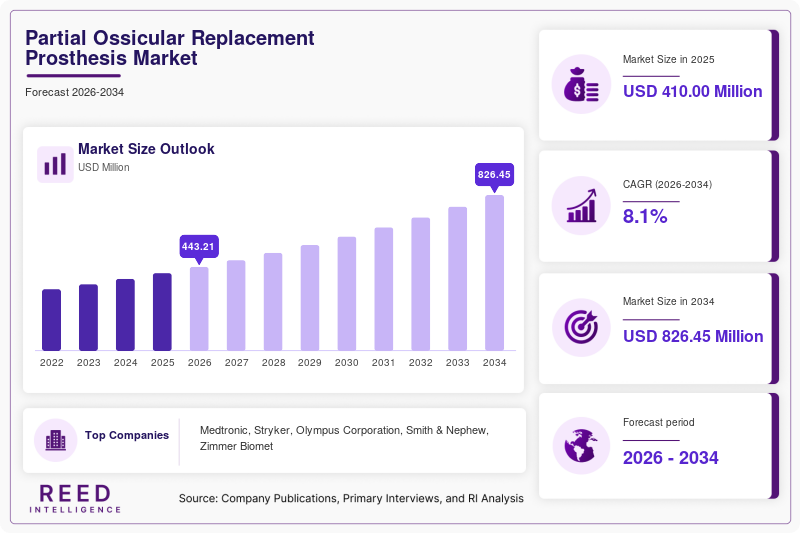
The Partial Ossicular Replacement Prosthesis (PORP) market size is estimated at approximately USD 410 million. In 2026, the market is projected to reach around USD 438 million, supported by growing adoption of minimally invasive ENT procedures and improvements in prosthetic design. By 2034, the market is forecasted to attain nearly USD 820 million, expanding at a CAGR of approximately 8.1% during the forecast period (2025–2034).
Several growth factors are contributing to this upward trajectory. First, the rising incidence of otitis media and associated complications is increasing the patient pool requiring ossicular reconstruction. Second, advancements in biomaterials such as titanium and hydroxyapatite are enhancing prosthesis compatibility and surgical outcomes. Third, expanding healthcare infrastructure in emerging economies is improving access to ENT surgical procedures, thereby supporting market penetration. Additionally, increasing awareness regarding hearing restoration and the availability of specialized ENT surgeons are further accelerating procedural volumes.
Key Highlights
- Market size in 2025 reached USD 410 million, reflecting steady demand for ossicular reconstruction procedures.
The growth was supported by increasing diagnosis of conductive hearing disorders and improved access to ENT care. - Market size in 2026 is projected to reach USD 438 million, indicating continued market expansion.
This increase is driven by rising adoption of advanced prosthetic materials and minimally invasive surgical techniques. - The market is forecasted to reach USD 820 million by 2034, showing strong long-term growth potential.
Expansion is supported by technological advancements and growing healthcare infrastructure in emerging regions. - The CAGR for the period 2025–2034 is estimated at approximately 8.1%, highlighting consistent market growth.
This steady growth rate reflects increasing procedural volumes and innovation in prosthesis design. - Market growth is driven by rising ear disorders and trauma cases globally.
Increasing incidence of chronic otitis media and ear injuries is significantly boosting demand for surgical reconstruction solutions.
Market Trends
Shift Toward Biocompatible and Lightweight Materials
A significant trend shaping the Partial Ossicular Replacement Prosthesis Market is the shift toward biocompatible and lightweight materials, particularly titanium and composite polymers. Titanium PORPs are increasingly preferred due to their durability, corrosion resistance, and excellent sound conduction properties. These materials reduce the risk of extrusion and improve long-term patient outcomes. Manufacturers are investing in material engineering to enhance prosthesis integration with natural ossicles and surrounding tissues. The trend is also supported by advancements in microfabrication techniques that allow for more precise prosthesis designs tailored to patient-specific anatomical structures. Surgeons are increasingly favoring these modern materials due to improved surgical success rates and reduced revision procedures.
Growth of Minimally Invasive and Endoscopic Ear Surgery
Another prominent trend is the growing adoption of minimally invasive and endoscopic surgical techniques for ossicular reconstruction procedures. These approaches allow surgeons to access the middle ear through smaller incisions, resulting in reduced tissue damage, shorter recovery times, and fewer postoperative complications. The integration of high-definition endoscopes has enhanced visualization of the middle ear structures, enabling more accurate placement of partial ossicular prostheses. Hospitals and ambulatory surgical centers are increasingly investing in endoscopic ENT equipment, which is contributing to procedural efficiency. This trend is also aligned with patient preference for faster recovery and reduced hospital stays, further supporting the demand for PORP devices.
Market Drivers
Rising Prevalence of Conductive Hearing Disorders
The increasing prevalence of conductive hearing disorders is a primary driver of the Partial Ossicular Replacement Prosthesis Market. Conditions such as chronic otitis media, cholesteatoma, and tympanic membrane perforation often result in ossicular chain damage, necessitating surgical intervention. The global burden of hearing impairment continues to rise due to aging populations, environmental noise exposure, and untreated infections in low- and middle-income regions. As awareness of hearing restoration solutions improves, more patients are seeking surgical treatment options. PORP devices play a critical role in restoring the mechanical transmission of sound, making them essential in otologic surgeries. The growing diagnosis rate and improved healthcare access are further contributing to increased procedure volumes.
Technological Advancements in ENT Surgical Devices
Technological innovation in ENT surgical devices is another major factor driving market growth. The development of precision-engineered prostheses with improved articulation and stability has enhanced surgical outcomes. Additionally, innovations in imaging technologies, such as intraoperative navigation systems and digital otoscopy, are enabling better preoperative planning and intraoperative accuracy. Device manufacturers are focusing on customizable prosthesis designs that can accommodate varying anatomical requirements. Integration of 3D printing technology is also emerging as a potential advancement, allowing for patient-specific implants. These technological improvements are increasing surgeon confidence and expanding the adoption of PORP procedures across both developed and developing healthcare systems.
Market Restraints
One of the key restraints affecting the Partial Ossicular Replacement Prosthesis Market is the high cost associated with surgical procedures and prosthetic devices. PORP implantation requires specialized surgical expertise, advanced operating room infrastructure, and post-operative care, which collectively increase the overall treatment cost. In many developing regions, limited insurance coverage and out-of-pocket expenses discourage patients from undergoing such procedures. Additionally, the availability of trained otologic surgeons is uneven across regions, further limiting access to treatment. The cost factor also impacts healthcare providers, particularly in public hospitals with constrained budgets, which may prioritize essential procedures over elective reconstructive surgeries. As a result, despite increasing demand, affordability and accessibility remain significant challenges in expanding market penetration globally.
Market Opportunities
Expansion in Emerging Economies
Emerging economies present significant growth opportunities for the Partial Ossicular Replacement Prosthesis Market due to improving healthcare infrastructure and rising awareness of hearing disorders. Countries in Asia Pacific, Latin America, and parts of Africa are witnessing increased investments in ENT care facilities and surgical capabilities. Government initiatives aimed at reducing the burden of untreated hearing loss are also encouraging early diagnosis and intervention. As disposable incomes rise, patients are more willing to seek advanced surgical treatments. Additionally, international collaborations and medical training programs are helping to bridge the gap in skilled ENT professionals. This combination of factors is expected to create a favorable environment for market expansion in these regions over the forecast period.
Integration of Digital and 3D Printing Technologies
The integration of digital technologies, particularly 3D printing, represents a promising opportunity in the PORP market. Customizable prostheses manufactured using 3D printing can be tailored to match individual patient anatomy, improving fit and functional outcomes. This approach also reduces production time and allows for rapid prototyping of new designs. Digital surgical planning tools, combined with imaging data, enable surgeons to simulate procedures and select optimal prosthesis configurations. Manufacturers are increasingly exploring partnerships with digital health companies to develop patient-specific solutions. As these technologies mature and become more cost-effective, they are expected to enhance surgical precision, reduce complications, and drive adoption of advanced ossicular replacement devices.
Segmental Analysis
By Material Type
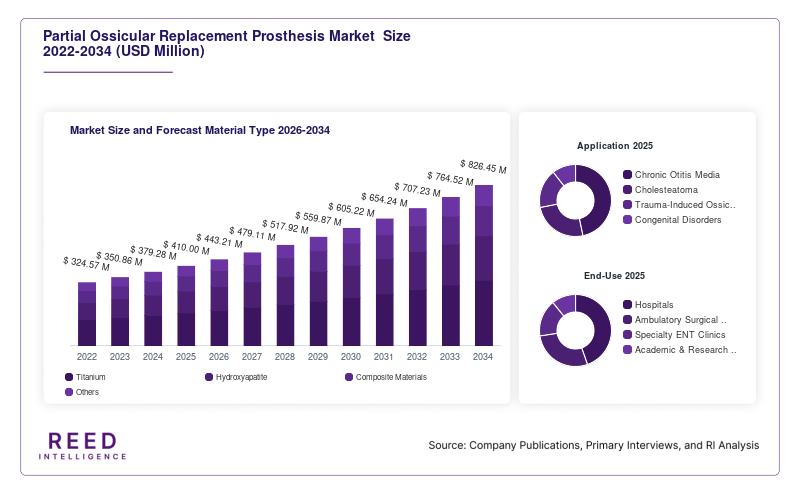
Titanium-based prostheses dominate the material segment, accounting for approximately 55% of the market share in 2024 due to their high strength, biocompatibility, and excellent acoustic transmission properties. These prostheses are widely used in ossiculoplasty procedures because they offer durability and reduced risk of rejection. Their lightweight structure and ease of surgical handling make them the preferred choice among ENT surgeons.
Hydroxyapatite and other composite materials represent the fastest-growing subsegment, projected to expand at a CAGR of around 8.9%. Growth in this segment is driven by increasing research into bioactive materials that promote better integration with natural bone structures. These materials are gaining attention due to their ability to mimic natural ossicles and reduce complications such as extrusion and displacement.
By Application
Chronic otitis media is the dominant application segment, accounting for nearly 48% of the market share in 2024. This condition often leads to ossicular chain damage, requiring surgical reconstruction using partial prostheses. The high prevalence of ear infections, particularly in pediatric and underserved populations, supports the dominance of this segment.
Cholesteatoma treatment is the fastest-growing application segment, with a projected CAGR of around 9.2%. The growth is driven by increasing diagnosis rates and advancements in surgical techniques that allow for effective removal of abnormal tissue while preserving hearing structures. Improved imaging technologies are also enabling earlier detection and intervention, contributing to segment expansion.
By End-Use
Hospitals dominate the end-use segment, accounting for approximately 62% of the market share in 2024. Hospitals are equipped with advanced surgical infrastructure and trained specialists, making them the primary centers for ossiculoplasty procedures. The availability of multidisciplinary care teams further supports their dominance in this segment.
Ambulatory surgical centers (ASCs) are the fastest-growing end-use segment, projected to grow at a CAGR of around 9.0%. The growth of ASCs is driven by the increasing preference for outpatient procedures, lower costs compared to hospital settings, and shorter recovery times. Technological advancements in minimally invasive techniques are enabling more procedures to be safely performed in these settings.
Regional Analysis
North America
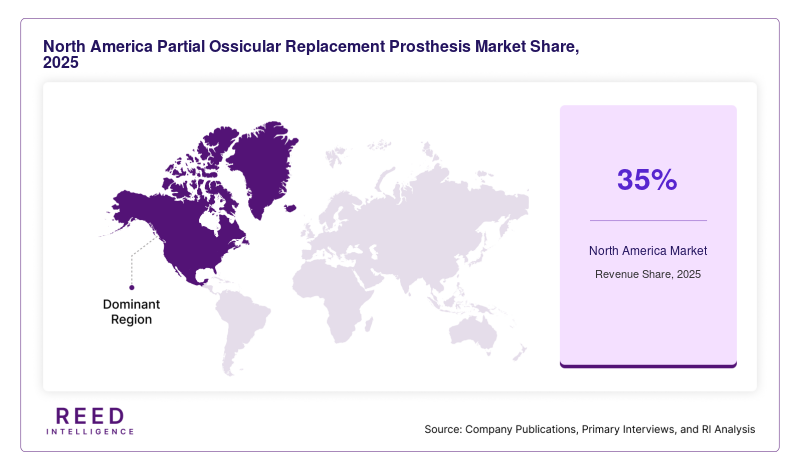
North America holds a significant share of the Partial Ossicular Replacement Prosthesis Market, accounting for approximately 35% of the global market in 2025, with a projected CAGR of around 7.8% during the forecast period. The region benefits from advanced healthcare infrastructure, high adoption of innovative medical devices, and strong reimbursement frameworks that support surgical procedures. The presence of well-established ENT specialty centers further contributes to the high procedural volume.
The United States dominates the regional market due to its large patient population, high awareness levels, and availability of skilled otologic surgeons. A key growth factor in this region is the increasing incidence of age-related hearing loss combined with favorable insurance coverage, which encourages patients to opt for surgical interventions rather than relying solely on hearing aids.
Europe
Europe accounts for approximately 28% of the global Partial Ossicular Replacement Prosthesis Market in 2025, with an expected CAGR of around 7.5% through 2034. The region’s growth is supported by robust public healthcare systems, increasing ENT surgical procedures, and strong regulatory standards ensuring device safety and efficacy.
Germany, France, and the United Kingdom are leading contributors to the European market. Germany stands out as the dominant country due to its advanced medical technology sector and high healthcare expenditure. A unique growth factor in this region is the emphasis on early diagnosis programs and national hearing health initiatives, which are increasing the number of patients undergoing reconstructive ear surgeries.
Asia Pacific
Asia Pacific is the fastest-growing regional market, holding approximately 22% share in 2025 and projected to expand at a CAGR of around 9.5%. Rapid population growth, rising healthcare expenditure, and increasing awareness of hearing health are key contributors to market expansion.
China, India, and Japan are the major markets in the region. India is emerging as a key growth hub due to its expanding healthcare infrastructure and growing middle-class population. A unique factor driving growth in Asia Pacific is the increasing number of government-led initiatives aimed at improving access to ENT care in rural and semi-urban areas.
Middle East & Africa
The Middle East & Africa region accounts for around 8% of the global market in 2025, with a CAGR of approximately 7.2%. Growth in this region is driven by improving healthcare infrastructure, increasing investments in specialty hospitals, and rising awareness of hearing disorders.
Countries such as Saudi Arabia, the United Arab Emirates, and South Africa are leading contributors. Saudi Arabia dominates the regional market due to government healthcare investments and expanding hospital networks. A key growth factor is the increasing availability of advanced ENT surgical facilities in urban centers, which is improving access to prosthetic ear reconstruction procedures.
Latin America
Latin America holds about 7% of the global Partial Ossicular Replacement Prosthesis Market in 2025, with a projected CAGR of around 7.6%. The region is experiencing gradual growth due to improving healthcare systems and increasing adoption of advanced medical technologies.
Brazil and Mexico are the primary markets, with Brazil leading due to its larger healthcare infrastructure and patient base. A unique growth factor in Latin America is the rising collaboration between public and private healthcare providers, which is helping expand access to specialized ENT surgeries and prosthetic solutions.
Competitive Landscape
The Partial Ossicular Replacement Prosthesis Market is moderately consolidated, with several global medical device companies competing based on product innovation, material advancements, and surgical support solutions. Key players include Medtronic, Stryker, Olympus Corporation, Smith & Nephew, and Zimmer Biomet. These companies focus on expanding their ENT product portfolios and strengthening their distribution networks across developed and emerging markets.
Medtronic is considered one of the leading players in the market due to its broad range of ENT surgical solutions and continuous investment in research and development. Recent developments include the introduction of advanced otologic surgical instruments and integration of digital surgical planning tools to improve procedural accuracy. Companies are also focusing on partnerships, acquisitions, and product innovation to strengthen their competitive positioning and address evolving clinical needs.
Key Players List
- Medtronic
- Stryker
- Olympus Corporation
- Smith & Nephew
- Zimmer Biomet
- KARL STORZ
- Grace Medical
- Heinz Kurz GmbH
- Spiggle & Theis Medizintechnik
- Xomed Surgical Products
- Oticon Medical
- Gyrus ACMI
- MicroSurgical Technology
- Audina Hearing Instruments
- Meril Life Sciences
Recent Developments
- Introduction of next-generation titanium PORPs with improved articulation and reduced extrusion rates by leading manufacturers.
- Increasing adoption of 3D-printed patient-specific ossicular prostheses in pilot clinical programs across Europe and North America.
- Strategic collaborations between medical device companies and ENT research institutes to develop advanced biomaterials for middle ear reconstruction.
Partial Ossicular Replacement Prosthesis Market Segments
Material Type
- Titanium
- Hydroxyapatite
- Composite Materials
- Others
Application
- Chronic Otitis Media
- Cholesteatoma
- Trauma-Induced Ossicular Damage
- Congenital Disorders
End-Use
- Hospitals
- Ambulatory Surgical Centers
- Specialty ENT Clinics
- Academic & Research Institutes
By Region
- North America
- Europe
- APAC
- Middle East and Africa
- LATAM