Parylene Market Size, Share & Demand Report By Type (Parylene C, Parylene N, Parylene D, Others), By Application (Electronics Coatings, Medical Device Coatings, Aerospace Coatings, Automotive Coatings), By End-Use Industry (Electronics, Healthcare, Automotive, Aerospace & Defense), By Deposition Technology (Chemical Vapor Deposition (CVD), Hybrid Techniques) & Segment Forecasts, 2026–2034
USD 3950
Market Overview
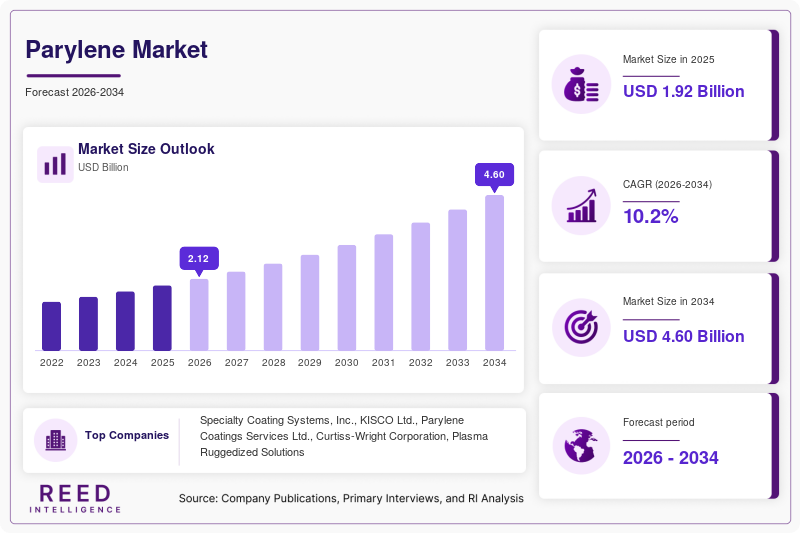
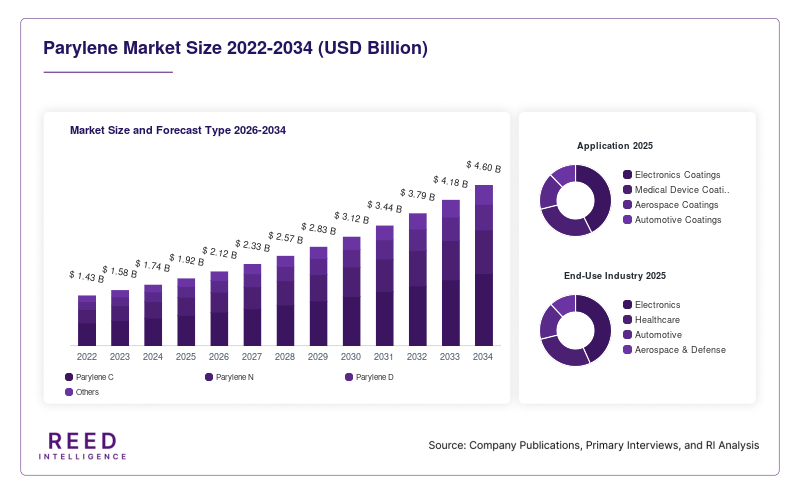
The global Parylene Market size was valued at USD 1.92 billion in 2026 and is projected to reach USD 4.18 billion by 2034, expanding at a CAGR of 10.2% during the forecast period (2026–2034). The market is witnessing steady growth due to increasing demand for high-performance conformal coatings across electronics, medical devices, aerospace, and automotive industries. Parylene coatings offer unique advantages such as chemical inertness, biocompatibility, dielectric strength, and ultra-thin uniform deposition, making them suitable for mission-critical applications.
A key global factor supporting the growth of the Parylene Market is the rapid miniaturization of electronic components. As devices become smaller and more complex, the need for reliable protective coatings that can ensure durability without adding bulk has increased significantly. This trend is particularly evident in consumer electronics, semiconductor manufacturing, and wearable technologies.
Key Highlights:
- North America dominated the market with 34.5% share in 2025, while Asia Pacific is expected to grow at the fastest CAGR of 11.6% (2026–2034).
- By type, Parylene C led with 42.8% share, whereas Parylene N is projected to grow fastest at a CAGR of 11.1%.
- By application, electronics coatings held the largest share, while medical device coatings are expected to expand at a CAGR of 11.8%.
- The United States remained the dominant country, with market values of USD 620 million in 2024 and USD 675 million in 2025.
Market Trends
Rising Adoption in Medical Implants and Wearable Devices
The Parylene Market is increasingly influenced by its growing application in medical implants and wearable health devices. Parylene’s biocompatibility and ability to form pinhole-free coatings make it suitable for implantable electronics such as pacemakers, neurostimulators, and biosensors. As healthcare shifts toward personalized and minimally invasive solutions, the demand for reliable coatings that can protect sensitive electronics from bodily fluids is rising. Wearable devices also require lightweight and durable protection, which Parylene coatings provide effectively. This trend is expected to strengthen as healthcare digitization continues globally.
Expansion in Semiconductor and Advanced Electronics Manufacturing
Another significant trend shaping the Parylene Market is the growing integration of Parylene coatings in semiconductor fabrication and advanced electronics. As chip architectures become more complex, manufacturers are adopting advanced coating technologies to enhance insulation, corrosion resistance, and performance reliability. Parylene is increasingly used in MEMS devices, sensors, and printed circuit boards due to its conformal coverage even on intricate geometries. The rise of IoT devices and high-frequency electronics is further accelerating this trend, as these applications demand precise and dependable protective solutions.
Market Drivers
Increasing Demand for High-Performance Coatings in Electronics
The rising demand for high-performance protective coatings in the electronics industry is a primary driver of the Parylene Market. Modern electronic devices operate in challenging environments where exposure to moisture, dust, and chemicals can lead to performance degradation. Parylene coatings provide excellent barrier properties and electrical insulation, ensuring long-term reliability. This has led to their widespread adoption in consumer electronics, automotive electronics, and industrial control systems. The continuous evolution of smart devices and connected technologies is further fueling demand.
Growing Use in Aerospace and Defense Applications
The aerospace and defense sectors are increasingly utilizing Parylene coatings due to their ability to withstand extreme conditions. These coatings offer resistance to temperature fluctuations, radiation, and chemical exposure, making them suitable for critical components in aircraft, satellites, and defense equipment. The need for lightweight materials that do not compromise performance has also contributed to the adoption of Parylene coatings. As global defense spending and space exploration initiatives expand, the demand within this sector is expected to remain strong.
Market Restraint
High Cost of Parylene Coating Processes
One of the major restraints impacting the Parylene Market is the high cost associated with the coating process. Parylene deposition requires specialized vacuum equipment and controlled environments, which increases operational expenses. Additionally, the raw materials used in Parylene production are relatively expensive compared to alternative coating solutions such as epoxy or acrylic coatings.
The complexity of the deposition process also limits scalability for small and medium enterprises, which may find it difficult to justify the investment. Furthermore, maintenance and operational costs of coating systems can add to the overall expenditure. These factors can restrict adoption, particularly in cost-sensitive industries.
Despite its superior performance characteristics, the cost barrier may encourage some manufacturers to opt for less expensive alternatives, especially in applications where high-end performance is not critical. Addressing this challenge will be essential for broader market penetration.
Market Opportunities
Emerging Applications in Electric Vehicles (EVs)
The rapid growth of electric vehicles presents a significant opportunity for the Parylene Market. EVs rely heavily on advanced electronics, including battery management systems, sensors, and power electronics. These components require robust protection against moisture, heat, and chemical exposure. Parylene coatings offer reliable insulation and corrosion resistance, making them ideal for EV applications. As the global transition toward sustainable mobility accelerates, the demand for Parylene coatings in this sector is expected to increase substantially.
Expansion in Emerging Economies
Emerging economies are witnessing rapid industrialization and growth in electronics manufacturing, creating new opportunities for the Parylene Market. Countries in Asia Pacific, Latin America, and the Middle East are investing in advanced manufacturing capabilities and infrastructure development. This is driving demand for high-performance materials, including Parylene coatings. Additionally, the expansion of healthcare systems in these regions is increasing the adoption of medical devices, further boosting market growth. Companies that establish a strong presence in these markets are likely to benefit from long-term growth prospects.
Segmental Analysis
By Type
Parylene C dominated the Parylene Market in 2025, accounting for 42.8% of the total share. This dominance was attributed to its balanced properties, including excellent moisture barrier performance, chemical resistance, and cost-effectiveness. It has been widely used across electronics, medical devices, and automotive applications, making it the preferred choice for many manufacturers.
Parylene N is expected to be the fastest-growing subsegment, with a projected CAGR of 11.1% during the forecast period. Its superior dielectric properties and high penetration capability will drive its adoption in advanced electronics and micro-scale applications. The increasing demand for precision coatings in MEMS and semiconductor devices will further support its growth.
By Application
Electronics coatings held the largest share in 2025, contributing 38.6% to the Parylene Market. The segment’s dominance was driven by the widespread use of Parylene coatings in printed circuit boards, sensors, and connectors. The need for reliable protection against environmental factors has supported its adoption.
Medical device coatings are expected to grow at the fastest CAGR of 11.8%. The increasing use of implantable devices and wearable health technologies will drive demand. Parylene’s biocompatibility and ability to provide ultra-thin coatings will make it a preferred choice in this segment.
By End-Use Industry
The electronics industry dominated the market in 2025, accounting for 41.3% share. The rapid growth of consumer electronics and industrial automation has contributed to this dominance. The need for durable and reliable coatings in high-performance devices has further strengthened the segment.
The automotive industry is projected to be the fastest-growing segment, with a CAGR of 10.9%. The increasing integration of electronics in vehicles, especially in electric and autonomous vehicles, will drive demand for Parylene coatings. These coatings provide protection against harsh environmental conditions, enhancing component reliability.
By Deposition Technology
Chemical vapor deposition (CVD) remained the dominant technology in 2025, capturing 85.2% of the market share. Its ability to produce uniform, pinhole-free coatings with precise thickness control has made it the standard method for Parylene application.
Emerging hybrid deposition techniques are expected to grow at a CAGR of 10.4%. These methods will offer improved efficiency and cost-effectiveness, making them suitable for large-scale production. Continuous innovation in deposition technologies will support this growth.
Regional Analysis
North America
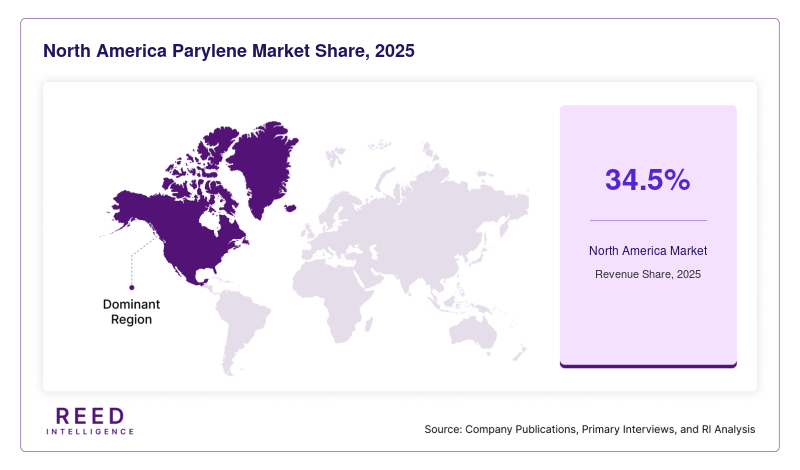
North America accounted for 34.5% of the Parylene Market share in 2025 and is expected to grow at a CAGR of 9.4% during 2026–2034. The region has a well-established electronics and healthcare industry, which has supported consistent demand for Parylene coatings. Strong research and development capabilities and early adoption of advanced coating technologies have further strengthened the market position.
The United States dominated the regional market due to its advanced semiconductor manufacturing ecosystem. The presence of leading technology firms and medical device manufacturers has driven demand for high-performance coatings. Additionally, ongoing investments in aerospace innovation have contributed to steady growth.
Europe
Europe held a 24.2% share in 2025 and is projected to grow at a CAGR of 9.1% over the forecast period. The region’s focus on precision engineering and industrial automation has supported the adoption of Parylene coatings. Regulatory standards related to product safety and environmental protection have also encouraged the use of high-quality coating solutions.
Germany emerged as the dominant country due to its strong automotive and industrial base. The country’s emphasis on advanced manufacturing and export-oriented industries has driven demand for protective coatings, particularly in high-performance applications.
Asia Pacific
Asia Pacific captured 28.8% of the market share in 2025 and is expected to register the fastest CAGR of 11.6% from 2026 to 2034. Rapid industrialization, expanding electronics manufacturing, and increasing investments in healthcare infrastructure have contributed to market growth in the region.
China led the regional market, supported by its large-scale electronics production and growing semiconductor industry. The country’s focus on technological self-reliance and domestic manufacturing has increased demand for advanced materials such as Parylene coatings.
Middle East & Africa
The Middle East & Africa region accounted for 6.3% of the market share in 2025 and is expected to grow at a CAGR of 8.7% during the forecast period. The market in this region is gradually expanding due to increasing investments in infrastructure and industrial development.
The United Arab Emirates was the dominant country, driven by its focus on technological advancement and diversification of its economy. Growth in aerospace and healthcare sectors has contributed to the adoption of Parylene coatings.
Latin America
Latin America held a 6.2% share in 2025 and is projected to grow at a CAGR of 8.9% from 2026 to 2034. The region is witnessing gradual growth due to expanding manufacturing activities and increasing adoption of advanced materials.
Brazil dominated the regional market due to its growing industrial base and investments in automotive and electronics sectors. The country’s focus on modernization and technology adoption has supported the demand for Parylene coatings.
Competitive Landscape
The Parylene Market is moderately consolidated, with key players focusing on product innovation, capacity expansion, and strategic partnerships. Leading companies are investing in research to enhance coating performance and expand application areas.
The market leader, Specialty Coating Systems, Inc., has maintained its position through continuous innovation and global expansion. The company recently introduced advanced coating solutions tailored for next-generation electronics and medical devices, strengthening its competitive edge.
Other major players are also focusing on expanding their presence in emerging markets and enhancing their service offerings to cater to diverse industry needs. The competitive landscape is characterized by technological advancements and increasing collaboration among industry participants.
Key Players List
- Specialty Coating Systems, Inc.
- KISCO Ltd.
- Parylene Coatings Services Ltd.
- Curtiss-Wright Corporation
- Plasma Ruggedized Solutions
- Galentis S.r.l.
- Chireach Group
- HZO Inc.
- Para Tech Coating Inc.
- Comelec SA
- Diamond-MT
- Shieldex Trading Inc.
- VSi Parylene
- Advanced Coating Systems
- Semicoa Coatings
Recent Developments
- Specialty Coating Systems expanded its coating facility to increase production capacity for electronics applications.
- Curtiss-Wright Corporation introduced new Parylene coating solutions for aerospace systems.
- HZO Inc. developed advanced moisture barrier coatings targeting wearable electronics.
- KISCO Ltd. invested in R&D to improve coating efficiency and reduce costs.
- Plasma Ruggedized Solutions expanded its presence in Asia Pacific to cater to growing demand.
Parylene Market Segments
Type
- Parylene C
- Parylene N
- Parylene D
- Others
Application
- Electronics Coatings
- Medical Device Coatings
- Aerospace Coatings
- Automotive Coatings
End-Use Industry
- Electronics
- Healthcare
- Automotive
- Aerospace & Defense
Deposition Technology
- Chemical Vapor Deposition (CVD)
- Hybrid Deposition Techniques
By Region
- North America
- Europe
- APAC
- Middle East and Africa
- LATAM